A French Word to Live By
Translate Moi to English
/mwa/
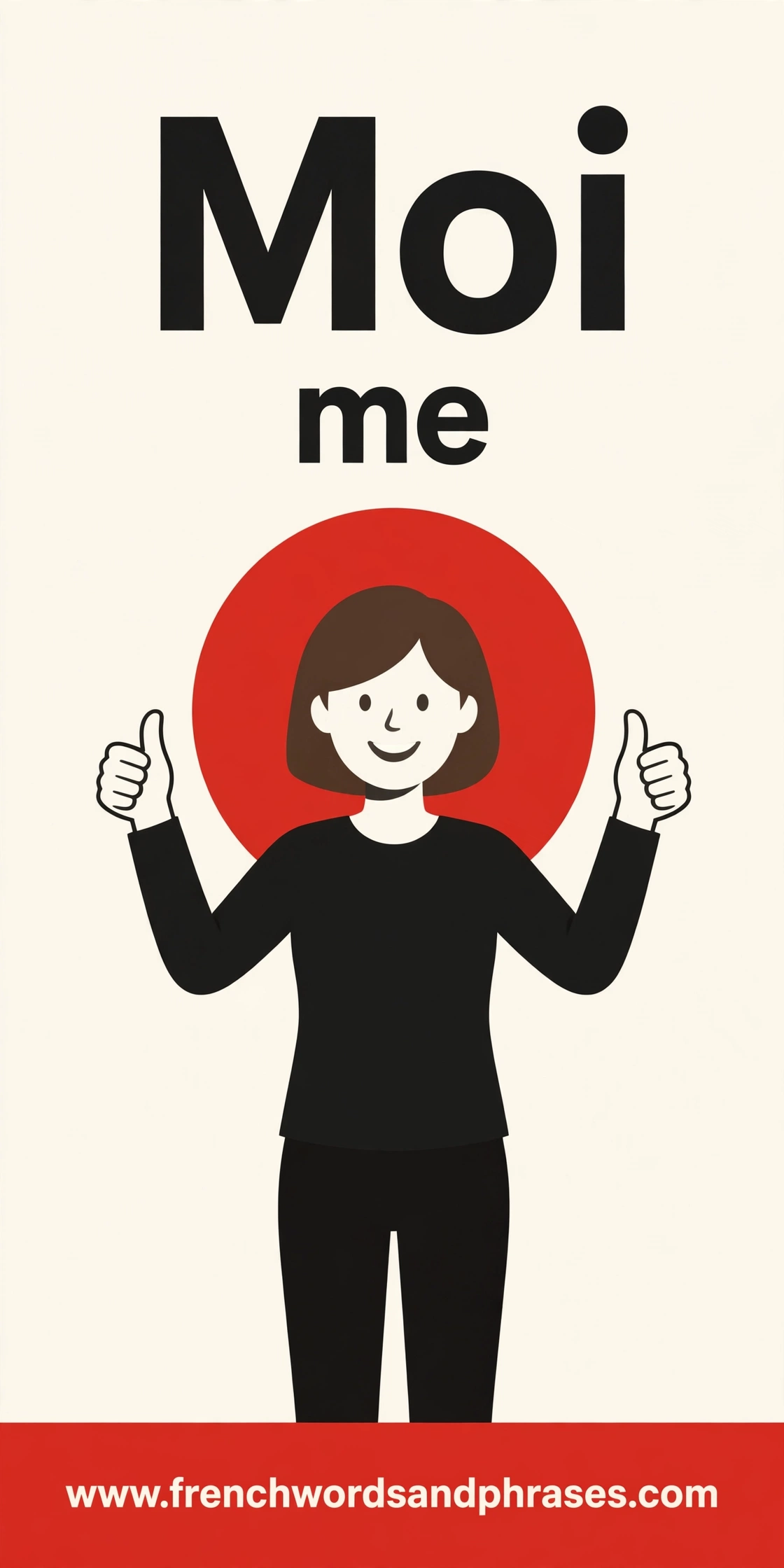
Moi means me — the stressed pronoun for the first person.
A hand raised in a classroom, a finger pointed at one’s own chest in a family argument, a small child stamping her foot: « Moi aussi ! » — me too! Moi is the pronoun of the self, standing tall: the form of je that appears after prepositions, in comparisons, and whenever the self wants emphasis.
Let’s explore how moi works in French, beginning with the whole word on one card.
Understanding the French Pronoun Moi
Moi is a French stressed (disjunctive) pronoun — the strong form of je and me. It is used after prepositions (avec moi, with me; chez moi, at my place), after c’est (c’est moi, it’s me), in comparisons (plus grand que moi, taller than me), standing alone (Qui ? — Moi !), and for emphasis (Moi, je pars, as for me, I’m leaving). The verb’s ordinary object form remains me: il me voit, he sees me.
It means me — the me that can stand on its own. Where English uses one word, French keeps two registers: the little clinging me of il me voit, and the free-standing moi of c’est moi, viens avec moi, moi aussi. Moi is also a noun in philosophy and everyday talk: le moi, the self, the ego — son moi est énorme, his ego is enormous.
Type: Stressed (disjunctive) pronoun — first person singular
Answers the question: Qui ? Avec qui ? — Who? With whom? (Answer: me)
Its territory: after prepositions, after c’est, in comparisons, alone, and for emphasis
Watch the pair: moi (strong, free-standing) vs me (the object pronoun glued to the verb)
One important usage detail: chez moi means at my place, at my home — chez + stressed pronoun is the whole French system of addresses: chez toi, chez lui, chez nous. And in commands with an affirmative imperative, moi follows the verb with a hyphen: donne-moi, give me; laisse-moi, let me — while the negative returns to me: ne me donne pas.
Experience the Word
Moi is the pronoun with a spine — the self that answers for itself.
Imagine the photograph at the school gate: thirty children, one gate, and a small boy tapping the picture with one finger — « là, c’est moi ! » There I am, that’s me! Moi is the word every child finds first for the person they know best.
You have not just said ‘me’. You have planted the self in the sentence like a flag.
How to Use Moi in French: Complete Guide
Let’s explore how moi works in French, beginning with the whole word on one card.
Moi at a Glance
The Whole Word on One Card
Meaning, job, territory and family — moi in four lines.
| Point | Moi |
|---|---|
| Meaning | me — the strong form of the first person |
| Job | stands for the speaker wherever a pronoun must stand free |
| Territory | after prepositions, c’est, comparisons, alone, emphasis |
| Its family | toi, lui, elle, nous, vous, eux, elles — the stressed set |
Example
C’est moi qui ai la clé.
I’m the one who has the key.
The Pattern in Action: Where Moi Stands
Moi appears wherever the pronoun is not glued to a verb — at the ends and edges of the sentence, where it can be pointed at.
| Pattern | Example |
|---|---|
| after a preposition | viens avec moi — come with me |
| after c’est | c’est moi — it’s me |
| in a comparison | plus jeune que moi — younger than me |
| standing alone | Qui est là ? — Moi ! — Who’s there? — Me! |
| for emphasis | moi, je reste — as for me, I’m staying |
Example
Ce cadeau est pour moi ?
Is this present for me?
Quick Quiz 1
“Come with me” — avec me or avec moi?
Reveal the answer
avec moi — after a preposition, French uses the stressed pronoun.
Viens avec moi.
Come with me.
Chez moi: The Home Phrase
Chez + stressed pronoun is the French address system: chez moi is my home, whoever is speaking.
| Pattern | Example |
|---|---|
| my place | chez moi — at my place, at home |
| your place (tu) | chez toi — at your place |
| his / her place | chez lui / chez elle — at his / her place |
| our place | chez nous — at our place |
| their place | chez eux / chez elles — at their place |
Example
Le dîner est chez moi samedi.
Dinner is at my place on Saturday.
Moi in Commands: Donne-moi, Laisse-moi
In affirmative commands, moi follows the verb, joined by a hyphen; the negative command puts me back before the verb.
| Pattern | Example |
|---|---|
| give me | donne-moi le sel — give me the salt |
| let me | laisse-moi passer — let me through |
| help me | aide-moi — help me |
| negative | ne me laisse pas — don’t leave me |
Example
Écoute-moi bien, s’il te plaît.
Listen to me carefully, please.
Quick Quiz 2
How do you say ‘at my place’?
Reveal the answer
chez moi
Viens chez moi ce soir.
Come to my place this evening.
Everyday Expressions with Moi
Me too, poor me, and as for me — moi in the phrases of the day.
| Expression | In English |
|---|---|
| moi aussi | me too |
| moi non plus | me neither |
| c’est moi | it’s me, that’s me |
| pauvre de moi ! | poor me! |
| quant à moi | as for me, for my part |
| moi-même | myself |
Example
Quant à moi, je préfère le train.
As for me, I prefer the train.
Close Cousins: Me, Je and the Stressed Set
One person, three costumes: je does, me receives glued to the verb, moi stands free.
| Word | The difference |
|---|---|
| je | the subject: je pars — I am leaving |
| me | the object glued to the verb: il me voit — he sees me |
| moi | the stressed form, free-standing: avec moi, c’est moi |
| moi-même | myself, emphatic: je l’ai fait moi-même |
Example
Je le sais, il me l’a dit à moi.
I know it, he told me — me in person.
Quick Quiz 3
“He sees me” — il moi voit or il me voit?
Reveal the answer
il me voit — before the verb, the object form is me; moi is for standing free.
Il me voit.
He sees me.
Moi and Its Neighbours
The stressed shelf: the whole set that follows prepositions and c’est.
| French | In English |
|---|---|
| moi | me |
| toi | you (tu, stressed) |
| lui / elle | him / her |
| nous / vous | us / you |
| eux / elles | them |
Example
Entre toi et moi, ce plan est parfait.
Between you and me, this plan is perfect.
Watch Out: The Traps Around Moi
The traps: moi before a verb, and the missing hyphen in commands.
| Trap | The truth |
|---|---|
| saying ‘moi vois’ or ‘il moi voit’ | the verb takes je and me: je vois, il me voit — moi never touches the verb directly |
| forgetting the hyphen in commands | affirmative commands join with a hyphen: donne-moi, aide-moi |
| using moi after a comparison adjective without que | comparisons take que moi: plus grand que moi |
| translating ‘myself’ always as moi-même | for ordinary reflexives French uses me: je me lève — moi-même is only for emphasis |
Example
Je me lève tôt, mais donne-moi cinq minutes.
I get up early, but give me five minutes.
Quick Quiz 4
What does moi aussi mean?
Reveal the answer
Me too
— Tu as faim ? — Moi aussi !
— Are you hungry? — Me too!
Moi in Everyday French: Real-Life Examples
Now that you know the word, let’s see how moi appears in everyday French.
Example 1 — Me too
Tu viens ? Moi aussi, je viens !
Are you coming? Me too, I’m coming!
Example 2 — An invitation
Le thé est chez moi à quatre heures.
Tea is at my place at four o’clock.
Example 3 — A command
Donne-moi la main pour traverser.
Give me your hand to cross.
Example 4 — It’s me
Ouvre, c’est moi !
Open up, it’s me!
Example 5 — A comparison
Mon frère est plus grand que moi.
My brother is taller than me.
Example 6 — As for me
Moi, je préfère rester à la maison.
As for me, I prefer to stay at home.
Beyond Translation: The Meaning of Moi
Moi is the word of the famous French beginning: « Moi, je… » — the small ceremony by which a speaker takes the floor and plants their flag. Philosophy took it up as a noun, le moi, the self that Descartes found by doubting everything else: je pense, donc je suis begins, in French mouths, with moi at the door.
Moi is the self, standing up to be counted.
And its tenderness is chez moi — two small words that contain a whole home, an address with no number, understood by everyone who loves you.
How to Remember the French Pronoun Moi
Remember it this way: Moi is me — the strong form: after prepositions, after c’est, in comparisons, and standing alone.
- You follow prepositions with it — avec moi, pour moi, chez moi.
- You answer the door with it — c’est moi !, it’s me!
- You command with it — donne-moi, laisse-moi, hyphen and all.
The key idea is moi means me (stressed); chez moi = at my place; c’est moi = it’s me; donne-moi = give me.
Test Your Knowledge of Moi
Let’s see how much you’ve learned. Try answering these questions before revealing the answers.
Question 1
What does moi mean?
Reveal the answer
Me — the stressed, free-standing form of the first person.
Question 2
How do you say at my place?
Reveal the answer
Chez moi.
Question 3
Translate: It’s me.
Reveal the answer
C’est moi.
Question 4
What is the difference between me and moi?
Reveal the answer
Me clings to the verb (il me voit); moi stands free (avec moi, c’est moi).
Question 5
Complete the sentence:
Ce livre est pour ______.
Reveal the answer
moi
Ce livre est pour moi.
This book is for me.
Your Final Challenge
Can You Use It?
How would you say this in French?
“Come to my place this evening.”
Reveal the answer
Viens chez moi ce soir.
Come to my place this evening.
A little French. A little curiosity. A richer everyday life.
LEARN FRENCH ONE WORD AT A TIME