A French Word to Live By
Translate Ton to English
/tɔ̃/
Ton means your.
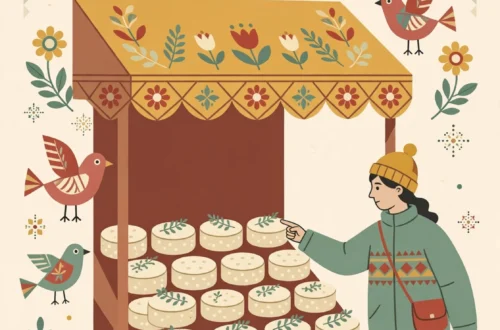
A grandmother hands her grandson a warm scarf at the door. « N’oublie pas ton écharpe, il fait froid » — do not forget your scarf, it is cold. Ton is the friendly face of ‘your’ in French: the word you use with one person you know well — a friend, a brother, a child — for everything that belongs to them.
Let’s explore how ton works in French, beginning with the whole word on one card.
Understanding the French Determiner Ton
Ton is a French possessive determiner — the ‘your’ used with tu, for one owner you know well. It stands in front of a noun and agrees with that noun: ton livre (your book), ta sœur (your sister), tes clés (your keys).
It means your. The picture it paints is a hand pointing at a friend’s things: your coat, your house, your turn. English ‘your’ is one word for everyone; French asks who you are talking to first — ton for a friend (tu), votre for a stranger or a group (vous).
Type: Possessive determiner — your (one owner, addressed as tu)
Answers the question: À qui ? / De qui ? — Whose? (Answer: yours, belonging to the friend in front of you)
What follows it: A noun: ton frère, ta maison, tes amis
Watch the pair: ton (determiner, your — before a noun) vs le tien (pronoun, yours — standing alone): ton vélo = your bike, le tien = yours
One important usage detail: ton agrees with the thing owned, not with the owner. A boy and a girl hear exactly the same words for their own things: ton livre, ta sœur, tes parents. The owner’s gender changes nothing — the noun decides everything.
Experience the Word
Ton is the determiner of friendship — it only exists inside the small circle of people you call tu.
Imagine two old friends packing a car for the sea: ton sac dans le coffre, ta guitare à l’arrière, tes lunettes sur le tableau de bord — your bag in the boot, your guitar in the back, your sunglasses on the dashboard.
You have not just marked a possession. You have said: we are close, you and I — close enough for tu, and for ton.
How to Use Ton in French: Complete Guide
Let’s explore how ton works in French, beginning with the whole word on one card.
Ton at a Glance
The Whole Word on One Card
Meaning, job, grid and pair — ton in four lines.
| Point | Ton |
|---|---|
| Meaning | your (speaking to one friend, as tu) |
| Job | possessive determiner — marks the owner before the noun |
| The grid | ton (masc. sg.), ta (fem. sg.), tes (plural) |
| What it signals | this belongs to you — the friend I am talking to |
Example
Ton café est sur la table.
Your coffee is on the table.
The Pattern in Action: A Friend’s Things
Ton connects a noun to its owner — one person, known well, standing right in front of you.
| Pattern | Example |
|---|---|
| before a masculine noun | ton frère habite à Paris — your brother lives in Paris |
| before a feminine noun | ta maison est magnifique — your house is beautiful |
| before a plural noun | tes clés sont sur la table — your keys are on the table |
| with the owner’s whole world | ton école, tes amis, ta famille — your school, your friends, your family |
Example
Ton chien attend devant la porte.
Your dog is waiting in front of the door.
Quick Quiz 1
Talking to your best friend: “your sister” — ton sœur or ta sœur?
Reveal the answer
ta sœur — sœur is feminine, and the determiner copies the noun, not the owner.
Ta sœur arrive demain.
Your sister arrives tomorrow.
The Tricky Bit: When Ta Becomes Ton
One famous exception: before a vowel sound, French swaps ta for ton — even for a feminine noun — because it sounds smoother.
| Situation | What happens |
|---|---|
| feminine noun + consonant: ta stays | ta maison, ta voiture, ta sœur — ta before a consonant sound |
| feminine noun + vowel: ta becomes ton | ton école (your school), ton amie (your friend), ton histoire (your story) |
| feminine noun + mute h: ton again | ton habitude — the h is silent, so the vowel rule applies |
| masculine nouns never change | ton livre, ton ami — ton for every masculine singular noun |
Example
Ton école est loin de ton appartement.
Your school is far from your flat.
Where It Goes: Directly Before the Noun
Ton leads the noun phrase: determiner first, then any adjective, then the noun — and each noun gets its own.
| Position / pattern | Example |
|---|---|
| directly before the noun | ton travail, ta patience, tes efforts — the determiner leads |
| before noun + adjective | ton petit frère, ta grande sœur — ton and ta still stand first |
| repeated before each noun | ton père et ta mère — your father and your mother (one determiner per noun) |
| agreement in gender and number | ton / ta for one thing, tes for several: tes parents, tes affaires |
Example
Ton meilleur ami habite dans ta rue.
Your best friend lives on your street.
Quick Quiz 2
“Your school” — ta école or ton école?
Reveal the answer
ton école — école is feminine but begins with a vowel, so ta becomes ton.
Ton école commence à huit heures.
Your school starts at eight o’clock.
Everyday Expressions with Ton
Ton lives in the phrases friends and families exchange all day long.
| Expression | In English |
|---|---|
| à ton avis | in your opinion |
| c’est ton tour | it is your turn |
| de ton côté | on your side / for your part |
| fais de ton mieux | do your best |
| ton meilleur ami | your best friend |
Example
À ton avis, quel film choisir ?
In your opinion, which film should we choose?
Close Cousins: Ton, Le tien, Votre
Three ways to say ‘your’ — the difference is the noun’s presence and the relationship.
| Word | The difference |
|---|---|
| ton / ta / tes | the determiner — it needs a noun after it: ton vélo (your bike) |
| le tien | the pronoun ‘yours’ — it stands alone: le tien est rouge (yours is red) |
| votre / vos | the formal or plural ‘your’ — for vous: votre vélo, Madame |
| son / sa / ses | his / her — the same grid, one person further away: son vélo |
Example
Ton vélo est prêt ; le vôtre aussi, Madame.
Your bike is ready; yours too, Madam.
Quick Quiz 3
Which cousin stands alone to mean “yours” — ton or le tien?
Reveal the answer
le tien — ton must hold a noun’s hand; le tien walks on its own.
Mon vélo est bleu, le tien est rouge.
My bike is blue, yours is red.
Ton and Its Neighbours
The possessive shelf: the whole determiner family, owner by owner.
| French | In English |
|---|---|
| mon / ma / mes | my |
| ton / ta / tes | your (for tu) |
| son / sa / ses | his / her |
| notre / nos | our |
| votre / vos | your (for vous) |
| leur / leurs | their |
Example
Mon sac, ton sac, son sac — chacun prend le sien.
My bag, your bag, his bag — everyone takes their own.
Watch Out: The Traps Around Ton
The traps: a vowel that changes everything, and the friend/stranger line that French takes seriously.
| Trap | The truth |
|---|---|
| writing ‘ta école’ or ‘ta amie’ | before a vowel sound, feminine nouns take ton: ton école, ton amie |
| using ton with a stranger or a teacher | people you call vous keep votre: votre nom, s’il vous plaît, Madame |
| forgetting the plural | several things take tes, whatever their gender: tes livres, tes chaussures |
| agreeing with the owner instead of the noun | a girl’s brother is still ton frère — the noun is masculine, so ton |
Example
Ton amie Léa adore ta maison.
Your friend Léa loves your house.
Quick Quiz 4
Complete: ______ anniversaire est la semaine prochaine. (Your birthday is next week — talking to a friend)
Reveal the answer
Ton — anniversaire is masculine singular, so ton.
Ton anniversaire est la semaine prochaine.
Your birthday is next week.
Ton in Everyday French: Real-Life Examples
Now that you know the word, let’s see how ton appears in everyday French.
Example Example 1 — Morning
Ton réveil n’a pas sonné ce matin.
Your alarm did not ring this morning.
Example Example 2 — At school
Ton professeur de français est très gentil.
Your French teacher is very kind.
Example Example 3 — Family
Ta grand-mère fait les meilleures tartes.
Your grandmother makes the best tarts.
Example Example 4 — Friends
Tes idées sont toujours intéressantes.
Your ideas are always interesting.
Example Example 5 — A phone call
Ton numéro est dans mon téléphone.
Your number is in my phone.
Example Example 6 — At the door
N’oublie pas ton manteau, il pleut.
Do not forget your coat, it is raining.
Beyond Translation: The Meaning of Ton
English “your” says nothing about the relationship — the same word serves a queen and a childhood friend. French ton is a small act of closeness: it can only exist where tu exists, between people who have dropped the formalities.
To say ton is to say: this is yours — and you are one of mine.
That is why ton, ta and tes fill the speech of families and friends all day long: ton café, ta main, tes affaires — a whole shared life, sorted one possession at a time.
How to Remember the French Determiner Ton
Remember it this way: Remember it this way: Ton belongs to the world of tu — if you would say tu to the owner, you say ton, ta or tes for their things.
- You match the noun, never the owner — ton livre, ta sœur, tes clés.
- You swap ta for ton before a vowel — ton école, ton amie, even though the noun is feminine.
- You keep the border with vous — strangers and teachers get votre, friends get ton.
The key idea is ton / ta / tes means your for one owner you call tu — and ta becomes ton before a vowel sound.
Test Your Knowledge of Ton
Let’s see how much you’ve learned. Try answering these questions before revealing the answers.
Question 1
What does ton mean?
Reveal the answer
Your — the possessive determiner for one owner addressed as tu.
Question 2
What are the three forms of ‘your’ for tu?
Reveal the answer
Ton, ta and tes — ton (masculine singular), ta (feminine singular), tes (plural).
Question 3
Translate: Your house is near your school.
Reveal the answer
Ta maison est près de ton école.
Question 4
Why do we say ton école and not ta école?
Reveal the answer
École begins with a vowel — before a vowel sound, the feminine form ta is replaced by ton.
Question 5
Complete the sentence:
______ clés sont sur la table. (Your keys are on the table.)
Reveal the answer
Tes
Tes clés sont sur la table.
Your keys are on the table.
Your Final Challenge
Can You Use It?
How would you say this in French?
“How would you say this in French?”
Reveal the answer
Ton frère et ta sœur arrivent demain.
Your brother and your sister arrive tomorrow.
A little French. A little curiosity. A richer everyday life.
LEARN FRENCH ONE WORD AT A TIME