A French Word to Live By
Translate Lui to English
/lɥi/
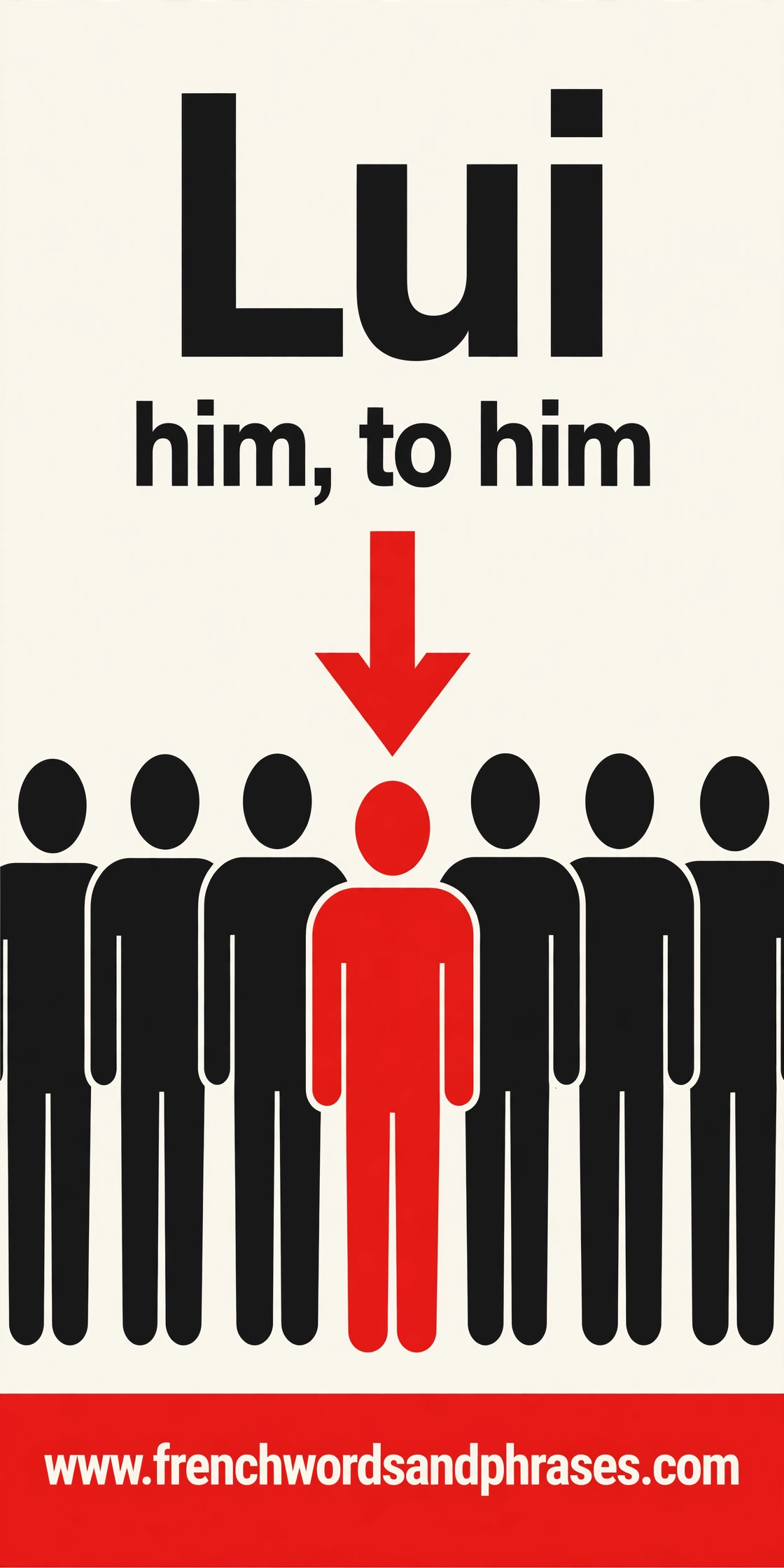
Lui means him; to him, to her.
Two friends are whispering about the tall man by the door. « Tu le connais ? — Non, mais je lui ai parlé hier. » — Do you know him? — No, but I spoke to him yesterday. Lui is the pronoun French uses when a man (or, quietly, a woman) is spoken to, given to, or simply pointed at without his name.
Let’s explore how lui works in French, beginning with the whole word on one card.
Understanding the French Pronoun Lui
Lui is a French personal pronoun with two jobs. As an indirect object pronoun it stands before the verb and means to him or to her: je lui parle, I speak to him. As a stressed (tonic) pronoun it stands after prepositions and in comparisons: avec lui, with him; plus grand que lui, taller than him. One small word, two posts — and it serves both genders in its indirect job.
It means him, and to him — and, in its object job, also to her. Je lui ai donné le livre — I gave him the book, or I gave her the book; only the story tells you which. C’est lui — it’s him. The picture it paints is a finger pointing at the third person in the room, the one being talked about or talked to.
Type: Personal pronoun — indirect object and stressed (tonic) pronoun
Answers the question: À qui ? — To whom? (Answer: to him, to her)
Agreement: No change of form: lui serves him and, as an indirect object, her as well
Watch the pair: lui (to him — indirect) vs le (him — direct): je lui parle (I speak to him) vs je le vois (I see him)
One important usage detail: before the verb, lui is the indirect object — it replaces à + a person. Je parle à Paul → je lui parle. But after a preposition, lui is only masculine: avec lui (with him), chez elle (at her place — the feminine stressed form is elle). And when two object pronouns meet, the direct one comes first: je le lui donne — I give it to him.
Experience the Word
Lui is the pronoun of the third chair at the table — the person who is present in every sentence but whose name is spared.
Imagine a village café where everyone knows everyone: « Tu as vu Marc ? — Oui, je lui ai dit bonjour, il était avec son frère, c’est lui qui paie toujours le café. » Four jobs for lui in one breath of gossip.
You have not just replaced a name. You have kept the conversation moving at the speed of people who already know who is who.
How to Use Lui in French: Complete Guide
Let’s explore how lui works in French, beginning with the whole word on one card.
Lui at a Glance
The Whole Word on One Card
Meaning, jobs, position and family — lui in four lines.
| Point | Lui |
|---|---|
| Meaning | him; to him, to her |
| Jobs | indirect object before the verb; stressed pronoun after prepositions |
| Agreement | one form only — lui never changes |
| Its family | moi, toi, lui, elle, nous, vous, eux, elles — the stressed set |
Example
Je lui ai téléphoné hier.
I phoned him yesterday.
The Pattern in Action: Two Jobs, One Word
Before the verb, lui means to him or to her. After a preposition or a comparison, lui is the stressed him — masculine only.
| Pattern | Example |
|---|---|
| indirect object — to him | je lui donne le livre — I give him the book |
| indirect object — to her | je lui écris une lettre — I write her a letter (lui = à elle here) |
| after a preposition — with him | elle part avec lui — she is leaving with him |
| in a comparison | il est plus grand que lui — he is taller than him |
| standing alone | c’est lui ! — it’s him! |
Example
Tu lui as dit la vérité ?
Did you tell him the truth?
Quick Quiz 1
In je lui ai écrit, can lui mean « to her »?
Reveal the answer
Yes — as an indirect object, lui replaces à lui and à elle alike.
Je lui ai écrit une longue lettre.
I wrote him (or her) a long letter.
The Tricky Bit: Lui vs Le
The classic mix-up: le is the direct object (him, the person seen, taken, known), lui is the indirect object (to him, the person spoken to or given to). The verb decides.
| Verb type | Pronoun |
|---|---|
| voir, connaître, écouter (direct) | je le vois, je le connais — I see him, I know him |
| parler à, téléphoner à, donner à (indirect) | je lui parle, je lui téléphone, je lui donne — I speak to him, I phone him, I give to him |
| both together | je le lui donne — I give it to him (direct le first, then lui) |
| répondre à | je lui réponds — I answer him |
Example
Je le vois, mais je ne lui parle jamais.
I see him, but I never speak to him.
Where It Goes: Before the Verb, or After a Preposition
As an object, lui slips in front of the verb, just before it. As a stressed pronoun, it follows its preposition and carries the weight of the voice.
| Position / pattern | Example |
|---|---|
| before the verb | elle lui sourit — she smiles at him |
| before the infinitive it belongs to | je vais lui écrire — I am going to write to him |
| after a preposition | chez lui, pour lui, sans lui — at his place, for him, without him |
| in a command (after the verb) | donne-lui le livre ! — give him the book! |
Example
Sans lui, la fête ne commence pas.
Without him, the party does not start.
Quick Quiz 2
« I speak to him » — je le parle or je lui parle?
Reveal the answer
je lui parle — parler takes à, so the object is indirect: lui.
Je lui parle chaque matin.
I speak to him every morning.
Everyday Expressions with Lui
Lui turns up wherever French talks about the third person in the room.
| Expression | In English |
|---|---|
| chez lui | at his place, at home (his home) |
| c’est lui | it’s him |
| quant à lui | as for him |
| lui-même | himself |
| à lui de jouer | it’s his turn to play |
Example
Quant à lui, il préfère rester à la maison.
As for him, he prefers to stay at home.
Close Cousins: The Stressed Family
After prepositions, French uses the stressed set — lui is its third person masculine.
| Word | The difference |
|---|---|
| moi | me — after a preposition: avec moi, with me |
| toi | you — chez toi, at your place |
| elle | her — the feminine twin: avec elle, with her |
| eux / elles | them — pour eux, for them (masculine); pour elles (feminine) |
Example
Elle vient avec lui, et moi, je reste avec elles.
She is coming with him, and me, I am staying with them.
Quick Quiz 3
« With her » — avec lui or avec elle?
Reveal the answer
avec elle — after a preposition, the stressed pronoun is gendered: lui for him, elle for her.
Il danse avec elle.
He is dancing with her.
Lui and Its Neighbours
The third-person shelf: subjects, direct objects, indirect objects and stressed forms side by side.
| French | In English |
|---|---|
| il | he (subject) |
| le | him (direct object) |
| lui | to him, to her (indirect object); him (stressed) |
| elle | she (subject); her (stressed) |
| se | himself, herself (reflexive) |
Example
Il le connaît, il lui parle, il habite chez lui.
He knows him, he speaks to him, he lives at his place.
Watch Out: The Traps Around Lui
The traps: using lui for a direct object, forgetting it also means to her, and splitting le lui.
| Trap | The truth |
|---|---|
| je lui vois (wrong) | voir is direct: je le vois — lui is only for à + person |
| lui = him only | as an indirect object, lui also means to her: je lui ai écrit (à elle) |
| je lui le donne (wrong order) | direct before indirect: je le lui donne — I give it to him |
| avec lui for a woman | after a preposition, a woman is elle: avec elle, chez elle |
Example
Le livre ? Je le lui ai donné hier.
The book? I gave it to him yesterday.
Quick Quiz 4
Complete: Le stylo, je ______ donne. (I give it to him.)
Reveal the answer
le lui — the direct object le comes before the indirect lui.
Le stylo, je le lui donne.
The pen, I give it to him.
Lui in Everyday French: Real-Life Examples
Now that you know the word, let’s see how lui appears in everyday French.
Example 1 — A phone call
Je lui ai téléphoné ce matin.
I phoned him this morning.
Example 2 — A gift
Nous lui avons offert un livre.
We gave him a book.
Example 3 — At his place
Le dîner est chez lui, ce soir.
Dinner is at his place this evening.
Example 4 — A comparison
Mon frère est plus jeune que lui.
My brother is younger than him.
Example 5 — It’s him
Quelqu’un frappe à la porte — c’est lui !
Someone is knocking at the door — it’s him!
Example 6 — A question
Tu lui as demandé son adresse ?
Did you ask him for his address?
Beyond Translation: The Meaning of Lui
English keeps its pronouns in separate boxes — him for the object, to him with a preposition doing the extra work. French lets one small word, lui, walk between the boxes: it leans before the verb as the quiet indirect object, then steps out after prepositions and takes the stress of the whole sentence — c’est lui.
To master lui is to feel how French trusts position, not extra words, to say who did what to whom.
And it carries a small act of fairness: before the verb, lui refuses to choose between him and her — je lui parle speaks to them both with the same word.
How to Remember the French Pronoun Lui
Remember it this way: Lui does two jobs — to him (and to her) before the verb, and the stressed him after prepositions.
- You check the verb — parler à, donner à: the object is lui; voir, connaître: the object is le.
- You remember the double service — je lui écris can mean I write to him or to her.
- You order the pair — je le lui donne: direct le first, then lui.
The key idea is lui = to him / to her before the verb; stressed him after prepositions (avec lui, chez lui); direct object is le.
Test Your Knowledge of Lui
Let’s see how much you’ve learned. Try answering these questions before revealing the answers.
Question 1
What does lui mean?
Reveal the answer
Him; to him, to her — an indirect object pronoun before the verb, and the stressed pronoun after prepositions.
Question 2
How do you say « I speak to him »?
Reveal the answer
Je lui parle — parler à takes the indirect object lui.
Question 3
Translate: It’s him.
Reveal the answer
C’est lui.
Question 4
What is the difference between le and lui?
Reveal the answer
Le is the direct object (je le vois, I see him); lui is the indirect object (je lui parle, I speak to him).
Question 5
Complete the sentence:
Elle habite chez ______. (at his place)
Reveal the answer
lui
Elle habite chez lui.
She lives at his place.
Your Final Challenge
Can You Use It?
How would you say this in French?
“I phoned him yesterday.”
Reveal the answer
Je lui ai téléphoné hier.
I phoned him yesterday.
A little French. A little curiosity. A richer everyday life.
LEARN FRENCH ONE WORD AT A TIME