A French Word to Live By
Translate Je to English
/ʒə/
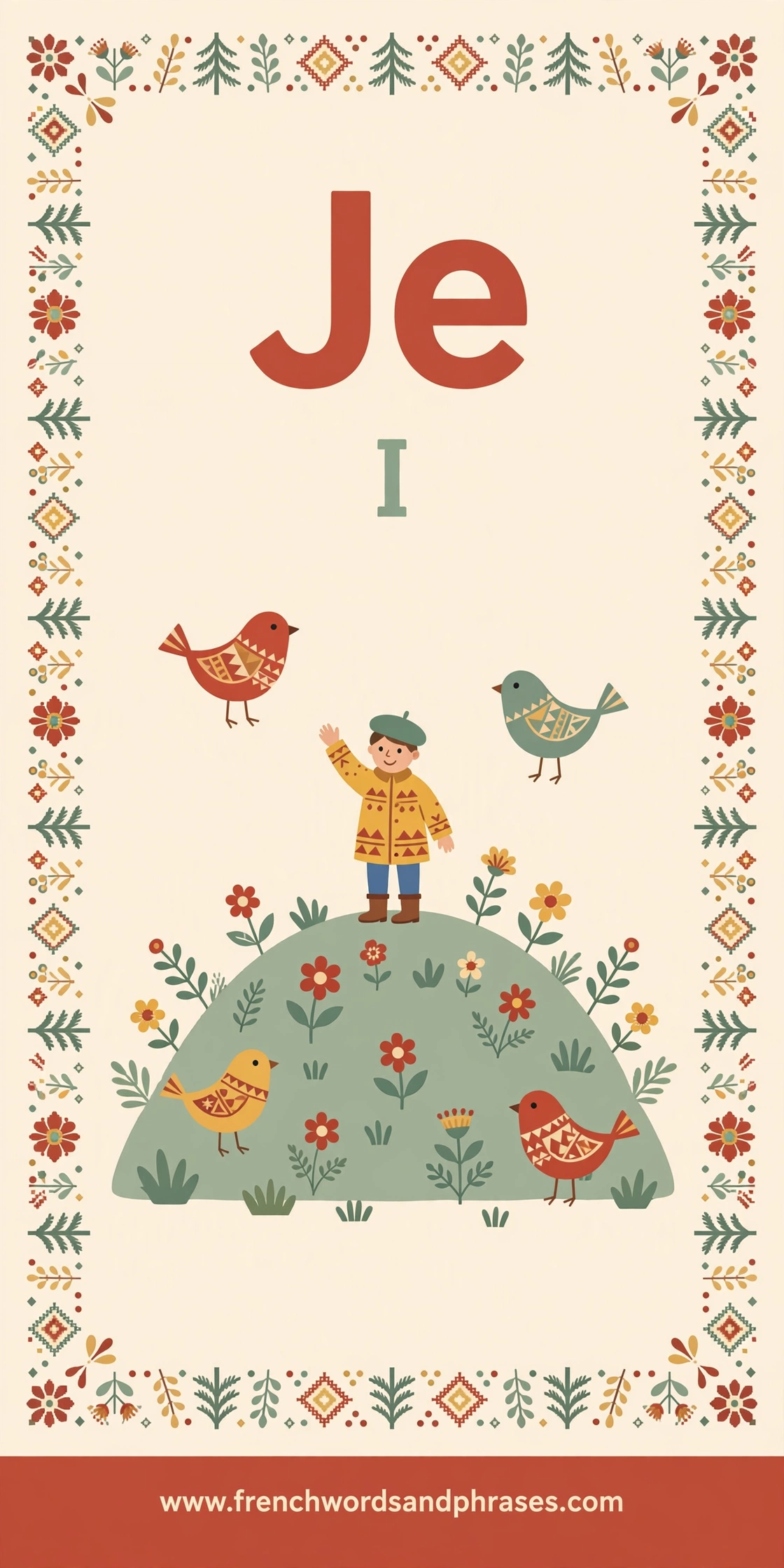
Je means I.
A small boy stands on a chair in a busy kitchen, wooden spoon in hand like a captain. « Je prépare le dîner ! » — I am making dinner! Je is the very first word of the speaker in French: the tiny ‘I’ that steps forward, takes the verb by the hand, and starts almost every sentence a person ever says about themselves.
Let’s explore how je works in French, beginning with the whole word on one card.
Understanding the French Pronoun Je
Je is a French subject pronoun — the first person singular, the speaker talking about themselves. It stands before the verb and tells you who is acting: je parle (I speak), je suis (I am), je voudrais (I would like).
It means I. The picture it paints is a person stepping into the light: every action in the sentence flows from this one small word. English ‘I’ stands tall with its capital letter in every position; French je stays modest and lowercase mid-sentence — but it is just as essential, because a French verb almost never appears without its subject.
Type: Subject pronoun — first person singular (the speaker)
Answers the question: Qui ? — Who? (Answer: me, the one speaking)
What follows it: A verb: je parle, je finis, je suis, j’aime
Watch the pair: je (subject, glued to the verb) vs moi (stressed form — after prepositions, in comparisons, standing alone): avec moi, plus grand que moi
One important usage detail: je shrinks to j’ before a vowel or a mute h — j’aime, j’habite, j’écoute. The apostrophe is not decoration; writing ‘je aime’ is simply wrong in French, every time.
Experience the Word
Je is the pronoun of the stage door — the moment the speaker steps out and the story becomes theirs.
Imagine a child on her first day of school, hand raised high above the whole class: je sais, Madame, je sais ! — I know, Miss, I know! Everything she is burns inside those two small letters.
You have not just named a person. You have put yourself at the centre of the sentence — the one who acts, wants, knows and dreams.
How to Use Je in French: Complete Guide
Let’s explore how je works in French, beginning with the whole word on one card.
Je at a Glance
The Whole Word on One Card
Meaning, job, shape and pair — je in four lines.
| Point | Je |
|---|---|
| Meaning | I — the speaker |
| Job | subject pronoun: the person doing the action |
| Its two shapes | je before a consonant (je parle), j’ before a vowel (j’aime) |
| Its effect on the verb | the verb dresses for je: je parle, je finis, je vais, je suis |
Example
Je parle français et j’apprends l’espagnol.
I speak French and I am learning Spanish.
The Pattern in Action: The Speaker at Work
Je connects the speaker to every kind of action — being, doing, wanting and knowing.
| Pattern | Example |
|---|---|
| je + être | je suis content — I am happy |
| je + a regular verb | je regarde la mer — I am looking at the sea |
| je + a modal idea | je voudrais un thé — I would like a tea |
| je + a negative | je ne sais pas — I do not know |
Example
Je travaille le matin et je me repose le soir.
I work in the morning and I rest in the evening.
Quick Quiz 1
“I love” — je aime or j’aime?
Reveal the answer
j’aime — before a vowel, je always elides to j’.
J’aime le chocolat chaud.
I love hot chocolate.
The Tricky Bit: Je Becomes J’
Je has one transformation, and it is compulsory: before a vowel sound, the e disappears and an apostrophe takes its place.
| Situation | What happens |
|---|---|
| before a consonant, je stays whole | je parle, je mange, je dors — the e survives |
| before a vowel, je becomes j’ | j’aime, j’écoute, j’arrive, j’ouvre |
| before a mute h, j’ again | j’habite à Nice, j’hésite un peu — the h is silent, so the vowel rule applies |
| before h aspiré, je stays whole | je hais les araignées — haïr starts with an h aspiré (everyday French prefers je déteste) |
Example
J’habite à Lyon, mais je travaille à Paris.
I live in Lyon, but I work in Paris.
Where It Goes: First, Before the Verb
Je opens the sentence and holds the verb’s hand — in statements, in negatives, and turned around in formal questions.
| Position / pattern | Example |
|---|---|
| at the head of the sentence | je comprends — I understand |
| in the negative, je … ne + verb | je ne comprends pas — I do not understand |
| in questions with est-ce que | est-ce que je peux entrer ? — can I come in? |
| inverted in formal questions | puis-je vous aider ? — may I help you? (bookish, polite) |
Example
Je ne comprends pas, mais j’écoute.
I do not understand, but I am listening.
Quick Quiz 2
Can a French sentence drop je the way Spanish drops its subject — saying just suis fatigué for “I am tired”?
Reveal the answer
No — French verbs need their subject; je must be there.
Je suis fatigué.
I am tired.
Everyday Expressions with Je
Je carries the most useful sentences in the language — knowing, wanting, not knowing.
| Expression | In English |
|---|---|
| je sais | I know |
| je ne sais pas | I do not know |
| je voudrais… | I would like… |
| je crois que oui | I think so |
| moi, je… | as for me, I… (je with moi for emphasis) |
Example
Je ne sais pas, mais je vais demander.
I do not know, but I am going to ask.
Close Cousins: Je, Moi, Nous
Three forms of the same person — the difference is the job each one does in the sentence.
| Word | The difference |
|---|---|
| je | the subject form — only before a verb: je viens (I am coming) |
| moi | the stressed form — after prepositions, in comparisons, alone: avec moi, moi aussi |
| nous | the plural of the speaker’s side: we — je seul, nous ensemble |
| tu | the other side of the conversation: you — je parle, tu écoutes |
Example
Moi, je préfère le thé ; et toi ?
As for me, I prefer tea; and you?
Quick Quiz 3
“Come with me” — viens avec je or viens avec moi?
Reveal the answer
viens avec moi — after a preposition, French uses the stressed form moi, never je.
Viens avec moi au marché.
Come with me to the market.
Je and Its Neighbours
The subject shelf: the whole family of people who can drive a verb.
| French | In English |
|---|---|
| je | I |
| tu | you (one friend) |
| il / elle | he / she |
| nous | we |
| vous | you (formal or plural) |
| ils / elles | they |
Example
Je chante, tu danses, et nous rions ensemble.
I sing, you dance, and we laugh together.
Watch Out: The Traps Around Je
The traps: the missing subject, the forgotten apostrophe, and the capital letter that French does not want.
| Trap | The truth |
|---|---|
| dropping je before the verb | French is not Spanish: ‘suis prêt’ is wrong — je suis prêt |
| writing ‘je aime’, ‘je habite’ | before a vowel or mute h, je becomes j’: j’aime, j’habite |
| using je after a preposition | after avec, pour, chez, sans, it is always moi: pour moi, chez moi |
| capitalising je mid-sentence like English I | French je stays lowercase: hier, je suis allé au marché |
Example
Je suis désolé, j’arrive dans cinq minutes.
I am sorry, I will arrive in five minutes.
Quick Quiz 4
Complete: ______ habite dans une petite maison. (I live in a small house)
Reveal the answer
J’ — habite begins with a mute h, so je elides to j’.
J’habite dans une petite maison.
I live in a small house.
Je in Everyday French: Real-Life Examples
Now that you know the word, let’s see how je appears in everyday French.
Example Example 1 — Introducing yourself
Je m’appelle Hugo et je suis étudiant.
My name is Hugo and I am a student.
Example Example 2 — At a café
Je voudrais un café et un croissant, s’il vous plaît.
I would like a coffee and a croissant, please.
Example Example 3 — Opinions
Je pense que ce film est magnifique.
I think this film is wonderful.
Example Example 4 — Daily life
Je me lève à sept heures tous les jours.
I get up at seven o’clock every day.
Example Example 5 — Honesty
Je ne comprends pas très bien, répétez, s’il vous plaît.
I do not understand very well, please repeat.
Example Example 6 — Feelings
Je suis très content de te voir.
I am very happy to see you.
Beyond Translation: The Meaning of Je
English writes its speaker with a capital letter — I, always upright, always noticed. French je asks for no such honour: two small letters, lowercase even mid-sentence, that quietly carry every confession, promise and plan a person ever makes.
To say je is to take responsibility for the sentence — I did it, I want it, I am here.
And when je needs weight, French doubles it with its stressed twin: moi, je sais — as for me, I know. The smallest pronoun in the language holds the biggest person in every conversation: the one who is speaking.
How to Remember the French Pronoun Je
Remember it this way: Remember it this way: Je is the speaker on stage — it never leaves the verb alone, and it shrinks to j’ whenever a vowel walks in.
- You never drop it — a French verb without its subject is a sentence without a driver: je suis, je vais, je sais.
- You elide before vowels — j’aime, j’habite, j’écoute, never ‘je aime’.
- You switch to moi for stress — after prepositions and standing alone: avec moi, moi aussi.
The key idea is je means I — it stands before the verb, becomes j’ before a vowel, and hands over to moi whenever the pronoun is stressed.
Test Your Knowledge of Je
Let’s see how much you’ve learned. Try answering these questions before revealing the answers.
Question 1
What does je mean?
Reveal the answer
I — the subject pronoun of the first person singular.
Question 2
When does je become j’?
Reveal the answer
Before a vowel or a mute h — j’aime, j’habite, j’écoute.
Question 3
Translate: I am French and I live in Paris.
Reveal the answer
Je suis français et j’habite à Paris.
Question 4
What form of ‘I’ follows a preposition like avec or pour?
Reveal the answer
Moi — the stressed form: avec moi, pour moi. Je only works as a subject.
Question 5
Complete the sentence:
______ écoute la radio tous les matins. (I listen to the radio every morning.)
Reveal the answer
J’
J’écoute la radio tous les matins.
I listen to the radio every morning.
Your Final Challenge
Can You Use It?
How would you say this in French?
“How would you say this in French?”
Reveal the answer
Je parle un peu français, et j’apprends tous les jours.
I speak a little French, and I learn every day.
A little French. A little curiosity. A richer everyday life.
LEARN FRENCH ONE WORD AT A TIME