A French Word to Live By
Translate Son to English
/sɔ̃/
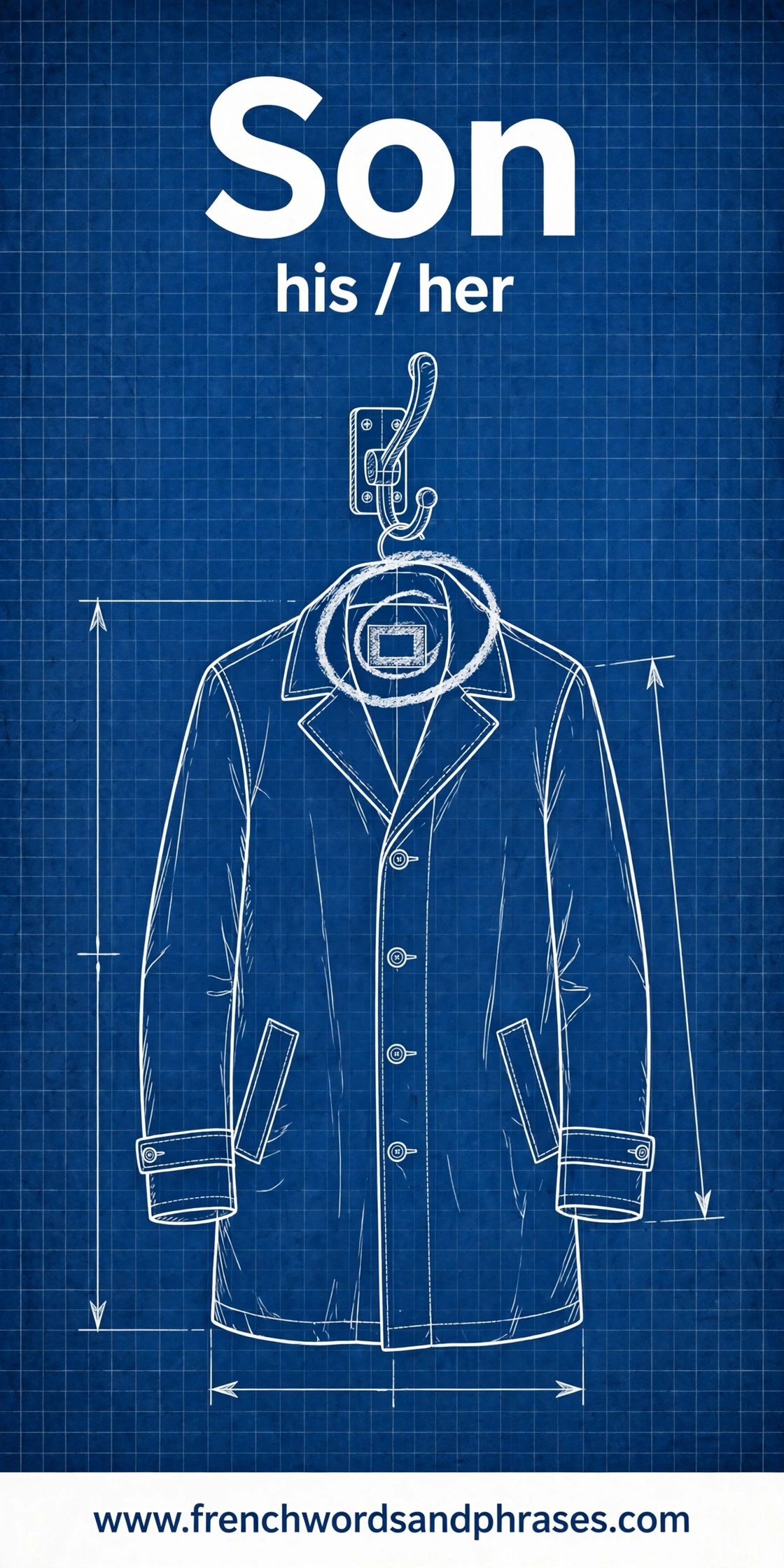
Son means his / her.
A mother points across the square as a small boy runs ahead, his satchel bouncing on his back. « C’est son école, là-bas, et son frère l’attend » — that is his school, over there, and his brother is waiting for him. Son is the French word for ‘his’ and ‘her’ at once: it points at one owner — a man or a woman — and lets the noun beside it do all the talking.
Let’s explore how son works in French, beginning with the whole word on one card.
Understanding the French Determiner Son
Son is a French possessive determiner — ‘his’, ‘her’ or ‘its’ for one owner. It stands in front of a noun and agrees with that noun: son livre (his or her book), sa sœur (his or her sister), ses parents (his or her parents).
It means his or her — French refuses to choose between them. The picture it paints is a label tied to a thing, not to a person: son attaches to the possession, and the possession’s gender decides whether you hear son, sa or ses. Whether the owner is a king or a queen, son livre is son livre.
Type: Possessive determiner — his / her / its (one owner)
Answers the question: À qui ? / De qui ? — Whose? (Answer: his, or hers — the noun will not tell you which)
What follows it: A noun: son frère, sa maison, ses enfants
Watch the pair: son (determiner, his/her — before a noun) vs le sien (pronoun, his/hers — standing alone): son vélo = his bike, le sien = his
One important usage detail: because son agrees with the thing owned, son livre can mean his book or her book — French leaves the owner’s gender a mystery, and only the story around it tells you whose it really is. Context is the only detective available.
Experience the Word
Son is the determiner of the third person — the one we talk about, not to: he and she, equally served by the same three forms.
Imagine a novelist describing two neighbours: son jardin touche sa maison, ses enfants jouent avec son chien — his garden touches her house, her children play with his dog. Son and sa flow over both owners without ever revealing who is who.
You have not just marked a possession. You have tied a thing to its owner — and politely kept the owner’s secret.
How to Use Son in French: Complete Guide
Let’s explore how son works in French, beginning with the whole word on one card.
Son at a Glance
The Whole Word on One Card
Meaning, job, grid and pair — son in four lines.
| Point | Son |
|---|---|
| Meaning | his / her / its (one owner) |
| Job | possessive determiner — marks the owner before the noun |
| The grid | son (masc. sg.), sa (fem. sg.), ses (plural) |
| What it signals | this belongs to him — or to her; the noun decides the form |
Example
Son train part dans dix minutes.
His (or her) train leaves in ten minutes.
The Pattern in Action: One Owner, Every Thing
Son connects nouns to a single owner — his world or her world, told entirely through the things.
| Pattern | Example |
|---|---|
| before a masculine noun | son frère travaille à Lyon — her brother works in Lyon |
| before a feminine noun | sa maison est près de la mer — his house is near the sea |
| before a plural noun | ses parents habitent à la campagne — her parents live in the countryside |
| the owner’s whole world | son travail, sa famille, ses amis — his work, his family, his friends |
Example
Elle a oublié son parapluie dans sa voiture.
She forgot her umbrella in her car.
Quick Quiz 1
Marie parle de son frère. Is the brother hers — and does son tell you Marie is female?
Reveal the answer
The brother is hers, but son says nothing about Marie — son copies frère (masculine), not the owner. A man’s brother is also son frère.
Marie et son frère arrivent demain.
Marie and her brother arrive tomorrow.
The Tricky Bit: The Noun Decides, and Sa Becomes Son
Son carries the two great possessive rules at once: agreement with the thing owned — and the vowel swap that turns sa into son.
| Situation | What happens |
|---|---|
| the noun is masculine: son | son livre, son chien, son jardin — whatever the owner’s gender |
| the noun is feminine, consonant first: sa | sa maison, sa voiture, sa sœur — sa before a consonant sound |
| the noun is feminine, vowel first: son | son école, son amie, son histoire — sa becomes son before a vowel |
| the noun is plural: ses | ses livres, ses amies, ses enfants — one form for every plural |
Example
Son amie habite près de son école.
Her friend lives near her school.
Where It Goes: Directly Before the Noun
Son leads the noun phrase exactly like its cousins — determiner first, adjective next, noun last.
| Position / pattern | Example |
|---|---|
| directly before the noun | son bureau, sa patience, ses efforts — the determiner leads |
| before noun + adjective | son petit jardin, sa grande maison — son and sa still stand first |
| repeated before each noun | son père et sa mère — his father and his mother (one determiner per noun) |
| agreement in gender and number | son / sa for one thing, ses for several: ses parents, ses affaires |
Example
Son meilleur ami connaît bien sa famille.
His best friend knows his family well.
Quick Quiz 2
“Her school” — sa école or son école?
Reveal the answer
son école — école is feminine but begins with a vowel, so sa becomes son.
Son école est très loin de sa maison.
Her school is very far from her house.
Everyday Expressions with Son
Son fills the sentences we use to talk about other people’s lives, work and families.
| Expression | In English |
|---|---|
| à son avis | in his / her opinion |
| de son côté | on his / her side, for his / her part |
| son petit ami / sa petite amie | his boyfriend / her girlfriend |
| faire de son mieux | to do his / her best |
| son anniversaire | his / her birthday |
Example
À son avis, le film est trop long.
In her opinion, the film is too long.
Close Cousins: Son, Le sien, Ton
Three forms around one idea — the difference is the noun’s presence and who is listening.
| Word | The difference |
|---|---|
| son / sa / ses | the determiner — it needs a noun after it: son vélo (his bike) |
| le sien | the pronoun ‘his / hers’ — it stands alone: le sien est rouge (his is red) |
| ton / ta / tes | your — the same grid aimed at a friend: ton vélo, ta maison |
| leur / leurs | their — several owners: leur vélo, leurs maisons |
Example
Son vélo est neuf ; le sien aussi.
His bike is new; his (the other man’s) is too.
Quick Quiz 3
Which cousin stands alone to mean “his” or “hers” — son or le sien?
Reveal the answer
le sien — son must hold a noun’s hand; le sien walks on its own.
Mon livre est ici, le sien est là-bas.
My book is here, his is over there.
Son and Its Neighbours
The possessive shelf: the whole determiner family, owner by owner.
| French | In English |
|---|---|
| mon / ma / mes | my |
| ton / ta / tes | your (for tu) |
| son / sa / ses | his / her |
| notre / nos | our |
| votre / vos | your (for vous) |
| leur / leurs | their |
Example
Son sac, ton sac, mon sac — chacun prend le sien.
His bag, your bag, my bag — everyone takes their own.
Watch Out: The Traps Around Son
The traps: hunting for the owner’s gender where French hides it, and the vowel that changes sa into son.
| Trap | The truth |
|---|---|
| choosing son or sa by the owner’s gender | the noun decides: a woman’s brother is son frère, a man’s sister is sa sœur |
| writing ‘sa école’ or ‘sa amie’ | before a vowel sound, feminine nouns take son: son école, son amie |
| forgetting the plural | several things take ses, whatever their gender: ses livres, ses chaussures |
| confusing son with sont | son = his/her (determiner); sont = they are (verb): ses enfants sont grands |
Example
Sa sœur et son frère sont dans son jardin.
His sister and his brother are in his garden.
Quick Quiz 4
Complete: Il a perdu ______ clés ce matin. (He lost his keys this morning)
Reveal the answer
ses — clés is plural, so the plural form ses.
Il a perdu ses clés ce matin.
He lost his keys this morning.
Son in Everyday French: Real-Life Examples
Now that you know the word, let’s see how son appears in everyday French.
Example Example 1 — Family
Son fils s’appelle Théo et sa fille s’appelle Emma.
His son is called Théo and his daughter is called Emma.
Example Example 2 — At work
Elle a présenté son projet à son directeur.
She presented her project to her manager.
Example Example 3 — Weather plans
Il prend son parapluie parce qu’il pleut.
He takes his umbrella because it is raining.
Example Example 4 — A phone call
Elle appelle sa mère tous les dimanches.
She calls her mother every Sunday.
Example Example 5 — School
Il a oublié ses cahiers dans sa classe.
He forgot his exercise books in his classroom.
Example Example 6 — At the market
Elle choisit ses légumes avec soin.
She chooses her vegetables with care.
Beyond Translation: The Meaning of Son
English forces a choice French simply refuses: his or her, announced in every sentence, the owner’s gender broadcast to the world. Son keeps the secret. Son livre might sit on his desk or on hers — the word cares only about the book.
To say son is to point at the thing and let the owner stay in shadow — his, hers, the noun decides.
Learners call this confusing; French speakers call it normal. The language ties its possessives to the possession, and the person — king, queen, brother, sister — remains gracefully unspecified.
How to Remember the French Determiner Son
Remember it this way: Remember it this way: Son looks at the thing, never at the owner — the noun’s gender picks son, sa or ses, and a vowel swaps sa for son.
- You match the noun, never the owner — son livre, sa sœur, ses clés, for him and for her alike.
- You swap sa for son before a vowel — son école, son amie, even though the noun is feminine.
- You let context do the detective work — son livre is his book or her book; the story tells you.
The key idea is son / sa / ses means his or her for one owner — the form agrees with the thing owned, and sa becomes son before a vowel sound.
Test Your Knowledge of Son
Let’s see how much you’ve learned. Try answering these questions before revealing the answers.
Question 1
What does son mean?
Reveal the answer
His / her / its — the possessive determiner for one owner.
Question 2
What are the three forms for one owner?
Reveal the answer
Son, sa and ses — son (masculine singular), sa (feminine singular), ses (plural).
Question 3
Translate: Her house is near his school.
Reveal the answer
Sa maison est près de son école.
Question 4
In ‘son livre’, can you tell whether the owner is a man or a woman?
Reveal the answer
No — son agrees with livre (masculine), so the owner’s gender stays hidden; only the context tells you.
Question 5
Complete the sentence:
Elle a téléphoné à ______ amie hier soir. (She phoned her friend yesterday evening.)
Reveal the answer
son
Elle a téléphoné à son amie hier soir.
She phoned her friend yesterday evening.
Your Final Challenge
Can You Use It?
How would you say this in French?
“How would you say this in French?”
Reveal the answer
Son frère habite près de sa maison.
Her brother lives near her house.
A little French. A little curiosity. A richer everyday life.
LEARN FRENCH ONE WORD AT A TIME