A French Word to Live By
Translate Front to English
/fʁɔ̃/
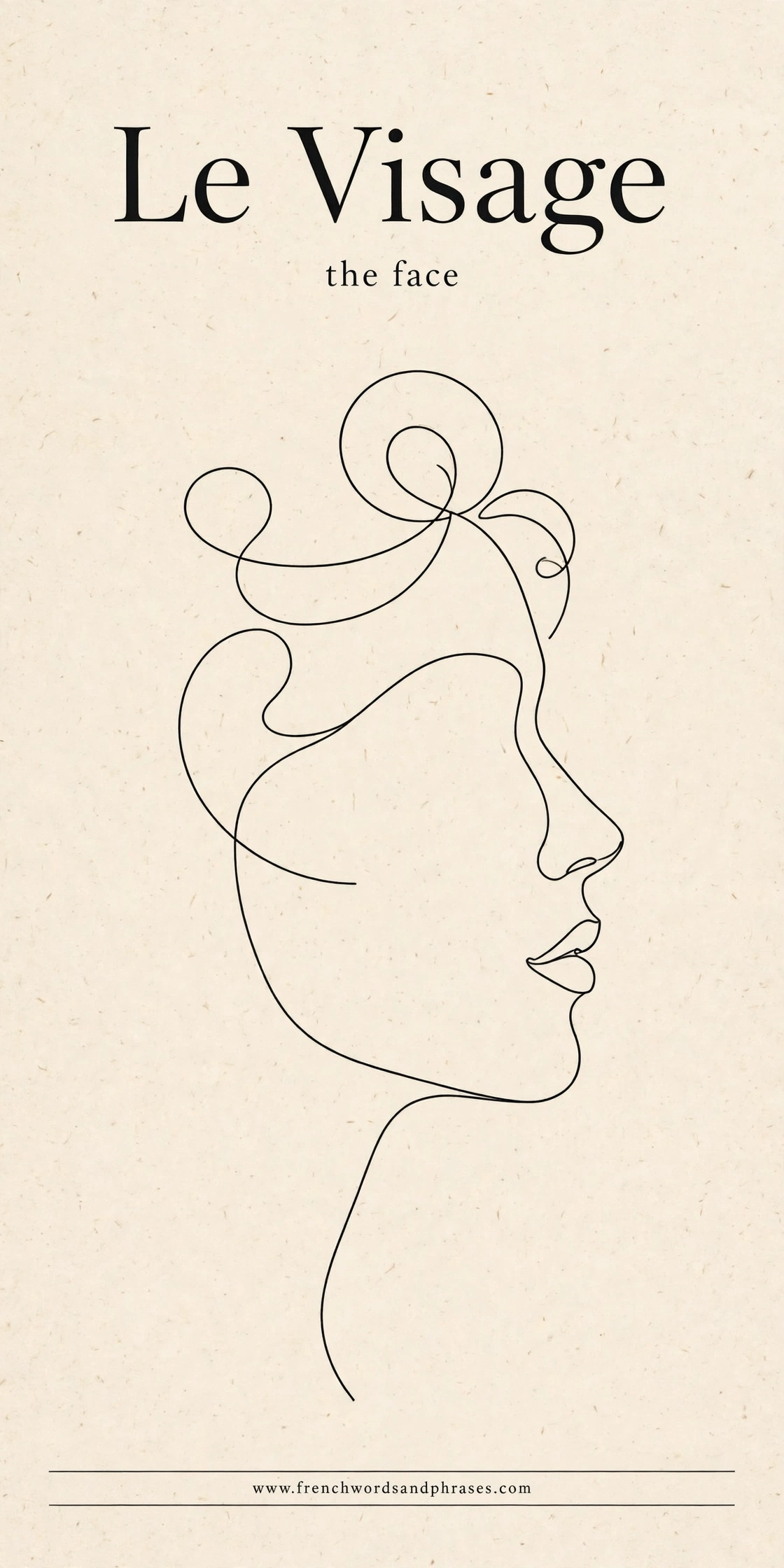
Le front means the forehead.
Midday in August, the sun directly overhead, and the first bead of sweat rolls slowly down — le front, the forehead, the body’s own sun terrace.
In this guide, you’ll learn what front means in English, how to use it with its articles, how to form its plural, and how it appears in everyday French. Explore French examples, English translations, and practice quizzes.
Understanding the French Noun Front
Front is a masculine French noun, learned with its article: le front, un front. The final -t is silent: the word sounds like « fron ». Like its English cousin, it means both the forehead and a front — a weather front, a battle front.
It means the forehead — the broad, flat part of the face above the eyebrows. A high forehead is un front haut, a sign of intelligence in every French compliment. But le front also leads a double life: it is the front line in a war, the front of a building’s weather system — un front froid, a cold front — and doing two things de front means tackling them head-on, at the same time.
Gender: Masculine — le front
Definite article: le — le front (the forehead)
Indefinite article: un — un front (a forehead)
Plural: les fronts
Sound note: The final -t is silent: front sounds like « fron »
Other senses: A front (weather, war, politics): un front froid, le front populaire
English equivalents: The forehead; a front.
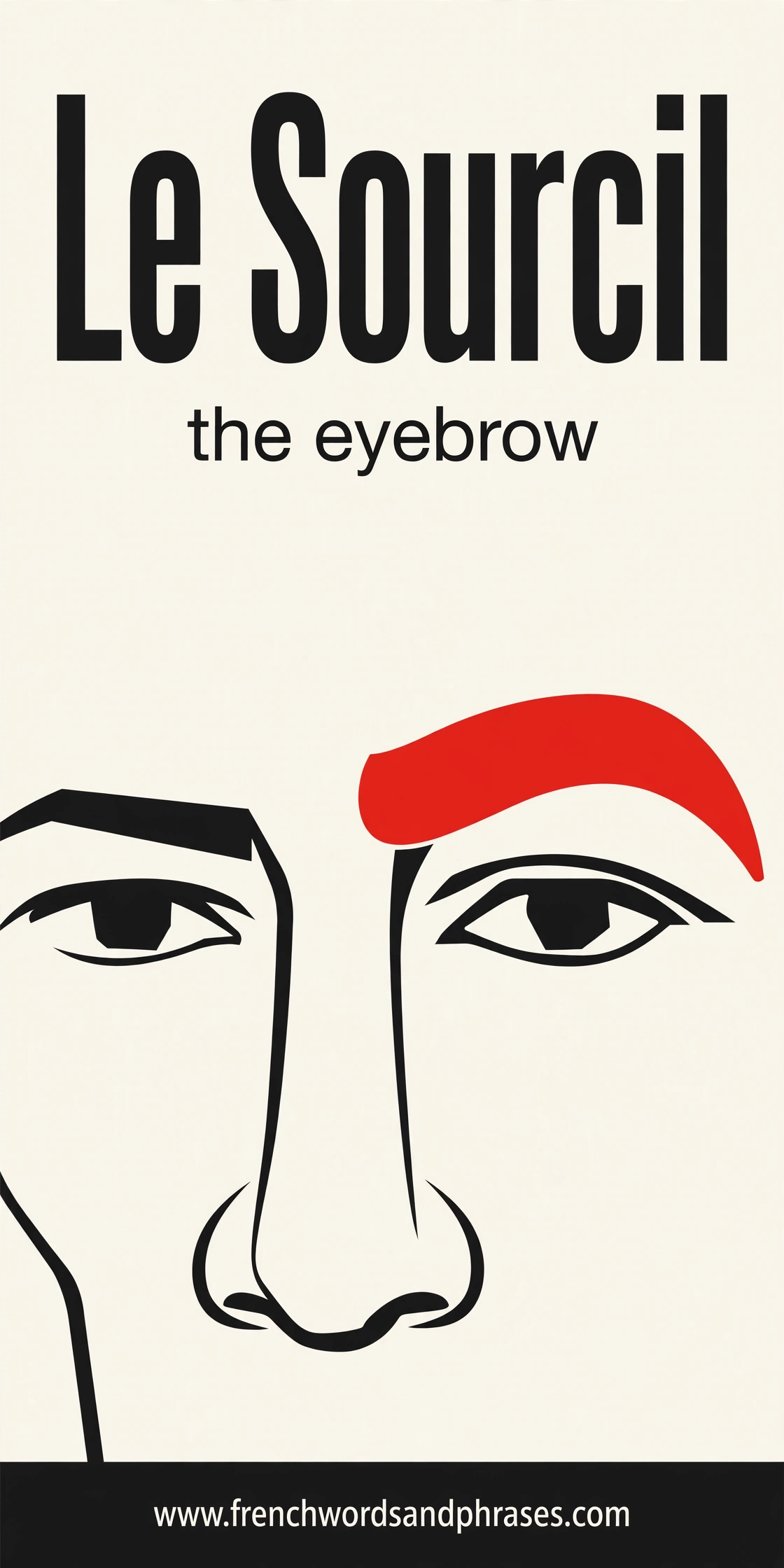
Watch the difference between le front and la tête: the front is only the forehead, the flat stage above the eyes — you wipe it (s’essuyer le front), you wrinkle it (plisser le front), and a determined person advances le front haut, head held high. Knitting your brows is a different verb for a different feature: froncer les sourcils.
Experience the Word
Front is where effort shows first. The farmer in his field, the runner at kilometre thirty, the student before an exam — all of them wipe the same place: le front.
Imagine a grandmother reading a child’s temperature the old way, with the back of her hand pressed gently to a small forehead — no thermometer in the world is trusted more.
You have not just felt a forehead. You have taken the measure of a person — pris la température, the French way.
How to Use Front in French: Complete Guide
Let’s explore how front works in French, beginning with its articles — le front, un front, des fronts.
Front with the Definite Article (Le, Les)
Used for a specific forehead — usually your own, in reflexive phrases.
| Form | French |
|---|---|
| Masculine singular | le front |
| Plural | les fronts |
Example
Elle s’essuie le front après l’effort.
She wipes her forehead after the effort.
Front with the Indefinite Article (Un, Des)
Used for a forehead in general — often with an adjective of shape.
| Form | French |
|---|---|
| Masculine singular | un front |
| Plural | des fronts |
Example
Il a un front haut et des yeux vifs.
He has a high forehead and lively eyes.
Front with the Partitive and Quantities (De la sueur sur le…)
What lands on a forehead is measured with the partitive — sweat, dust and kisses.
| Quantity | French |
|---|---|
| some sweat on the forehead | de la sueur sur le front |
| wrinkles on the forehead | des rides sur le front |
| a kiss on the forehead | un baiser sur le front |
| head-on, at the same time | de front |
| the whole forehead | tout le front |
Example
Elle lui dépose un baiser sur le front avant de partir.
She places a kiss on his forehead before leaving.
Quick Quiz 1
Complete the sentence:
Il s’essuie ______ front avec un mouchoir. (the)
Reveal the answer
le
Il s’essuie le front avec un mouchoir.
He wipes his forehead with a handkerchief — body parts take le with the reflexive.
The Plural of Front
Front adds an -s in the plural — les fronts, heard mostly in its « front line » sense.
| Number | French |
|---|---|
| Singular | le front |
| Plural | les fronts |
Example
Un front froid traverse le pays cette nuit.
A cold front is crossing the country tonight.
Front with Possessive Adjectives (Mon, Ton, Son…)
Possessives agree with the noun: front is masculine, so mon, ton, son.
| Owner | French |
|---|---|
| my | mon front |
| your (tu) | ton front |
| his / her | son front |
| our | notre front |
| your (vous) | votre front |
| their | leur front |
Example
Son front brille sous le soleil de midi.
His forehead shines under the midday sun.
Quick Quiz 2
Complete the sentence:
______ front est couvert de sueur après la course. (His)
Reveal the answer
Son
Son front est couvert de sueur après la course.
His forehead is covered in sweat after the race.
Front with Demonstrative Adjectives (Ce, Ces)
Used to point: ce front, this forehead.
| Form | French |
|---|---|
| Masculine singular | ce front |
| Plural | ces fronts |
Example
Ce front haut lui donne un air intelligent.
That high forehead gives him an intelligent air.
Front with Adjectives
Adjectives agree with front — masculine singular: un front haut, un front large.
| Adjective | With Front |
|---|---|
| haut (high) | un front haut |
| large (broad) | un front large |
| bas (low) | un front bas |
| dégagé (clear, open) | un front dégagé |
| ridé (wrinkled) | un front ridé |
Example
Le vieux professeur a un front large et ridé.
The old professor has a broad, wrinkled forehead.
Quick Quiz 3
Complete the sentence:
Elle a un front ______ et des cheveux frisés. (high)
Reveal the answer
haut
Elle a un front haut et des cheveux frisés.
She has a high forehead and curly hair.
Everyday Expressions with Front
Head-on attacks and heads held high — the front phrases of daily life.
| Expression | In English |
|---|---|
| de front | head-on; at the same time |
| faire front à | to stand up to, to face up to |
| le front haut | with your head held high |
| s’essuyer le front | to wipe your forehead |
| un front froid | a cold front (weather) |
| avoir le front de | to have the nerve to (literary) |
Example
Elle mène trois projets de front sans se plaindre.
She is running three projects at the same time without complaining.
Words from the Same Family as Front
Facing, confronting and foreheads — the words that travel with front.
| French | In English |
|---|---|
| affronter | to confront, to face |
| frontal | frontal, head-on |
| la frontière | the border, the frontier |
| le front de mer | the seafront |
| faire face à | to face, to deal with |
Example
L’hôtel se trouve sur le front de mer, face à la plage.
The hotel is on the seafront, facing the beach.
Quick Quiz 4
What does mener deux projets de front mean?
Reveal the answer
To run two projects at the same time, head-on — de front means tackling things directly and simultaneously.
Il mène ses études et son travail de front.
He is handling his studies and his job at the same time.
Front in Everyday French: Real-Life Examples
Now that you know the word, let’s see how front appears in everyday French.
Example 1 — Hot weather
Il s’essuie le front toutes les cinq minutes.
He wipes his forehead every five minutes.
Example 2 — A tender gesture
Sa mère lui pose la main sur le front pour vérifier la fièvre.
His mother lays her hand on his forehead to check for fever.
Example 3 — Describing someone
C’est un homme au front large et aux yeux doux.
He is a man with a broad forehead and gentle eyes.
Example 4 — Determination
Elle avance le front haut malgré les critiques.
She moves forward with her head held high despite the criticism.
Example 5 — Weather news
Un front froid arrive par l’ouest ce soir.
A cold front is arriving from the west this evening.
Example 6 — A kiss goodnight
Il embrasse sa fille sur le front avant qu’elle dorme.
He kisses his daughter on the forehead before she sleeps.
Beyond Translation: The Meaning of Front
The French front carries honour on it: to advance le front haut is to walk proudly, and the old literary phrase avoir le front de means to have the sheer nerve. The word comes straight from the Latin frons — forehead, but also front and facade — and French kept every layer: the brow of a thinker, the front of an army, the front of a storm. Rodin’s Thinker rests his chin in his hand, but it is the great furrowed front above that does the thinking.
To say front is to name the banner under which a person faces the world.
It evokes the wiped brow of the worker, the kissed forehead of the child, and the cold front rolling in over the Atlantic.
How to Remember the French Noun Front
Remember it this way: Front is the forehead — masculine, with a silent final -t: le front, said « fron ».
- The silent ending — le front, where the -t never sounds.
- The family business — de front, head-on and all at once.
- The proud walk — le front haut, head held high.
The key idea is le front — the forehead, t silent.
Test Your Knowledge of Front
Let’s see how much you’ve learned. Try answering these questions before revealing the answers.
Question 1
Is front masculine or feminine?
Reveal the answer
Masculine — le front, un front.
Question 2
How is the end of front pronounced?
Reveal the answer
The final -t is silent — front sounds like « fron ».
Question 3
Translate: She wipes her forehead.
Reveal the answer
Elle s’essuie le front.
Question 4
What is un front froid?
Reveal the answer
A cold front — the weather sense of front, exactly as in English.
Question 5
Complete the sentence:
Il avance ______ front haut. (with his head held high — literally « the forehead high »)
Reveal the answer
le
Il avance le front haut.
He walks forward with his head held high.
Your Final Challenge
Can You Use It?
How would you say this in French?
“She places a kiss on his forehead.”
Reveal the answer
Elle lui dépose un baiser sur le front.
She places a kiss on his forehead.
A little French. A little curiosity. A richer everyday life.
LEARN FRENCH ONE WORD AT A TIME