A French Word to Live By
Translate Visage to English
/vi.zaʒ/
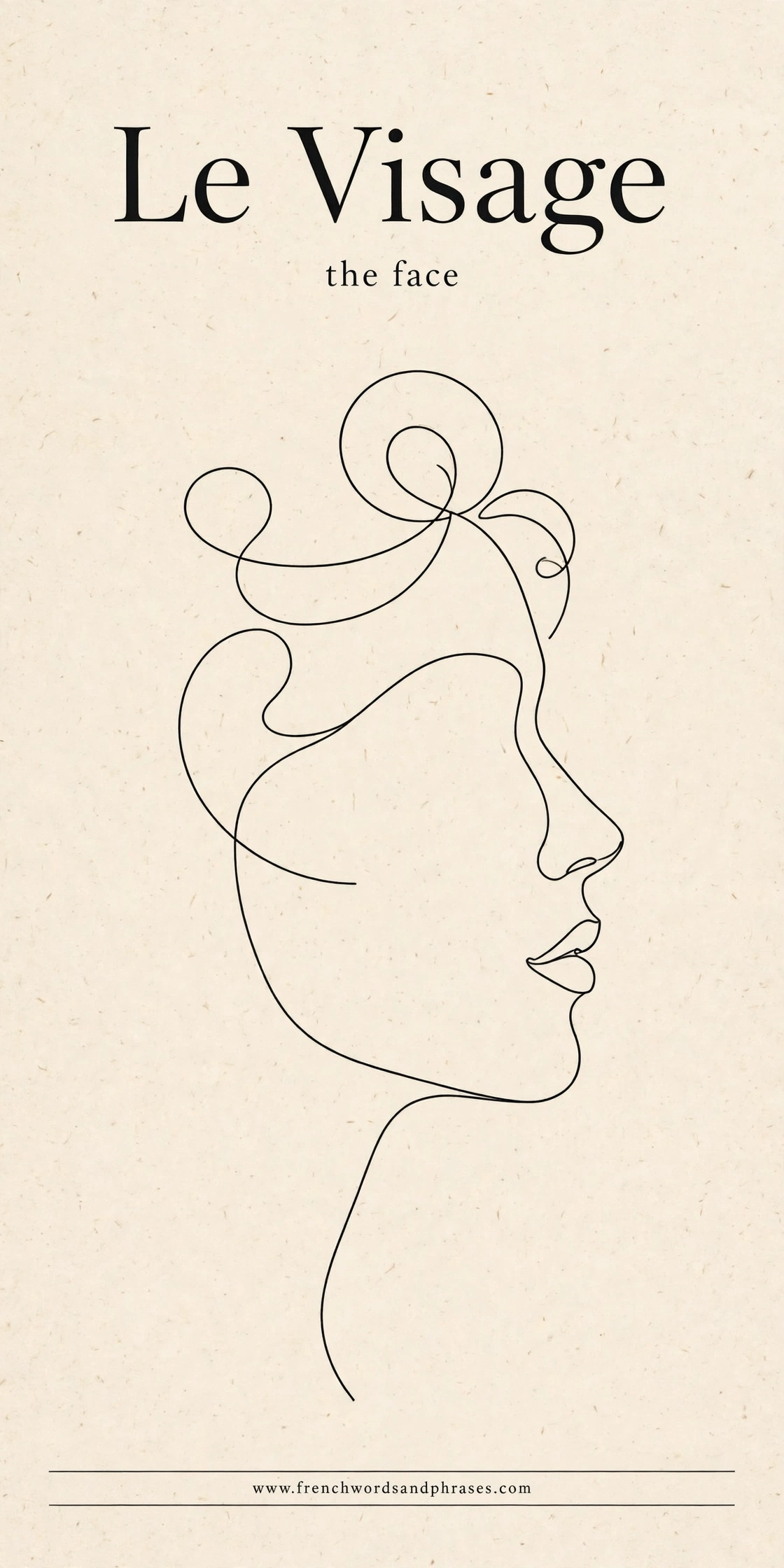
Le visage means the face.
In the train window, between two tunnels, a reflection appears and disappears — your own face, looking back at you: le visage.
In this guide, you’ll learn what visage means in English, how to use it with its articles, how to form its plural, and how it appears in everyday French. Explore French examples, English translations, and practice quizzes.
Understanding the French Noun Visage
Visage is a masculine French noun, learned with its article: le visage, un visage. The ending -age is a useful friend: most nouns in -age are masculine — le visage, le village, le fromage.
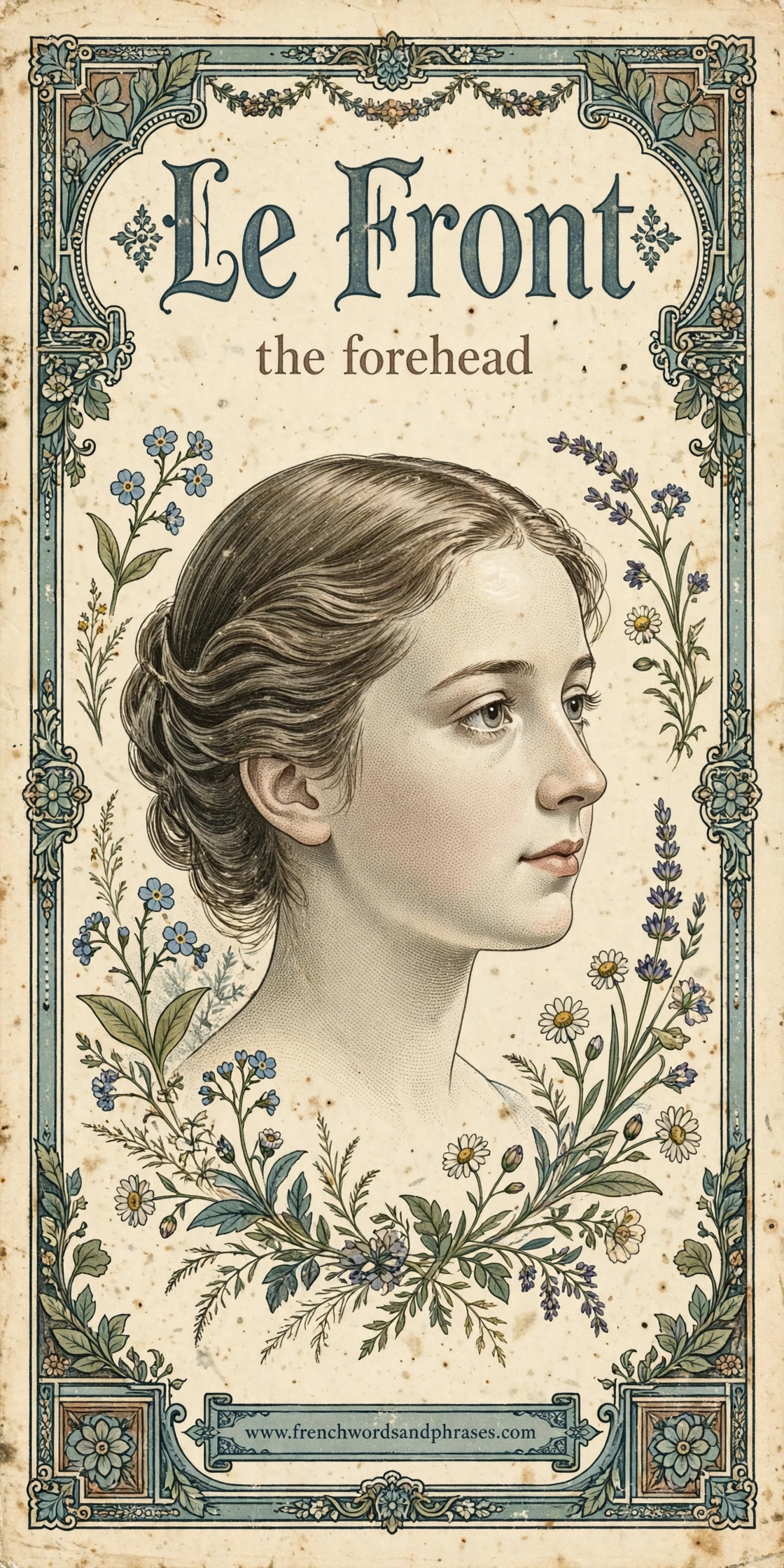
It means the face — the front of the head, with the forehead, the eyes, the nose and the mouth. French has a second word, la figure, which also means the face in everyday speech, but le visage is the warmer, more expressive word: it is the face that smiles, blushes and shows what you feel. A face you recognise is un visage familier.
Gender: Masculine — le visage
Definite article: le — le visage (the face)
Indefinite article: un — un visage (a face)
Plural: les visages
Near-synonym: la figure — also « the face » in everyday French
English equivalents: The face.
A lovely trap for English speakers: French washes le visage but points at la figure in « tu as quelque chose sur la figure » — you have something on your face. Visage is the word of portraits and expressions; figure is the word of everyday bumps and splashes. And note the phrase à visage découvert — openly, with nothing to hide.
Experience the Word
Visage is the first thing we read in another person. Before a word is spoken, the visage has already told the story — joy, worry, mischief, love.
Imagine a platform crowd at rush hour: a hundred visages pass, each one a small novel — and suddenly, among them, un visage familier, and your whole day changes.
You have not just seen a face. You have read a person — déchiffré, the French way.
How to Use Visage in French: Complete Guide
Let’s explore how visage works in French, beginning with its articles — le visage, un visage, des visages.
Visage with the Definite Article (Le, Les)
Used for a specific face — the one in the mirror, the one in the photograph.
| Form | French |
|---|---|
| Masculine singular | le visage |
| Plural | les visages |
Example
Le visage de l’enfant est couvert de chocolat.
The child’s face is covered in chocolate.
Visage with the Indefinite Article (Un, Des)
Used for a face in general — a face in the crowd.
| Form | French |
|---|---|
| Masculine singular | un visage |
| Plural | des visages |
Example
J’ai vu un visage connu dans la foule.
I saw a familiar face in the crowd.
Visage with the Partitive and Quantities (Du visage, La moitié du…)
Faces are talked about in parts and halves — here is the du and de la of the visage.
| Quantity | French |
|---|---|
| the top of the face | le haut du visage |
| the lower face | le bas du visage |
| half of the face | la moitié du visage |
| a face full of freckles | un visage plein de taches de rousseur |
| the whole face | tout le visage |
Example
La moitié du visage est cachée par son écharpe.
Half of her face is hidden by her scarf.
Quick Quiz 1
Complete the sentence:
Elle a ______ visage doux et souriant. (a)
Reveal the answer
un
Elle a un visage doux et souriant.
She has a gentle, smiling face — visage is masculine, so un.
The Plural of Visage
Visage adds an -s in the plural — les visages, the faces in a crowd or a gallery.
| Number | French |
|---|---|
| Singular | le visage |
| Plural | les visages |
Example
Tous les visages se tournent vers la scène.
All the faces turn towards the stage.
Visage with Possessive Adjectives (Mon, Ton, Son…)
Possessives agree with the noun: visage is masculine, so mon, ton, son — even for a woman’s face.
| Owner | French |
|---|---|
| my | mon visage |
| your (tu) | ton visage |
| his / her | son visage |
| our | notre visage |
| your (vous) | votre visage |
| their | leur visage |
Example
Son visage s’illumine quand elle voit son fils.
Her face lights up when she sees her son.
Quick Quiz 2
Complete the sentence:
Lave-toi ______ visage avant de partir. (your)
Reveal the answer
le
Lave-toi le visage avant de partir.
Wash your face before you leave — with body parts, French uses le, not ton.
Visage with Demonstrative Adjectives (Ce, Ces)
Used to point: ce visage, this face.
| Form | French |
|---|---|
| Masculine singular | ce visage |
| Plural | ces visages |
Example
Je connais ce visage, mais je ne sais plus d’où.
I know that face, but I can’t remember from where.
Visage with Adjectives
Adjectives agree with visage — masculine singular: un visage pâle, un visage rond.
| Adjective | With Visage |
|---|---|
| pâle (pale) | un visage pâle |
| rond (round) | un visage rond |
| doux (gentle) | un visage doux |
| familier (familiar) | un visage familier |
| jeune (young) | un jeune visage |
Example
Après la course, il avait un visage pâle et fatigué.
After the race, he had a pale, tired face.
Quick Quiz 3
Complete the sentence:
C’est un visage ______ : je l’ai déjà vu quelque part. (familiar)
Reveal the answer
familier
C’est un visage familier : je l’ai déjà vu quelque part.
It is a familiar face: I have seen it somewhere before.
Everyday Expressions with Visage
Open faces and long faces — the visage phrases of daily life.
| Expression | In English |
|---|---|
| à visage découvert | openly, without hiding anything |
| faire bon visage | to put a brave face on things |
| un visage familier | a familiar face |
| lire sur le visage de quelqu’un | to read someone’s face |
| se laver le visage | to wash your face |
| un visage d’ange | an angelic face |
Example
Malgré la mauvaise nouvelle, elle fait bon visage.
Despite the bad news, she puts a brave face on things.
Words from the Same Family as Visage
Stares, faces and facing things — the words that travel with visage.
| French | In English |
|---|---|
| la figure | the face (everyday word) |
| dévisager | to stare at, to eye someone |
| envisager | to consider, to envisage |
| le vis-à-vis | the person opposite |
| visager | to aim at (old-fashioned) |
Example
Ne dévisage pas les gens dans le métro, ce n’est pas poli.
Don’t stare at people in the metro, it isn’t polite.
Quick Quiz 4
What does à visage découvert mean?
Reveal the answer
Openly, with nothing to hide — literally « with uncovered face ».
Il défend ses idées à visage découvert.
He defends his ideas openly.
Visage in Everyday French: Real-Life Examples
Now that you know the word, let’s see how visage appears in everyday French.
Example 1 — In the mirror
Elle regarde son visage dans le miroir de la salle de bain.
She looks at her face in the bathroom mirror.
Example 2 — A familiar face
Parmi les invités, je cherche un visage familier.
Among the guests, I am looking for a familiar face.
Example 3 — Reading emotions
On peut lire la joie sur son visage.
You can read the joy on his face.
Example 4 — Morning routine
Il se lave le visage à l’eau froide pour se réveiller.
He washes his face in cold water to wake himself up.
Example 5 — A portrait
Le peintre étudie le visage de son modèle.
The painter studies his model’s face.
Example 6 — Surprise
Son visage change complètement quand il entend la nouvelle.
His face changes completely when he hears the news.
Beyond Translation: The Meaning of Visage
The French visage is the seat of honesty: one acts à visage découvert, openly, or hides behind un masque. The word descends from the Latin visus — sight, appearance — the face as the thing that is seen, and French literature is full of visages read like open books. Painters from Ingres to Picasso spent lifetimes on this one word, because the visage is where a person becomes visible to the world.
To say visage is to name the page on which every feeling is written first.
It evokes the mirror in the morning and the portrait in the museum, the familiar face in the crowd — the most human landscape there is.
How to Remember the French Noun Visage
Remember it this way: Visage is the face — masculine, like most words in -age: le visage, un visage.
- The -age team — le visage, le village, le fromage, all masculine.
- The warm word — le visage for expressions and portraits, la figure for everyday splashes.
- The honest face — à visage découvert, openly, nothing hidden.
The key idea is le visage — the face, and -age means masculine.
Test Your Knowledge of Visage
Let’s see how much you’ve learned. Try answering these questions before revealing the answers.
Question 1
Is visage masculine or feminine?
Reveal the answer
Masculine — le visage, un visage, like most nouns ending in -age.
Question 2
What is the other everyday French word for the face?
Reveal the answer
La figure — as in « tu as quelque chose sur la figure », you have something on your face.
Question 3
Translate: Her face lights up.
Reveal the answer
Son visage s’illumine.
Question 4
What does faire bon visage mean?
Reveal the answer
To put a brave face on things — to look cheerful despite difficulties.
Question 5
Complete the sentence:
Je cherche un visage ______ dans la foule. (familiar)
Reveal the answer
familier
Je cherche un visage familier dans la foule.
I am looking for a familiar face in the crowd.
Your Final Challenge
Can You Use It?
How would you say this in French?
“You can read the joy on her face.”
Reveal the answer
On peut lire la joie sur son visage.
You can read the joy on her face.
A little French. A little curiosity. A richer everyday life.
LEARN FRENCH ONE WORD AT A TIME