A French Word to Live By
Translate Frisé to English
/fʁize/
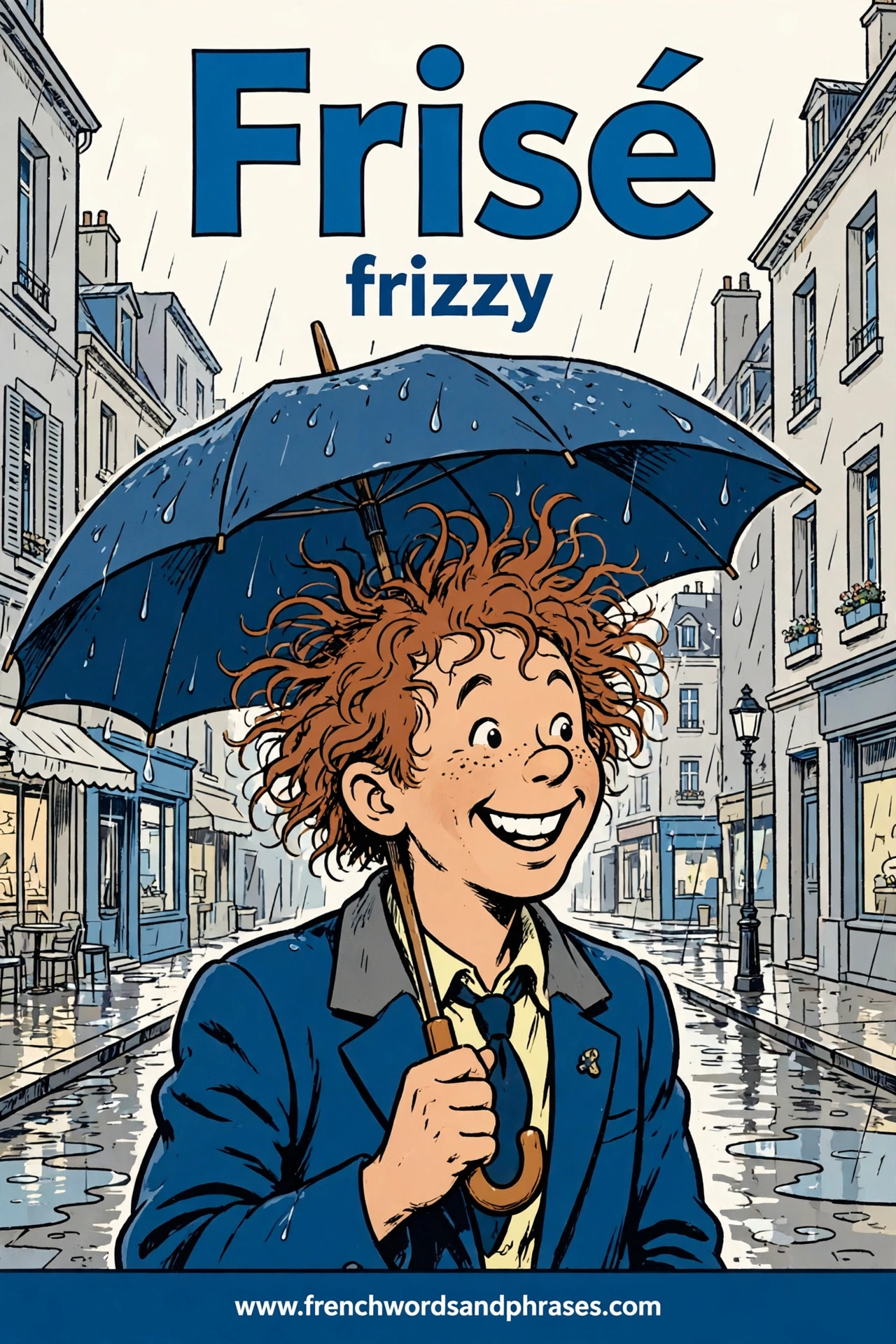
Frisé means frizzy.
A humid afternoon in Marseille: the sea air is thick, the mistral has dropped, and every head of hair in the street is slowly escaping. Straight hair lifts, smooth hair puffs, and by the time Claire reaches the café her neat morning style has become a soft halo. Her friend takes one look and smiles: « Tu es toute frisée ! »
In this guide, you’ll learn what frisé means in English, how it differs from bouclé, how its feminine is formed, and why French also uses its verb for things that nearly happen. Explore French examples, English translations, and practice quizzes.
Understanding the French Adjective Frisé
Frisé is a French adjective of appearance — the adjective of tight curls and frizz. It agrees like a regular -é adjective: frisé, frisée, frisés, frisées, and it stands after the noun.
It means frizzy — hair in very tight, small curls that puff and escape, especially in damp weather: des cheveux frisés, frizzy hair. Where bouclé draws neat ringlets, frisé is the wilder cousin: curls so fine and close that the hair seems to glow with its own weather.
Type: Adjective of appearance — hair and frizz
Answers the question: What does it look like? — frizzy
Changes form: Yes — frisé, frisée, frisés, frisées
English equivalents: Frizzy; very tightly curled.
One important usage detail: frisé stands AFTER the noun — les cheveux frisés. And do not confuse the adjective with the verb friser, which means to curl — and, figuratively, to come very close to something: friser le ridicule, to border on the ridiculous.
Experience the Word
Frisé is the adjective of the damp day — the morning the mirror shows you a halo you did not ask for, and every strand has decided to live separately.
Imagine a Breton fisherman with a beard and hair curled tight by fifty years of sea wind. Nothing about him is untidy; the frisé is simply what the ocean does to hair, written on his head.
You have not just described a hairstyle. You have described hair negotiating with the weather.
How to Use Frisé in French: Complete Guide
Let’s explore how frisé works in French, beginning with the whole word on one card.
Frisé at a Glance
Before the details, here is the whole word on one card.
The Whole Word on One Card
Meaning, type, position and forms — frisé in four lines.
| Point | Frisé |
|---|---|
| Meaning | frizzy |
| Type | adjective of appearance — tight curls and frizz |
| Usual position | after the noun — les cheveux frisés |
| Form | frisé / frisée / frisés / frisées |
Example
Elle a les cheveux frisés.
She has frizzy hair.
The Four Forms of Frisé
Frisé agrees with the noun it describes. The feminine adds an e, the plurals add an s, and the sound never changes.
| Form | Frisé | Example |
|---|---|---|
| Masculine singular | frisé | un garçon frisé — a frizzy-haired boy |
| Feminine singular | frisée | une fille frisée — a frizzy-haired girl |
| Masculine plural | frisés | les cheveux frisés — frizzy hair |
| Feminine plural | frisées | des mèches frisées — frizzy locks |
Example
Après la pluie, ses cheveux sont tout frisés.
After the rain, her hair is all frizzy.
Quick Quiz 1
Which form of frisé goes with cheveux (masculine plural)?
Reveal the answer
frisés
Les cheveux frisés.
Frizzy hair.
Frisée: The Feminine Just Adds an E
The feminine of frisé is formed the regular way: add an e and keep the é. The spelling changes; the sound stays exactly the same.
| Situation | Example |
|---|---|
| The rule | just add -e — frisé → frisée |
| The sound | frisé and frisée sound the same: /fʁize/ |
| Masculine plural | frisés — des garçons frisés |
| Feminine plural | frisées — des filles frisées |
Example
La petite fille frisée secoue la tête en riant.
The little frizzy-haired girl shakes her head, laughing.
Where Frisé Goes: After the Noun
Frisé follows the noun it describes, like most adjectives of appearance, and it appears constantly after être when the weather has done its work.
| Pattern | Example |
|---|---|
| After the noun | des cheveux frisés — frizzy hair |
| After être | tes cheveux sont frisés — your hair is frizzy |
| With an adverb | légèrement frisé — slightly frizzy |
| Before the noun | des frisés cheveux — not in everyday French |
Example
Avec ce temps humide, tout le monde a les cheveux frisés.
In this damp weather, everyone’s hair is frizzy.
Quick Quiz 2
How do you say ‘frizzy hair’ — les frisés cheveux or les cheveux frisés?
Reveal the answer
les cheveux frisés
Frisé stands after the noun.
Frizzy hair.
Frizzier Still: Comparing with Frisé
Frisé compares the regular way, with plus, moins and aussi — and the superlative agrees as usual: le plus frisé, la plus frisée.
| Degree | Example |
|---|---|
| As frizzy as | aussi frisé que — as frizzy as |
| Frizzier | plus frisé — frizzier |
| Less frizzy | moins frisé — less frizzy |
| The frizziest (masc.) | le plus frisé — le plus frisé de la classe |
| The frizziest (fem.) | la plus frisée — la plus frisée de la famille |
Example
En été, ses cheveux sont plus frisés qu’en hiver.
In summer, her hair is frizzier than in winter.
Everyday Expressions with Frisé
Frisé lives at the hairdresser’s and in the weather forecast — and its verb, friser, has a second career describing anything that comes within a hair’s breadth of happening.
| Expression | In English |
|---|---|
| les cheveux frisés | frizzy hair |
| frisé par l’humidité | made frizzy by the damp |
| un mouton frisé | a curly-fleeced sheep |
| friser le ridicule | to border on the ridiculous (the verb friser) |
| ça frise l’insolence | that borders on insolence |
| se faire friser | to have one’s hair curled |
Example
Son excuse frise le ridicule, franchement.
His excuse borders on the ridiculous, frankly.
Quick Quiz 3
What does friser le ridicule mean?
Reveal the answer
To border on the ridiculous
Ce prix frise le ridicule.
That price borders on the ridiculous.
Frisé and Its Neighbours
On the curl scale, frisé sits at the tight, wild end: bouclé is more formed, ondulé barely waves, and crépu is tighter still.
| French | In English |
|---|---|
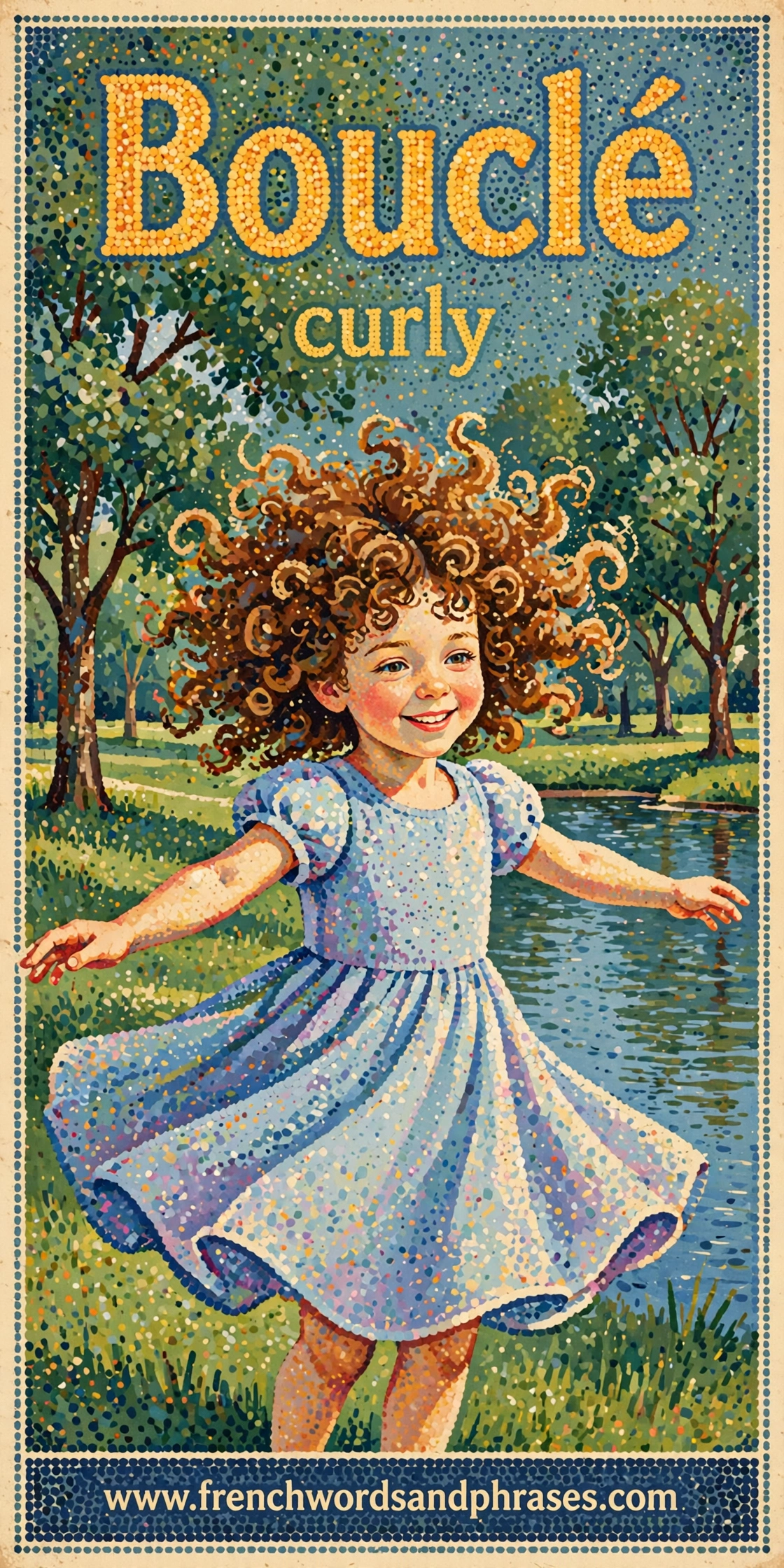
| bouclé | curly — formed curls and ringlets |
| crépu | very tightly curled (of Afro-textured hair) |
| ondulé | wavy — gentle waves |
| lisse | smooth, sleek — hair lying flat |
| raide | straight — the opposite end of the scale |
Example
Ses cheveux sont frisés, pas seulement bouclés.
Her hair is frizzy, not just curly.
Watch Out: The Traps Around Frisé
The traps here are the near-twin bouclé, the double life of the verb friser, and the usual agreement hiding inside cheveux.
| Trap | The truth |
|---|---|
| frisé vs bouclé | frisé = tight, puffing frizz; bouclé = shaped curls and ringlets |
| friser | the verb also means to graze or border on — friser la catastrophe, to come close to disaster |
| Agreement | cheveux is masculine plural: les cheveux frisés, never ‘frisées’ |
| Spelling | the é stays in every form — frisée, frisés, frisées |
Example
On a frisé la catastrophe sur cette route glissante.
We came close to disaster on that slippery road.
Quick Quiz 4
Which word describes tight, puffing curls — bouclé or frisé?
Reveal the answer
frisé
Ses cheveux frisés ne tiennent pas en place.
Her frizzy hair won’t stay in place.
Frisé in Everyday French: Real-Life Examples
Now that you know the word, let’s see how frisé appears in everyday French.
Example 1 — After the rain
Après la pluie, ses cheveux sont tout frisés.
After the rain, her hair is all frizzy.
Example 2 — At the hairdresser’s
Mes cheveux frisés ont besoin d’un bon soin.
My frizzy hair needs a good treatment.
Example 3 — Describing a colleague
C’est le jeune homme frisé du deuxième étage.
He’s the frizzy-haired young man from the second floor.
Example 4 — Summer holidays
À la mer, tout le monde revient frisé et bronzé.
At the seaside, everyone comes back frizzy and tanned.
Example 5 — A child’s hair
Le bébé a de petites mèches frisées sur le front.
The baby has little frizzy locks on his forehead.
Example 6 — Laughing it off
Ne ris pas, tes cheveux sont aussi frisés que les miens !
Don’t laugh, your hair is as frizzy as mine!
Beyond Translation: The Meaning of Frisé
English says frizzy for the meaning of frisé — usually as a complaint. French is kinder: frisé is first of all a texture, the tight curl of sheep’s wool and sea-wind hair, and only sometimes a bad hair day.
To call hair frisé is to say the curl has won — and the hair is doing what it was born to do.
And the family verb keeps the image of closeness: friser le ridicule, friser la catastrophe — to brush past something by the width of one small curl.
How to Remember the French Adjective Frisé
Remember it this way: Frisé is the wild end of the curl family — tighter than bouclé, puffed by damp air, and regular as clockwork in its forms.
- You picture the halo — hair frisé escaping in every direction on a humid day.
- You put it after the noun — les cheveux frisés, une fille frisée.
- You keep the é everywhere — frisée, frisés, frisées.
The key idea is frisé stands after the noun, means tighter and wilder than bouclé, and its feminine frisée just adds an e.
Test Your Knowledge of Frisé
Let’s see how much you’ve learned. Try answering these questions before revealing the answers.
Question 1
What does frisé mean?
Reveal the answer
Frizzy — in tight, small, unruly curls.
Question 2
What is the feminine of frisé?
Reveal the answer
frisée — just add an e.
Question 3
Translate: frizzy hair.
Reveal the answer
Les cheveux frisés.
Question 4
Complete the sentence:
Après la pluie, ses cheveux sont tout ______ .
Reveal the answer
frisés
Après la pluie, ses cheveux sont tout frisés.
After the rain, her hair is all frizzy.
Question 5
How is frisé different from bouclé?
Reveal the answer
Frisé is tighter and wilder — bouclé forms neat curls and ringlets; frisé puffs and escapes.
Your Final Challenge
Can You Use It?
How would you say this in French?
“After the rain, her hair is all frizzy.”
Reveal the answer
Après la pluie, ses cheveux sont tout frisés.
After the rain, her hair is all frizzy.
A little French. A little curiosity. A richer everyday life.
LEARN FRENCH ONE WORD AT A TIME