A French Word to Live By
Translate Bouclé to English
/bukle/
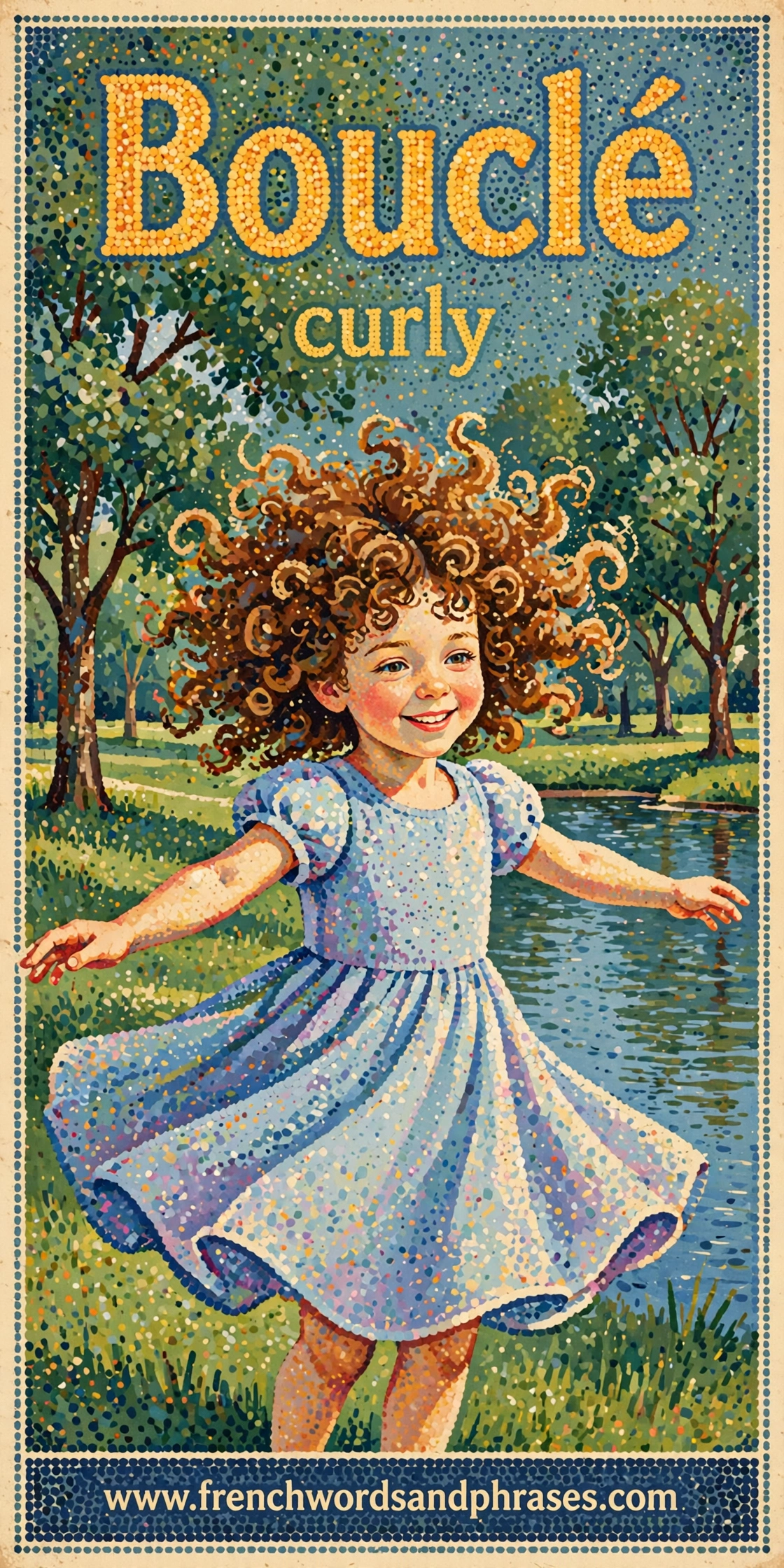
Bouclé means curly.
Saturday morning at the hairdresser’s: a little girl climbs into the big chair and her dark curls bounce at every step, springing back the moment the brush lets them go. The hairdresser laughs and shakes her head — there will be no taming this hair today, and nobody would want to. It is gloriously bouclé.
In this guide, you’ll learn what bouclé means in English, how its feminine is formed, why it stands after the noun, and how it differs from its close cousin frisé. Explore French examples, English translations, and practice quizzes.
Understanding the French Adjective Bouclé
Bouclé is a French adjective of appearance — the adjective of curls. It is built on the noun une boucle, a curl or a loop, and it agrees like a regular -é adjective: bouclé, bouclée, bouclés, bouclées.
It means curly — above all of hair that grows in real curls and ringlets: les cheveux bouclés, curly hair; une mèche bouclée, a curly lock. It can describe a poodle’s coat, a child’s head, or anything that loops and springs back into rings.
Type: Adjective of appearance — hair and curls
Answers the question: What does it look like? — curly
Changes form: Yes — bouclé, bouclée, bouclés, bouclées
English equivalents: Curly; ringleted.
One important usage detail: bouclé stands AFTER the noun — les cheveux bouclés, une fille bouclée. And keep the family straight: une boucle is the noun (a curl, a buckle, a loop), while boucler is the verb (to buckle, to fasten).
Experience the Word
Bouclé is the adjective of hair that will not lie down — the curl that escapes the ribbon, the ringlet that bounces back after every brushing.
Imagine the little girl leaving the salon, shaking her head just to feel the curls move. Each one is a small spring, wound by nature, doing exactly what it wants.
You have not just described hair. You have described hair with a life of its own.
How to Use Bouclé in French: Complete Guide
Let’s explore how bouclé works in French, beginning with the whole word on one card.
Bouclé at a Glance
Before the details, here is the whole word on one card.
The Whole Word on One Card
Meaning, type, position and forms — bouclé in four lines.
| Point | Bouclé |
|---|---|
| Meaning | curly |
| Type | adjective of appearance — curly hair |
| Usual position | after the noun — les cheveux bouclés |
| Form | bouclé / bouclée / bouclés / bouclées |
Example
Elle a les cheveux bouclés.
She has curly hair.
The Four Forms of Bouclé
Bouclé agrees with the noun it describes. The feminine adds an e, the plurals add an s, and the sound never changes.
| Form | Bouclé | Example |
|---|---|---|
| Masculine singular | bouclé | un caniche bouclé — a curly poodle |
| Feminine singular | bouclée | une fille bouclée — a curly-haired girl |
| Masculine plural | bouclés | les cheveux bouclés — curly hair |
| Feminine plural | bouclées | des mèches bouclées — curly locks |
Example
Ses cheveux bouclés tombent sur ses épaules.
Her curly hair falls on her shoulders.
Quick Quiz 1
Which form of bouclé goes with cheveux (masculine plural)?
Reveal the answer
bouclés
Les cheveux bouclés.
Curly hair.
Bouclée: The Feminine Just Adds an E
The feminine of bouclé is formed the regular way: add an e and keep the é. Spelling changes, sound does not — bouclé and bouclée are pronounced exactly alike.
| Situation | Example |
|---|---|
| The rule | just add -e — bouclé → bouclée |
| The sound | bouclé and bouclée sound the same: /bukle/ |
| Masculine plural | bouclés — des garçons bouclés |
| Feminine plural | bouclées — des filles bouclées |
Example
La petite fille bouclée rit devant le miroir.
The little curly-haired girl laughs in front of the mirror.
Where Bouclé Goes: After the Noun
Bouclé follows the noun it describes, like most adjectives of appearance, and it sits naturally after être when you describe someone’s hair.
| Pattern | Example |
|---|---|
| After the noun | des cheveux bouclés — curly hair |
| After être | ses cheveux sont bouclés — her hair is curly |
| With an adverb | naturellement bouclé — naturally curly |
| Before the noun | des bouclés cheveux — not in everyday French |
Example
Il a les cheveux bouclés et le sourire facile.
He has curly hair and an easy smile.
Quick Quiz 2
How do you say ‘curly hair’ — les bouclés cheveux or les cheveux bouclés?
Reveal the answer
les cheveux bouclés
Bouclé stands after the noun.
Curly hair.
Curlier Still: Comparing with Bouclé
Bouclé compares the regular way, with plus, moins and aussi — and the superlative agrees as usual: le plus bouclé, la plus bouclée.
| Degree | Example |
|---|---|
| As curly as | aussi bouclé que — as curly as |
| Curlier | plus bouclé — curlier |
| Less curly | moins bouclé — less curly |
| The curliest (masc.) | le plus bouclé — le plus bouclé des frères |
| The curliest (fem.) | la plus bouclée — la plus bouclée des sœurs |
Example
Sa sœur est plus bouclée que lui.
His sister is curlier than he is.
Everyday Expressions with Bouclé
Bouclé belongs to the hairdresser’s vocabulary — but its noun, la boucle, travels everywhere, from earrings to the phrase for coming full circle.
| Expression | In English |
|---|---|
| les cheveux bouclés | curly hair |
| bouclé naturellement | naturally curly |
| une boucle | a curl; a buckle; a loop (the noun) |
| une boucle d’oreille | an earring |
| boucler la boucle | to come full circle |
| une boucle de cheveux | a lock of curly hair |
Example
Elle porte des boucles d’oreille dorées.
She is wearing gold earrings.
Quick Quiz 3
What is une boucle d’oreille?
Reveal the answer
An earring
Une boucle is a loop — and an earring is a loop for the ear.
She wears pretty earrings.
Bouclé and Its Neighbours
French is precise about hair. Bouclé is the well-formed curl; frisé is tighter and wilder, ondulé barely waves, and raide gives up curling altogether.
| French | In English |
|---|---|
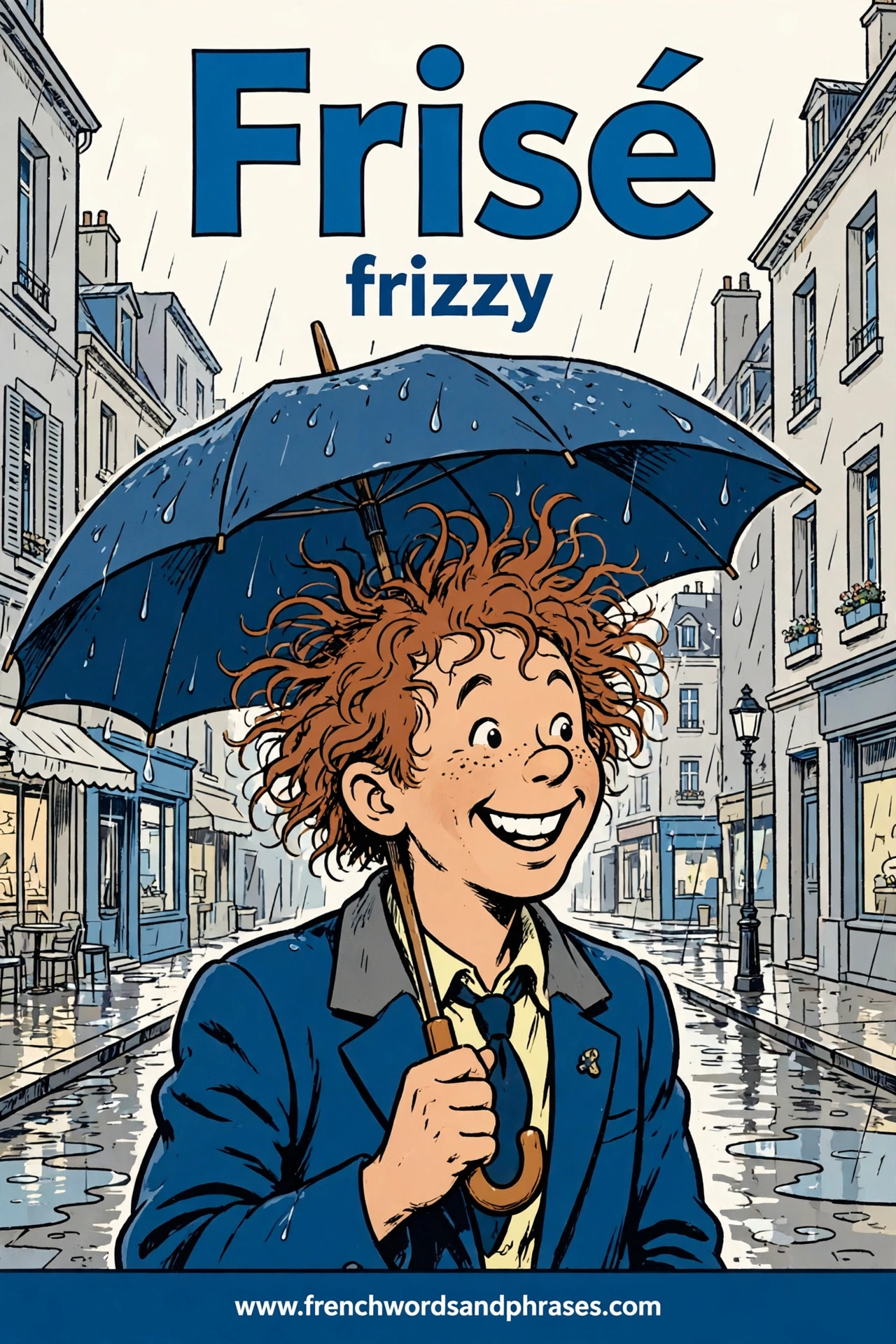
| frisé | frizzy — tight, small, unruly curls |
| ondulé | wavy — gentle waves, not full curls |
| crépu | very tightly curled, frizzy (of Afro-textured hair) |
| lisse | smooth, straight — of hair that lies flat |
| raide | straight — the opposite of bouclé |
Example
Elle a les cheveux bouclés, lui les a raides.
She has curly hair, he has straight hair.
Watch Out: The Traps Around Bouclé
The traps here are family confusion — the noun, the verb — and an agreement that hides inside the word cheveux.
| Trap | The truth |
|---|---|
| une boucle | with the article, boucle is a noun — a curl, a buckle, a loop |
| boucler | the verb means to buckle or fasten — boucler sa ceinture |
| Agreement | cheveux is masculine plural: les cheveux bouclés, never ‘bouclées’ |
| bouclé vs frisé | bouclé = formed curls and ringlets; frisé = tight, frizzy curls |
Example
Boucle ta ceinture, on décolle dans cinq minutes.
Fasten your seatbelt, we take off in five minutes.
Quick Quiz 4
Is this right or wrong: ses cheveux sont bouclées?
Reveal the answer
Wrong
Cheveux is masculine plural, so: ses cheveux sont bouclés.
Her hair is curly.
Bouclé in Everyday French: Real-Life Examples
Now that you know the word, let’s see how bouclé appears in everyday French.
Example 1 — At the hairdresser’s
Je veux garder mes cheveux bouclés, juste un peu plus courts.
I want to keep my curly hair, just a little shorter.
Example 2 — A childhood photo
Sur cette photo, tu avais les cheveux bouclés comme un ange.
In this photo, you had curly hair like an angel.
Example 3 — Describing a friend
Tu verras, c’est la fille bouclée près de la porte.
You’ll see, she’s the curly-haired girl near the door.
Example 4 — The poodle
Leur caniche bouclé fait rire tous les enfants du parc.
Their curly poodle makes all the children in the park laugh.
Example 5 — After the rain
Avec l’humidité, mes cheveux deviennent très bouclés.
With the humidity, my hair gets very curly.
Example 6 — A compliment
Tes cheveux bouclés te vont très bien.
Your curly hair really suits you.
Beyond Translation: The Meaning of Bouclé
English says curly for the meaning of bouclé — but the French word carries its picture inside it: une boucle is a loop, and bouclé hair is hair that travels in loops, rings and springs.
To call hair bouclé is to say it moves in circles and always comes back.
French even borrows the image for a finished story: boucler la boucle, to close the loop — to end exactly where you began.
How to Remember the French Adjective Bouclé
Remember it this way: Bouclé is the adjective of the spring and the ringlet — it follows the noun, and its feminine simply adds an e.
- You picture a loop — une boucle — because bouclé hair travels in rings.
- You put it after the noun — les cheveux bouclés, une fille bouclée.
- You add only an e for her — bouclée — and an s for the plural.
The key idea is bouclé stands after the noun, and its feminine bouclée just adds an e.
Test Your Knowledge of Bouclé
Let’s see how much you’ve learned. Try answering these questions before revealing the answers.
Question 1
What does bouclé mean?
Reveal the answer
Curly — of hair in curls and ringlets.
Question 2
What is the feminine of bouclé?
Reveal the answer
bouclée — just add an e.
Question 3
Translate: curly hair.
Reveal the answer
Les cheveux bouclés.
Question 4
Complete the sentence:
Ses cheveux sont ______ .
Reveal the answer
bouclés
Ses cheveux sont bouclés.
Her hair is curly.
Question 5
What does boucler la boucle mean?
Reveal the answer
To come full circle — to end where you began.
Your Final Challenge
Can You Use It?
How would you say this in French?
“My daughter has curly hair.”
Reveal the answer
Ma fille a les cheveux bouclés.
My daughter has curly hair.
A little French. A little curiosity. A richer everyday life.
LEARN FRENCH ONE WORD AT A TIME