A French Word to Live By
Translate Fil to English
/fil/
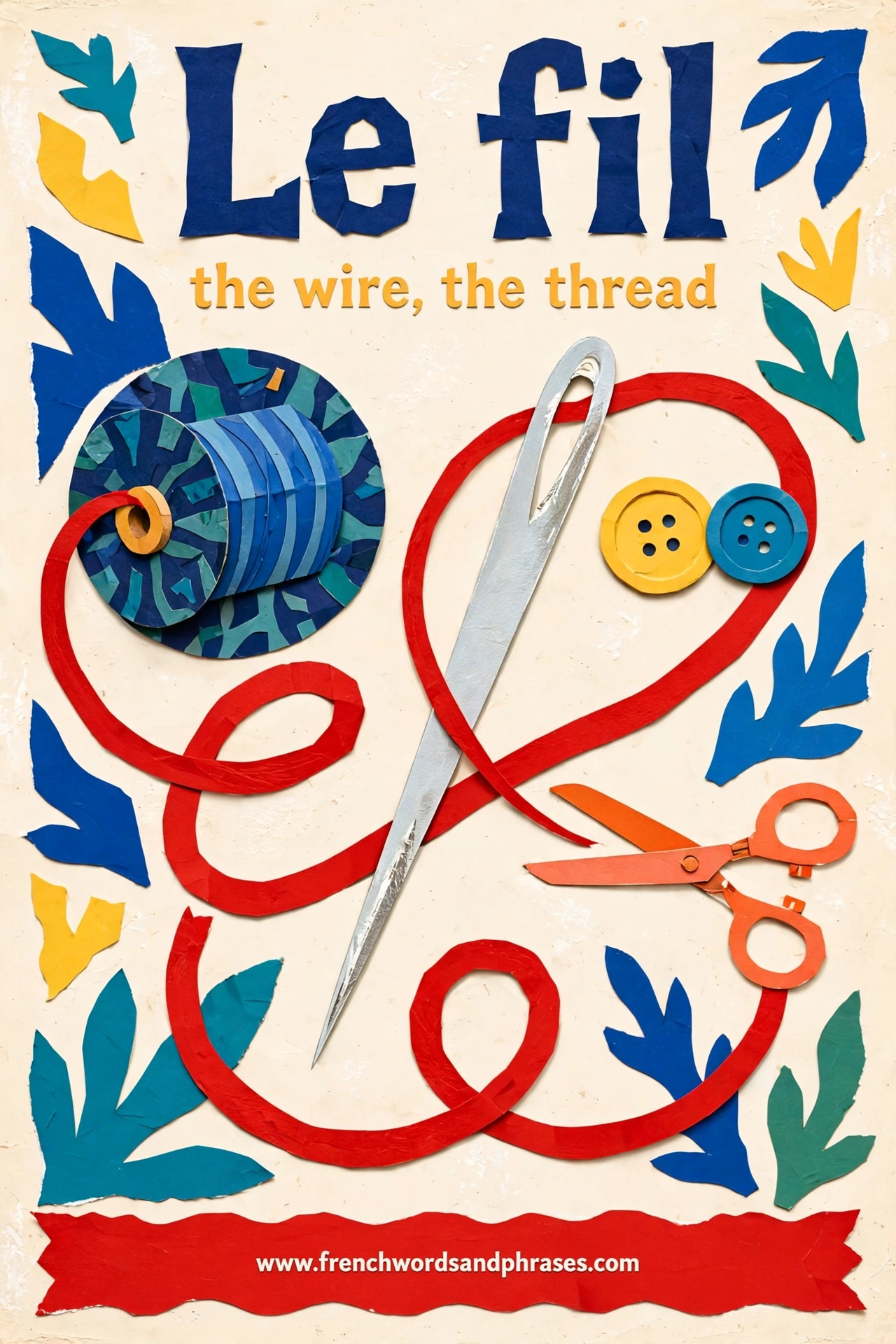
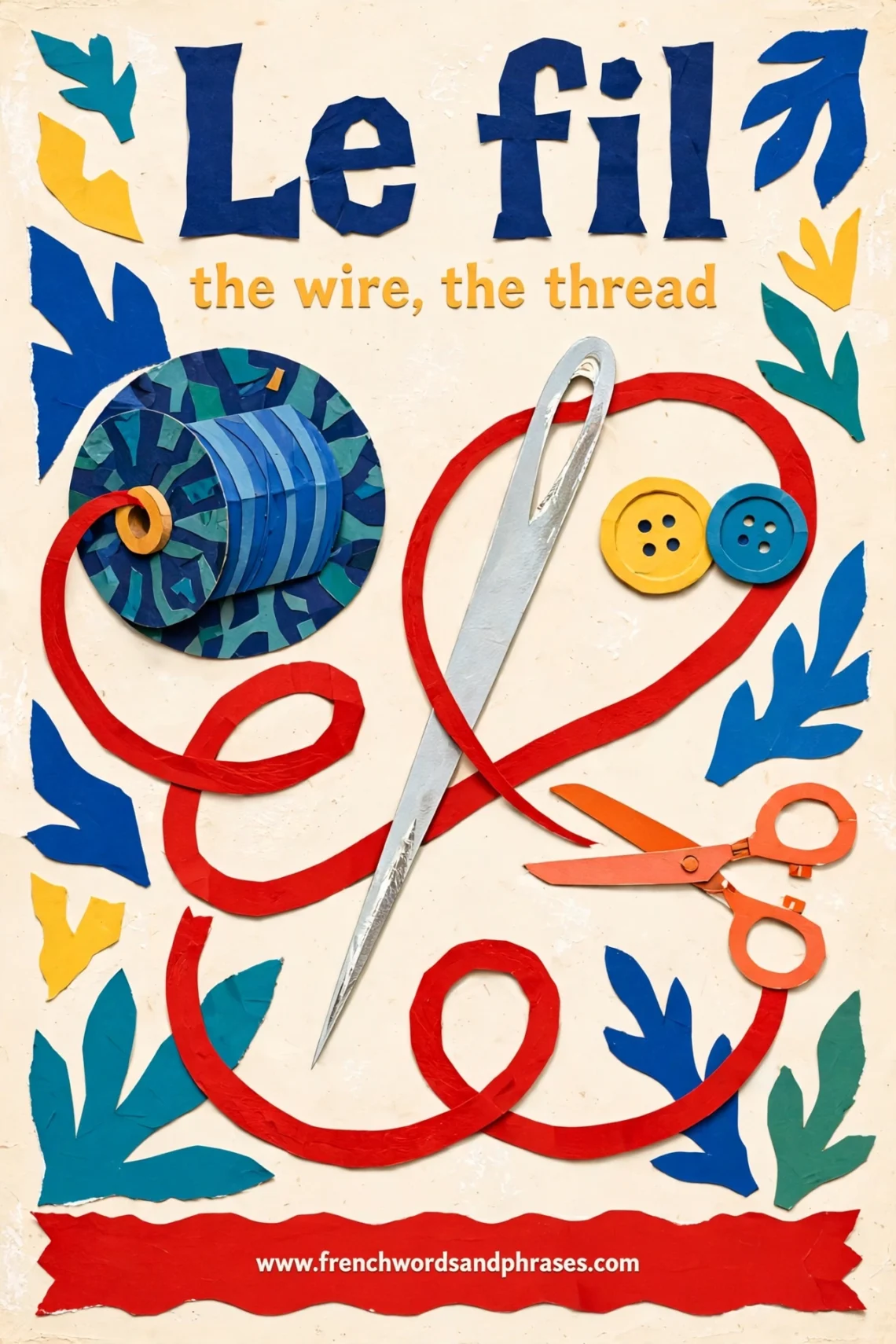
Le fil means the wire, the thread.
A needle pulling red cotton through a hem, a copper line carrying a voice across a city, a tightrope over a square: le fil, the thread and the wire — the thin line along which half of French life, from sewing baskets to telephone calls, is strung.
In this guide, you’ll learn what fil means in English, how to use it with its articles, how to form its plural, and how it appears in everyday French. Explore French examples, English translations, and practice quizzes.
Understanding the French Noun Fil
Fil is a masculine French noun, learned with its article: le fil, un fil. It comes from the Latin filum, a thread. The word never decided between the sewing basket and the engineer’s toolbox: it is the thread you sew with and the wire that carries current and calls.
It means a thread — for sewing: du fil et une aiguille, thread and a needle, un fil de coton, a cotton thread, enfiler is to thread the needle. And a wire: un fil électrique, an electric wire, les fils du téléphone, the telephone wires, sans fil, wireless — literally without wire. By extension, anything long and thin and continuous: le fil de l’eau, the flow of the water, le fil de la conversation, the thread of the conversation, perdre le fil, to lose the thread.
Gender: Masculine — le fil
Definite article: le — le fil (the wire, the thread)
Indefinite article: un — un fil (a wire, a thread)
Plural: les fils — regular, with a simple -s (but see the trap below)
Spelling trap: les fils can also be the plural of fils, son — context decides: des fils électriques vs mes fils
Key phrase: perdre le fil — to lose the thread (of a story, a conversation)
English equivalents: The wire, the thread.
The great trap: un fils (pronounced “fiss”) is a son, but un fil (pronounced “feel”) is a thread — one letter’s difference in sound, a family apart in meaning. In the plural they merge on paper: les fils can be the sons or the wires. For technology, remember sans fil: un téléphone sans fil, une connexion sans fil — wireless.
Experience the Word
Fil is the line that holds things together: the seam, the call, the story — cut it, and everything falls into pieces.
Imagine the grandmother’s sewing basket: a dozen colours of fil wound on cards, the needle kept in a pincushion like a hedgehog. With these threads she has mended fifty years of shirts — le fil is the smallest, cheapest, most faithful tool in the house.
You have not just named a string. You have named continuity itself — le fil, the thread that runs through everything.
How to Use Fil in French: Complete Guide
Let’s explore how fil works in French, beginning with its articles — le fil, un fil, perdre le fil.
Fil with the Definite Article (Le, Les)
Used for a specific fil — the red one, the one carrying the current.
| Form | French |
|---|---|
| Masculine singular | le fil |
| Plural | les fils |
Example
Le fil rouge est pour la couture, le noir pour l’électricité.
The red thread is for sewing, the black wire for the electrics.
Fil with the Indefinite Article (Un, Des)
Used for a fil in general — any thread, any wire.
| Form | French |
|---|---|
| Masculine singular | un fil |
| Plural | des fils |
Example
Il me faut un fil plus solide pour ce bouton.
I need a stronger thread for this button.
Fil in Its Two Worlds (Couture, Électricité…)
One word at home in the sewing basket and on the telegraph pole.
| Quantity | French |
|---|---|
| sewing thread | du fil à coudre |
| an electric wire | un fil électrique |
| a cotton thread | un fil de coton |
| wireless | sans fil |
| a telephone wire | un fil de téléphone |
Example
Les fils du téléphone courent le long de la rue.
The telephone wires run along the street.
Quick Quiz 1
Complete the sentence:
______ fil de la conversation est difficile à suivre. (the)
Reveal the answer
Le
Le fil de la conversation est difficile à suivre.
The thread of the conversation is hard to follow — fil is masculine, so le.
The Plural of Fil
Fil takes a regular plural in -s — written exactly like the plural of fils, son.
| Number | French |
|---|---|
| Singular | le fil |
| Plural | les fils |
Example
Les fils sont emmêlés derrière la télévision.
The wires are tangled behind the television.
Fil with Possessive Adjectives (Mon, Ton, Son…)
Possessives agree with the noun: fil is masculine, so mon, ton, son in the singular.
| Owner | French |
|---|---|
| my | mon fil |
| your (tu) | ton fil |
| his / her | son fil |
| our | notre fil |
| your (vous) | votre fil |
| their | leur fil |
Example
Mon fil à coudre est dans la petite boîte bleue.
My sewing thread is in the little blue box.
Quick Quiz 2
Complete the sentence:
Attention, tu as coupé ______ fil électrique ! (the)
Reveal the answer
le
Attention, tu as coupé le fil électrique !
Careful, you’ve cut the electric wire!
Fil with Demonstrative Adjectives (Ce, Ces)
Used to point: ce fil, this wire — this thread.
| Form | French |
|---|---|
| Masculine singular | ce fil |
| Plural | ces fils |
Example
Ce fil est trop fin pour ce tissu épais.
This thread is too fine for this thick fabric.
Fil with Adjectives
Adjectives agree with fil — masculine singular: un fil électrique, un fil fin.
| Adjective | With Fil |
|---|---|
| électrique (electric) | un fil électrique |
| fin (fine, thin) | un fil fin |
| de coton (cotton) | un fil de coton |
| sans (without — wireless) | un appareil sans fil |
| rouge (red) | un fil rouge |
Example
Un fil fin suffit pour ce tissu léger.
A fine thread is enough for this light fabric.
Quick Quiz 3
Complete the sentence:
Pardon, j’ai perdu le ______ de ton histoire. (thread)
Reveal the answer
fil
Pardon, j’ai perdu le fil de ton histoire.
Sorry, I lost the thread of your story — perdre le fil is the fixed phrase.
Everyday Expressions with Fil
Sewing baskets, phone lines and tightropes — the fil phrases of daily life.
| Expression | In English |
|---|---|
| perdre le fil | to lose the thread (of a story) |
| sans fil | wireless, cordless |
| le fil de l’eau | the flow of the current |
| un fil à retordre | a hard time (être donné du fil à retordre) |
| au fil des jours | as the days go by |
Example
Au fil des jours, le jardin devient magnifique.
As the days go by, the garden becomes magnificent.
Words from the Same Family as Fil
Threads and lines — the words that travel with fil.
| French | In English |
|---|---|
| une aiguille | a needle |
| enfiler | to thread (a needle); to slip on (clothes) |
| un fils | a son — the famous near-twin |
| la couture | sewing, dressmaking |
| un câble | a cable — the wire’s big brother |
Example
Elle enfile l’aiguille avec du fil rouge.
She threads the needle with red thread.
Quick Quiz 4
What does sans fil mean on a box in a shop?
Reveal the answer
Wireless, cordless — literally “without wire”.
Ce casque sans fil fonctionne très bien.
These wireless headphones work very well.
Fil in Everyday French: Real-Life Examples
Now that you know the word, let’s see how fil appears in everyday French.
Example 1 — Sewing
Passe-moi le fil rouge et une aiguille.
Pass me the red thread and a needle.
Example 2 — The house
Les fils sont cachés derrière le meuble.
The wires are hidden behind the furniture.
Example 3 — Technology
Je préfère un clavier sans fil.
I prefer a wireless keyboard.
Example 4 — A story
Reprends ton histoire, j’ai perdu le fil.
Go back over your story, I lost the thread.
Example 5 — Time
Au fil des années, ils sont devenus amis.
Over the years, they became friends.
Example 6 — The river
Le bateau descend au fil de l’eau.
The boat drifts down with the current.
Beyond Translation: The Meaning of Fil
Fil is Latin filum, and the Romans already spun metaphors from it: the thread of life, held by the Fates. French kept the whole spool — the thread of a conversation you can lose (perdre le fil), the days that unroll (au fil des jours), the water’s flow (au fil de l’eau). Then the engineers arrived and the same thread learned to carry voices and current, until progress cut it and named the miracle by its absence: sans fil, wireless.
To say fil is to follow the line that joins things.
It evokes the sewing basket, the tightrope, the tangled wires behind the television — the humble thread that civilisation is sewn and wired with.
How to Remember the French Noun Fil
Remember it this way: Fil is the thread and the wire — masculine: le fil, and its famous trap is un fils, a son.
- Always masculine — le fil, un fil, mon fil.
- The trap — un fil (thread) vs un fils, pronounced “fiss” (a son); in the plural both are les fils.
- The phrases — perdre le fil, to lose the thread; sans fil, wireless; au fil des jours, as the days go by.
The key idea is le fil — the wire, the thread, masculine; perdre le fil = to lose the thread; sans fil = wireless.
Test Your Knowledge of Fil
Let’s see how much you’ve learned. Try answering these questions before revealing the answers.
Question 1
Is fil masculine or feminine?
Reveal the answer
Masculine — le fil, un fil.
Question 2
How do you say to lose the thread of a story?
Reveal the answer
Perdre le fil.
Question 3
Translate: I prefer a wireless keyboard.
Reveal the answer
Je préfère un clavier sans fil.
Question 4
What is the difference between un fil and un fils?
Reveal the answer
Un fil is a thread or wire; un fils (pronounced “fiss”) is a son.
Question 5
Complete the sentence:
______ fils électriques sont dangereux. (the)
Reveal the answer
Les
Les fils électriques sont dangereux.
The electric wires are dangerous.
Your Final Challenge
Can You Use It?
How would you say this in French?
“Sorry, I lost the thread of your story.”
Reveal the answer
Pardon, j’ai perdu le fil de ton histoire.
Sorry, I lost the thread of your story.
A little French. A little curiosity. A richer everyday life.
LEARN FRENCH ONE WORD AT A TIME