A French Word to Live By
Translate Coût to English
/ku/
Le coût means the cost.
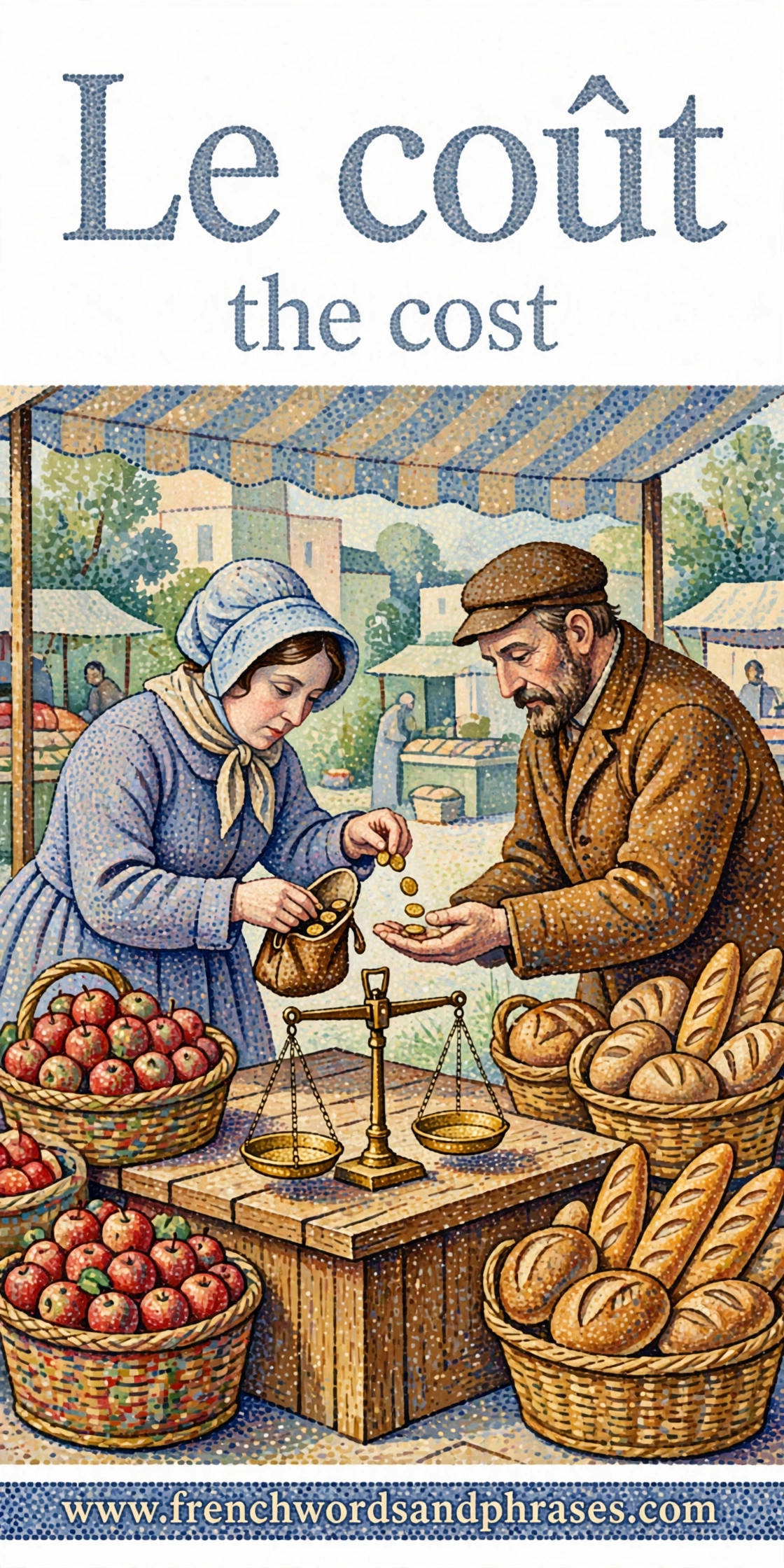
The builder spreads his estimate on the kitchen table, the mayor opens the budget, the traveller counts what the journey really took from her: le coût, the cost — the word that turns every project, journey and decision into a number, in money, in time, or in tears.
In this guide, you’ll learn what coût means in English, how to use it with its articles, how to form its plural, and how it appears in everyday French. Explore French examples, English translations, and practice quizzes.
Understanding the French Noun Coût
Coût is a masculine French noun, learned with its article: le coût, un coût. It is the noun of the verb coûter, to cost, from Latin constare, to stand firm — the price that stands, whatever we wish. The circumflex on the û is the word’s little hat: coût, coûter, both keep it.
It means the cost — what something requires in money: le coût de la vie, the cost of living, le coût des travaux, the cost of the building work, un coût élevé, a high cost, réduire les coûts, to cut costs. And what it requires beyond money: le coût humain, the human cost, au coût de sa santé, at the cost of his health. Its close cousin le prix is the price tag on the shelf; le coût is the whole bill, seen from the payer’s side.
Gender: Masculine — le coût
Definite article: le — le coût (the cost)
Indefinite article: un — un coût (a cost)
Plural: les coûts — regular, with a simple -s
Spelling note: the circumflex stays: coût, coûter, coûteux — û throughout the family
Key phrase: le coût de la vie — the cost of living
English equivalents: The cost.
Choose between coût and prix: le prix is what the seller asks — le prix du pain; le coût is what the buyer, the builder or the taxpayer bears — le coût du projet. Companies speak of les coûts de production, and every French household knows le coût de la vie. The verb is coûter: combien ça coûte ? — how much does it cost?
Experience the Word
Coût is the sober word at the bottom of every dream: the house, the journey, the war — each one, in the end, has its coût, and someone pays it.
Imagine the young couple with the architect’s drawing unrolled: a kitchen here, a window there. Then the pencil moves to the last page, and the room goes quiet around one line — le coût total. The dream does not die; it simply puts on its real clothes.
You have not just named a price. You have named what a thing truly takes from us — le coût, the cost, counted in full.
How to Use Coût in French: Complete Guide
Let’s explore how coût works in French, beginning with its articles — le coût, un coût, le coût de la vie.
Coût with the Definite Article (Le, Les)
Used for a specific cost — the one on the estimate, the one in the budget.
| Form | French |
|---|---|
| Masculine singular | le coût |
| Plural | les coûts |
Example
Le coût des travaux dépasse le budget.
The cost of the work exceeds the budget.
Coût with the Indefinite Article (Un, Des)
Used for a cost in general — any cost a project carries.
| Form | French |
|---|---|
| Masculine singular | un coût |
| Plural | des coûts |
Example
Un tel voyage représente un coût important.
Such a journey represents a significant cost.
Coût with What It Counts (Vie, Travaux, Production…)
Coût is almost always followed by de — the cost of something.
| Quantity | French |
|---|---|
| the cost of living | le coût de la vie |
| the cost of the work | le coût des travaux |
| production costs | les coûts de production |
| the total cost | le coût total |
| the human cost | le coût humain |
Example
Le coût de la vie augmente chaque année.
The cost of living rises every year.
Quick Quiz 1
Complete the sentence:
______ coût du projet est de dix mille euros. (the)
Reveal the answer
Le
Le coût du projet est de dix mille euros.
The cost of the project is ten thousand euros — coût is masculine, so le.
The Plural of Coût
Coût takes a regular plural in -s — les coûts, the word of every finance meeting.
| Number | French |
|---|---|
| Singular | le coût |
| Plural | les coûts |
Example
L’entreprise cherche à réduire les coûts.
The company is trying to cut costs.
Coût with Possessive Adjectives (Mon, Ton, Son…)
Possessives agree with the noun: coût is masculine, so mon, ton, son in the singular.
| Owner | French |
|---|---|
| my | mon coût |
| your (tu) | ton coût |
| his / her | son coût |
| our | notre coût |
| your (vous) | votre coût |
| their | leur coût |
Example
Chaque famille calcule son coût de la vie à sa façon.
Every family calculates its cost of living in its own way.
Quick Quiz 2
Complete the sentence:
Nous devons connaître ______ coût avant de signer. (the)
Reveal the answer
le
Nous devons connaître le coût avant de signer.
We must know the cost before signing.
Coût with Demonstrative Adjectives (Ce, Ces)
Used to point: ce coût, this cost — usually the one nobody expected.
| Form | French |
|---|---|
| Masculine singular | ce coût |
| Plural | ces coûts |
Example
Ce coût supplémentaire n’était pas prévu.
This additional cost was not planned for.
Coût with Adjectives
Adjectives agree with coût — masculine singular: un coût élevé, un coût réel.
| Adjective | With Coût |
|---|---|
| élevé (high) | un coût élevé |
| total (total) | le coût total |
| réel (real) | le coût réel |
| humain (human) | le coût humain |
| supplémentaire (additional) | un coût supplémentaire |
Example
Le coût réel du projet est double du budget.
The real cost of the project is twice the budget.
Quick Quiz 3
Complete the sentence:
Le coût de la vie est très ______ dans la capitale. (high)
Reveal the answer
élevé
Le coût de la vie est très élevé dans la capitale.
The cost of living is very high in the capital — élevé, masculine, to agree with coût.
Everyday Expressions with Coût
Budgets, building sites and hard truths — the coût phrases of daily life.
| Expression | In English |
|---|---|
| le coût de la vie | the cost of living |
| réduire les coûts | to cut costs |
| à tout coût | at all costs (rare; usually à tout prix) |
| le coût total | the total cost |
| coûte que coûte | whatever it costs, at all costs |
Example
Il veut réussir, coûte que coûte.
He wants to succeed, whatever it costs.
Words from the Same Family as Coût
Paying and pricing — the words that travel with coût.
| French | In English |
|---|---|
| coûter | to cost (the verb) |
| coûteux / coûteuse | costly, expensive |
| le prix | the price — the seller’s number |
| une dépense | an expense, spending |
| un budget | a budget |
Example
Ce projet coûteux dépasse notre budget.
This costly project exceeds our budget.
Quick Quiz 4
What is the difference between le coût and le prix?
Reveal the answer
Le prix is the price asked; le coût is the cost borne — the whole bill from the payer’s side.
Le prix du billet est de vingt euros, mais le coût du voyage est bien plus élevé.
The ticket price is twenty euros, but the cost of the journey is much higher.
Coût in Everyday French: Real-Life Examples
Now that you know the word, let’s see how coût appears in everyday French.
Example 1 — At home
Le coût de la vie augmente encore.
The cost of living is rising again.
Example 2 — Building work
Le coût des travaux sera connu demain.
The cost of the work will be known tomorrow.
Example 3 — At work
La direction veut réduire les coûts.
Management wants to cut costs.
Example 4 — Travel
Le coût total du voyage est de mille euros.
The total cost of the trip is a thousand euros.
Example 5 — Determination
Elle finira ses études, coûte que coûte.
She will finish her studies, whatever it costs.
Example 6 — Hard truth
La guerre a eu un coût humain terrible.
The war had a terrible human cost.
Beyond Translation: The Meaning of Coût
Coût descends from Latin constare — to stand firm, to stand at a price: the cost is the figure that stands when all the wishing is done. French keeps the family’s circumflex like a receipt: coût, coûter, coûteux. And its sternest phrase is a small masterpiece of repetition — coûte que coûte, cost what it may cost, where the verb doubles itself to say: whatever the bill, we pay it.
To say coût is to read the last page of the estimate first.
It evokes the kitchen-table budget, the mayor’s spreadsheet, the traveller’s honest arithmetic — the number that turns plans into commitments.
How to Remember the French Noun Coût
Remember it this way: Coût is the cost — masculine: le coût, with its circumflex, and le coût de la vie is the phrase everyone knows.
- Always masculine — le coût, un coût, mon coût.
- Cost vs price — le coût is what the payer bears; le prix is what the seller asks.
- The family hat — coût, coûter, coûteux all keep the circumflex on the u.
The key idea is le coût — the cost, masculine; le coût de la vie = the cost of living; coûte que coûte = at all costs.
Test Your Knowledge of Coût
Let’s see how much you’ve learned. Try answering these questions before revealing the answers.
Question 1
Is coût masculine or feminine?
Reveal the answer
Masculine — le coût, un coût.
Question 2
How do you say the cost of living?
Reveal the answer
Le coût de la vie.
Question 3
Translate: The company is trying to cut costs.
Reveal the answer
L’entreprise cherche à réduire les coûts.
Question 4
What does coûte que coûte mean?
Reveal the answer
Whatever it costs — at all costs.
Question 5
Complete the sentence:
______ coûts de production ont augmenté. (the)
Reveal the answer
Les
Les coûts de production ont augmenté.
Production costs have risen.
Your Final Challenge
Can You Use It?
How would you say this in French?
“The cost of living rises every year.”
Reveal the answer
Le coût de la vie augmente chaque année.
The cost of living rises every year.
A little French. A little curiosity. A richer everyday life.
LEARN FRENCH ONE WORD AT A TIME