A French Word to Live By
Translate Féminin to English
/fe.mi.nɛ̃/
Féminin means female.
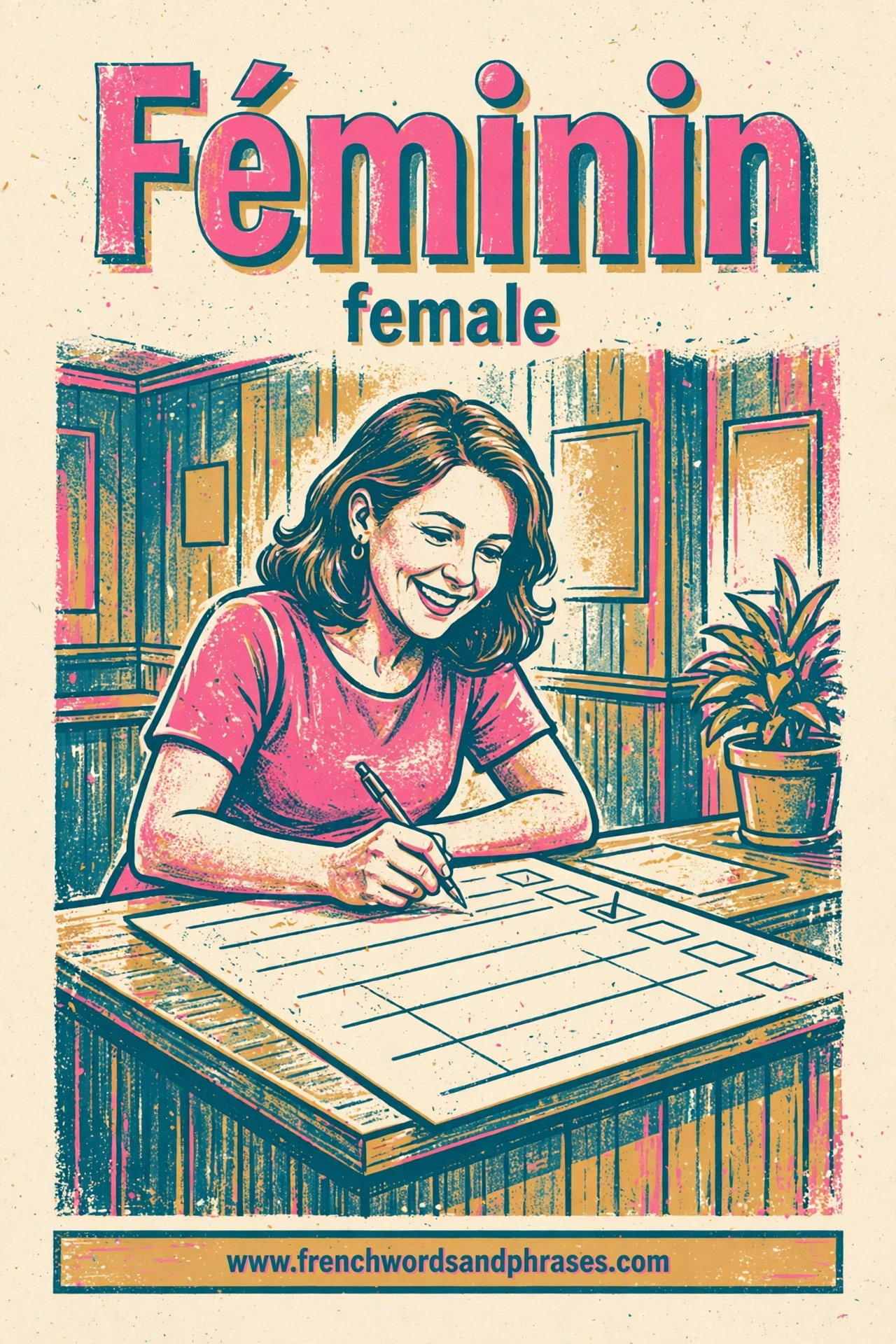
The same mairie office, the same form, the second word on the line. A mother in a blue coat leans over the counter, her newborn daughter asleep against her shoulder, and ticks « féminin » with a small flourish — the word that will follow the child through every school file and identity card in France: féminin.
In this guide, you’ll learn what féminin means in English, how its feminine wakes the sleeping n, where it stands in the sentence, and why it names half of French grammar — la terminaison féminine. Explore French examples, English translations, and practice quizzes.
Understanding the French Adjective Féminin
Féminin is a French adjective of identity — the word that forms, documents and grammar books use for the female side of the world. It agrees like its mirror image masculin: féminin, féminine, féminins, féminines — and in the feminine the sleeping n wakes up.
It means female. On official forms it labels people (un enfant de sexe féminin, a female child); in everyday French it describes voices, clothes and elegance (une voix féminine, a feminine voice; une robe féminine, a feminine dress); and in grammar it names the second gender of French nouns — lune, table and patience are all féminin. Wherever English says female or feminine, French reaches for this word.
Type: Adjective of identity — sex and grammatical gender
Answers the question: Male or female? — female
Changes form: Yes — féminin, féminine, féminins, féminines
English equivalents: Female; feminine.
One important usage detail: on forms, féminin travels in the fixed phrase de sexe féminin — un enfant de sexe féminin. Elsewhere it stands after the noun: une voix féminine, la mode féminine. And in grammar it becomes a noun: le féminin — mettre un mot au féminin, to put a word into the feminine.
Experience the Word
Féminin is the adjective of the second word on the line — ticked in mairies, clinics and school offices across France, millions of times a year.
Imagine a perfume shop in Grasse: rows of glass bottles catching the light, and a card in gold letters — « parfum féminin ». The word does not just describe the scent; it promises grace and softness, a certain French idea of elegance.
You have not just labelled a person. You have placed them on the female side of every form, list and grammar table in France.
How to Use Féminin in French: Complete Guide
Let’s explore how féminin works in French, beginning with the whole word on one card.
Féminin at a Glance
Before the details, here is the whole word on one card.
The Whole Word on One Card
Meaning, type, position and forms — féminin in four lines.
| Point | Féminin |
|---|---|
| Meaning | female |
| Type | adjective of identity — sex and gender |
| Usual position | after the noun — de sexe féminin |
| Form | féminin / féminine / féminins / féminines |
Example
Cochez la case « féminin ».
Tick the ‘female’ box.
The Four Forms of Féminin
Féminin agrees with the noun it describes. The feminine adds an e — and the n wakes up, exactly as it does for masculin.
| Form | Féminin | Example |
|---|---|---|
| Masculine singular | féminin | un public féminin — a female audience |
| Feminine singular | féminine | une voix féminine — a feminine voice |
| Masculine plural | féminins | des prénoms féminins — female first names |
| Feminine plural | féminines | des voix féminines — feminine voices |
Example
C’est un prénom féminin.
It’s a female first name.
Quick Quiz 1
What is the feminine of féminin?
Reveal the answer
féminine
Une terminaison féminine.
A feminine ending.
Féminine: The N Wakes Up
In the masculine, the final -in is a nasal sound and the n stays silent. Add the feminine e and the n wakes up and is pronounced: the ending opens from a hum into a clear syllable.
| Situation | Example |
|---|---|
| The rule | just add -e — féminin → féminine |
| The sound | the nasal opens and the n is pronounced in féminine |
| Masculine plural | féminins — des noms féminins |
| Feminine plural | féminines — des robes féminines |
Example
« Table » est un nom féminin.
‘Table’ is a feminine noun.
Where Féminin Goes: After the Noun
Féminin follows the noun it describes, hides inside the fixed phrase de sexe féminin on forms, and steps forward as a noun in its own right in grammar lessons.
| Pattern | Example |
|---|---|
| On a form | de sexe féminin — of the female sex |
| After the noun | la mode féminine — women’s fashion |
| As a noun | le féminin — the feminine (in grammar) |
| Before the noun | une féminine voix — not in French |
Example
Le mot « lune » est féminin.
The word ‘lune’ is feminine.
Quick Quiz 2
How do you say ‘a female child’ on a French form?
Reveal the answer
un enfant de sexe féminin
Forms use the fixed phrase de sexe féminin.
A female child.
More Feminine: Comparing with Féminin
Féminin compares the regular way, with plus, moins and aussi — useful for dresses, voices and styles that lean more or less to one side.
| Degree | Example |
|---|---|
| As feminine as | aussi féminine que — as feminine as |
| More feminine | plus féminin — more feminine |
| Less feminine | moins féminin — less feminine |
| The most feminine (masc.) | le plus féminin — le plus féminin des parfums |
| The most feminine (fem.) | la plus féminine — la plus féminine des robes |
Example
Cette robe est plus féminine que l’autre.
This dress is more feminine than the other one.
Everyday Expressions with Féminin
Féminin works in three worlds at once: the form at the mairie, the world of fashion and sport, and the grammar lesson.
| Expression | In English |
|---|---|
| de sexe féminin | female (on forms) — un enfant de sexe féminin |
| le genre féminin | the feminine gender |
| un nom féminin | a feminine noun |
| la mode féminine | women’s fashion |
| une équipe féminine | a women’s team |
| mettre au féminin | to put into the feminine — a grammar exercise |
Example
Mettez cette phrase au féminin.
Put this sentence into the feminine.
Quick Quiz 3
What does de sexe féminin mean on a form?
Reveal the answer
Female
Un enfant de sexe féminin.
A female child.
Féminin and Its Neighbours
Féminin shares its field with masculin across the form, with femelle in the animal kingdom, and with féminité, the noun of the quality itself.
| French | In English |
|---|---|
| masculin | male — the other word on the form |
| femelle | female — for animals: une tortue femelle |
| féminité | femininity — the noun |
| femme | woman — the noun itself |
| doux | soft, gentle — a frequent companion of féminin |
Example
C’est une tortue femelle.
It’s a female tortoise.
Watch Out: The Traps Around Féminin
The traps here are a sleeping letter, an animal that needs a different word, and a near-twin that means something political.
| Trap | The truth |
|---|---|
| femelle or féminin? | femelle is for animals; féminin is for people, things and grammar |
| The sleeping n | féminin hides its n; féminine pronounces it |
| Also a noun | le féminin is the grammar term — au féminin, in the feminine |
| féministe | a different word — féministe means feminist, not feminine |
Example
« Soleil » est masculin, « lune » est féminin.
‘Soleil’ is masculine, ‘lune’ is feminine.
Quick Quiz 4
Which word describes a female animal — féminin or femelle?
Reveal the answer
femelle
Une tortue femelle.
A female tortoise.
Féminin in Everyday French: Real-Life Examples
Now that you know the word, let’s see how féminin appears in everyday French.
Example 1 — At the mairie
Cochez la case « féminin » pour votre fille.
Tick the ‘female’ box for your daughter.
Example 2 — Grammar class
Le mot « lune » est féminin en français.
The word ‘lune’ is feminine in French.
Example 3 — Shopping
La mode féminine est au premier étage.
Women’s fashion is on the first floor.
Example 4 — A voice
Elle a une voix douce et féminine.
She has a soft, feminine voice.
Example 5 — Sport
L’équipe féminine de football a gagné le match.
The women’s football team won the match.
Example 6 — An exercise
Mettez les phrases au féminin, s’il vous plaît.
Put the sentences into the feminine, please.
Beyond Translation: The Meaning of Féminin
English splits the work between female and feminine; French gives both jobs to féminin — and adds the grammar empire: la lune, la table, la patience, millions of nouns live under this adjective’s flag.
Learn féminin, and the other half of the French dictionary falls into place.
French also hears grace in the word — une élégance féminine is a compliment an English translation only half carries.
How to Remember the French Adjective Féminin
Remember it this way: Féminin is the female adjective — the form’s second word, the grammar’s second gender, with an n that wakes up in féminine.
- You tick the second word — féminin, female, on every form in France.
- You wake the n in the feminine — féminin becomes féminine, and the n is heard.
- You keep the grammar sense — la lune, la table : des noms féminins.
The key idea is féminin means female, its feminine féminine wakes the n, and it names a grammar gender.
Test Your Knowledge of Féminin
Let’s see how much you’ve learned. Try answering these questions before revealing the answers.
Question 1
What does féminin mean?
Reveal the answer
Female — and feminine, for voices, styles and grammar.
Question 2
What is the feminine of féminin?
Reveal the answer
féminine — the added e wakes the n up, and it is pronounced.
Question 3
Translate: a feminine noun.
Reveal the answer
Un nom féminin.
Question 4
Complete the sentence:
Un enfant de ______ féminin.
Reveal the answer
sexe
Un enfant de sexe féminin.
A female child.
Question 5
Which word is used for a female animal?
Reveal the answer
femelle — une tortue femelle. Féminin is for people, things and grammar.
Your Final Challenge
Can You Use It?
How would you say this in French?
“On the form, tick the ‘female’ box for your daughter.”
Reveal the answer
Sur le formulaire, cochez la case « féminin » pour votre fille.
On the form, tick the ‘female’ box for your daughter.
A little French. A little curiosity. A richer everyday life.
LEARN FRENCH ONE WORD AT A TIME