A French Word to Live By
Translate Masculin to English
/mas.ky.lɛ̃/
Masculin means male.
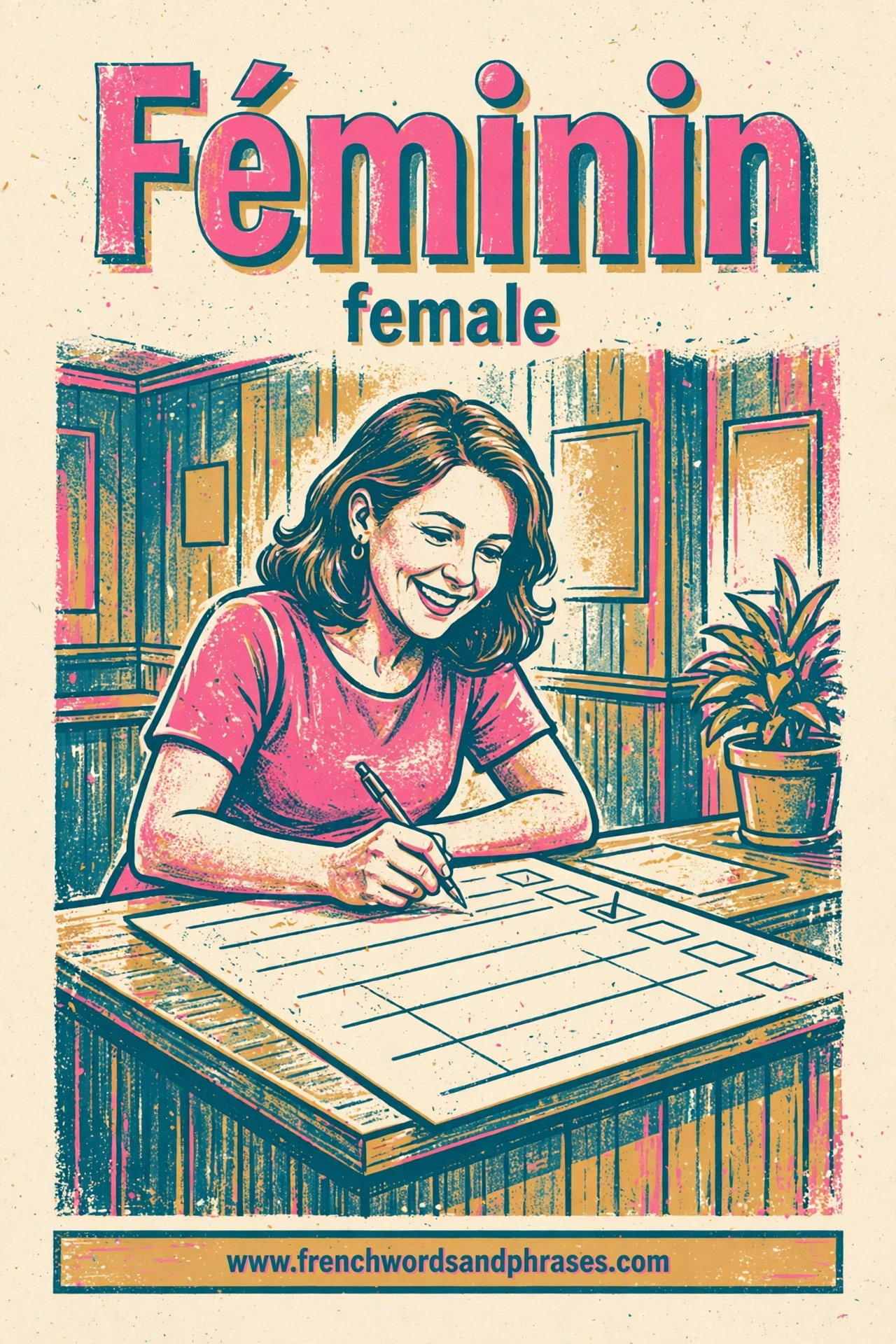
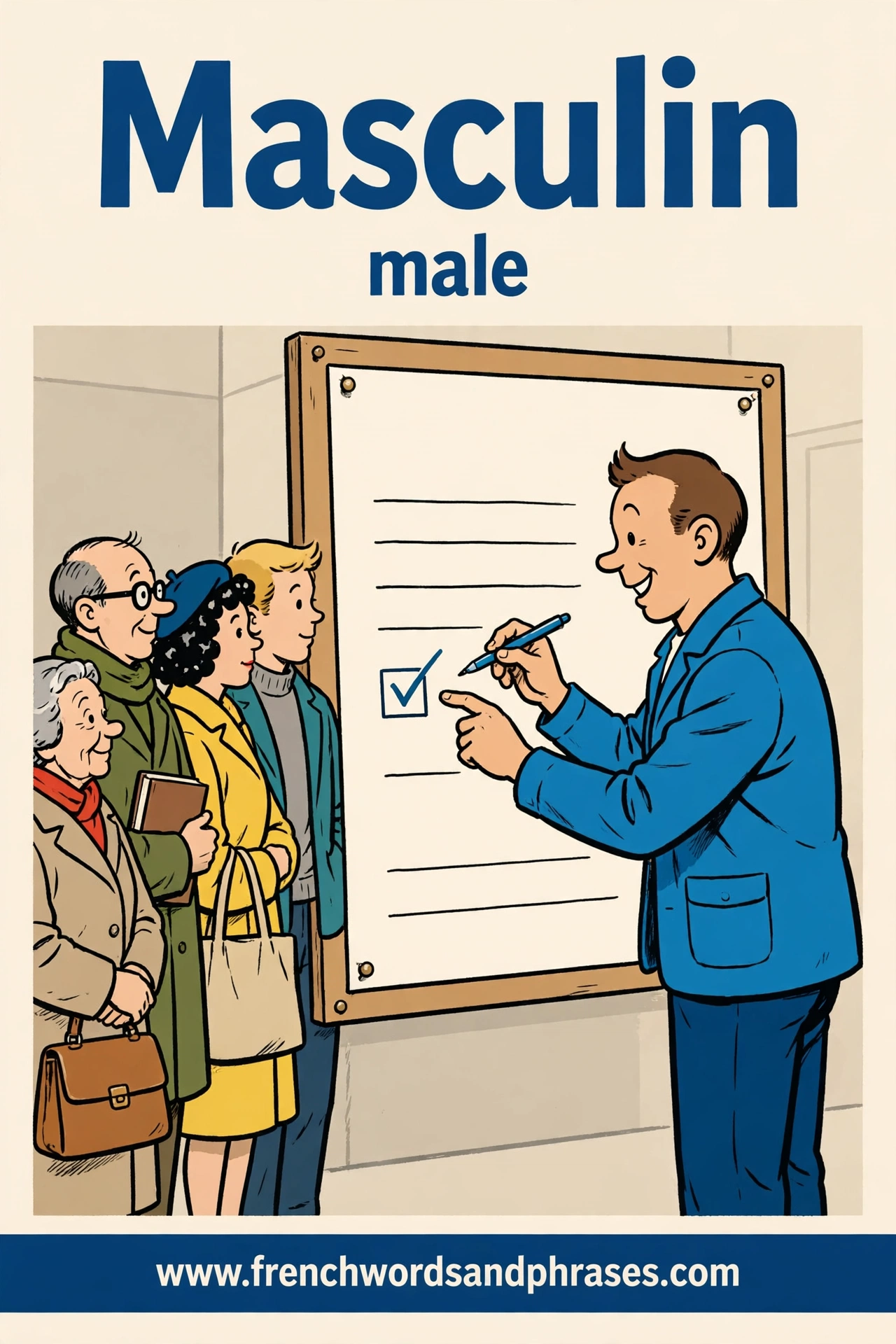
A small office at the mairie, morning light through tall windows. A young father leans over a birth declaration form, pen hovering at a tiny line: « Sexe : masculin ou féminin ». He ticks the first word, and his son officially exists. That first word is masculin.
In this guide, you’ll learn what masculin means in English, how its feminine wakes the sleeping n, where it stands in the sentence, and why the same word rules French grammar — le nom masculin. Explore French examples, English translations, and practice quizzes.
Understanding the French Adjective Masculin
Masculin is a French adjective of identity — the word that forms, documents and grammar books use for the male side of the world. It agrees in the classic -in way: masculin, masculine, masculins, masculines — and the feminine wakes the sleeping n up.
It means male. On official forms it labels people (un enfant de sexe masculin, a male child); in everyday French it describes voices, clothes and styles (une voix masculine, a masculine voice); and in grammar it names one of the two genders of French nouns — pain, soleil and silence are all masculin. If English would say male or masculine, French reaches for this word.
Type: Adjective of identity — sex and grammatical gender
Answers the question: Male or female? — male
Changes form: Yes — masculin, masculine, masculins, masculines
English equivalents: Male; masculine.
One important usage detail: on forms, masculin almost always travels in the fixed phrase de sexe masculin — un enfant de sexe masculin. Elsewhere it stands after the noun: le genre masculin, une voix masculine. And when French talks about grammar, masculin becomes a noun itself: le masculin.
Experience the Word
Masculin is the adjective of the ticked box — the first small fact the French state records about a newborn, written in a clerk’s careful hand.
Imagine a tailor’s shop on a grey street: on one side, rows of dark jackets and polished shoes, and a brass sign that reads « rayon masculin ». Nobody explains it. Everybody understands: this half of the shop belongs to men.
You have not just labelled a person. You have placed them on the male side of every form, list and grammar table in France.
How to Use Masculin in French: Complete Guide
Let’s explore how masculin works in French, beginning with the whole word on one card.
Masculin at a Glance
Before the details, here is the whole word on one card.
The Whole Word on One Card
Meaning, type, position and forms — masculin in four lines.
| Point | Masculin |
|---|---|
| Meaning | male |
| Type | adjective of identity — sex and gender |
| Usual position | after the noun — de sexe masculin |
| Form | masculin / masculine / masculins / masculines |
Example
Cochez la case « masculin ».
Tick the ‘male’ box.
The Four Forms of Masculin
Masculin agrees with the noun it describes. The feminine adds an e — and that small letter changes the sound, because the n wakes up.
| Form | Masculin | Example |
|---|---|---|
| Masculine singular | masculin | un employé masculin — a male employee |
| Feminine singular | masculine | une voix masculine — a masculine voice |
| Masculine plural | masculins | des prénoms masculins — male first names |
| Feminine plural | masculines | des voix masculines — masculine voices |
Example
C’est un prénom masculin.
It’s a male first name.
Quick Quiz 1
What is the feminine of masculin?
Reveal the answer
masculine
Une voix masculine.
A masculine voice.
Masculine: The N Wakes Up
In the masculine, the final -in is a nasal sound and the n stays silent. Add the feminine e and the n wakes up and is pronounced: the ending opens from a hum into a clear syllable.
| Situation | Example |
|---|---|
| The rule | just add -e — masculin → masculine |
| The sound | the nasal opens and the n is pronounced in masculine |
| Masculine plural | masculins — des noms masculins |
| Feminine plural | masculines — des terminaisons masculines |
Example
Pain est un nom masculin.
Pain is a masculine noun.
Where Masculin Goes: After the Noun
Masculin follows the noun it describes, hides inside the fixed phrase de sexe masculin on forms, and steps forward as a noun in its own right in grammar lessons.
| Pattern | Example |
|---|---|
| On a form | de sexe masculin — of the male sex |
| After the noun | le genre masculin — the masculine gender |
| As a noun | le masculin — the masculine (in grammar) |
| Before the noun | un masculin employé — not in French |
Example
Le mot « soleil » est masculin.
The word ‘soleil’ is masculine.
Quick Quiz 2
How do you say ‘a male child’ on a French form?
Reveal the answer
un enfant de sexe masculin
Forms use the fixed phrase de sexe masculin.
A male child.
More Masculine: Comparing with Masculin
Masculin compares the regular way, with plus, moins and aussi — handy for voices, names and styles that lean more or less to one side.
| Degree | Example |
|---|---|
| As masculine as | aussi masculin que — as masculine as |
| More masculine | plus masculin — more masculine |
| Less masculine | moins masculin — less masculine |
| The most masculine (masc.) | le plus masculin — le plus masculin des prénoms |
| The most masculine (fem.) | la plus masculine — la plus masculine des voix |
Example
Ce prénom est plus masculin que l’autre.
This first name is more masculine than the other one.
Everyday Expressions with Masculin
Masculin works in three worlds at once: the form at the mairie, the shop floor, and the grammar lesson.
| Expression | In English |
|---|---|
| de sexe masculin | male (on forms) — un enfant de sexe masculin |
| le genre masculin | the masculine gender |
| un nom masculin | a masculine noun |
| une voix masculine | a masculine voice |
| la mode masculine | men’s fashion |
| le rayon masculin | the men’s department |
Example
En grammaire, « livre » est masculin.
In grammar, ‘livre’ is masculine.
Quick Quiz 3
What does de sexe masculin mean on a form?
Reveal the answer
Male
Un enfant de sexe masculin.
A male child.
Masculin and Its Neighbours
Masculin shares its field with féminin across the form, with mâle in the animal kingdom, and with viril in descriptions of character.
| French | In English |
|---|---|
| féminin | female — the other word on the form |
| mâle | male — for animals: un lion mâle |
| viril | manly, virile — of character and bearing |
| homme | man — the noun itself |
| masculinité | masculinity — the noun |
Example
Un lion mâle protège le groupe.
A male lion protects the group.
Watch Out: The Traps Around Masculin
The traps here are a sleeping letter, an animal that needs a different word, and a second life as a grammar noun.
| Trap | The truth |
|---|---|
| mâle or masculin? | mâle is for animals; masculin is for people, things and grammar |
| The sleeping n | masculin hides its n; masculine pronounces it |
| Also a noun | le masculin is the grammar term — au masculin, in the masculine |
| Capital letter | none — masculin stays lowercase, even in grammar books |
Example
« Lune » est féminin, « soleil » est masculin.
‘Lune’ is feminine, ‘soleil’ is masculine.
Quick Quiz 4
Which word describes a male animal — masculin or mâle?
Reveal the answer
mâle
Un lion mâle.
A male lion.
Masculin in Everyday French: Real-Life Examples
Now that you know the word, let’s see how masculin appears in everyday French.
Example 1 — At the mairie
Cochez la case « masculin » pour votre fils.
Tick the ‘male’ box for your son.
Example 2 — Grammar class
Le mot « pain » est masculin en français.
The word ‘pain’ is masculine in French.
Example 3 — Shopping
La mode masculine est au deuxième étage.
Men’s fashion is on the second floor.
Example 4 — A voice
Elle a une voix étonnamment masculine.
She has a surprisingly masculine voice.
Example 5 — At the clinic
C’est un patient de sexe masculin, âgé de quarante ans.
It’s a male patient, forty years old.
Example 6 — Names
Alex est un prénom masculin et féminin.
Alex is a male and female first name.
Beyond Translation: The Meaning of Masculin
English splits the work between male and masculine; French gives both jobs to masculin — and adds a third that English never asks of it: every noun in the language is either masculin or féminin, so this little adjective quietly governs half the dictionary.
Learn masculin, and you hold the key to every le and every agreement in French.
It begins as a box on a form and ends as the architecture of the whole language.
How to Remember the French Adjective Masculin
Remember it this way: Masculin is the male adjective — it ticks the form’s first word, rules half the grammar, and wakes its n up in the feminine.
- You tick the first word — masculin, male, on every form in France.
- You wake the n in the feminine — masculin becomes masculine, and the n is heard.
- You keep the grammar sense — le soleil, le pain : des noms masculins.
The key idea is masculin means male, its feminine masculine wakes the n, and it names a grammar gender.
Test Your Knowledge of Masculin
Let’s see how much you’ve learned. Try answering these questions before revealing the answers.
Question 1
What does masculin mean?
Reveal the answer
Male — and masculine, for voices, styles and grammar.
Question 2
What is the feminine of masculin?
Reveal the answer
masculine — the added e wakes the n up, and it is pronounced.
Question 3
Translate: a masculine noun.
Reveal the answer
Un nom masculin.
Question 4
Complete the sentence:
Un enfant de ______ masculin.
Reveal the answer
sexe
Un enfant de sexe masculin.
A male child.
Question 5
Which word is used for a male animal?
Reveal the answer
mâle — un lion mâle. Masculin is for people, things and grammar.
Your Final Challenge
Can You Use It?
How would you say this in French?
“On the form, tick the ‘male’ box for your son.”
Reveal the answer
Sur le formulaire, cochez la case « masculin » pour votre fils.
On the form, tick the ‘male’ box for your son.
A little French. A little curiosity. A richer everyday life.
LEARN FRENCH ONE WORD AT A TIME