A French Word to Live By
Translate Dé to English
/de/
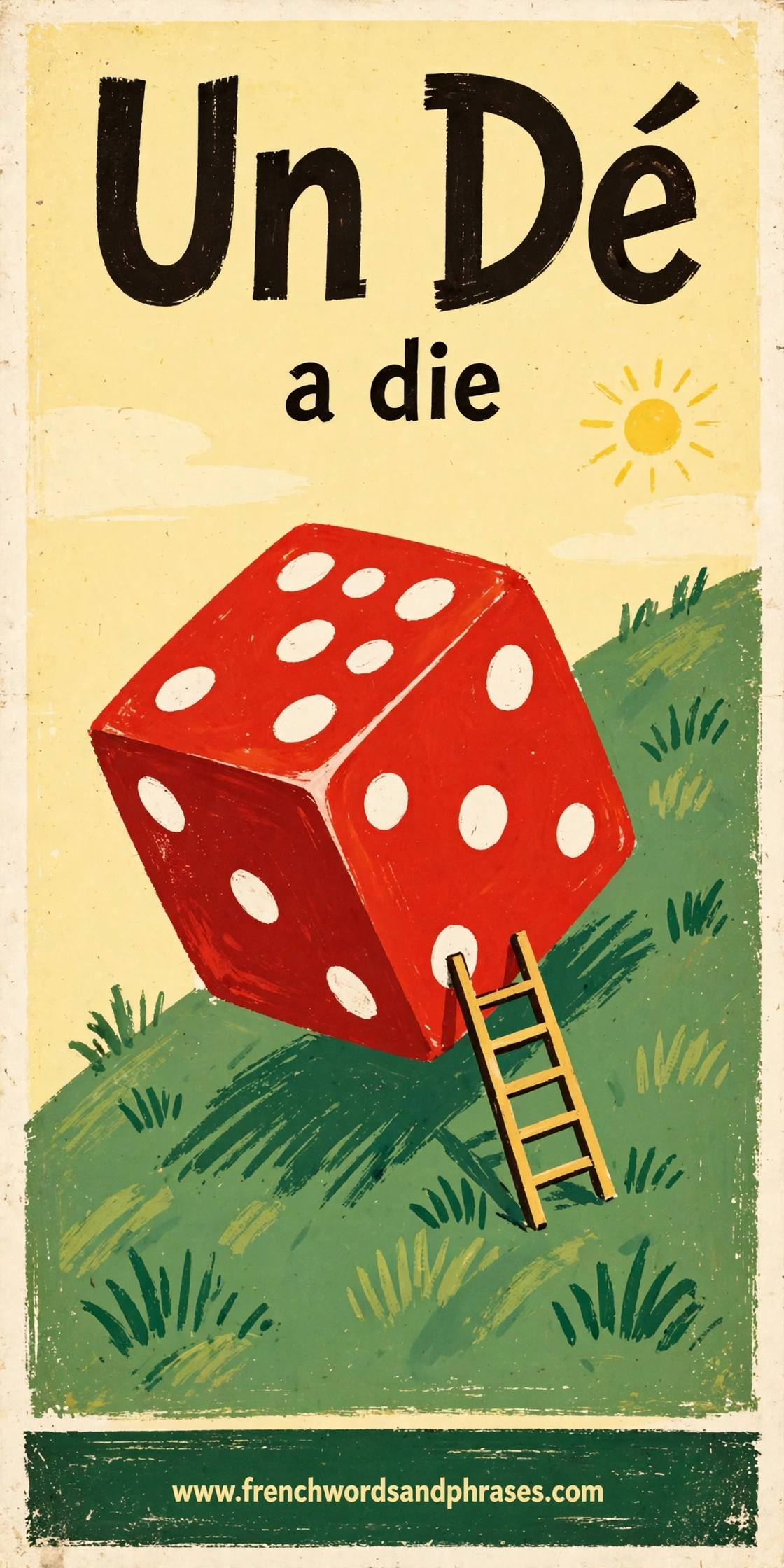
Le dé means the die.
The board is spread on the kitchen table, the counters are lined up, and everything depends on one small cube tumbling across the squares. Someone shakes it in a closed fist, blows on it for luck, and throws — le dé has spoken.
In this guide, you’ll learn what dé means in English, how to use it with its articles, how to form its plural, and how it appears in everyday French. Explore French examples, English translations, and practice quizzes.
Understanding the French Noun Dé
Dé is a masculine French noun. It is learned together with its article: le dé, un dé. It is the little numbered cube of board games — and its whole identity hangs on one small accent, as the traps below will show.
It means the die — the small cube, marked with dots from one to six, that you roll to move, to score and to decide who wins. One die is un dé; the pair you throw together is les dés, the dice. And the same word, in un dé à coudre, names a thimble — the little cap a sewer wears on a fingertip, shaped just like the cube.
Gender: Masculine
Definite article: le — le dé (the die)
Indefinite article: un — un dé (a die)
Plural: les dés (the dice)
English equivalents: The die (plural: the dice); in un dé à coudre, a thimble.
One important usage detail: mind the homonym. Without its accent, de is the little preposition ‘of, from’ — the most frequent word in French, and the site already has a page for it. The accent aigu on dé changes everything: it turns the grammar word into the gaming cube. Written French keeps the two apart with that single stroke.
Experience the Word
Dé is more than a cube. It is chance itself, small enough to hold in a fist — the moment where skill stops and luck begins, rattling across the table.
Imagine the family game at its crisis: one throw left, four needed, the whole table holding its breath. The dé spins, hesitates on an edge… and settles. Groans, laughter, a rematch demanded at once.
You have not just rolled a cube. You have thrown les dés — and let fate move your counter.
How to Use Dé in French: Complete Guide
Let’s explore how dé works in French, beginning with its articles.
Dé with the Definite Article (Le, Les)
Used for the die on the table, the one everyone is watching — le dé.
| Number | French |
|---|---|
| Singular | le dé |
| Plural | les dés |
Example
Le dé roule et s’arrête sur le six.
The die rolls and stops on the six.
Dé with the Indefinite Article (Un, Des)
Used for a die in general — un dé, one cube out of the box.
| Number | French |
|---|---|
| Singular | un dé |
| Plural | des dés |
Example
Il manque un dé dans la boîte du jeu.
There is a die missing from the game box.
At the Game Table: Rolling the Dice
Throws, games and famous words — the vocabulary that gathers around le dé.
| French | In English |
|---|---|
| lancer les dés | to roll the dice |
| un jeu de dés | a dice game |
| un coup de dé | a throw of the dice |
| faire un six | to roll a six |
| à ton tour de lancer | your turn to roll |
| les dés sont jetés | the die is cast |
Example
Lance les dés, c’est à toi de jouer.
Roll the dice, it’s your turn to play.
Quick Quiz 1
What does « les dés sont jetés » literally describe, and what does it mean?
Reveal the answer
The dice have been thrown — and the decision is made, there is no going back: the die is cast.
Les dés sont jetés, on ne peut plus reculer.
The die is cast, we cannot turn back now.
The Plural of Dé
Dé adds an -s and keeps its accent — les dés, the dice, almost always used as a pair.
| Number | French |
|---|---|
| Singular | le dé |
| Plural | les dés |
Example
Les dés roulent sur la table sous les yeux des joueurs.
The dice roll across the table under the players’ eyes.
Dé with Possessive Adjectives (Mon, Ton, Son…)
Possessives agree with the noun, not with the owner — and dé is masculine, so it takes mon, ton, son.
| Owner | French |
|---|---|
| my | mon dé |
| your (tu) | ton dé |
| his / her | son dé |
| our | notre dé |
| your (vous) | votre dé |
| their | leur dé |
Example
Mon dé porte-bonheur est rouge.
My lucky die is red.
Quick Quiz 2
Complete the sentence:
Secoue ______ dé dans ta main avant de le lancer. (Your)
Reveal the answer
ton
Secoue ton dé dans ta main avant de le lancer.
Shake your die in your hand before throwing it.
Dé with Demonstrative Adjectives (Ce, Ces)
Used to point: this die here, those dice there.
| Number | French |
|---|---|
| Singular | ce dé |
| Plural | ces dés |
Example
Ce dé me porte chance depuis des années.
This die has brought me luck for years.
Dé with Adjectives
Adjectives agree with dé, masculine — rouge, géant, and the cheater’s pipé.
| Adjective | With Dé |
|---|---|
| rouge (red) | un dé rouge |
| en bois (wooden) | un dé en bois |
| géant (giant) | un dé géant |
| à six faces (six-sided) | un dé à six faces |
| pipé (loaded) | un dé pipé |
Example
Un dé pipé fausse tout le jeu.
A loaded die ruins the whole game.
Quick Quiz 3
Complete the sentence:
Les enfants jouent avec un dé ______. (giant)
Reveal the answer
géant
Les enfants jouent avec un dé géant.
The children are playing with a giant die.
Everyday Expressions with Dé
From the board game to the sewing basket — the dé phrases of the day.
| Expression | In English |
|---|---|
| jouer aux dés | to play dice |
| lancer les dés | to roll the dice |
| les dés sont jetés | the die is cast |
| un dé à coudre | a thimble |
| tenir les dés | to hold the dice, to be in control |
| un coup de dé | a throw of the dice, a gamble |
Example
Le soir, ils jouent aux dés après le dîner.
In the evening, they play dice after dinner.
Words from the Same Family as Dé
Games, chance and sewing — the words that travel with dé.
| French | In English |
|---|---|
| le jeu | the game |
| jouer | to play |
| le hasard | chance, luck |
| la chance | luck |
| le joueur | the player |
| gagner | to win |
Example
Dans ce jeu, le hasard décide de tout.
In this game, chance decides everything.
Quick Quiz 4
A learner writes: « J’ai perdu le de du jeu. » What is missing?
Reveal the answer
The accent — de without an accent is the preposition ‘of, from’; the gaming cube is le dé, with an accent aigu.
J’ai perdu le dé du jeu de société.
I have lost the die from the board game.
Dé in Everyday French: Real-Life Examples
Now that you know the word, let’s see how dé appears in everyday French.
Example 1 — Game night
On sort les dés, la partie commence.
Out come the dice, the game begins.
Example 2 — A lucky throw
Elle lance le dé et fait un six.
She rolls the die and gets a six.
Example 3 — The missing piece
Il manque un dé, on ne peut pas jouer.
A die is missing, we can’t play.
Example 4 — In the sewing basket
Grand-mère cherche son dé à coudre.
Grandmother is looking for her thimble.
Example 5 — No turning back
Les dés sont jetés, la décision est prise.
The die is cast, the decision is made.
Example 6 — Cheating
Ce dé est pipé, ce n’est pas juste !
This die is loaded, that’s not fair!
Beyond Translation: The Meaning of Dé
Le dé is one of the oldest toys in the world — knucklebones first, then cubes of bone, ivory and wood — and French honours its long history with a phrase the whole language uses: les dés sont jetés, the die is cast, the words Julius Caesar is said to have spoken crossing the Rubicon. A six-sided cube became the symbol of every irreversible decision.
To say dé is to hold chance in your hand — and to let it go.
It evokes rainy-afternoon board games and grandparents who never lose gracefully, the rattle in the closed fist, and that tiny accent that separates a game of luck from the most ordinary word in French.
How to Remember the French Noun Dé
Remember it this way: Dé is the die — masculine, rolled as les dés, and saved from the preposition de by one small accent.
- You hear the rattle — les dés roulent sur la table.
- You guard the accent — le dé joue, de tout seul ne joue pas.
- You meet its twin — un dé à coudre, le petit chapeau de la couturière.
The key idea is le dé rolls — de without the accent just links.
Test Your Knowledge of Dé
Let’s see how much you’ve learned. Try answering these questions before revealing the answers.
Question 1
Is dé masculine or feminine?
Reveal the answer
Masculine — le dé, un dé.
Question 2
How do you say ‘to roll the dice’ in French?
Reveal the answer
Lancer les dés — the plural, because dice travel in pairs.
Question 3
Translate: She rolls the die and gets a six.
Reveal the answer
Elle lance le dé et fait un six.
Question 4
What is un dé à coudre?
Reveal the answer
A thimble — the same word dé, worn on a sewer’s fingertip.
Question 5
Complete the sentence:
Les ______ sont jetés, on ne peut plus reculer.
Reveal the answer
dés
Les dés sont jetés, on ne peut plus reculer.
The die is cast, we cannot turn back.
Your Final Challenge
Can You Use It?
How would you say this in French?
“He rolls the dice and gets a six.”
Reveal the answer
Il lance les dés et fait un six.
He rolls the dice and gets a six.
A little French. A little curiosity. A richer everyday life.
LEARN FRENCH ONE WORD AT A TIME