A French Word to Live By
Translate Sieste to English
/sjɛst/
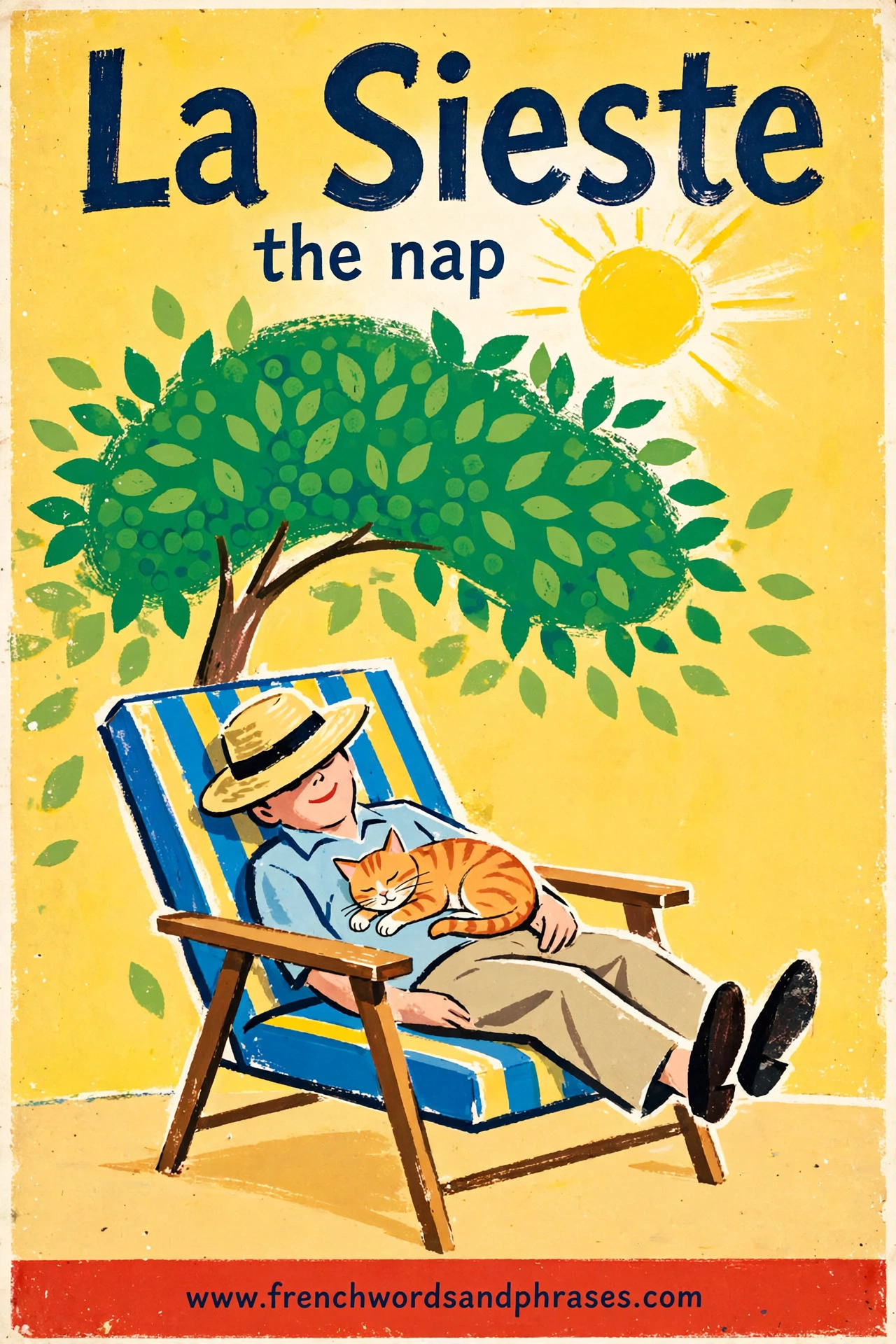
La sieste means the nap.
Lunch is over, the shutters are half-closed against the summer heat, and the house falls deliciously quiet. On the sofa, grandfather is already asleep, a newspaper folded on his chest. It is the hour of la sieste.
In this guide, you’ll learn what sieste means in English, how to use it with its articles, how to form its plural, and how it appears in everyday French. Explore French examples, English translations, and practice quizzes.
Understanding the French Noun Sieste
Sieste is a feminine French noun. It is learned together with its article: la sieste, une sieste. The word came from the Spanish siesta, itself from the Latin for the sixth hour of the day — the hot hour after lunch, made for resting.
It means the nap — the short sleep taken after lunch, especially in hot weather. In France la sieste belongs to small children, to grandparents, and to anyone wise enough to close the shutters on a summer afternoon: twenty minutes on the sofa, and the day starts again, refreshed.
Gender: Feminine
Definite article: la — la sieste (the nap)
Indefinite article: une — une sieste (a nap)
Plural: les siestes
English equivalents: The nap; the siesta; an after-lunch rest.
One important usage detail: the verb is faire, not prendre — you faites la sieste, you ‘do’ the nap. For a very short doze, French also says faire un petit somme, to have a little snooze, but la sieste is the classic after-lunch institution.
Experience the Word
Sieste is more than a nap. It is a small daily ceremony of the South — shutters drawn, house silent, the whole street paused while the heat does its worst outside.
Imagine the summer lunch that ends with coffee, then yawns, then the sofa. Twenty minutes later you wake up in the cool half-dark, and the afternoon feels brand new.
You have not just slept. You have kept the oldest appointment of the Mediterranean day — la sieste.
How to Use Sieste in French: Complete Guide
Let’s explore how sieste works in French, beginning with its articles.
Sieste with the Definite Article (La, Les)
Used for the nap as an institution — la sieste, the after-lunch rest everyone knows.
| Number | French |
|---|---|
| Singular | la sieste |
| Plural | les siestes |
Example
La sieste est sacrée chez mes grands-parents.
The nap is sacred at my grandparents’ house.
Sieste with the Indefinite Article (Une, Des)
Used for one nap in particular — une sieste, the one you are about to take.
| Number | French |
|---|---|
| Singular | une sieste |
| Plural | des siestes |
Example
Après le déjeuner, je vais faire une sieste.
After lunch, I am going to have a nap.
The Many Siestes
Short ones, long ones and the famous power nap — sieste comes in several sizes.
| French | In English |
|---|---|
| la petite sieste | the short nap |
| une longue sieste | a long nap |
| la sieste réparatrice | the restorative nap |
| la sieste éclair | the power nap |
| la sieste du dimanche | the Sunday nap |
| la sieste des enfants | the children’s nap time |
Example
Une sieste éclair de vingt minutes et je suis en forme.
A twenty-minute power nap and I am full of energy.
Quick Quiz 1
What is une sieste éclair?
Reveal the answer
A power nap — éclair means lightning: a very short, sharp nap.
Une sieste éclair avant la réunion, et ça repart.
A power nap before the meeting, and off we go again.
The Plural of Sieste
Sieste adds an -s in the plural — les siestes, the naps of a whole summer.
| Number | French |
|---|---|
| Singular | la sieste |
| Plural | les siestes |
Example
Les siestes de l’été sont les meilleurs souvenirs des vacances.
Summer naps are the best holiday memories.
Sieste with Possessive Adjectives (Ma, Ta, Sa…)
Possessives agree with the noun, not with the owner — and sieste is feminine, so it takes ma, ta, sa.
| Owner | French |
|---|---|
| my | ma sieste |
| your (tu) | ta sieste |
| his / her | sa sieste |
| our | notre sieste |
| your (vous) | votre sieste |
| their | leur sieste |
Example
Ne me réveille pas pendant ma sieste.
Do not wake me during my nap.
Quick Quiz 2
Complete the sentence:
Le bébé fait ______ sieste après le repas. (His)
Reveal the answer
sa
Le bébé fait sa sieste après le repas.
The baby has his nap after the meal.
Sieste with Demonstrative Adjectives (Cette, Ces)
Used to point: this nap here, those naps there.
| Number | French |
|---|---|
| Singular | cette sieste |
| Plural | ces siestes |
Example
Cette sieste m’a fait un bien fou.
That nap did me a world of good.
Sieste with Adjectives
Adjectives agree with sieste, feminine — petite, courte, réparatrice.
| Adjective | With Sieste |
|---|---|
| petite (little) | une petite sieste |
| courte (short) | une sieste courte |
| longue (long) | une longue sieste |
| réparatrice (restorative) | une sieste réparatrice |
| bienvenue (welcome) | une sieste bienvenue |
Example
Après la randonnée, une sieste réparatrice s’impose.
After the hike, a restorative nap is in order.
Quick Quiz 3
Complete the sentence:
Une sieste ______ de vingt minutes suffit. (short)
Reveal the answer
courte
Une sieste courte de vingt minutes suffit.
A short nap of twenty minutes is enough.
Everyday Expressions with Sieste
Shutters, sofas and small sleeps — the sieste phrases of the day.
| Expression | In English |
|---|---|
| faire la sieste | to have a nap |
| l’heure de la sieste | nap time |
| faire un petit somme | to have a little snooze |
| une sieste réparatrice | a restorative nap |
| piquer un petit somme | to grab forty winks |
| être frais et dispos | to be fresh and ready (after resting) |
Example
C’est l’heure de la sieste, les enfants dorment.
It’s nap time, the children are asleep.
Words from the Same Family as Sieste
Sleep, rest and waking — the words that travel with sieste.
| French | In English |
|---|---|
| dormir | to sleep |
| le sommeil | sleep |
| le repos | rest |
| se réveiller | to wake up |
| la fatigue | tiredness |
| faire un somme | to have a nap, a doze |
Example
Après la sieste, on se réveille frais et dispos.
After the nap, you wake up fresh and ready.
Quick Quiz 4
A learner says: « Je prends une sieste après le déjeuner. » What is the trap?
Reveal the answer
The verb — French does not ‘take’ a nap, it ‘does’ one: faire la sieste.
Je fais la sieste après le déjeuner.
I have a nap after lunch.
Sieste in Everyday French: Real-Life Examples
Now that you know the word, let’s see how sieste appears in everyday French.
Example 1 — After lunch
Après le déjeuner, grand-mère fait la sieste.
After lunch, grandmother has a nap.
Example 2 — At nursery
Les enfants font la sieste après le repas.
The children have their nap after the meal.
Example 3 — Summer heat
Il fait trop chaud, c’est l’heure de la sieste.
It’s too hot, it’s nap time.
Example 4 — On holiday
En vacances, nous faisons une sieste tous les jours.
On holiday, we have a nap every day.
Example 5 — The power nap
Une petite sieste de quinze minutes avant de conduire.
A short fifteen-minute nap before driving.
Example 6 — Waking up
Après sa sieste, il est frais et dispos.
After his nap, he is fresh and ready.
Beyond Translation: The Meaning of Sieste
La sieste came up from Spain with the afternoon sun: in the hot South of France, shops once closed for it, streets emptied for it, and a whole civilisation agreed that the hours after lunch belonged to rest, not work. Modern life has shrunk it to twenty minutes on a sofa — but the word still carries the closed shutters and the silence of a village at two o’clock.
To say sieste is to give the day a pause — and to wake up owning the afternoon.
It evokes the grandfather asleep over his newspaper, the baby in the cool bedroom, the traveller restored by twenty stolen minutes — rest, taken seriously.
How to Remember the French Noun Sieste
Remember it this way: Sieste is the nap — feminine, taken after lunch, and you make it with faire: faire la sieste.
- You close the shutters — la sieste commence après le déjeuner.
- You pick the right verb — faire la sieste, jamais prendre une sieste.
- You keep it short and sweet — une sieste éclair, vingt minutes, et ça repart.
The key idea is la sieste — the after-lunch pause you faire, not take.
Test Your Knowledge of Sieste
Let’s see how much you’ve learned. Try answering these questions before revealing the answers.
Question 1
Is sieste masculine or feminine?
Reveal the answer
Feminine — la sieste, une sieste.
Question 2
How do you say ‘to have a nap’ in French?
Reveal the answer
Faire la sieste — with faire, not prendre.
Question 3
Translate: The children are having their nap.
Reveal the answer
Les enfants font la sieste.
Question 4
What is faire un petit somme?
Reveal the answer
To have a little snooze — a short, light doze, cousin of la sieste.
Question 5
Complete the sentence:
Après le repas, le bébé fait ______ sieste.
Reveal the answer
sa
Après le repas, le bébé fait sa sieste.
After the meal, the baby has his nap.
Your Final Challenge
Can You Use It?
How would you say this in French?
“After lunch, grandfather always has a nap on the sofa.”
Reveal the answer
Après le déjeuner, grand-père fait toujours la sieste sur le canapé.
After lunch, grandfather always has a nap on the sofa.
A little French. A little curiosity. A richer everyday life.
LEARN FRENCH ONE WORD AT A TIME