A French Word to Live By
Translate Davantage to English
/da.vɑ̃.taʒ/
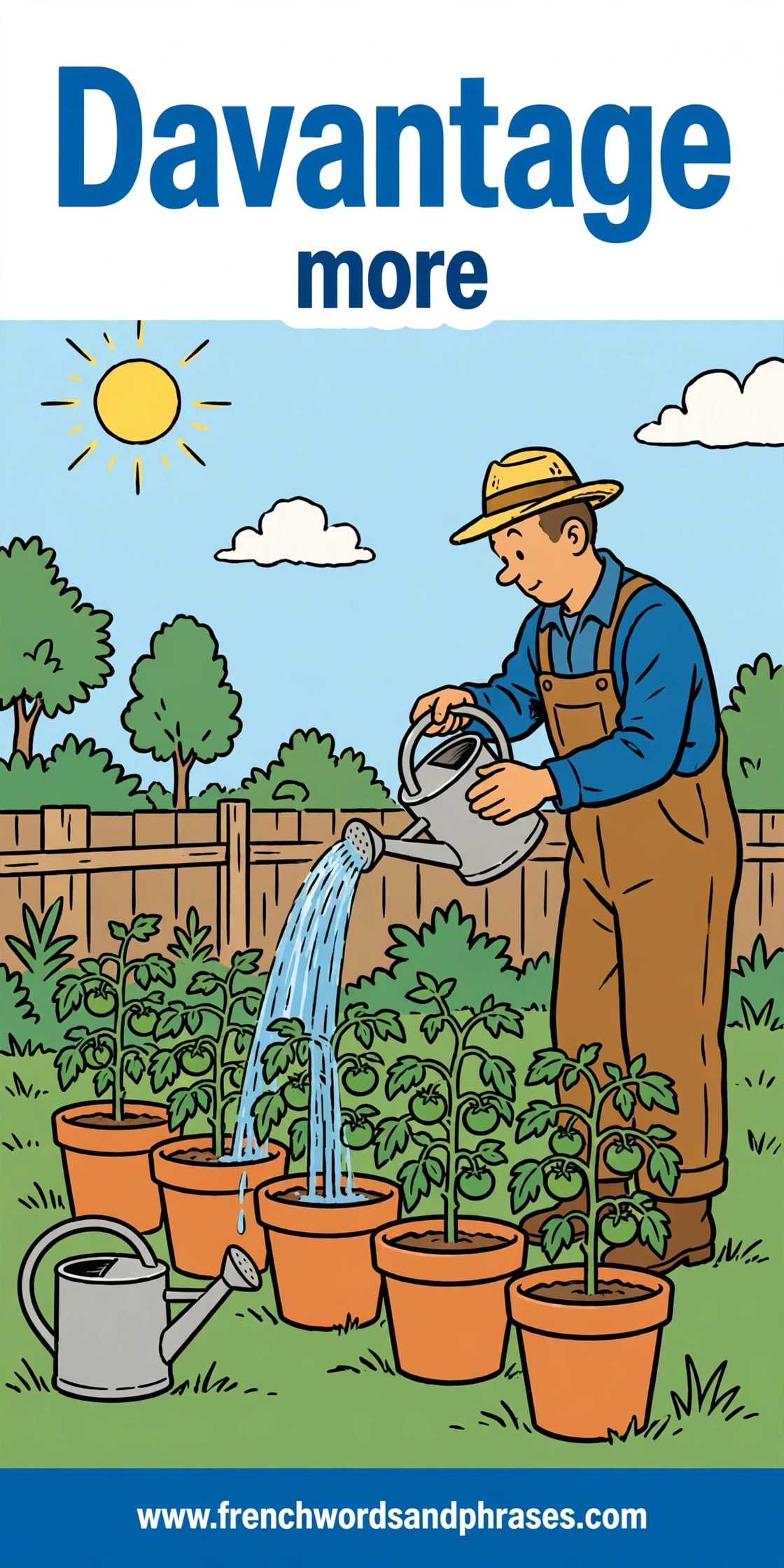
Davantage means more.
The soup tureen comes back for the third time, and the grandmother, delighted, ladles with a grand sweep: « Tu en veux davantage ? » More — davantage — the polite, generous word for a second helping of anything good.
In this guide, you’ll learn what davantage means in English, how it asks for and offers more, why it loves the end of the clause, and how it differs from plus. Explore French examples, English translations, and practice quizzes.
Understanding the French Adverb Davantage
Davantage is a French adverb of quantity. It means more — a greater amount — and it behaves differently from its cousin plus: davantage never compares two named things and never holds a noun with de. It simply adds quantity, and it loves to stand at the end of its clause.
It means more. Je veux travailler davantage — I want to work more. Davantage is the adverb of the extra helping and the extra hour: it stretches what is already there. Where plus measures against something (plus grand que moi, taller than me), davantage measures against nothing but the present amount — more than now.
Type: Adverb of quantity — increase
Answers the question: How much? — more
Changes form: Never — davantage is invariable
English equivalents: More; (davantage de) more (of); any more in questions.
One important usage detail: davantage sits at the END of its clause — il travaille davantage, he works more — and it cannot do plus’s comparison job: never « davantage grand que ». With a noun, it takes de like plus: davantage de temps, more time. Think of davantage as plus without a rival: more, full stop.
Experience the Word
Davantage is the adverb of appetite and ambition — the second helping, the extra chapter, the hour more of light in June. It is generosity’s word, and effort’s.
Imagine the baker at the end of market day, pressing an extra loaf into the student’s bag: « Tiens, tu en as davantage pour ce soir. » No scales, no rival loaf — just more, given freely.
You have not just increased a number. You have opened the door to more of a good thing.
How to Use Davantage in French: Complete Guide
Let’s explore how davantage works in French, beginning with the whole word on one card.
Davantage at a Glance
Before the details, here is the whole word on one card.
The Whole Word on One Card
Meaning, type, position and form — davantage in four lines.
| Point | Davantage |
|---|---|
| Meaning | more |
| Type | adverb of quantity — increase |
| Usual position | at the end of the clause, after the verb |
| Form | invariable — never changes |
Example
Après les vacances, il travaille davantage.
After the holidays, he works more.
Where Davantage Goes in the Sentence
Davantage closes clauses. It follows the verb or the past participle, and with a noun it builds davantage de + noun.
| Situation | Pattern |
|---|---|
| After the verb | verb + davantage — elle lit davantage |
| Passé composé | Il a dormi davantage. — He slept more. |
| With a noun | davantage de + noun — davantage de patience |
| In a question | Tu en veux davantage ? — Do you want more (of it)? |
Example
Nous avons besoin de davantage de temps.
We need more time.
Quick Quiz 1
True or false: davantage can compare two people, as in « il est davantage grand que moi ».
Reveal the answer
False
Comparisons belong to plus: il est plus grand que moi.
Davantage only adds quantity — il mange davantage, he eats more.
Davantage with Everyday Verbs
Davantage stretches the verbs of working, sleeping, reading, eating and waiting.
| Situation | Example |
|---|---|
| Working | En hiver, ils travaillent davantage. |
| Sleeping | Le dimanche, je dors davantage. |
| Reading | Elle lit davantage depuis la retraite. |
| Eating | Ne mange pas davantage, garde de la place. |
| Waiting | Je ne peux pas attendre davantage. |
Example
Après sa maladie, il se repose davantage.
After his illness, he rests more.
Everyday Expressions with Davantage
Davantage builds polite offers and patient limits.
| Expression | In English |
|---|---|
| davantage de + noun | more (of) — davantage de pain |
| en vouloir davantage | to want more of it |
| ne… pas davantage | not any more, no more than that |
| attendre davantage | to wait (any) longer |
| d’autant plus… (a cousin) | all the more… |
Example
Il n’en faut pas davantage pour être heureux.
It takes no more than that to be happy.
Quick Quiz 2
Complete the sentence:
Le dimanche, je dors ______. (more)
Reveal the answer
davantage
Le dimanche, je dors davantage.
On Sundays, I sleep more. Davantage closes the clause.
Davantage and Its Neighbours
Plus is the comparing cousin; encore stretches time; trop overshoots the mark.
| French | In English |
|---|---|
| davantage | more (no comparison) |
| plus | more (compares — plus que) |
| encore | still, more (encore un peu — a little more) |
| trop | too much — the overshoot |
Example
Elle travaille plus que moi, et le dimanche elle se repose davantage.
She works more than me, and on Sundays she rests more.
Davantage or Plus? The Key Lesson
The whole art of this page in one table. Plus compares and precedes adjectives; davantage adds quantity and closes clauses.
| Aspect | The Difference |
|---|---|
| plus + adjective + que | plus riche que lui — richer than him |
| verb + davantage | il gagne davantage — he earns more |
| plus de + noun | plus de temps — more time |
| davantage de + noun | davantage de temps — more time (a shade more formal) |
Example
Il a plus d’argent que son frère, mais il travaille davantage.
He has more money than his brother, but he works more.
Quick Quiz 3
What does davantage de temps mean?
Reveal the answer
More time
Donne-moi davantage de temps.
Give me more time.
Davantage in Negatives and Limits
With ne… pas, davantage draws the line: no more, no longer, not any further.
| Pattern | Example |
|---|---|
| ne… pas davantage | Je ne peux pas payer davantage. — I cannot pay any more. |
| No longer | Il ne veut pas attendre davantage. — He does not want to wait any longer. |
| No more than | Ce n’est pas davantage compliqué. — It is no more complicated than that. |
| Enough | Il n’en faut pas davantage. — That is all it takes. |
Example
Merci, je n’en prendrai pas davantage.
Thank you, I will not have any more.
Watch Out: Davantage Never Compares
English more does both jobs; French divides them. Reach for davantage only when there is no rival in the sentence.
| Mistake | Correct French |
|---|---|
| « davantage grand que » | plus grand que |
| « le davantage » as a noun | le plus — c’est lui qui travaille le plus |
| « davantage » before the verb as its home | il lit davantage (after the verb, end of clause) |
| « davantage que » comparisons | plus que — elle chante plus que moi |
Example
Elle est plus patiente que moi, et elle écoute davantage.
She is more patient than me, and she listens more.
Quick Quiz 4
Choose the correct French: He works more than me — Il travaille ______ que moi. (davantage / plus)
Reveal the answer
plus
A comparison with que takes plus.
Davantage would close the sentence without a rival: il travaille davantage.
Davantage in Everyday French: Real-Life Examples
Now that you know the word, let’s see how davantage appears in everyday French.
Example 1 — At the table
Tu veux davantage de soupe ?
Do you want more soup?
Example 2 — At work
Ce mois-ci, nous travaillons davantage.
This month, we are working more.
Example 3 — Health
Le docteur lui dit de se reposer davantage.
The doctor tells him to rest more.
Example 4 — Studying
Pour réussir, il faut lire davantage.
To succeed, you have to read more.
Example 5 — Patience
Je ne peux pas attendre davantage.
I cannot wait any longer.
Example 6 — Money
Nous avons besoin de davantage d’argent pour le projet.
We need more money for the project.
Beyond Translation: The Meaning of Davantage
French keeps two words where English keeps one, and the division is a small philosophy: plus looks sideways, at the rival; davantage looks inward, at the pile itself, and simply asks for it to grow.
To say davantage is to want more of life without measuring anyone else.
It is the adverb of second helpings and second chances — the generous comparative, the one with no loser.
How to Remember the French Adverb Davantage
Remember it this way: Davantage means more — it adds quantity at the end of the clause and never compares.
- You offer seconds — tu en veux davantage ?
- You close the clause — le dimanche, je dors davantage.
- You leave comparisons to plus — plus grand que, never davantage que.
The key idea is more — end of clause, no comparison; plus + que does the comparing.
Test Your Knowledge of Davantage
Let’s see how much you’ve learned. Try answering these questions before revealing the answers.
Question 1
What does davantage mean?
Reveal the answer
More — a greater amount, with no comparison.
Question 2
Where does davantage like to stand?
Reveal the answer
At the end of the clause — il travaille davantage.
Question 3
Translate: Do you want more soup?
Reveal the answer
Tu veux davantage de soupe ?
Question 4
How do you say taller than me?
Reveal the answer
Plus grand que moi — comparisons always take plus, never davantage.
Question 5
Complete the sentence:
Je ne peux pas attendre ______. (any longer / more)
Reveal the answer
davantage
Je ne peux pas attendre davantage.
I cannot wait any longer.
Your Final Challenge
Can You Use It?
How would you say this in French?
“On Sundays, I sleep more.”
Reveal the answer
Le dimanche, je dors davantage.
On Sundays, I sleep more.
A little French. A little curiosity. A richer everyday life.
LEARN FRENCH ONE WORD AT A TIME