A French Word to Live By
Translate Cheveux to English
/ʃə.vø/
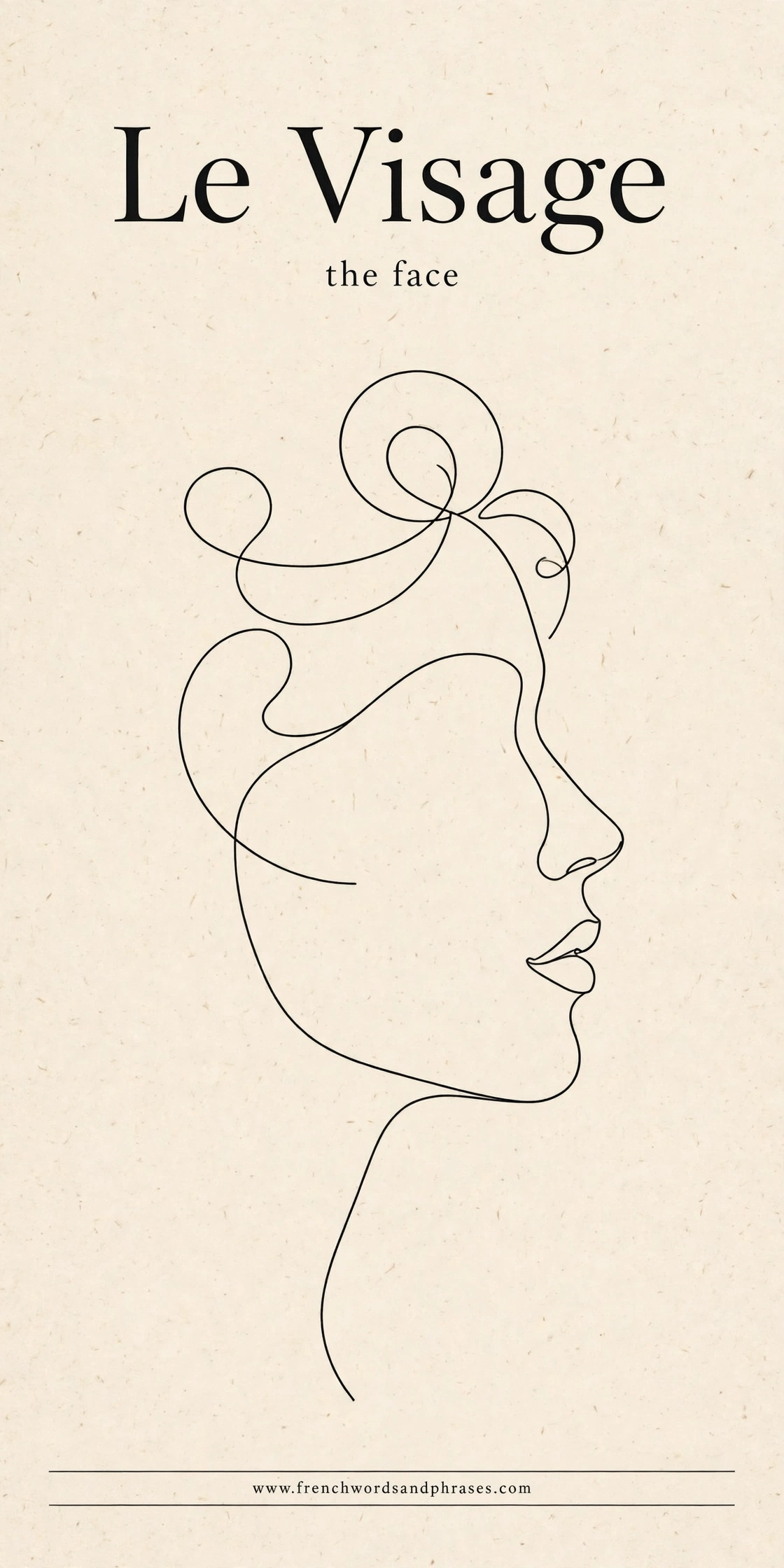
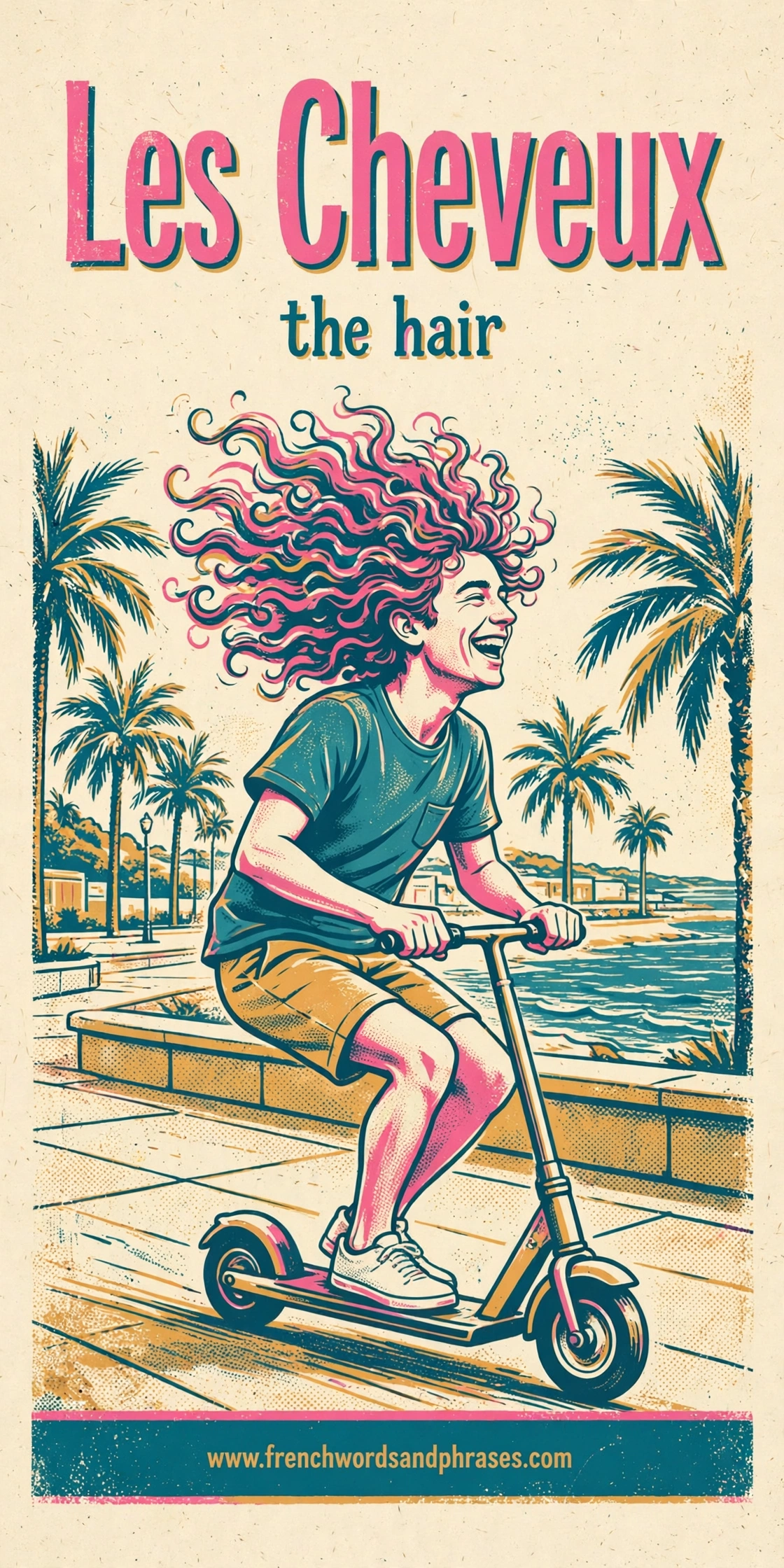
Les cheveux means the hair.
The hairdresser’s chair, the cape around your shoulders, and the question that starts every visit: « On coupe un peu ? » Everything in that chair revolves around one word — les cheveux.
In this guide, you’ll learn what cheveux means in English, how to use it with its articles, how to form its plural, and how it appears in everyday French. Explore French examples, English translations, and practice quizzes.
Understanding the French Noun Cheveux
Cheveux is a masculine French noun that lives in the plural: les cheveux, des cheveux. It is the plural of le cheveu — but where English counts hair as one uncountable mass, French counts it in the plural. A single hair, one strand on its own, is un cheveu.
It means the hair — the hair on your head, taken as a whole. You wash it (se laver les cheveux), brush it, cut it and style it, and French always speaks of it in the plural: mes cheveux sont longs, my hair is long. The singular cheveu appears when one individual hair is meant — a hair in your soup, a hair on your jacket.
Gender: Masculine — les cheveux
Number: Plural in everyday use; the singular is le cheveu, un cheveu
Definite article: les — les cheveux (the hair)
Indefinite article: des — des cheveux (hair, some hair)
Singular: un cheveu — one single hair, one strand
Plural pattern: cheveu → cheveux: words in -eu take -eux (like jeu → jeux)
English equivalents: The hair (on the head).
The classic trap: English says « my hair IS long », with a singular verb, but French says mes cheveux SONT longs — plural noun, plural verb, plural adjective. And when you get it cut, French uses the reflexive with the definite article: je me fais couper les cheveux, never « mes cheveux » in that phrase.
Experience the Word
Cheveux is never just hair in France. It is the appointment at the coiffeur you would not miss, the fringe you regret for a month, the grey hairs counted with theatrical despair.
Imagine the salon on a Saturday morning: the mirrors, the scissors singing, the wonderful smell of shampoo, and the mirror held up behind your head at the end — « Ça vous plaît ? »
You have not just had a haircut. You have been transformed — métamorphosé, one snip at a time.
How to Use Cheveux in French: Complete Guide
Let’s explore how cheveux works in French, beginning with its articles — and remember the golden rule: the hair on your head is plural, les cheveux.
Cheveux with the Definite Article (Les)
The hair as a whole takes les; one single strand takes le.
| Form | French |
|---|---|
| Plural — the hair on your head | les cheveux |
| Singular — one single hair | le cheveu |
Example
Les cheveux de Marie sont longs et bouclés.
Marie’s hair is long and curly.
Cheveux with the Indefinite Article (Des, Un)
Des for hair in general, un for one lone hair.
| Form | French |
|---|---|
| Plural | des cheveux |
| Singular — one hair | un cheveu |
Example
Il y a un cheveu dans ma soupe !
There is a hair in my soup!
Cheveux with the Partitive and Quantities (Des, Une mèche de…)
Hair is measured in locks, handfuls and lengths — here is how French counts it.
| Quantity | French |
|---|---|
| some hair | des cheveux |
| a lock of hair | une mèche de cheveux |
| a handful of hair | une poignée de cheveux |
| a lot of hair | beaucoup de cheveux |
| a single hair | un seul cheveu |
Example
Elle garde une mèche de cheveux de son bébé dans un livre.
She keeps a lock of her baby’s hair in a book.
Quick Quiz 1
Complete the sentence:
Mes cheveux ______ longs et noirs. (are)
Reveal the answer
sont
Mes cheveux sont longs et noirs.
My hair is long and black — cheveux is plural, so the verb and the adjectives are plural too.
The Plural of Cheveu
Cheveu belongs to the -eu family: the plural swaps -eu for -eux, like jeu → jeux and feu → feux.
| Number | French |
|---|---|
| Singular | le cheveu |
| Plural | les cheveux |
Example
Un cheveu blanc, puis deux, puis toute une tête de cheveux blancs.
One white hair, then two, then a whole head of white hair.
Cheveux with Possessive Adjectives (Mes, Tes, Ses…)
Because cheveux is plural, the possessives are the plural ones: mes, tes, ses.
| Owner | French |
|---|---|
| my | mes cheveux |
| your (tu) | tes cheveux |
| his / her | ses cheveux |
| our | nos cheveux |
| your (vous) | vos cheveux |
| their | leurs cheveux |
Example
Ses cheveux sont magnifiques après le brushing.
Her hair looks wonderful after the blow-dry.
Quick Quiz 2
Complete the sentence:
Elle se brosse ______ cheveux avant la photo. (the)
Reveal the answer
les
Elle se brosse les cheveux avant la photo.
She brushes her hair before the photo — with body parts, French uses the reflexive + les, not a possessive.
Cheveux with Demonstrative Adjectives (Ces)
Used to point: ces cheveux, those hairs — or that hair.
| Form | French |
|---|---|
| Plural | ces cheveux |
| Singular — one hair | ce cheveu |
Example
Regarde ces cheveux, ils brillent au soleil !
Look at that hair, it is shining in the sun!
Cheveux with Adjectives
Adjectives agree in the plural — longs, bouclés, blonds — because cheveux is masculine plural.
| Adjective | With Cheveux |
|---|---|
| long (long) | des cheveux longs |
| court (short) | des cheveux courts |
| bouclé (curly) | des cheveux bouclés |
| raide (straight) | des cheveux raides |
| blond (blond) | des cheveux blonds |
| gris (grey) | des cheveux gris |
Example
Il a des cheveux courts et une barbe grise.
He has short hair and a grey beard.
Quick Quiz 3
Complete the sentence:
Elle a les cheveux ______. (curly)
Reveal the answer
bouclés
Elle a les cheveux bouclés.
She has curly hair — bouclés, masculine plural, to agree with cheveux.
Everyday Expressions with Cheveux
Haircuts, hair-pulling and hair-splitting — the cheveux phrases of daily life.
| Expression | In English |
|---|---|
| se faire couper les cheveux | to get a haircut |
| se laver les cheveux | to wash your hair |
| s’arracher les cheveux | to tear your hair out (in despair) |
| couper les cheveux en quatre | to split hairs |
| avoir les cheveux longs | to have long hair |
| se faire une couleur | to dye your hair |
Example
Je me fais couper les cheveux samedi chez le coiffeur.
I’m getting my hair cut on Saturday at the hairdresser’s.
Words from the Same Family as Cheveux
Salons, shampoos and whole heads of hair — the words that travel with cheveux.
| French | In English |
|---|---|
| la chevelure | a head of hair, a mane |
| le coiffeur / la coiffeuse | the hairdresser |
| le shampooing | the shampoo |
| la brosse à cheveux | the hairbrush |
| le sèche-cheveux | the hairdryer |
| chevelu | long-haired, hairy |
Example
Sa chevelure rousse attire tous les regards.
Her red mane of hair turns every head.
Quick Quiz 4
What does s’arracher les cheveux mean?
Reveal the answer
To tear your hair out — in despair or frustration, not literally (usually).
Ce problème de maths me fait m’arracher les cheveux.
This maths problem is making me tear my hair out.
Cheveux in Everyday French: Real-Life Examples
Now that you know the word, let’s see how cheveux appears in everyday French.
Example 1 — At the hairdresser’s
Je voudrais me faire couper les cheveux, s’il vous plaît.
I would like to get my hair cut, please.
Example 2 — A compliment
Tes cheveux sont superbes aujourd’hui !
Your hair looks gorgeous today!
Example 3 — In the morning
Elle se brosse les cheveux devant le miroir.
She brushes her hair in front of the mirror.
Example 4 — Growing it out
Il laisse pousser ses cheveux depuis un an.
He has been growing his hair for a year.
Example 5 — Bad weather
Le vent a complètement défait mes cheveux.
The wind has completely messed up my hair.
Example 6 — A single hair
Attends, tu as un cheveu sur ton épaule.
Wait, you have a hair on your shoulder.
Beyond Translation: The Meaning of Cheveux
French hair has its own mythology: Samson’s strength lived in his cheveux, and the French language keeps the drama — one tears one’s hair out in despair, splits it in four to argue over nothing, and pulls a story « par les cheveux » when it is far-fetched. The word itself is ancient, from the Latin for the head’s covering, and it never travels alone: in French, hair is always a crowd, never a single mass.
To say les cheveux is to see hair the French way — a thousand individual strands, each one counted.
It evokes the salon mirror and the first grey hair, the lock kept in a baby book, and the plural verb that English speakers must learn to love: mes cheveux sont…
How to Remember the French Noun Cheveux
Remember it this way: Cheveux is the hair — and in French it is always plural: les cheveux, with a plural verb. One single strand is un cheveu.
- The hair on your head — les cheveux, mes cheveux sont longs.
- One hair in the soup — un cheveu, the lonely singular.
- The -eu family — cheveu, cheveux, like jeu, jeux.
The key idea is les cheveux — hair is plural in French.
Test Your Knowledge of Cheveux
Let’s see how much you’ve learned. Try answering these questions before revealing the answers.
Question 1
How do you say « my hair is long » in French?
Reveal the answer
Mes cheveux sont longs. — plural noun, plural verb, plural adjective.
Question 2
What is un cheveu?
Reveal the answer
One single hair — a lone strand. The hair on your head as a whole is les cheveux.
Question 3
Translate: I’m getting my hair cut tomorrow.
Reveal the answer
Je me fais couper les cheveux demain.
Question 4
What is la chevelure?
Reveal the answer
A head of hair, a mane — the whole mass of hair, seen as one splendid whole.
Question 5
Complete the sentence:
Elle a les cheveux ______ et bouclés. (long)
Reveal the answer
longs
Elle a les cheveux longs et bouclés.
She has long, curly hair.
Your Final Challenge
Can You Use It?
How would you say this in French?
“Her hair is long and curly.”
Reveal the answer
Ses cheveux sont longs et bouclés.
Her hair is long and curly.
A little French. A little curiosity. A richer everyday life.
LEARN FRENCH ONE WORD AT A TIME