A French Word to Live By
Translate Dame to English
/dam/
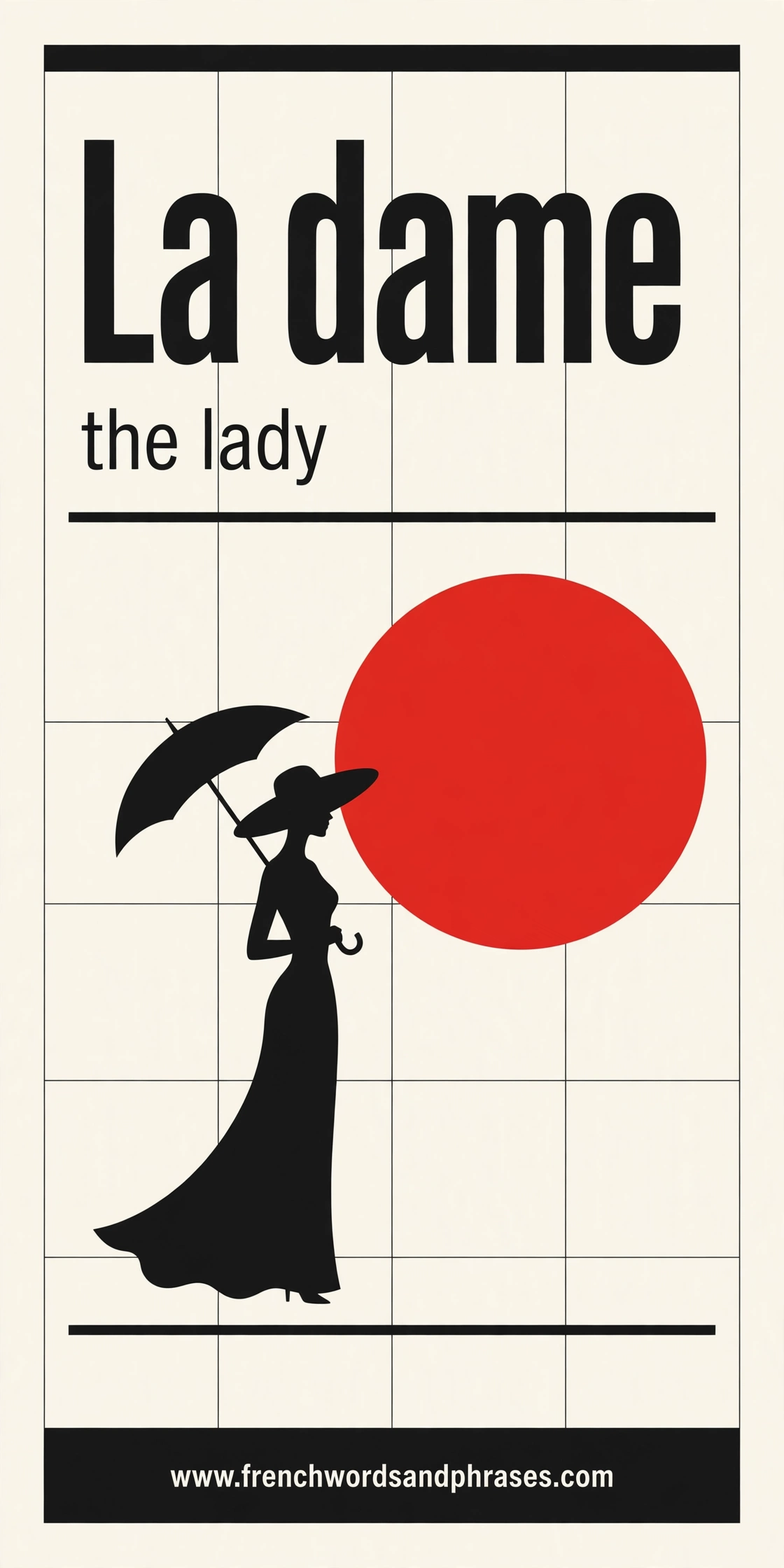
La dame means the lady.
A white glove, a straight back, a voice that makes a noisy room polite without raising itself: la dame, the lady — the word French children learn at the baker’s, where every customer in a skirt becomes une dame and politeness begins.
In this guide, you’ll learn what dame means in English, how to use it with its articles, how to form its plural, and how it appears in everyday French. Explore French examples, English translations, and practice quizzes.
Understanding the French Noun Dame
Dame is a feminine French noun, learned with its article: la dame, une dame. It comes from the Latin domina, the mistress of the house — the feminine of dominus, lord. The word still carries that old dignity: a dame is never just a female, she is a woman addressed with respect.
It means a lady, a grown woman spoken of politely: une dame âgée, an elderly lady, la dame du troisième, the lady on the third floor, une grande dame, a great lady. In games, la dame is the queen — at chess and at cards — and le jeu de dames is draughts (checkers). Children meet the word first in la dame de la cantine, the dinner lady, and in the respectful address bonjour, madame — for madame is dame wearing its title.
Gender: Feminine — la dame
Definite article: la — la dame (the lady)
Indefinite article: une — une dame (a lady)
Plural: les dames — regular, with a simple -s
Spelling note: from Latin domina, mistress of the house — the root of madame (ma dame)
In games: la dame is the queen at chess and cards; le jeu de dames is draughts
English equivalents: The lady.
French politeness runs on dame: a shopkeeper greets bonjour, madame, a child is told dis bonjour à la dame, say hello to the lady. Where English says “ladies and gentlemen”, French says mesdames et messieurs. Do not confuse dame with femme, the plain word for a woman or wife: femme describes, dame respects.
Experience the Word
Dame is the word that stands up when a woman enters the room: it is politeness turned into a noun.
Imagine the little bakery on the corner. The bell rings, an old lady in a grey coat comes in, and the baker’s boy — six years old, chin at counter height — pipes up: « Bonjour, madame ! » He has just learned the first law of French life: every woman is une dame until further notice.
You have not just named a woman. You have paid her a compliment in a single word — la dame, the lady.
How to Use Dame in French: Complete Guide
Let’s explore how dame works in French, beginning with its articles — la dame, une dame, une grande dame.
Dame with the Definite Article (La, Les)
Used for a specific lady — the one at the counter, the one upstairs.
| Form | French |
|---|---|
| Feminine singular | la dame |
| Plural | les dames |
Example
La dame du troisième étage nourrit les chats du quartier.
The lady on the third floor feeds the neighbourhood cats.
Dame with the Indefinite Article (Une, Des)
Used for a lady in general — any woman spoken of with respect.
| Form | French |
|---|---|
| Feminine singular | une dame |
| Plural | des dames |
Example
Une dame a demandé le chemin de la gare.
A lady asked the way to the station.
Dame with Ages and Kinds (Âgée, Grande, Jeune…)
Dame welcomes the adjectives of a whole life — young, old, great.
| Quantity | French |
|---|---|
| an elderly lady | une dame âgée |
| a young lady | une jeune dame |
| a great lady | une grande dame |
| the dinner lady | la dame de la cantine |
| the lady opposite | la dame d’en face |
Example
Une dame âgée traverse lentement la place.
An elderly lady crosses the square slowly.
Quick Quiz 1
Complete the sentence:
______ dame de la cantine sert les frites le vendredi. (the)
Reveal the answer
La
La dame de la cantine sert les frites le vendredi.
The dinner lady serves chips on Fridays — dame is feminine, so la.
The Plural of Dame
Dame takes a regular plural in -s — and les dames is where French politeness gathers.
| Number | French |
|---|---|
| Singular | la dame |
| Plural | les dames |
Example
Les dames du club de lecture se réunissent le jeudi.
The ladies of the book club meet on Thursdays.
Dame with Possessive Adjectives (Ma, Ta, Sa…)
Possessives agree with the noun: dame is feminine, so ma, ta, sa in the singular.
| Owner | French |
|---|---|
| my | ma dame |
| your (tu) | ta dame |
| his / her | sa dame |
| our | notre dame |
| your (vous) | votre dame |
| their | leur dame |
Example
Il a présenté sa dame à ses parents.
He introduced his lady to his parents.
Quick Quiz 2
Complete the sentence:
Dis bonjour à ______ dame, s’il te plaît. (the)
Reveal the answer
la
Dis bonjour à la dame, s’il te plaît.
Say hello to the lady, please — the first lesson of French politeness.
Dame with Demonstrative Adjectives (Cette, Ces)
Used to point: cette dame, this lady — the one everyone is looking at.
| Form | French |
|---|---|
| Feminine singular | cette dame |
| Plural | ces dames |
Example
Cette dame chante à l’opéra depuis vingt ans.
This lady has sung at the opera for twenty years.
Dame with Adjectives
Adjectives agree with dame — feminine singular: une dame charmante, une vieille dame.
| Adjective | With Dame |
|---|---|
| âgée (elderly) | une dame âgée |
| charmante (charming) | une dame charmante |
| grande (great, tall) | une grande dame |
| vieille (old) | une vieille dame |
| élégante (elegant) | une dame élégante |
Example
Une vieille dame nourrit les pigeons sur la place.
An old lady feeds the pigeons on the square.
Quick Quiz 3
Complete the sentence:
C’est une dame très ______, tout le monde l’aime. (charming)
Reveal the answer
charmante
C’est une dame très charmante, tout le monde l’aime.
She is a very charming lady, everyone loves her — charmante, feminine, to agree with dame.
Everyday Expressions with Dame
Bakeries, chessboards and wedding speeches — the dame phrases of daily life.
| Expression | In English |
|---|---|
| une grande dame | a great lady |
| le jeu de dames | draughts, checkers |
| la dame (aux échecs) | the queen (at chess) |
| mesdames et messieurs | ladies and gentlemen |
| la dame de la cantine | the dinner lady |
Example
Le dimanche, les enfants jouent au jeu de dames.
On Sundays, the children play draughts.
Words from the Same Family as Dame
Respect and address — the words that travel with dame.
| French | In English |
|---|---|
| madame | Mrs, Madam — ma dame, my lady |
| la femme | the woman, the wife — the plain word |
| une demoiselle | a young lady, a Miss (older usage) |
| Notre-Dame | Our Lady — the Virgin; the Paris cathedral |
| un damier | a draughtboard, a chequered pattern |
Example
Notre-Dame de Paris se dresse au bord de la Seine.
Notre-Dame of Paris stands on the bank of the Seine.
Quick Quiz 4
What is le jeu de dames?
Reveal the answer
Draughts (checkers) — the board game played with round pieces, named after its promoted pieces.
Mon grand-père gagne toujours au jeu de dames.
My grandfather always wins at draughts.
Dame in Everyday French: Real-Life Examples
Now that you know the word, let’s see how dame appears in everyday French.
Example 1 — At the bakery
Bonjour, madame, une baguette, s’il vous plaît.
Hello, madam, a baguette, please.
Example 2 — In the street
Une dame âgée demande le chemin de la poste.
An elderly lady asks the way to the post office.
Example 3 — At school
La dame de la cantine connaît tous les enfants.
The dinner lady knows all the children.
Example 4 — At chess
Attention, ta dame est en danger !
Careful, your queen is in danger!
Example 5 — A speech
Mesdames et messieurs, merci d’être venus.
Ladies and gentlemen, thank you for coming.
Example 6 — Respect
C’est une grande dame du théâtre français.
She is a great lady of the French theatre.
Beyond Translation: The Meaning of Dame
Dame is Latin domina worn smooth by a thousand years of good manners: the mistress of the house became the lady of the town, then every woman a polite tongue speaks of. French folded the word into its most famous address — madame is simply ma dame, my lady — and into its most famous building, Notre-Dame. On the chessboard the dame rose highest of all: the queen, the strongest piece on the board, carries the name of the lady.
To say dame is to bow in one syllable.
It evokes the bakery greeting, the elderly neighbour, the queen sweeping across the chessboard — respect, in its everyday uniform.
How to Remember the French Noun Dame
Remember it this way: Dame is the lady — feminine: la dame, the word of politeness, and the queen on the chessboard.
- Always feminine — la dame, une dame, ma dame (which became madame).
- Politeness, not description — femme is the plain word for a woman; dame adds respect.
- The games — la dame is the queen at chess; le jeu de dames is draughts.
The key idea is la dame — the lady, feminine; madame = ma dame; la dame is also the queen at chess.
Test Your Knowledge of Dame
Let’s see how much you’ve learned. Try answering these questions before revealing the answers.
Question 1
Is dame masculine or feminine?
Reveal the answer
Feminine — la dame, une dame.
Question 2
What word is hidden inside madame?
Reveal the answer
Dame — madame is ma dame, my lady.
Question 3
Translate: An elderly lady crosses the square.
Reveal the answer
Une dame âgée traverse la place.
Question 4
At chess, what is la dame?
Reveal the answer
The queen — the strongest piece on the board.
Question 5
Complete the sentence:
______ dames du club arrivent à dix heures. (the)
Reveal the answer
Les
Les dames du club arrivent à dix heures.
The ladies of the club arrive at ten.
Your Final Challenge
Can You Use It?
How would you say this in French?
“Say hello to the lady, please.”
Reveal the answer
Dis bonjour à la dame, s’il te plaît.
Say hello to the lady, please.
A little French. A little curiosity. A richer everyday life.
LEARN FRENCH ONE WORD AT A TIME