A French Word to Live By
Translate Cour to English
/kuʁ/
La cour means the courtyard.
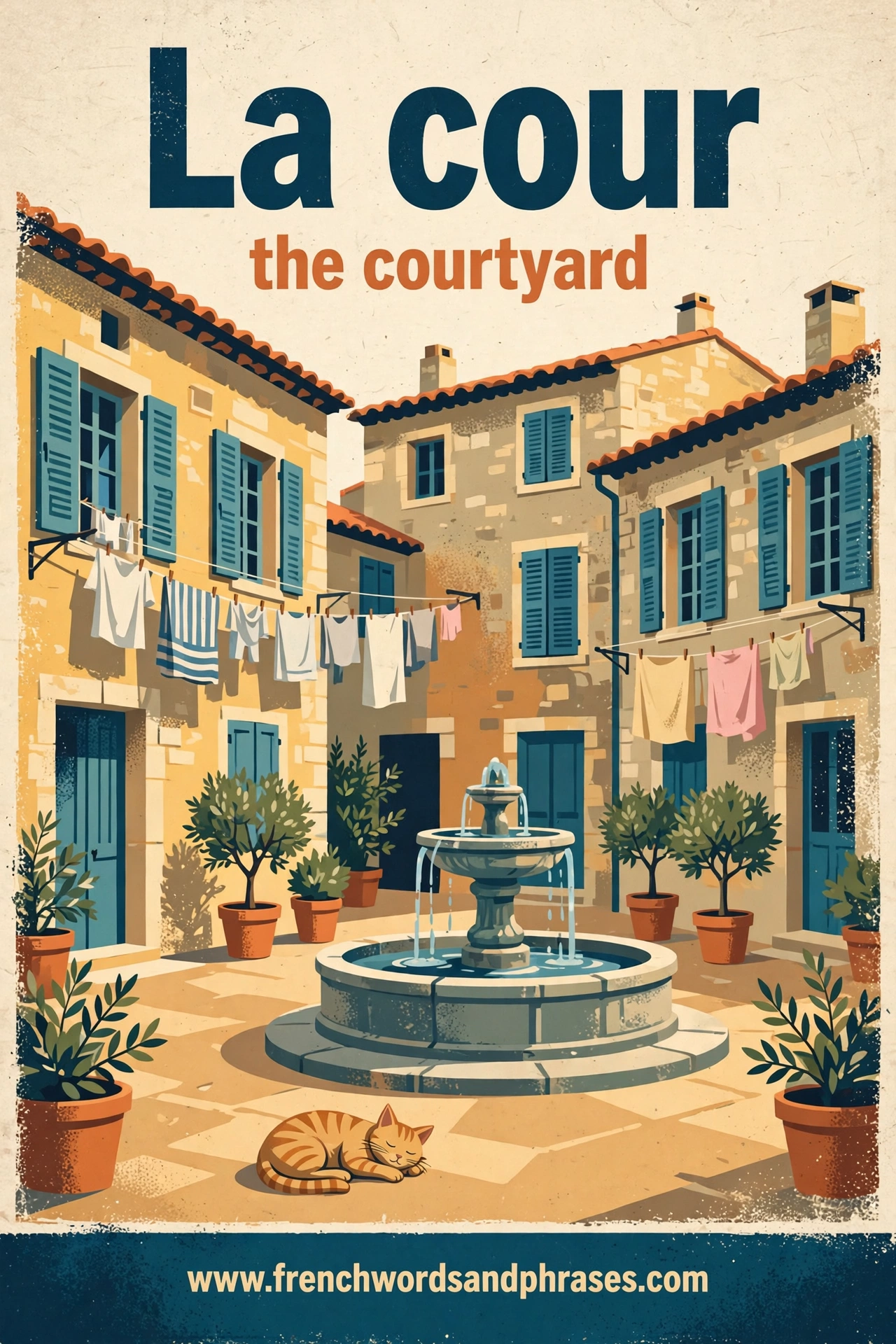
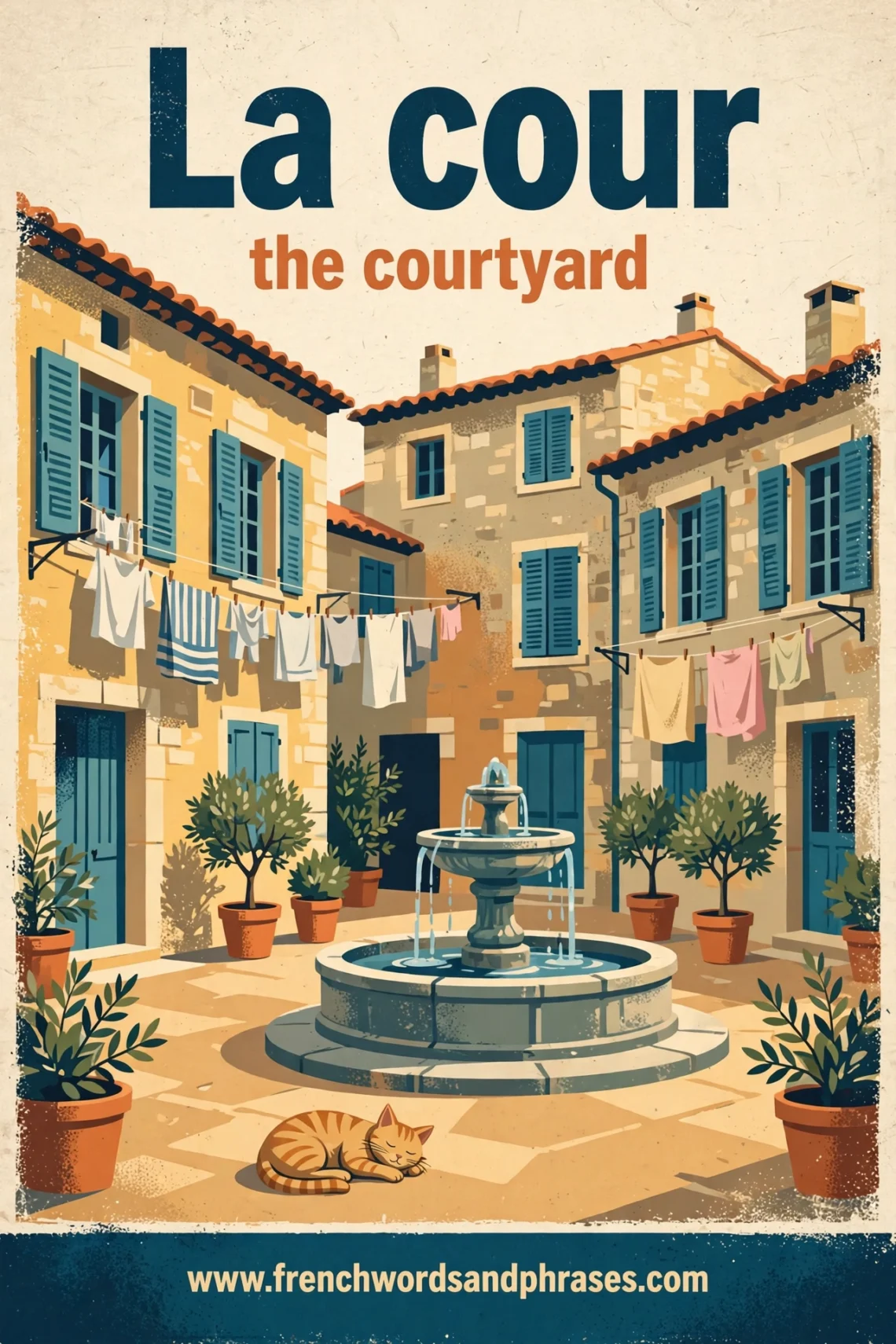
Sunlight falling into a stone square between old walls, a fountain in the middle, washing lines overhead: la cour, the courtyard — and the same word, in a robe and wig, judges thieves, and in a crown, surrounds a king.
In this guide, you’ll learn what cour means in English, how to use it with its articles, how to form its plural, and how it appears in everyday French. Explore French examples, English translations, and practice quizzes.
Understanding the French Noun Cour
Cour is a feminine French noun, learned with its article: la cour, une cour. It comes from the Latin cohors, an enclosed yard. One word, three great houses: the yard behind a building, the court of law, and the royal court — all of them, at root, an enclosure where people gather around a centre.
It means first a courtyard, a yard enclosed by buildings: la cour de l’école, the schoolyard, une cour intérieure, an inner courtyard, une maison avec cour, a house with a yard. Then the law: la cour d’appel, the court of appeal, la Cour de cassation, France’s highest court, comparaître devant la cour, to appear before the court. Then royalty: la cour du roi, the king’s court, faire sa cour à quelqu’un, to court someone, to pay court to them — the flattery sense that gives English its word courtship.
Gender: Feminine — la cour
Definite article: la — la cour (the courtyard, the court)
Indefinite article: une — une cour (a courtyard, a court)
Plural: les cours — regular, with a simple -s
Spelling note: not cours (a lesson, a course) and not cœur (the heart) — three near-twins
Three lives: the yard, the court of law, the royal court
English equivalents: The courtyard, the yard; the court (of law, of a king).
Children live the first sense daily: la cour de récréation is the school playground, and dans la cour des grands — in the big children’s yard — is the French idiom for being among the grown-ups, playing in the big league. For the law, learn the fixed names: la cour d’assises tries serious crimes, la cour d’appel hears appeals. And faire sa cour is the flattering dance around anyone powerful, king or boss.
Experience the Word
Cour is the space a wall creates: whoever stands in the middle of it — teacher, judge or king — becomes the centre of the world for an hour.
Imagine the school bell at ten. Doors burst open and two hundred children pour into la cour, and for fifteen minutes the stone yard is the loudest, happiest parliament in France — then the bell again, and silence, and the empty cour shining in the sun.
You have not just named a yard. You have named every gathered circle of power — la cour, courtyard, courtroom and court.
How to Use Cour in French: Complete Guide
Let’s explore how cour works in French, beginning with its articles — la cour, une cour, la cour de l’école.
Cour with the Definite Article (La, Les)
Used for a specific cour — the school one, the king’s one.
| Form | French |
|---|---|
| Feminine singular | la cour |
| Plural | les cours |
Example
La cour de l’école est pleine d’enfants à dix heures.
The schoolyard is full of children at ten o’clock.
Cour with the Indefinite Article (Une, Des)
Used for a cour in general — any yard, any court.
| Form | French |
|---|---|
| Feminine singular | une cour |
| Plural | des cours |
Example
La vieille maison a une cour pleine de fleurs.
The old house has a courtyard full of flowers.
Cour in Its Three Lives (École, Justice, Roi…)
One word, three theatres — the yard, the law and the crown.
| Quantity | French |
|---|---|
| the schoolyard | la cour de l’école |
| an inner courtyard | une cour intérieure |
| the court of appeal | la cour d’appel |
| the king’s court | la cour du roi |
| the playground (break) | la cour de récréation |
Example
La cour d’appel a confirmé le jugement.
The court of appeal upheld the judgement.
Quick Quiz 1
Complete the sentence:
______ cour de récréation est fermée quand il pleut. (the)
Reveal the answer
La
La cour de récréation est fermée quand il pleut.
The playground is closed when it rains — cour is feminine, so la.
The Plural of Cour
Cour takes a regular plural in -s — les cours, not to be read as lessons.
| Number | French |
|---|---|
| Singular | la cour |
| Plural | les cours |
Example
Les cours des vieilles maisons donnent sur la ruelle.
The courtyards of the old houses open onto the lane.
Cour with Possessive Adjectives (Ma, Ta, Sa…)
Possessives agree with the noun: cour is feminine, so ma, ta, sa in the singular.
| Owner | French |
|---|---|
| my | ma cour |
| your (tu) | ta cour |
| his / her | sa cour |
| our | notre cour |
| your (vous) | votre cour |
| their | leur cour |
Example
De ma fenêtre, je vois ma cour et mon petit jardin.
From my window, I can see my courtyard and my little garden.
Quick Quiz 2
Complete the sentence:
Le roi recevait ______ cour tous les matins. (his)
Reveal the answer
sa
Le roi recevait sa cour tous les matins.
The king received his court every morning — sa, because cour is feminine.
Cour with Demonstrative Adjectives (Cette, Ces)
Used to point: cette cour, this courtyard — this court.
| Form | French |
|---|---|
| Feminine singular | cette cour |
| Plural | ces cours |
Example
Cette cour, en été, devient un vrai four.
This courtyard, in summer, becomes a real oven.
Cour with Adjectives
Adjectives agree with cour — feminine singular: une cour ombragée, une cour suprême.
| Adjective | With Cour |
|---|---|
| intérieure (inner) | une cour intérieure |
| ombragée (shaded) | une cour ombragée |
| suprême (supreme) | la Cour suprême |
| grande (big) | une grande cour |
| pavée (paved) | une cour pavée |
Example
Nous déjeunons dans une cour ombragée, loin du bruit.
We have lunch in a shaded courtyard, away from the noise.
Quick Quiz 3
Complete the sentence:
La maison a une cour ______ pleine de rosiers. (inner)
Reveal the answer
intérieure
La maison a une cour intérieure pleine de rosiers.
The house has an inner courtyard full of rose bushes — intérieure, feminine, to agree with cour.
Everyday Expressions with Cour
Playgrounds, palaces and law courts — the cour phrases of daily life.
| Expression | In English |
|---|---|
| la cour de récréation | the school playground |
| la cour d’appel | the court of appeal |
| faire sa cour à quelqu’un | to court someone, to pay court |
| dans la cour des grands | among the grown-ups, in the big league |
| la cour du roi | the king’s court |
Example
À vingt ans, il joue enfin dans la cour des grands.
At twenty, he is finally playing in the big league.
Words from the Same Family as Cour
Gathering and enclosing — the words that travel with cour.
| French | In English |
|---|---|
| un courtisan | a courtier |
| la courtoisie | courtesy — the manners of the court |
| un cours | a lesson, a course — the near-twin, masculine |
| le cœur | the heart — the other near-twin |
| une couronne | a crown |
Example
La courtoisie était la loi de la cour du roi.
Courtesy was the law of the king’s court.
Quick Quiz 4
What does dans la cour des grands mean?
Reveal the answer
Among the grown-ups — in the big league, literally in the big children’s yard.
Son premier roman l’a fait entrer dans la cour des grands.
His first novel put him in the big league.
Cour in Everyday French: Real-Life Examples
Now that you know the word, let’s see how cour appears in everyday French.
Example 1 — At school
Les enfants jouent dans la cour de récréation.
The children play in the schoolyard.
Example 2 — At home
La cour est pleine de fleurs au printemps.
The courtyard is full of flowers in spring.
Example 3 — The law
La cour d’appel siège dans le vieux palais.
The court of appeal sits in the old palace.
Example 4 — History
La cour du roi vivait à Versailles.
The king’s court lived at Versailles.
Example 5 — Flattery
Il fait sa cour au directeur depuis des mois.
He has been courting the director for months.
Example 6 — The big league
Cette victoire la place dans la cour des grands.
This victory puts her in the big league.
Beyond Translation: The Meaning of Cour
Cour began as a farmyard: Latin cohors was the enclosed ground where animals and soldiers were kept together. The yard of a great house filled with servants and petitioners became the king’s cour; the yard where justice was rendered under a tree became the cour of law; and the manners polished there gave English courtesy and the verb to court. One enclosure, three institutions — and a fourth, the schoolyard, where every French child first learns what a gathered crowd is.
To say cour is to stand in the middle of the enclosure and look at the centre.
It evokes the playground bell, the judge’s robe and the throne — every circle French life draws around a centre.
How to Remember the French Noun Cour
Remember it this way: Cour is the courtyard, the court of law and the royal court — feminine: la cour, three lives in one enclosure.
- Always feminine — la cour, une cour, ma cour.
- Three lives — la cour de l’école (yard), la cour d’appel (law), la cour du roi (royalty).
- Not its twins — un cours is a lesson, le cœur is the heart.
The key idea is la cour — the courtyard, the court, feminine; dans la cour des grands = in the big league.
Test Your Knowledge of Cour
Let’s see how much you’ve learned. Try answering these questions before revealing the answers.
Question 1
Is cour masculine or feminine?
Reveal the answer
Feminine — la cour, une cour.
Question 2
How do you say the school playground?
Reveal the answer
La cour de récréation — or simply la cour de l’école.
Question 3
Translate: The court of appeal upheld the judgement.
Reveal the answer
La cour d’appel a confirmé le jugement.
Question 4
What is the difference between la cour and un cours?
Reveal the answer
La cour is the courtyard/court; un cours is a lesson — same sound, different word and gender.
Question 5
Complete the sentence:
______ cours des vieilles maisons sont pavées. (the)
Reveal the answer
Les
Les cours des vieilles maisons sont pavées.
The courtyards of the old houses are paved.
Your Final Challenge
Can You Use It?
How would you say this in French?
“The children play in the schoolyard.”
Reveal the answer
Les enfants jouent dans la cour de récréation.
The children play in the schoolyard.
A little French. A little curiosity. A richer everyday life.
LEARN FRENCH ONE WORD AT A TIME