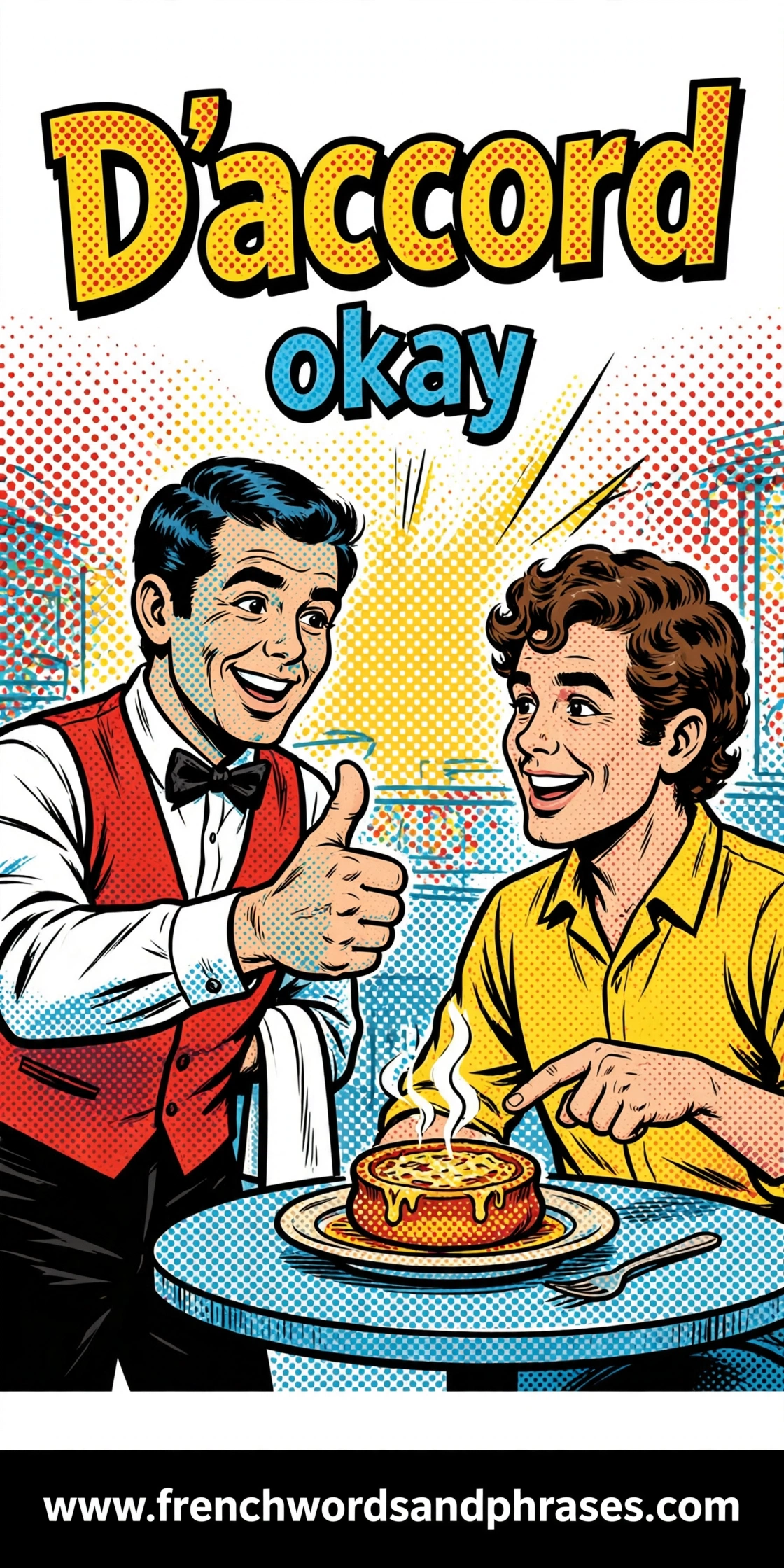
A French Word to Live By
Translate D’accord to English
/da.kɔʁ/
D’accord means okay!.
At a market stall in Bordeaux, the vendor names a price for the cheese, thinks, lowers it a little, and raises an eyebrow. The customer nods once, hand already in her pocket: « D’accord, je le prends. » Okay, I’ll take it. D’accord is the French handshake in word form — the moment a discussion ends and a deal, a plan or a truce begins.
Let’s explore how d’accord works in French, beginning with the whole reaction on one card.
Understanding the French Interjection D’accord
D’accord is a French agreement phrase — literally “of accord, in agreement”. As an interjection it is the everyday French yes-with-a-handshake: okay, agreed, deal. Behind it stands the verb form être d’accord, to agree.
It means okay, agreed, all right. But it is not a bare oui: d’accord accepts a proposal. Someone suggests, offers, proposes or requests — and d’accord is the word that closes the bargain and sets it in stone.
Type: Interjection / agreement phrase — agreeing, accepting a proposal
Answers the need: Saying yes properly — to an idea, a price, a plan, a request
Register: Neutral and universal — from the market stall to the boardroom
Strength: Clear and final — one d’accord closes the discussion; doubled, it can turn impatient
One important usage detail: d’accord never changes its shape. Je suis d’accord, nous sommes d’accord, elles sont d’accord — the verb être does all the moving, and accord keeps its form with every person, every gender, every number. Never write d’accords.
Experience the Word
D’accord is the click of a deal closing — small, clean, final.
Imagine two old friends dividing a cake, a flat and a holiday plan in one long phone call. At the end, everything settled, they both say it at the same time and laugh: « D’accord ! »
You have not just said yes. You have signed, in one word, at the bottom of the conversation.
How to Use D’accord in French: Complete Guide
Let’s explore how d’accord works in French, beginning with the whole reaction on one card.
D’accord at a Glance
The Whole Reaction on One Card
Meaning, job, register and strength — d’accord in four lines.
| Point | D’accord |
|---|---|
| Meaning | okay / agreed / all right — yes to a proposal |
| Job | accepts, confirms and closes an agreement |
| Register | neutral and universal — market, office, family, friends |
| Strength | clear and final — doubled (d’accord, d’accord) it can mean ‘enough, I heard you’ |
Example
On se retrouve à midi ? — D’accord !
Shall we meet at noon? — Okay!
When You Say It: The Trigger Moments
D’accord answers proposals — every time something is suggested, offered or requested.
| Situation | Example |
|---|---|
| A meeting time is proposed | à dix heures ? d’accord — at ten? okay |
| A price is settled | vingt euros, d’accord, je le prends — twenty euros, deal, I’ll take it |
| A plan is confirmed | d’accord, on part samedi matin — okay, we’re leaving on Saturday morning |
| A rule is accepted | d’accord, je rangerai ma chambre — okay, I’ll tidy my room |
| An opinion wins you over | je suis d’accord avec toi — I agree with you |
Example
D’accord pour le train de sept heures.
Agreed on the seven o’clock train.
Quick Quiz 1
Does d’accord answer a fact, or a proposal?
Reveal the answer
A proposal — for a plain factual yes, French uses oui; d’accord accepts something suggested or offered.
On mange italien ce soir ? — D’accord !
Shall we eat Italian tonight? — Okay!
The Reaction Question: One Word, Several Temperatures
D’accord is the same at every temperature — only the voice changes what the yes is worth.
| Delivery | What it does |
|---|---|
| Bright and quick, with a nod | enthusiastic yes — a pleasure to agree |
| Flat and calm | simple confirmation — noted, settled |
| Slow: d’a-ccord… | reluctant — okay, if we must |
| D’accord, d’accord ! | impatient — okay, okay, I heard you the first time |
| D’accord, mais… | a yes with a suitcase — agreement, then a condition |
Example
D’accord, mais je préfère partir tôt.
Okay, but I prefer to leave early.
Where It Goes: Standalone, and the Avec / Pour / Sur Family
D’accord stands alone as a complete answer, or grows three useful tails: avec, pour and sur.
| Position / pattern | Example |
|---|---|
| Standalone | d’accord ! — okay, agreed, the whole reply |
| Être d’accord avec + person | je suis d’accord avec toi — I agree with you |
| D’accord pour + noun / infinitive | d’accord pour demain — agreed for tomorrow; d’accord pour partir à huit heures |
| D’accord sur + noun | nous sommes d’accord sur l’essentiel — we agree on the main point |
Example
Elle est d’accord avec le directeur sur le prix.
She agrees with the director on the price.
Quick Quiz 2
“Je suis d’accord avec toi” — does accord change form for a woman speaking?
Reveal the answer
Never — d’accord is invariable; only être changes.
Elle est d’accord avec moi.
She agrees with me.
Everyday Expressions with D’accord
D’accord anchors a handful of everyday agreements — and one famous disagreement.
| Expression | In English |
|---|---|
| d’accord ! | agreed! / okay! |
| pas d’accord ! | I disagree! / not okay! |
| on est d’accord | we agree / it’s a deal |
| d’accord avec toi à cent pour cent | I agree with you one hundred percent |
| d’accord, mais… | okay, but… (the yes that negotiates) |
Example
On est d’accord, alors on signe demain.
We agree, so we’ll sign tomorrow.
Close Cousins: The Other Ways to Say Yes
French agrees in several flavours — d’accord is the general-purpose one; its cousins add colour.
| Word | The difference |
|---|---|
| d’accord | okay / agreed — the all-purpose yes to a proposal |
| bien sûr | of course — a stronger yes, for things that seem obvious |
| exactement | exactly — you agree with a statement, word for word |
| entendu | understood / agreed — businesslike, a little formal |
| ça marche | that works — an informal yes to a plan |
| volontiers | gladly — accepting an offer with pleasure |
Example
Un café ? — Volontiers ! Alors, d’accord pour la terrasse.
A coffee? — Gladly! Okay then, the terrace it is.
Quick Quiz 3
Which cousin accepts an invitation with pleasure — entendu or volontiers?
Reveal the answer
volontiers — entendu is the businesslike “noted and agreed”.
Tu viens avec nous ? — Volontiers !
Are you coming with us? — Gladly!
D’accord and Its Neighbours
The agreement shelf around d’accord, from the shrug to the full-hearted yes.
| French | In English |
|---|---|
| pas d’accord | I disagree (the shelf’s opposite end) |
| bof | meh (no yes at all — the shrug) |
| d’accord | okay, agreed (the standard yes) |
| ça marche | that works (the casual yes) |
| bien sûr | of course! (the emphatic yes) |
Example
Pas d’accord ? Alors explique-moi, je t’écoute.
You disagree? Then explain, I’m listening.
Watch Out: The Traps Around D’accord
The traps: the phantom plural, the nagging double, and answering everything with d’accord.
| Trap | The truth |
|---|---|
| adding agreement endings | never d’accords, never d’accorde — d’accord is invariable; être does the changing |
| d’accord, d’accord as a warm yes | doubled, it usually means “okay, okay, stop pushing” — warmth needs a single, smiling d’accord |
| using it for every yes | for a plain factual answer (Tu as faim ? — Oui), oui is the word; d’accord is for proposals |
| forgetting the apostrophe | it is d’accord, with the apostrophe of de + accord — the d’ is not optional decoration |
Example
Nous sommes tous d’accord, sans exception.
We all agree, without exception.
Quick Quiz 4
True or false: a woman says “je suis d’accorde”.
Reveal the answer
False — d’accord never changes: je suis d’accord, elle est d’accord, nous sommes d’accord.
Elles sont d’accord avec le plan.
They (the women) agree with the plan.
D’accord in Everyday French: Real-Life Examples
Now that you know the word, let’s see how d’accord appears in everyday French.
Example Example 1 — Plans
On se retrouve devant la gare ? — D’accord !
Shall we meet in front of the station? — Okay!
Example Example 2 — Shopping
Je vous le laisse à vingt euros. — D’accord, je le prends.
I’ll let you have it for twenty euros. — Deal, I’ll take it.
Example Example 3 — Family
Tu ranges ta chambre avant le dîner, d’accord ?
You’ll tidy your room before dinner, okay?
Example Example 4 — Work
Je suis d’accord avec cette proposition.
I agree with this proposal.
Example Example 5 — Travel
D’accord, on part à sept heures précises.
Okay, we’re leaving at seven sharp.
Example Example 6 — Negotiation
D’accord, mais je préfère le train.
Okay, but I prefer the train.
Beyond Translation: The Meaning of D’accord
Underneath d’accord sits an old, beautiful idea: accord is the same root as cœur’s Latin cousin cor — the heart. To be d’accord was, once, to be of one heart. The market haggling and the meeting-room confirmations have worn the poetry off, but the structure still shows it: an agreement in French is not a surrender, it is a tuning — two instruments brought to the same note.
To say d’accord is to tune yourself to the other person, out loud.
And its stubborn grammar carries the lesson: people change (je, tu, nous), but the accord itself does not bend. Once you are d’accord, the word stays exactly as it was.
How to Remember the French Interjection D’accord
Remember it this way: Remember it this way: D’accord is the handshake that ends the discussion — one word, signed by both sides.
- You answer proposals with it — for plain facts, plain oui is enough.
- You never change it — être moves, d’accord stays.
- You hear the temperature — one warm d’accord agrees; two flat ones end the nagging.
The key idea is d’accord means okay and agreed, it answers proposals, and it never changes form.
Test Your Knowledge of D’accord
Let’s see how much you’ve learned. Try answering these questions before revealing the answers.
Question 1
What does d’accord mean?
Reveal the answer
Okay / agreed / all right — a yes to a proposal, an offer or a plan.
Question 2
Does d’accord change for women or for groups?
Reveal the answer
Never — je suis d’accord, elle est d’accord, nous sommes d’accord. Only être changes.
Question 3
Translate: Okay, I’ll take it.
Reveal the answer
D’accord, je le prends.
Question 4
What is the difference between oui and d’accord?
Reveal the answer
Oui answers facts; d’accord accepts proposals. “Tu es prêt ? — Oui.” but “On part à huit heures ? — D’accord.”
Question 5
Complete the sentence:
Nous sommes ______ avec le directeur. (We are in agreement with the director.)
Reveal the answer
d’accord
Nous sommes d’accord avec le directeur.
We agree with the director.
Your Final Challenge
Can You Use It?
How would you say this in French?
“How would you say this in French?”
Reveal the answer
D’accord, à demain !
Okay, see you tomorrow!
A little French. A little curiosity. A richer everyday life.
LEARN FRENCH ONE WORD AT A TIME