
A French Word to Live By
Translate Derrière to English
/dɛ.ʁjɛʁ/
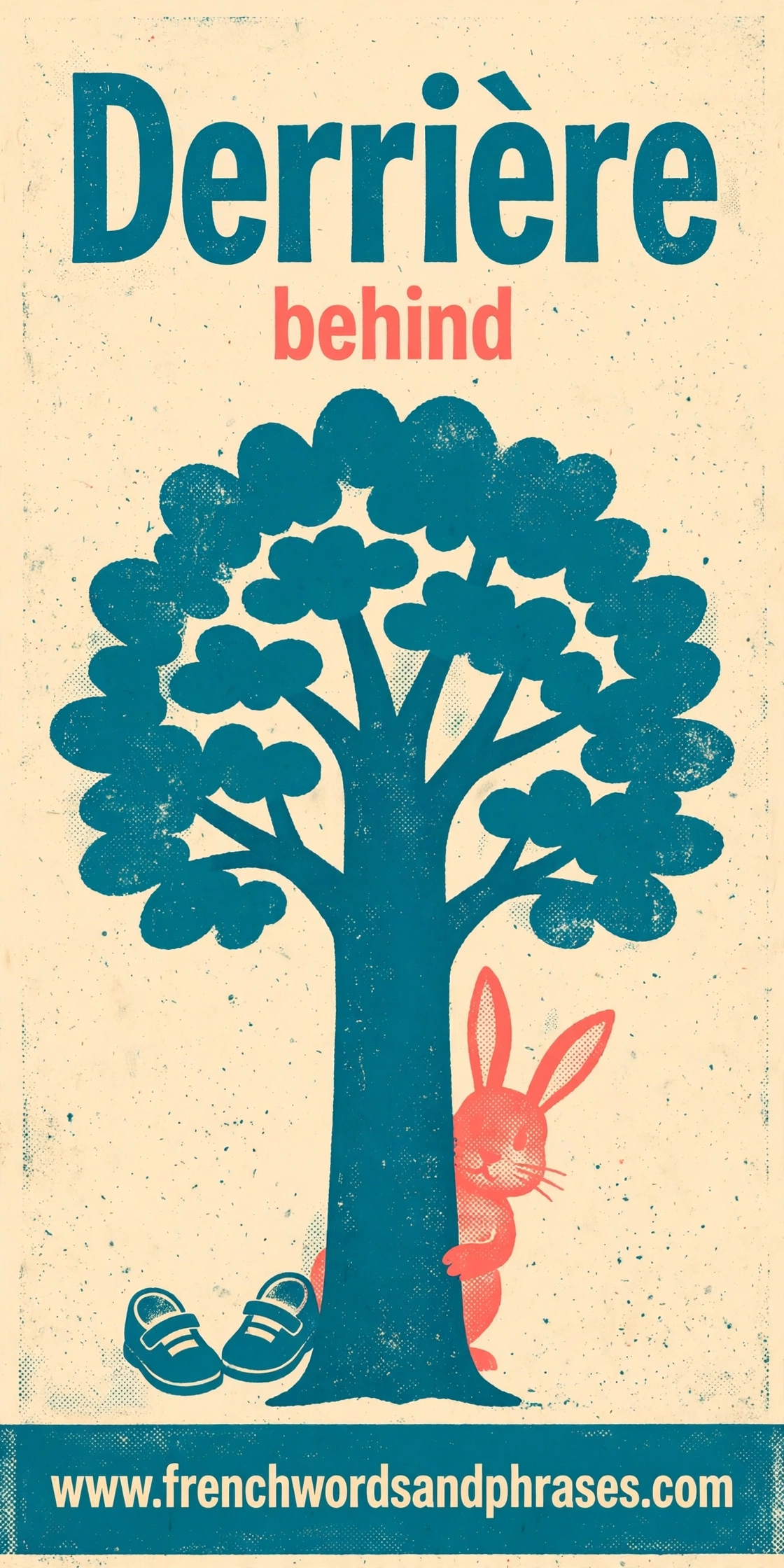
Derrière means behind.
In a schoolyard, a small boy hides behind his mother, holding her coat, peeking at the new teacher with one wide eye. « Le garçon se cache derrière sa mère. » The boy is hiding behind his mother. Derrière is the simplest of directions: what stands between you and the world is in front; what hides on the other side is behind. It also hides secrets, reasons and the past itself.
Let’s explore how derrière works in French, beginning with the whole word on one card.
Understanding the French Preposition Derrière
Derrière is a French preposition of place — and also an adverb, since it can stand alone without a noun. It places something on the far side of a landmark, hidden from view, and by extension it covers what supports, follows or lies in the past.
It means behind. The picture is a straight line: you, the landmark, and the hidden thing, in that order. The cat behind the curtain, the garden behind the house, the truth behind the smile — derrière always puts the landmark between you and the thing.
Type: Preposition (and adverb) — place (far side)
Answers the question: Où ? — Where? (Answer: on the hidden far side)
What follows it: A noun or pronoun: derrière la porte, derrière moi
Watch the pair: devant (in front of) vs derrière (behind) — the two sides of every landmark
One important usage detail: derrière also does hidden work — derrière la blague, il y a une vérité (behind the joke, there is a truth), être derrière quelqu’un (to support someone, to be behind them). French keeps the same spatial image for support and for secrets.
Experience the Word
Derrière is the preposition of hiding places — curtains, doors, mothers’ coats, and everything the eye cannot reach.
Imagine a game of hide and seek in a garden at dusk: one child behind the apple tree, one behind the shed, one flat behind the compost heap, giggling.
You have not just said where something is. You have put a wall, a tree or a person between the viewer and the thing — and made the thing invisible.
How to Use Derrière in French: Complete Guide
Let’s explore how derrière works in French, beginning with the whole word on one card.
Derrière at a Glance
The Whole Word on One Card
Meaning, job, pattern and pair — derrière in four lines.
| Point | Derrière |
|---|---|
| Meaning | behind (the far side, hidden from view) |
| Job | places something on the far side of a landmark |
| What follows | a noun or pronoun — la maison, le rideau, moi |
| Its opposite | devant — in front of |
Example
Le jardin est derrière la maison.
The garden is behind the house.
The Pattern in Action: The Hidden Side
Derrière connects a thing to the landmark that hides it — house, tree, curtain or person.
| Pattern | Example |
|---|---|
| behind a building | le jardin est derrière la maison — the garden is behind the house |
| behind a person | le chat se cache derrière le canapé — the cat hides behind the sofa |
| behind with a pronoun | mets-toi derrière moi — stand behind me |
| behind in a queue | il est derrière nous dans la file — he is behind us in the queue |
Example
Il y a un trésor derrière la vieille porte.
There is a treasure behind the old door.
Quick Quiz 1
“The cat is behind the curtain” — derrière or devant?
Reveal the answer
derrière — the curtain is between the viewer and the cat.
Le chat est derrière le rideau.
The cat is behind the curtain.
The Tricky Bit: Derrière vs Après — Behind in Space vs After in Time
English uses ‘behind’ and ‘after’ almost interchangeably. French draws a firm line: behind is space, after is time.
| Word | The difference |
|---|---|
| derrière | behind in SPACE: derrière la porte — behind the door |
| après | after in TIME or order: après le dîner — after dinner |
| derrière + person | support or secrecy: être derrière quelqu’un — to back someone |
| après + person | following in a line: après moi — after me (in the queue) |
Example
Après le dîner, il reste derrière la maison, à regarder les étoiles.
After dinner, he stays behind the house, looking at the stars.
Where It Goes: Between the Viewer and the Hidden Thing
Derrière stands alone as an adverb or takes a noun as a preposition — it never needs de, and it never contracts.
| Position / pattern | Example |
|---|---|
| as a preposition | derrière la porte — behind the door |
| as an adverb (alone) | regarde derrière toi ! — look behind you! |
| with a pronoun | derrière moi, derrière elle, derrière nous |
| with an infinitive of purpose | derrière le sourire, la fatigue — behind the smile, the tiredness |
Example
Attention, il y a quelqu’un derrière toi.
Careful, there is someone behind you.
Quick Quiz 2
“Look behind you!” — what do you say?
Reveal the answer
Regarde derrière toi ! — derrière stands alone as an adverb, no de needed.
Regarde derrière toi !
Look behind you!
Everyday Expressions with Derrière
Derrière hides people, secrets and the past — French uses it everywhere.
| Expression | In English |
|---|---|
| se cacher derrière | to hide behind (a person or an excuse) |
| être derrière quelqu’un | to support someone, to have their back |
| derrière chaque grand homme… | behind every great man… (the famous saying) |
| par-derrière | from behind / round the back way |
| le passé est derrière nous | the past is behind us |
Example
Ne te cache pas derrière des excuses : dis la vérité.
Don’t hide behind excuses: tell the truth.
Close Cousins: The Sides of a Landmark
Every landmark has sides — derrière is the hidden one.
| Word | The difference |
|---|---|
| derrière | behind, the far side, hidden |
| devant | in front of, the visible side |
| après | after in time or order, not space |
| en arrière | backwards, to the rear: marche en arrière — walk backwards |
Example
Devant la maison il y a un jardin, et derrière, une cour.
In front of the house there is a garden, and behind, a courtyard.
Quick Quiz 3
Which cousin means “after dinner” — derrière or après?
Reveal the answer
après — dinner is an event in time; derrière is space.
Après le dîner, on marche un peu.
After dinner, we go for a little walk.
Derrière and Its Neighbours
The direction shelf: front, back, side, above, below.
| French | In English |
|---|---|
| devant | in front of |
| derrière | behind |
| à côté de | next to |
| au-dessus de | above |
| au-dessous de | below |
Example
Devant la maison, une fontaine ; derrière, un verger.
In front of the house, a fountain; behind, an orchard.
Watch Out: The Traps Around Derrière
The traps: derrière for ‘after’, adding a de, and the English ‘behind schedule’ mix-up.
| Trap | The truth |
|---|---|
| using derrière for time | after dinner is après le dîner — derrière is space only |
| writing ‘derrière de la porte’ | derrière takes its noun directly — derrière la porte, no de |
| translating ‘behind schedule’ | that is en retard — not derrière, which is purely spatial |
| using it without a landmark | derrière needs something to hide behind; alone it means ‘behind (you)’ as an adverb |
Example
Le train est en retard, et le chat est derrière la porte.
The train is late, and the cat is behind the door.
Quick Quiz 4
True or false: derrière takes de before its noun.
Reveal the answer
False — derrière la maison, never ‘derrière de la maison’.
Le vélo est derrière la maison.
The bike is behind the house.
Derrière in Everyday French: Real-Life Examples
Now that you know the word, let’s see how derrière appears in everyday French.
Example Example 1 — Home
Les clés sont derrière le livre.
The keys are behind the book.
Example Example 2 — Garden
Le chien dort derrière la cabane.
The dog is sleeping behind the shed.
Example Example 3 — School
Il est assis derrière moi en classe.
He sits behind me in class.
Example Example 4 — Queue
Nous sommes derrière une famille avec trois enfants.
We are behind a family with three children.
Example Example 5 — Support
Nous sommes tous derrière toi.
We are all behind you (supporting you).
Example Example 6 — Past
Les soucis sont derrière nous maintenant.
The worries are behind us now.
Beyond Translation: The Meaning of Derrière
English “behind” already hides two ideas — the hidden side and the supporter standing at your back. French derrière keeps both, and adds the past: le passé est derrière nous, the past is behind us, walked past and left there.
To say derrière is to point at what cannot be seen — and sometimes that is a person, a secret, or a whole history.
That is why French loves it for excuses too: se cacher derrière un prétexte — to hide behind a pretext — puts the excuse between the speaker and the truth, exactly like a curtain.
How to Remember the French Preposition Derrière
Remember it this way: Remember it this way: Derrière is the curtain word — the landmark stands between you and the thing, and the thing is hidden.
- You draw the line — you, then the landmark, then the hidden thing.
- You never add de — derrière la porte, and it also stands alone as an adverb.
- You split space and time — derrière for behind, après for after.
The key idea is derrière means behind in space, takes its noun directly with no de, and after in time is après.
Test Your Knowledge of Derrière
Let’s see how much you’ve learned. Try answering these questions before revealing the answers.
Question 1
What does derrière mean?
Reveal the answer
Behind — on the far side of a landmark, hidden from view.
Question 2
What is the opposite of derrière?
Reveal the answer
Devant — in front of.
Question 3
Translate: The garden is behind the house.
Reveal the answer
Le jardin est derrière la maison.
Question 4
How do you say ‘after dinner’ — derrière or après?
Reveal the answer
Après le dîner — derrière is for space; après is for time.
Question 5
Complete the sentence:
Le chat se cache ______ le canapé. (behind the sofa)
Reveal the answer
derrière
Le chat se cache derrière le canapé.
The cat hides behind the sofa.
Your Final Challenge
Can You Use It?
How would you say this in French?
“How would you say this in French?”
Reveal the answer
Le jardin est derrière la maison.
The garden is behind the house.
A little French. A little curiosity. A richer everyday life.
LEARN FRENCH ONE WORD AT A TIME




