A French Word to Live By
How to Conjugate Connaître in French
Pronunciation: /kɔ.nɛtʁ/
Connaître means “to know,” “to be familiar with,” or “to be acquainted with” in French.
Some kinds of knowledge come from facts and information. Others come from experience: knowing a person, recognizing a place, or becoming familiar with something over time. The French verb connaître expresses this second kind of knowing. It is a useful and frequently encountered irregular verb that helps you talk about the people, places, and experiences that shape everyday life.
In this guide, you will learn how to conjugate connaître in every major French tense and mood. You will also discover practical examples, useful expressions, pronunciation guidance, and the important difference between connaître and savoir.
Understanding the French Verb Connaître
Connaître is an irregular third-group French verb ending in -aître. Its spelling changes across several conjugations, so it is important to learn its forms rather than rely on the regular patterns used by many other French verbs.
- Infinitive: connaître
- Meaning: to know, to be familiar with, to be acquainted with
- Verb group: Third group (irregular -aître verb)
- Auxiliary verb: avoir
- Past participle: connu
- Present participle: connaissant
Connaître vs. Savoir: What Is the Difference?
English uses the verb “to know” for several different situations. French makes an important distinction between connaître and savoir.
- Connaître is used when you know or are familiar with a person, place, or thing.
- Savoir is used when you know a fact, have information, or know how to do something.
Je connais Marie.
I know Marie.
Je connais Paris.
I know Paris.
Je sais la réponse.
I know the answer.
Je sais nager.
I know how to swim.
Important Spelling Changes
Connaître has several distinctive spelling patterns:
- The circumflex accent appears in many forms, including connaît, connaître, and the future and conditional forms.
- The present singular forms are connais, connais, and connaît.
- The plural forms use the stem connaiss-: connaissons, connaissez, and connaissent.
- The past participle is irregular: connu.
- The future and conditional use the stem connaîtr-.
Connaître uses avoir in compound tenses. Its past participle, connu, does not agree with the subject. It can agree with a preceding direct object when French grammar requires it.
J’ai connu cette ville autrefois.
I knew this city in the past.
Les personnes que j’ai connues étaient très gentilles.
The people I knew were very kind.
Experience the Word
Imagine meeting someone who has lived in Paris for many years. You might say:
Elle connaît très bien Paris.
She knows Paris very well.
Here, connaître suggests familiarity gained through experience. It is not simply knowing a fact about the city; it is knowing the place itself.
How to Conjugate Connaître: Complete French Conjugation Guide
Indicatif – The Indicative Mood
The indicative mood is used to express facts, observations, and events that are presented as real or certain. It is the mood you will encounter most often in everyday French.
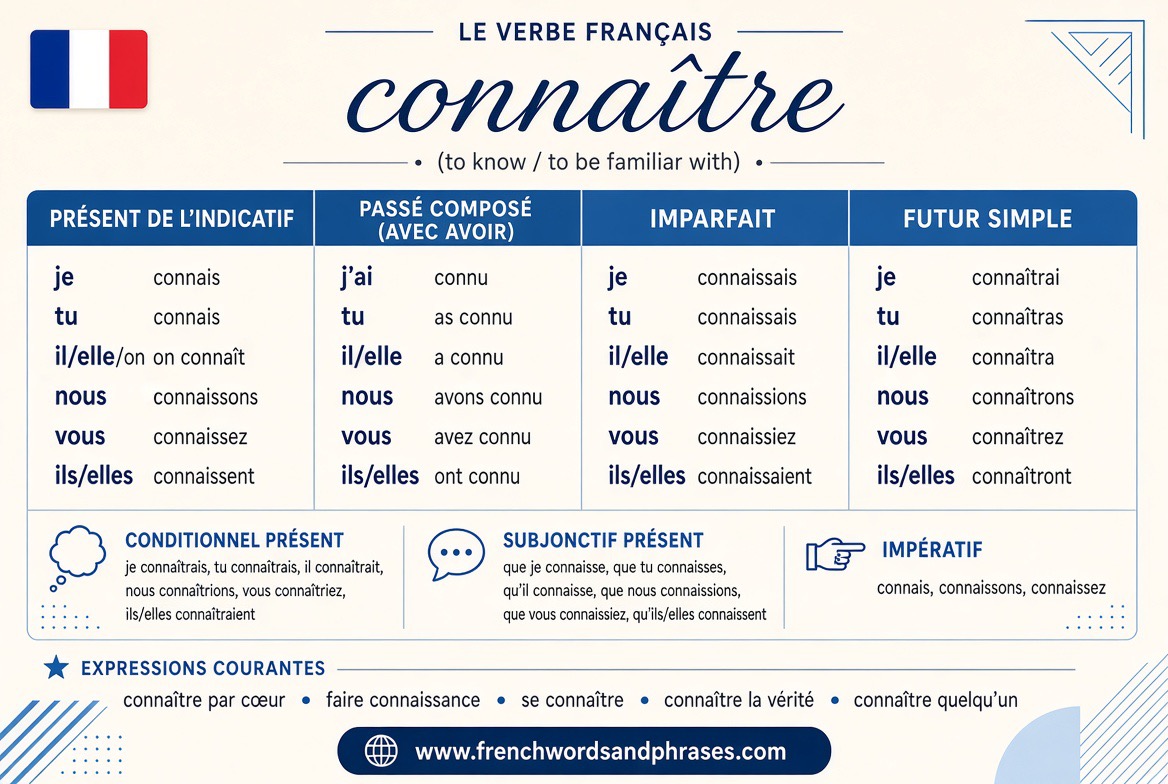
How to Conjugate Connaître in the Present Tense (Présent)
The present tense describes what someone knows or is familiar with now. Notice the spelling difference between the singular forms and the plural forms.
| Subject | Conjugation |
|---|---|
| Je | connais |
| Tu | connais |
| Il / Elle | connaît |
| Nous | connaissons |
| Vous | connaissez |
| Ils / Elles | connaissent |
Je connais bien cette région.
I know this region well.
Quick Quiz: Present Tense
Complete the sentence:
Nous ________ très bien ce restaurant.
Reveal the answer
connaissons – Nous connaissons très bien ce restaurant.
We know this restaurant very well.
How to Conjugate Connaître in the Passé Composé
The passé composé describes a completed past experience or an acquaintance that began or existed at a particular time. It is formed with the present tense of avoir and the past participle connu.
| Subject | Conjugation |
|---|---|
| J’ | ai connu |
| Tu | as connu |
| Il / Elle | a connu |
| Nous | avons connu |
| Vous | avez connu |
| Ils / Elles | ont connu |
J’ai connu mon meilleur ami à l’université.
I met my best friend at university.
How to Conjugate Connaître in the Imparfait
The imparfait describes an ongoing state of familiarity or knowledge in the past. It is especially useful when talking about people or places you knew over a period of time.
| Subject | Conjugation |
|---|---|
| Je | connaissais |
| Tu | connaissais |
| Il / Elle | connaissait |
| Nous | connaissions |
| Vous | connaissiez |
| Ils / Elles | connaissaient |
Quand j’étais jeune, je connaissais tous mes voisins.
When I was young, I knew all my neighbors.
Quick Quiz: Imparfait
Choose the correct form:
Elle ________ déjà cette chanson.
Reveal the answer
connaissait – Elle connaissait déjà cette chanson.
She already knew this song.
How to Conjugate Connaître in the Plus-que-parfait
The plus-que-parfait describes something that someone had known or been familiar with before another event in the past. It is formed with the imparfait of avoir and the past participle connu.
| Subject | Conjugation |
|---|---|
| J’ | avais connu |
| Tu | avais connu |
| Il / Elle | avait connu |
| Nous | avions connu |
| Vous | aviez connu |
| Ils / Elles | avaient connu |
J’avais connu cette ville avant mon déménagement.
I had known this city before my move.
How to Conjugate Connaître in the Passé Simple
The passé simple is a literary past tense, mainly found in novels, historical writing, and formal narratives. It expresses completed past events and is rarely used in everyday conversation.
| Subject | Conjugation |
|---|---|
| Je | connus |
| Tu | connus |
| Il / Elle | connut |
| Nous | connûmes |
| Vous | connûtes |
| Ils / Elles | connurent |
Il connut un grand succès dès son premier roman.
He experienced great success with his very first novel.
How to Conjugate Connaître in the Passé Antérieur
The passé antérieur is a literary compound tense used to describe an action completed just before another past action, often alongside the passé simple. It is formed with the passé simple of avoir and connu.
| Subject | Conjugation |
|---|---|
| J’ | eus connu |
| Tu | eus connu |
| Il / Elle | eut connu |
| Nous | eûmes connu |
| Vous | eûtes connu |
| Ils / Elles | eurent connu |
Lorsqu’il eut connu la vérité, il changea d’avis.
Once he had learned the truth, he changed his mind.
How to Conjugate Connaître in the Futur Simple
The futur simple expresses something someone will know or become familiar with in the future. Connaître uses the distinctive future stem connaîtr-.
| Subject | Conjugation |
|---|---|
| Je | connaîtrai |
| Tu | connaîtras |
| Il / Elle | connaîtra |
| Nous | connaîtrons |
| Vous | connaîtrez |
| Ils / Elles | connaîtront |
Un jour, tu connaîtras la joie de voyager seul.
One day, you will know the joy of traveling alone.
Quick Quiz: Future Tense
Complete the sentence with the correct future form:
Vous ________ bientôt toute l’équipe.
Reveal the answer
connaîtrez – Vous connaîtrez bientôt toute l’équipe.
You will soon know the whole team.
How to Conjugate Connaître in the Futur Antérieur
The futur antérieur describes something that will have been known or experienced by a particular point in the future. It is formed with the future simple of avoir and the past participle connu.
| Subject | Conjugation |
|---|---|
| J’ | aurai connu |
| Tu | auras connu |
| Il / Elle | aura connu |
| Nous | aurons connu |
| Vous | aurez connu |
| Ils / Elles | auront connu |
À la fin de l’année, j’aurai connu beaucoup de nouvelles personnes.
By the end of the year, I will have met many new people.
How to Conjugate Connaître in the Futur Proche
The futur proche expresses an action or experience that is going to happen soon. It is formed with the present tense of aller followed by the infinitive connaître.
| Subject | Conjugation |
|---|---|
| Je | vais connaître |
| Tu | vas connaître |
| Il / Elle | va connaître |
| Nous | allons connaître |
| Vous | allez connaître |
| Ils / Elles | vont connaître |
Nous allons connaître une nouvelle culture.
We are going to discover a new culture.
Conditionnel – The Conditional Mood
The conditional mood expresses possibilities, hypothetical situations, wishes, and polite or cautious statements. With connaître, it often describes who someone would know or what they would become familiar with under certain circumstances.
How to Conjugate Connaître in the Conditionnel Présent
The present conditional is formed using the future stem connaîtr- and the imperfect endings.
| Subject | Conjugation |
|---|---|
| Je | connaîtrais |
| Tu | connaîtrais |
| Il / Elle | connaîtrait |
| Nous | connaîtrions |
| Vous | connaîtriez |
| Ils / Elles | connaîtraient |
Je connaîtrais mieux cette région si j’y habitais.
I would know this region better if I lived there.
How to Conjugate Connaître in the Conditionnel Passé
The past conditional describes something someone would have known or experienced under different circumstances. It is formed with the conditional present of avoir and the past participle connu.
| Subject | Conjugation |
|---|---|
| J’ | aurais connu |
| Tu | aurais connu |
| Il / Elle | aurait connu |
| Nous | aurions connu |
| Vous | auriez connu |
| Ils / Elles | auraient connu |
J’aurais connu cette personne si j’avais accepté l’invitation.
I would have met that person if I had accepted the invitation.
How to Conjugate Connaître in the Conditionnel Passé – Alternative Form
This literary alternative uses the imperfect subjunctive of avoir with the past participle connu. It is highly formal and rarely encountered outside literary or elevated writing.
| Subject | Conjugation |
|---|---|
| J’ | eusse connu |
| Tu | eusses connu |
| Il / Elle | eût connu |
| Nous | eussions connu |
| Vous | eussiez connu |
| Ils / Elles | eussent connu |
Il eût connu une autre vie s’il était parti plus tôt.
He would have known a different life if he had left earlier.
Subjonctif – The Subjunctive Mood
The subjunctive expresses uncertainty, emotion, necessity, desire, and subjective judgment. Connaître often appears in the subjunctive after expressions such as il faut que, je souhaite que, and bien que.
How to Conjugate Connaître in the Subjonctif Présent
The present subjunctive is used when the action of knowing or becoming familiar with something is uncertain, desired, or required.
| Subject | Conjugation |
|---|---|
| Que je | connaisse |
| Que tu | connaisses |
| Qu’il / Qu’elle | connaisse |
| Que nous | connaissions |
| Que vous | connaissiez |
| Qu’ils / Qu’elles | connaissent |
Il faut que tu connaisses les règles.
You need to know the rules.
How to Conjugate Connaître in the Subjonctif Imparfait
The imperfect subjunctive is a literary tense found mainly in older French literature and formal writing. In modern spoken French, the present subjunctive is generally used instead.
| Subject | Conjugation |
|---|---|
| Que je | connusse |
| Que tu | connusses |
| Qu’il / Qu’elle | connût |
| Que nous | connussions |
| Que vous | connussiez |
| Qu’ils / Qu’elles | connussent |
Il souhaitait que je connusse mieux son histoire.
He wished that I knew his story better.
How to Conjugate Connaître in the Subjonctif Plus-que-parfait
The pluperfect subjunctive is a literary tense used to describe an action that would have been completed before another past action or situation. It is formed with the imperfect subjunctive of avoir and connu.
| Subject | Conjugation |
|---|---|
| Que j’ | eusse connu |
| Que tu | eusses connu |
| Qu’il / Qu’elle | eût connu |
| Que nous | eussions connu |
| Que vous | eussiez connu |
| Qu’ils / Qu’elles | eussent connu |
Il regrettait que nous eussions connu cette déception.
He regretted that we had experienced this disappointment.
How to Conjugate Connaître in the Subjonctif Passé
The past subjunctive describes an action that has been completed but is introduced by a phrase requiring the subjunctive. It is formed with the present subjunctive of avoir and the past participle connu.
| Subject | Conjugation |
|---|---|
| Que j’ | aie connu |
| Que tu | aies connu |
| Qu’il / Qu’elle | ait connu |
| Que nous | ayons connu |
| Que vous | ayez connu |
| Qu’ils / Qu’elles | aient connu |
Je suis heureux que tu aies connu ma famille.
I am happy that you have met my family.
Quick Quiz: Subjunctive
Complete the sentence:
Il faut que vous ________ la vérité.
Reveal the answer
connaissiez – Il faut que vous connaissiez la vérité.
You need to know the truth.
Impératif – The Imperative Mood
The imperative is used to give commands, instructions, or advice. Connaître is not especially common in commands, but it can be used when encouraging someone to become familiar with something.
How to Conjugate Connaître in the Impératif Présent
| Subject | Conjugation |
|---|---|
| (Tu) | connais |
| (Nous) | connaissons |
| (Vous) | connaissez |
Connais bien ton sujet avant de commencer.
Know your subject well before you begin.
Quick Quiz: Imperative
Which form completes this instruction?
________ bien les personnes avec qui tu travailles.
Reveal the answer
Connais – Connais bien les personnes avec qui tu travailles.
Get to know the people you work with well.
French Participles: Connaissant and Connu
French participles are useful for forming compound tenses and creating descriptive expressions. Connaître has an irregular past participle.
Present Participle – Connaissant
The present participle of connaître is connaissant. It can describe someone who knows or is familiar with something.
Connaissant bien la région, il nous a guidés.
Knowing the region well, he guided us.
connaissant
Past Participle – Connu
The past participle is connu. It is used with avoir to form compound tenses, including the passé composé and plus-que-parfait.
- connu – masculine singular
- connus – masculine plural
- connue – feminine singular
- connues – feminine plural
With avoir, the past participle does not agree with the subject. Agreement is required when a direct object precedes the verb and French grammar calls for it.
Les villes que j’ai connues étaient magnifiques.
The cities I knew were magnificent.
Everyday French: Connaître in Real-Life Sentences
Here are six examples showing how connaître appears in everyday French.
Je connais cette personne depuis longtemps.
I have known this person for a long time.
Nous avons connu des moments difficiles.
We have experienced difficult times.
Elle connaissait déjà la réponse.
She already knew the answer.
Tu connaîtras bientôt tes nouveaux collègues.
You will soon get to know your new colleagues.
J’aimerais connaître votre opinion.
I would like to know your opinion.
Il faut connaître ses limites.
You have to know your limits.
Beyond Translation: Useful Expressions with Connaître
Connaître appears in many useful French expressions. Learning these combinations will help you use the verb naturally.
- Connaître quelqu’un – to know someone
- Connaître un endroit – to know a place
- Connaître par cœur – to know by heart
- Faire connaître – to make known, introduce, or promote
- Se faire connaître – to make oneself known
- Connaître le succès – to achieve or experience success
- Connaître une période difficile – to go through a difficult period
- Apprendre à connaître quelqu’un – to get to know someone
J’apprends à connaître mes nouveaux voisins.
I am getting to know my new neighbors.
How to Remember the Conjugation of Connaître
Connaître may look complicated at first, but a few patterns make it easier to remember.
- Present singular: connais, connais, connaît.
- Present plural: connaissons, connaissez, connaissent.
- Future stem: connaîtr-.
- Conditional stem: connaîtr-.
- Past participle: connu.
- Present participle: connaissant.
One of the most useful ways to remember the verb is to connect it to familiar people and places. Think of someone you know or a city you have visited, and create a simple sentence using connaître.
Je connais cette ville.
I know this city.
Test Your Knowledge of Connaître
Try these five questions to check how well you understand the conjugation and use of connaître.
1. Which is the correct present-tense form for nous?
Reveal the answer
Nous connaissons.
2. What is the past participle of connaître?
Reveal the answer
Connu.
3. Which verb would you use to say that you know how to swim: connaître or savoir?
Reveal the answer
Savoir. The correct sentence is Je sais nager.
4. Complete the sentence with the correct future form: Tu ________ bientôt la vérité.
Reveal the answer
connaîtras. Tu connaîtras bientôt la vérité.
5. What auxiliary verb does connaître use in compound tenses?
Reveal the answer
Avoir. For example: J’ai connu.
Your Final Challenge
Translate this sentence into French:
“I would like to get to know your city better.”
Reveal the answer
J’aimerais mieux connaître votre ville.
I would like to get to know your city better.
Connaître is more than simply knowing a fact. It is about familiarity, experience, and the connections we make with people and places. As you continue learning French, you will find plenty of opportunities to use this versatile verb.
A little French. A little curiosity. A richer everyday life.
LEARN FRENCH ONE WORD AT A TIME