A French Word to Live By
How to Conjugate Paraître in French
/pa.ʁɛtʁ/
Paraître means to appear, to seem, or to look.
Some things are not what they first appear to be. A quiet street can seem empty, a smile can look tired, and a simple idea can appear suddenly, as if from nowhere.
In this guide, you’ll learn how to conjugate paraître in all the major French tenses and moods. Explore complete conjugation tables, French examples, English translations, and practice quizzes.
Understanding the French Verb Paraître
Paraître is an irregular French verb belonging to the third group of verbs, those ending in -aître.
It means to appear, to seem, or to look. It is commonly used to describe how something looks, how a person seems, or how a situation appears to be. It often introduces a perception rather than a certainty.
Verb classification: Third group (irregular -aître verb)
Auxiliary verb: Avoir
Past participle: paru
Present participle: paraissant
English equivalents: To appear, to seem, to look.
One important spelling detail: the accent circumflex on the î in paraître remains in the future and conditional stems — paraîtrai, paraîtrais — and in the third-person singular present, il paraît.
Experience the Word
Paraître is more than appearing. It is about how something presents itself to the world — a first impression, a look, a feeling that something is a certain way.
Imagine meeting an old friend after many years. At first, he seems the same, but something in his smile looks different, a little more tired, a little wiser.
You are not stating a fact. You are describing an impression.
How to Conjugate Paraître: Complete French Conjugation Guide
Let’s explore every major conjugation of paraître, beginning with the indicative mood.
How to Conjugate Paraître in the Indicative Mood
The indicative mood is used to express facts, observations, actions, and events.
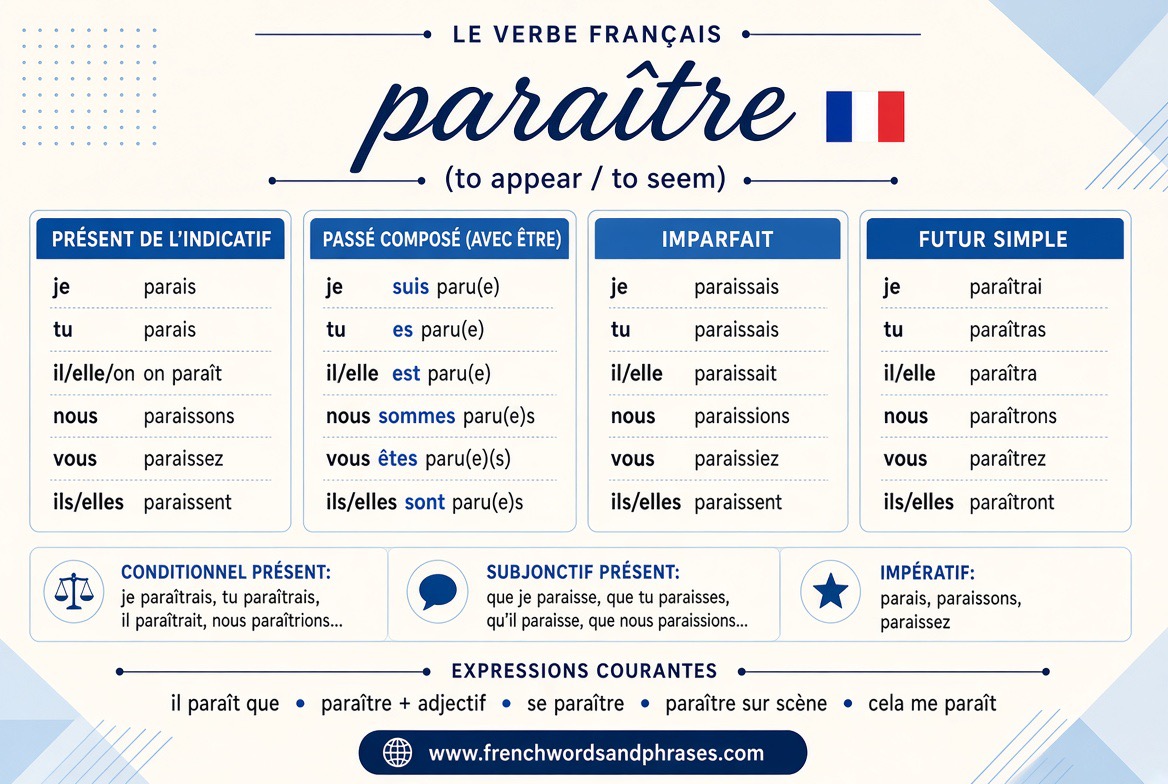
How to Conjugate Paraître in the Present Tense (Présent)
Used for actions happening now, habitual actions, and general truths.
| Subject | Conjugation |
|---|---|
| je | parais |
| tu | parais |
| il / elle | paraît |
| nous | paraissons |
| vous | paraissez |
| ils / elles | paraissent |
Example
Il paraît fatigué aujourd’hui.
He looks tired today.
Quick Quiz 1
Complete the sentence:
Nous ______ calmes aujourd’hui.
Reveal the answer
paraissons
Nous paraissons calmes aujourd’hui.
We seem calm today.
How to Conjugate Paraître in the Passé Composé
Used for completed actions in the past. Paraître takes the auxiliary verb avoir.
| Subject | Conjugation |
|---|---|
| j’ | ai paru |
| tu | as paru |
| il / elle | a paru |
| nous | avons paru |
| vous | avez paru |
| ils / elles | ont paru |
Example
Elle a paru surprise par la nouvelle.
She appeared surprised by the news.
How to Conjugate Paraître in the Imparfait (Imperfect Tense)
Used for habitual past actions, descriptions, and ongoing situations in the past.
| Subject | Conjugation |
|---|---|
| je | paraissais |
| tu | paraissais |
| il / elle | paraissait |
| nous | paraissions |
| vous | paraissiez |
| ils / elles | paraissaient |
Example
Quand il était jeune, il paraissait toujours calme.
When he was young, he always seemed calm.
Quick Quiz 2
Choose the correct form:
When we were children, we used to seem happy all the time.
Quand nous étions enfants, nous ______ toujours heureux.
Reveal the answer
paraissions
Quand nous étions enfants, nous paraissions toujours heureux.
How to Conjugate Paraître in the Plus-que-parfait
Used to describe an action that had already been completed before another past event.
| Subject | Conjugation |
|---|---|
| j’ | avais paru |
| tu | avais paru |
| il / elle | avait paru |
| nous | avions paru |
| vous | aviez paru |
| ils / elles | avaient paru |
Example
J’avais déjà paru dans ce journal avant.
I had already appeared in this newspaper before.
How to Conjugate Paraître in the Passé Simple
Primarily used in formal writing, literature, and historical narratives. It is rarely used in everyday conversation.
| Subject | Conjugation |
|---|---|
| je | parus |
| tu | parus |
| il / elle | parut |
| nous | parûmes |
| vous | parûtes |
| ils / elles | parurent |
Example
Il parut soudain à la porte.
He suddenly appeared at the door.
How to Conjugate Paraître in the Passé Antérieur
A literary tense used to express an action completed immediately before another past action, generally in the passé simple.
| Subject | Conjugation |
|---|---|
| j’ | eus paru |
| tu | eus paru |
| il / elle | eut paru |
| nous | eûmes paru |
| vous | eûtes paru |
| ils / elles | eurent paru |
Example
Dès qu’il eut paru sur scène, le public applaudit.
As soon as he had appeared on stage, the audience applauded.
How to Conjugate Paraître in the Future Tense (Futur Simple)
Used to describe actions that will take place in the future.
| Subject | Conjugation |
|---|---|
| je | paraîtrai |
| tu | paraîtras |
| il / elle | paraîtra |
| nous | paraîtrons |
| vous | paraîtrez |
| ils / elles | paraîtront |
Example
Demain, tout paraîtra plus clair.
Tomorrow, everything will seem clearer.
How to Conjugate Paraître in the Futur Antérieur (Future Perfect)
Used for an action that will have been completed before a particular point in the future.
| Subject | Conjugation |
|---|---|
| j’ | aurai paru |
| tu | auras paru |
| il / elle | aura paru |
| nous | aurons paru |
| vous | aurez paru |
| ils / elles | auront paru |
Example
À midi, il aura déjà paru à la télévision.
By noon, he will already have appeared on television.
How to Conjugate Paraître in the Near Future (Futur Proche)
Used to describe something that is going to happen soon. Formed with aller + infinitive.
| Subject | Conjugation |
|---|---|
| je | vais paraître |
| tu | vas paraître |
| il / elle | va paraître |
| nous | allons paraître |
| vous | allez paraître |
| ils / elles | vont paraître |
Example
Je vais paraître dans une nouvelle émission.
I am going to appear on a new show.
How to Conjugate Paraître in the Conditional Mood
The conditional mood expresses what would happen under certain circumstances. It is also frequently used to make polite requests or express wishes.
How to Conjugate Paraître in the Present Conditional
| Subject | Conjugation |
|---|---|
| je | paraîtrais |
| tu | paraîtrais |
| il / elle | paraîtrait |
| nous | paraîtrions |
| vous | paraîtriez |
| ils / elles | paraîtraient |
Example
Je paraîtrais plus confiant si je dormais mieux.
I would seem more confident if I slept better.
How to Conjugate Paraître in the Past Conditional
| Subject | Conjugation |
|---|---|
| j’ | aurais paru |
| tu | aurais paru |
| il / elle | aurait paru |
| nous | aurions paru |
| vous | auriez paru |
| ils / elles | auraient paru |
Example
J’aurais paru plus détendu si j’avais su.
I would have seemed more relaxed if I had known.
Paraître in the Literary Past Conditional Form
This less common literary form uses the imperfect subjunctive of avoir.
| Subject | Conjugation |
|---|---|
| j’ | eusse paru |
| tu | eusses paru |
| il / elle | eût paru |
| nous | eussions paru |
| vous | eussiez paru |
| ils / elles | eussent paru |
Example
Il eût paru plus sage de rester silencieux.
It would have seemed wiser to stay silent.
How to Conjugate Paraître in the Subjunctive Mood
The subjunctive is used to express wishes, emotions, doubts, necessity, and uncertainty. It frequently follows expressions such as il faut que (it is necessary that) or bien que (although).
How to Conjugate Paraître in the Present Subjunctive
| Subject | Conjugation |
|---|---|
| que je | paraisse |
| que tu | paraisses |
| qu’il / qu’elle | paraisse |
| que nous | paraissions |
| que vous | paraissiez |
| qu’ils / qu’elles | paraissent |
Example
Il faut que je paraisse calme.
I need to appear calm.
Quick Quiz 3
Complete the sentence using the subjunctive:
Il faut que nous ______ sereins.
Reveal the answer
paraissions
Il faut que nous paraissions sereins.
We need to appear serene.
How to Conjugate Paraître in the Imperfect Subjunctive
A literary tense, rarely encountered in modern spoken French.
| Subject | Conjugation |
|---|---|
| que je | parusse |
| que tu | parusses |
| qu’il / qu’elle | parût |
| que nous | parussions |
| que vous | parussiez |
| qu’ils / qu’elles | parussent |
Example
Il souhaitait qu’elle parût plus heureuse.
He wished that she would appear happier.
How to Conjugate Paraître in the Pluperfect Subjunctive
A literary construction used to express an action completed before another past action.
| Subject | Conjugation |
|---|---|
| que j’ | eusse paru |
| que tu | eusses paru |
| qu’il / qu’elle | eût paru |
| que nous | eussions paru |
| que vous | eussiez paru |
| qu’ils / qu’elles | eussent paru |
Example
Il regrettait que nous eussions paru si pressés.
He regretted that we had appeared so rushed.
How to Conjugate Paraître in the Past Subjunctive
| Subject | Conjugation |
|---|---|
| que j’ | aie paru |
| que tu | aies paru |
| qu’il / qu’elle | ait paru |
| que nous | ayons paru |
| que vous | ayez paru |
| qu’ils / qu’elles | aient paru |
Example
Je suis heureux que tu aies paru à l’heure.
I am happy that you appeared on time.
How to Conjugate Paraître in the Imperative
The imperative is used to give commands, instructions, invitations, or suggestions. Subject pronouns are omitted.
How to Conjugate Paraître in the Present Imperative
| Person | Conjugation |
|---|---|
| (tu) | parais |
| (nous) | paraissons |
| (vous) | paraissez |
Example
Paraissez confiants, s’il vous plaît !
Look confident, please!
Quick Quiz 4
How would you say “Look confident!” (formal, plural)?
Reveal the answer
Paraissez confiants !
French Participles of Paraître
Participles are verb forms that can be used in compound tenses and other grammatical constructions.
Present Participle of Paraître
paraissant
En paraissant à l’heure, il a rassuré tout le monde.
By appearing on time, he reassured everyone.
Past Participle of Paraître
paru
Il a paru dans trois films cette année.
He appeared in three films this year.
Paraître in Everyday French: Real-Life Examples
Now that you know the conjugations, let’s see how paraître appears in everyday French.
Example 1 — Present
Il paraît content.
He seems happy.
Example 2 — Passé composé
Elle a paru étonnée.
She looked astonished.
Example 3 — Imparfait
Elle paraissait toujours joyeuse.
She always seemed cheerful.
Example 4 — Future
Ils paraîtront bientôt à l’écran.
They will soon appear on screen.
Example 5 — Conditional
Je paraîtrais plus jeune avec cette coupe.
I would look younger with this haircut.
Example 6 — Subjunctive
Bien que je paraisse calme, je suis nerveux.
Although I seem calm, I am nervous.
Beyond Translation: The Meaning of Paraître
English has words such as appear, seem, and look. Each captures part of the meaning of paraître, but the French word often suggests a perception that may or may not match reality.
The difference between being and seeming.
To paraître is to present an appearance to others. It invites us to notice the gap between how something looks and how it really is — and to be curious about what lies underneath.
How to Remember the French Verb Paraître
Remember it this way: Paraître is about appearance, rather than certainty.
- You look at a person and form an impression — that impression is paraître.
- You hear surprising news and someone looks shocked — they paraissent surprised.
- You watch an actor step onto a stage — he paraît before the audience.
The key idea is appearance, rather than certainty.
Test Your Knowledge of Paraître
Let’s see how much you’ve learned. Try answering these questions before revealing the answers.
Question 1
What auxiliary verb is used with paraître in compound tenses?
Reveal the answer
Avoir
Question 2
How do you say “I will seem” in French?
Reveal the answer
Je paraîtrai.
Question 3
Translate: “She appeared surprised.”
Reveal the answer
Elle a paru surprise.
Question 4
What is the present participle of paraître?
Reveal the answer
Paraissant.
Question 5
Complete the sentence:
Si j’avais dormi, je ______ plus reposé.
Reveal the answer
paraîtrais
Si j’avais dormi, je paraîtrais plus reposé.
If I had slept, I would look more rested.
Your Final Challenge
Can You Use It?
How would you say this in French?
“Tomorrow, I want to appear more confident at work.”
Reveal the answer
Demain, je veux paraître plus confiant au travail.
Tomorrow, I want to appear more confident at work.
A little French. A little curiosity. A richer everyday life.
LEARN FRENCH ONE WORD AT A TIME