A French Word to Live By
How to Conjugate Rendre in French
IPA: /ʁɑ̃dʁ/
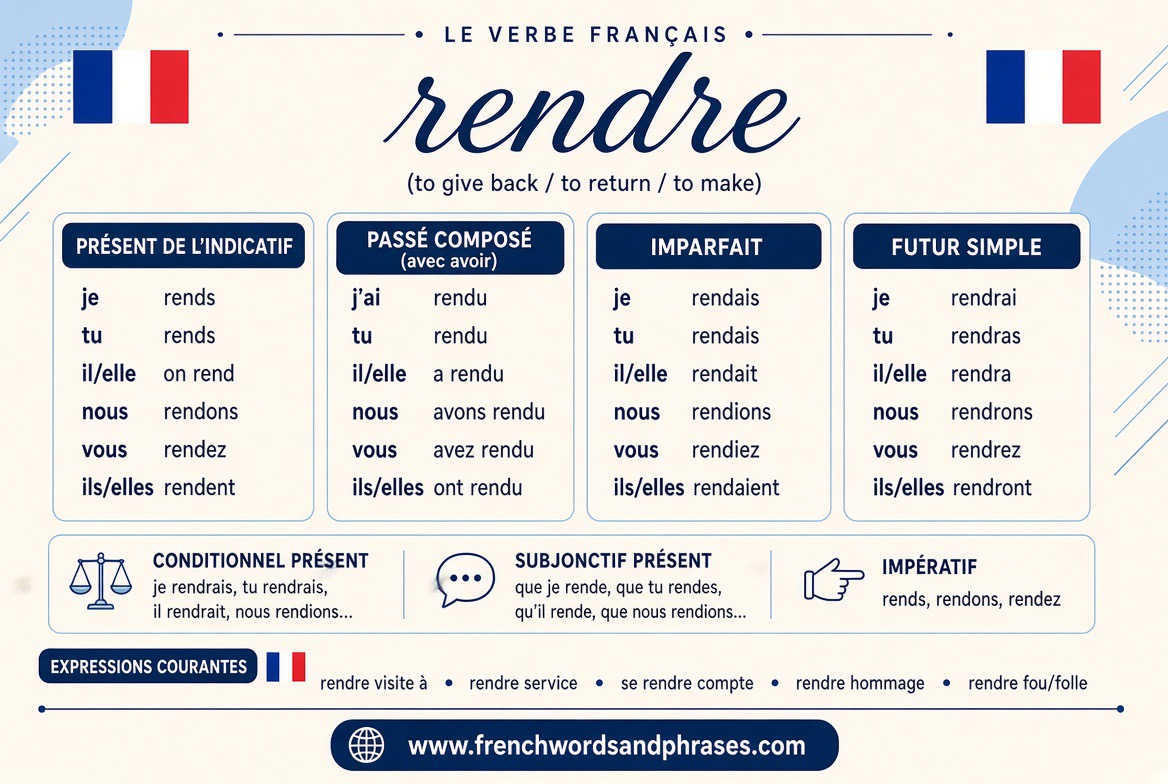
Rendre means “to give back,” “to return,” “to make,” or “to render” in French.
Some French verbs have several meanings, and rendre is a wonderful example. You can use it when returning a borrowed book, giving something back, expressing an opinion, or describing how something makes you feel. It is a versatile verb that appears in everyday conversations and a wide range of French expressions.
In this guide, you will learn how to conjugate rendre in all the major French tenses and moods. Explore complete conjugation tables, practical examples, useful expressions, pronunciation guidance, and quizzes to help you use this important verb with confidence.
Understanding the French Verb Rendre
Rendre is an irregular third-group French verb ending in -re. It follows a recognizable conjugation pattern shared by several verbs ending in -endre, although its forms differ from regular first-group -er verbs.
- Infinitive: rendre
- Meaning: to give back, return, make, render
- Verb group: Third group (-re)
- Auxiliary verb: avoir
- Past participle: rendu
- Present participle: rendant
Different Meanings of Rendre
The meaning of rendre depends heavily on the context. Here are some of its most common uses:
- Rendre un livre – to return a book
- Rendre de l’argent – to give money back
- Rendre visite à quelqu’un – to visit someone
- Rendre service à quelqu’un – to do someone a favor
- Rendre heureux – to make someone happy
- Rendre possible – to make possible
- Rendre compte de quelque chose – to report on or give an account of something
- Se rendre compte de quelque chose – to realize something
Rendre vs. Retourner
Both rendre and retourner can relate to the idea of returning, but they are used differently:
- Rendre commonly means to give something back to its owner or return something that was borrowed.
- Retourner often means to go back to a place or to turn something over.
For example:
Je dois rendre ce livre à la bibliothèque.
I have to return this book to the library.
Je vais retourner à Paris demain.
I am going back to Paris tomorrow.
The Expression Se Rendre Compte
One of the most useful expressions involving rendre is se rendre compte, meaning “to realize” or “to become aware of.” It is a pronominal expression and is commonly used in everyday French.
Je me rends compte de mon erreur.
I realize my mistake.
Elle s’est rendu compte du problème.
She realized the problem.
Notice that in the second example, rendu does not agree with the subject. In se rendre compte, the expression compte is the direct object, while se is indirect. The past participle therefore remains unchanged.
Past Participle Agreement
Rendre uses avoir in compound tenses. Its past participle, rendu, does not agree with the subject. However, it agrees with a preceding direct object when the rules of French past participle agreement require it.
For example:
Les clés que j’ai rendues sont sur la table.
The keys that I returned are on the table.
Here, que refers to les clés, a feminine plural direct object placed before the verb. Therefore, the past participle becomes rendues.
Experience the Word
Imagine borrowing a book from a friend. A few days later, you return it. In French, you rends le livre.
Now imagine a beautiful view that makes you happy. You might say it vous rend heureux. The same verb that describes giving something back can also describe the effect something has on a person.
That flexibility makes rendre an especially valuable word to learn. It connects everyday actions with emotions, impressions, and expressions that French speakers use regularly.
How to Conjugate Rendre: Complete French Conjugation Guide
Indicatif (Indicative Mood)
How to Conjugate Rendre in the Présent
The present tense describes actions happening now, habitual activities, and general facts. In the present tense, rendre follows the characteristic pattern of many third-group -re verbs.
| Subject | Conjugation |
|---|---|
| je | rends |
| tu | rends |
| il / elle | rend |
| nous | rendons |
| vous | rendez |
| ils / elles | rendent |
Je rends les livres à la bibliothèque chaque semaine.
I return the books to the library every week.
Quick Quiz
How do you say “We return the keys” in French?
Show answer
Nous rendons les clés.
How to Conjugate Rendre in the Passé Composé
The passé composé describes completed actions in the past. It is formed with the present tense of avoir followed by the past participle rendu.
| Subject | Conjugation |
|---|---|
| j’ | ai rendu |
| tu | as rendu |
| il / elle | a rendu |
| nous | avons rendu |
| vous | avez rendu |
| ils / elles | ont rendu |
J’ai rendu les clés à mon voisin hier.
I returned the keys to my neighbor yesterday.
How to Conjugate Rendre in the Imparfait
The imparfait describes ongoing or repeated actions in the past, habits, and background situations. It can often be translated as “was returning,” “used to return,” or “was making,” depending on the context.
| Subject | Conjugation |
|---|---|
| je | rendais |
| tu | rendais |
| il / elle | rendait |
| nous | rendions |
| vous | rendiez |
| ils / elles | rendaient |
À cette époque, je rendais visite à mes grands-parents chaque dimanche.
At that time, I used to visit my grandparents every Sunday.
How to Conjugate Rendre in the Plus-que-parfait
The plus-que-parfait expresses an action that had already been completed before another past action. It is formed with the imparfait of avoir and the past participle rendu.
| Subject | Conjugation |
|---|---|
| j’ | avais rendu |
| tu | avais rendu |
| il / elle | avait rendu |
| nous | avions rendu |
| vous | aviez rendu |
| ils / elles | avaient rendu |
J’avais déjà rendu le livre avant de recevoir son message.
I had already returned the book before receiving his message.
How to Conjugate Rendre in the Passé Simple
The passé simple is a literary past tense used mainly in novels, historical accounts, and formal written narratives. In everyday spoken French, the passé composé is generally used instead.
| Subject | Conjugation |
|---|---|
| je | rendis |
| tu | rendis |
| il / elle | rendit |
| nous | rendîmes |
| vous | rendîtes |
| ils / elles | rendirent |
Le chevalier rendit son épée au roi.
The knight returned his sword to the king.
How to Conjugate Rendre in the Passé Antérieur
The passé antérieur is a literary tense used to describe an action completed immediately before another action in the passé simple. It is formed with the passé simple of avoir and the past participle.
| Subject | Conjugation |
|---|---|
| j’ | eus rendu |
| tu | eus rendu |
| il / elle | eut rendu |
| nous | eûmes rendu |
| vous | eûtes rendu |
| ils / elles | eurent rendu |
Dès qu’il eut rendu les documents, il quitta le bureau.
As soon as he had returned the documents, he left the office.
How to Conjugate Rendre in the Futur Simple
The futur simple describes actions that will happen in the future. For rendre, the future stem is rendr-, to which the standard future endings are added.
| Subject | Conjugation |
|---|---|
| je | rendrai |
| tu | rendras |
| il / elle | rendra |
| nous | rendrons |
| vous | rendrez |
| ils / elles | rendront |
Je rendrai visite à mes amis pendant les vacances.
I will visit my friends during the holidays.
Quick Quiz
How do you say “She will return the book” in French?
Show answer
Elle rendra le livre.
How to Conjugate Rendre in the Futur Antérieur
The futur antérieur describes an action that will have been completed before a particular moment or another future action. It is formed with the future simple of avoir and the past participle rendu.
| Subject | Conjugation |
|---|---|
| j’ | aurai rendu |
| tu | auras rendu |
| il / elle | aura rendu |
| nous | aurons rendu |
| vous | aurez rendu |
| ils / elles | auront rendu |
Avant vendredi, nous aurons rendu tous les livres.
By Friday, we will have returned all the books.
How to Conjugate Rendre in the Futur Proche
The futur proche, or near future, describes something that is going to happen soon. It is formed with the present tense of aller followed by the infinitive rendre.
| Subject | Conjugation |
|---|---|
| je | vais rendre |
| tu | vas rendre |
| il / elle | va rendre |
| nous | allons rendre |
| vous | allez rendre |
| ils / elles | vont rendre |
Je vais rendre ce dictionnaire à mon professeur.
I am going to return this dictionary to my teacher.
Conditionnel (Conditional Mood)
How to Conjugate Rendre in the Conditionnel Présent
The present conditional expresses what someone would do under certain circumstances. It is also used to make polite requests and express hypothetical situations.
| Subject | Conjugation |
|---|---|
| je | rendrais |
| tu | rendrais |
| il / elle | rendrait |
| nous | rendrions |
| vous | rendriez |
| ils / elles | rendraient |
Je rendrais ce service si j’en avais la possibilité.
I would do this favor if I had the opportunity.
How to Conjugate Rendre in the Conditionnel Passé
The past conditional describes what would have happened under different circumstances in the past. It is formed with the conditional present of avoir followed by the past participle rendu.
| Subject | Conjugation |
|---|---|
| j’ | aurais rendu |
| tu | aurais rendu |
| il / elle | aurait rendu |
| nous | aurions rendu |
| vous | auriez rendu |
| ils / elles | auraient rendu |
J’aurais rendu le livre plus tôt si j’avais eu le temps.
I would have returned the book earlier if I had had the time.
How to Conjugate Rendre in the Conditionnel Passé: Literary Alternative
This alternative form uses the pluperfect subjunctive of avoir with the past participle. It is literary and rarely encountered in modern everyday French.
| Subject | Conjugation |
|---|---|
| j’ | eusse rendu |
| tu | eusses rendu |
| il / elle | eût rendu |
| nous | eussions rendu |
| vous | eussiez rendu |
| ils / elles | eussent rendu |
Il eût rendu ce service s’il en avait eu la possibilité.
He would have done this favor if he had had the opportunity.
Subjonctif (Subjunctive Mood)
How to Conjugate Rendre in the Subjonctif Présent
The present subjunctive is used after expressions of doubt, emotion, necessity, desire, and uncertainty. It commonly appears after que.
| Subject | Conjugation |
|---|---|
| que je | rende |
| que tu | rendes |
| qu’il / qu’elle | rende |
| que nous | rendions |
| que vous | rendiez |
| qu’ils / qu’elles | rendent |
Il faut que je rende ce document aujourd’hui.
I must return this document today.
How to Conjugate Rendre in the Subjonctif Imparfait
The imperfect subjunctive is a literary tense found mainly in older literature and formal writing. In everyday modern French, the present subjunctive is generally used instead.
| Subject | Conjugation |
|---|---|
| que je | rendisse |
| que tu | rendisses |
| qu’il / qu’elle | rendît |
| que nous | rendissions |
| que vous | rendissiez |
| qu’ils / qu’elles | rendissent |
Il souhaitait qu’elle rendît le livre avant son départ.
He wished that she would return the book before her departure.
How to Conjugate Rendre in the Subjonctif Plus-que-parfait
The pluperfect subjunctive is a literary tense expressing an action that had been completed before another past action or situation. It is formed with the pluperfect subjunctive of avoir and the past participle.
| Subject | Conjugation |
|---|---|
| que j’ | eusse rendu |
| que tu | eusses rendu |
| qu’il / qu’elle | eût rendu |
| que nous | eussions rendu |
| que vous | eussiez rendu |
| qu’ils / qu’elles | eussent rendu |
Elle regrettait que nous n’eussions pas rendu les documents à temps.
She regretted that we had not returned the documents on time.
How to Conjugate Rendre in the Subjonctif Passé
The past subjunctive describes an action that has already happened but is connected to a feeling, doubt, judgment, or necessity. It is formed with the present subjunctive of avoir and the past participle rendu.
| Subject | Conjugation |
|---|---|
| que j’ | aie rendu |
| que tu | aies rendu |
| qu’il / qu’elle | ait rendu |
| que nous | ayons rendu |
| que vous | ayez rendu |
| qu’ils / qu’elles | aient rendu |
Je suis heureux que tu aies rendu les clés.
I am happy that you returned the keys.
Impératif (Imperative Mood)
How to Conjugate Rendre in the Impératif Présent
The imperative is used to give commands, instructions, or advice. It uses the tu, nous, and vous forms without the subject pronoun.
| Subject | Conjugation |
|---|---|
| (tu) | rends |
| (nous) | rendons |
| (vous) | rendez |
Rends-moi mon livre, s’il te plaît !
Give me back my book, please!
Quick Quiz
How would you tell a group of people, “Return the documents!”?
Show answer
Rendez les documents !
French Participles: Rendre
French participles are used to form compound tenses and can also function as adjectives or describe ongoing actions.
Présent Participe
The present participle of rendre is rendant. It can describe an action taking place at the same time as another action.
rendant
En rendant visite à sa famille, elle a découvert une vieille photographie.
While visiting her family, she discovered an old photograph.
Passé Participe
The past participle of rendre is rendu. It is used with avoir to form compound tenses such as the passé composé.
rendu
rendus
rendue
rendues
These forms show the possible written agreements when a preceding direct object requires agreement. The past participle does not agree with the subject when rendre is conjugated with avoir.
Les décisions qu’elle a rendues ont surpris tout le monde.
The decisions she issued surprised everyone.
Rendre in Everyday French: Six Useful Examples
Here are six examples showing how rendre appears in everyday French conversation and writing.
1. Présent
Je rends visite à mes parents chaque semaine.
I visit my parents every week.
2. Passé composé
Elle a rendu son devoir au professeur.
She handed in her assignment to the teacher.
3. Imparfait
Ce travail me rendait très heureux.
This work used to make me very happy.
4. Futur simple
Nous rendrons les clés demain matin.
We will return the keys tomorrow morning.
5. Conditionnel présent
Cette nouvelle me rendrait très heureux.
This news would make me very happy.
6. Subjonctif présent
Je veux que tu rendes ce livre demain.
I want you to return this book tomorrow.
Beyond Translation: Understanding Rendre
Learning rendre means discovering a verb that does much more than describe returning an object. It can express the effect something has on a person, describe doing someone a favor, or appear in useful everyday expressions.
Remember these particularly common phrases:
- Se rendre compte – to realize
- Rendre visite à – to visit
- Rendre service à – to do someone a favor
- Rendre heureux – to make happy
- Rendre quelque chose à quelqu’un – to give something back to someone
Pay special attention to se rendre compte. It is one of the expressions you are likely to encounter frequently in conversations, books, and French media.
How to Remember Rendre
- Remember the verb group: Rendre is a third-group verb ending in -re.
- Learn the present forms: Focus on rends, rend, rendons, rendez, and rendent.
- Remember the auxiliary: Compound tenses use avoir.
- Learn the past participle: The form is rendu.
- Practice its different meanings: Think of returning an object, making someone happy, and doing someone a favor.
- Memorize useful expressions: Start with se rendre compte, rendre visite, and rendre service.
Test Your Knowledge: Rendre
Try these five questions to see how well you understand the verb rendre.
Question 1
What is the correct present-tense form for “nous”?
Show answer
Nous rendons.
Question 2
Which auxiliary verb is used to form the passé composé of rendre?
Show answer
Avoir. For example: J’ai rendu.
Question 3
How do you say “I will return” in French?
Show answer
Je rendrai.
Question 4
What does the expression se rendre compte mean?
Show answer
To realize or become aware of something.
Question 5
Complete the sentence: “We are going to return the books.”
Show answer
Nous allons rendre les livres.
Your Final Challenge
Translate the following sentence into French:
“Tomorrow, I will return the book to my friend.”
Reveal the translation
Demain, je rendrai le livre à mon ami.
Tomorrow, I will return the book to my friend.
Well done! You have explored the major tenses and moods of rendre, from everyday conversation to literary French. Keep practicing, and soon you will recognize and use its many meanings with confidence.
A little French. A little curiosity. A richer everyday life.
LEARN FRENCH ONE WORD AT A TIME