A French Word to Live By
How to Conjugate Correspondre in French
/kɔ.ʁɛs.pɔ̃dʁ/
Correspondre means to correspond or to match.
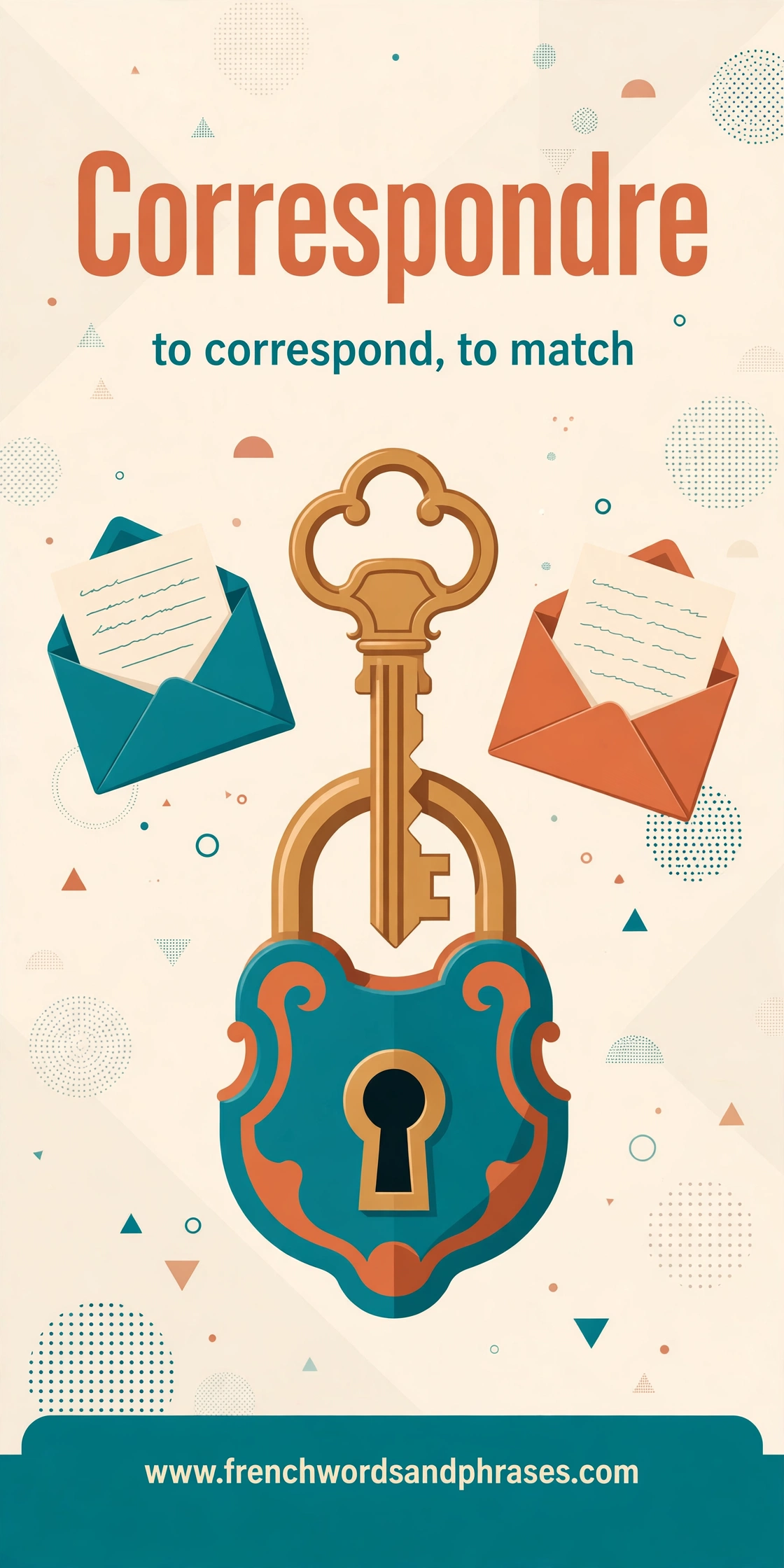
A key that fits its lock, a description that fits a face, two friends writing letters across an ocean — when things line up with each other, French reaches for correspondre, the verb of the perfect fit.
In this guide, you’ll learn how to conjugate correspondre in all the major French tenses and moods. Explore complete conjugation tables, French examples, English translations, and practice quizzes.
Understanding the French Verb Correspondre
Correspondre is a regular French verb belonging to the third group of verbs, those ending in -re.
It means to correspond, to match. It is commonly used for sizes and descriptions matching, trains and flights connecting in everyday speech (la correspondance is the connection itself), and pen-friends exchanging letters.
Verb classification: Third group (-re)
Auxiliary verb: Avoir
Past participle: correspondu
Present participle: correspondant
English equivalents: To correspond, to match, to be equivalent to, to write to each other.
One important detail: correspondre is built with à — something corresponds TO something else: la clé correspond à la serrure. For people writing to each other, French often uses the reflexive: nous nous correspondons depuis des années, though the plain verb with avec is also heard.
Experience the Word
Correspondre is the verb of the perfect fit — the moment two separate things turn out to belong together.
Imagine a small hotel in Bordeaux. You describe the room you booked months ago; the receptionist smiles, checks her screen, and nods: the description corresponds, the room is yours.
Nothing has been forced. Things simply match — and the day runs smoothly.
How to Conjugate Correspondre: Complete French Conjugation Guide
Let’s explore every major conjugation of correspondre, beginning with the indicative mood.
How to Conjugate Correspondre in the Indicative Mood
The indicative mood is used to express facts, observations, actions, and events.
How to Conjugate Correspondre in the Present Tense (Présent)
Used for actions happening now, habitual actions, and general truths.
| Subject | Conjugation |
|---|---|
| je | corresponds |
| tu | corresponds |
| il / elle | correspond |
| nous | correspondons |
| vous | correspondez |
| ils / elles | correspondent |
Example
Cette clé correspond à la serrure.
This key matches the lock.
Quick Quiz 1
Complete the sentence:
Les deux listes ______ parfaitement.
Reveal the answer
correspondent
Les deux listes correspondent parfaitement.
The two lists match perfectly.
How to Conjugate Correspondre in the Passé Composé
Used for completed actions in the past. Correspondre takes the auxiliary verb avoir.
| Subject | Conjugation |
|---|---|
| j’ | ai correspondu |
| tu | as correspondu |
| il / elle | a correspondu |
| nous | avons correspondu |
| vous | avez correspondu |
| ils / elles | ont correspondu |
Example
Sa description a correspondu au portrait.
His description matched the portrait.
How to Conjugate Correspondre in the Imparfait (Imperfect Tense)
Used for habitual past actions, descriptions, and ongoing situations in the past.
| Subject | Conjugation |
|---|---|
| je | correspondais |
| tu | correspondais |
| il / elle | correspondait |
| nous | correspondions |
| vous | correspondiez |
| ils / elles | correspondaient |
Example
Leur amitié correspondait à un vrai besoin.
Their friendship answered a real need.
Quick Quiz 2
Choose the correct form:
The figures matched.
Les chiffres ______ . (ont correspondu / sont correspondu)
Reveal the answer
ont correspondu
Les chiffres ont correspondu.
Correspondre takes avoir.
How to Conjugate Correspondre in the Plus-que-parfait
Used to describe an action that had already been completed before another past event.
| Subject | Conjugation |
|---|---|
| j’ | avais correspondu |
| tu | avais correspondu |
| il / elle | avait correspondu |
| nous | avions correspondu |
| vous | aviez correspondu |
| ils / elles | avaient correspondu |
Example
Les chiffres avaient correspondu parfaitement.
The figures had matched perfectly.
How to Conjugate Correspondre in the Passé Simple
Primarily used in formal writing, literature, and historical narratives. It is rarely used in everyday conversation.
| Subject | Conjugation |
|---|---|
| je | correspondis |
| tu | correspondis |
| il / elle | correspondit |
| nous | correspondîmes |
| vous | correspondîtes |
| ils / elles | correspondirent |
Example
Les deux témoignages correspondirent en tout point.
The two accounts corresponded in every detail.
How to Conjugate Correspondre in the Passé Antérieur
A literary tense used to express an action completed immediately before another past action, generally in the passé simple.
| Subject | Conjugation |
|---|---|
| j’ | eus correspondu |
| tu | eus correspondu |
| il / elle | eut correspondu |
| nous | eûmes correspondu |
| vous | eûtes correspondu |
| ils / elles | eurent correspondu |
Example
Quand les pièces eurent correspondu, il signa.
When the parts had matched, he signed.
How to Conjugate Correspondre in the Future Tense (Futur Simple)
Used to describe actions that will take place in the future.
| Subject | Conjugation |
|---|---|
| je | correspondrai |
| tu | correspondras |
| il / elle | correspondra |
| nous | correspondrons |
| vous | correspondrez |
| ils / elles | correspondront |
Example
Le résultat correspondra à vos efforts.
The result will match your efforts.
How to Conjugate Correspondre in the Futur Antérieur (Future Perfect)
Used for an action that will have been completed before a particular point in the future.
| Subject | Conjugation |
|---|---|
| j’ | aurai correspondu |
| tu | auras correspondu |
| il / elle | aura correspondu |
| nous | aurons correspondu |
| vous | aurez correspondu |
| ils / elles | auront correspondu |
Example
Demain, les deux listes auront correspondu.
By tomorrow, the two lists will have matched.
How to Conjugate Correspondre in the Near Future (Futur Proche)
Used to describe something that is going to happen soon. Formed with aller + infinitive.
| Subject | Conjugation |
|---|---|
| je | vais correspondre |
| tu | vas correspondre |
| il / elle | va correspondre |
| nous | allons correspondre |
| vous | allez correspondre |
| ils / elles | vont correspondre |
Example
Ce pantalon va correspondre à ta taille.
These trousers are going to match your size.
How to Conjugate Correspondre in the Conditional Mood
The conditional mood expresses what would happen under certain circumstances. It is also frequently used to make polite requests or express wishes.
How to Conjugate Correspondre in the Present Conditional
| Subject | Conjugation |
|---|---|
| je | correspondrais |
| tu | correspondrais |
| il / elle | correspondrait |
| nous | correspondrions |
| vous | correspondriez |
| ils / elles | correspondraient |
Example
Sans la photo, rien ne correspondrait.
Without the photo, nothing would match.
How to Conjugate Correspondre in the Past Conditional
| Subject | Conjugation |
|---|---|
| j’ | aurais correspondu |
| tu | aurais correspondu |
| il / elle | aurait correspondu |
| nous | aurions correspondu |
| vous | auriez correspondu |
| ils / elles | auraient correspondu |
Example
Le colis aurait correspondu à la commande.
The parcel would have matched the order.
Correspondre in the Literary Past Conditional Form
This less common literary form uses the imperfect subjunctive of avoir.
| Subject | Conjugation |
|---|---|
| j’ | eusse correspondu |
| tu | eusses correspondu |
| il / elle | eût correspondu |
| nous | eussions correspondu |
| vous | eussiez correspondu |
| ils / elles | eussent correspondu |
Example
Rien n’eût correspondu à ses espérances.
Nothing would have matched his hopes.
How to Conjugate Correspondre in the Subjunctive Mood
The subjunctive is used to express wishes, emotions, doubts, necessity, and uncertainty. It frequently follows expressions such as il faut que (it is necessary that) or bien que (although).
How to Conjugate Correspondre in the Present Subjunctive
| Subject | Conjugation |
|---|---|
| que je | corresponde |
| que tu | correspondes |
| qu’il / qu’elle | corresponde |
| que nous | correspondions |
| que vous | correspondiez |
| qu’ils / qu’elles | correspondent |
Example
Il faut que la signature corresponde au passeport.
The signature must match the passport.
Quick Quiz 3
Complete the sentence using the subjunctive:
Il faut que tout ______.
Reveal the answer
corresponde
Il faut que tout corresponde.
Everything has to match.
How to Conjugate Correspondre in the Imperfect Subjunctive
A literary tense, rarely encountered in modern spoken French.
| Subject | Conjugation |
|---|---|
| que je | correspondisse |
| que tu | correspondisses |
| qu’il / qu’elle | correspondît |
| que nous | correspondissions |
| que vous | correspondissiez |
| qu’ils / qu’elles | correspondissent |
Example
Je doutais que cela correspondît à la vérité.
I doubted that corresponded to the truth.
How to Conjugate Correspondre in the Pluperfect Subjunctive
A literary construction used to express an action completed before another past action.
| Subject | Conjugation |
|---|---|
| que j’ | eusse correspondu |
| que tu | eusses correspondu |
| qu’il / qu’elle | eût correspondu |
| que nous | eussions correspondu |
| que vous | eussiez correspondu |
| qu’ils / qu’elles | eussent correspondu |
Example
Il semblait que tout eût correspondu.
It seemed that everything had matched.
How to Conjugate Correspondre in the Past Subjunctive
| Subject | Conjugation |
|---|---|
| que j’ | aie correspondu |
| que tu | aies correspondu |
| qu’il / qu’elle | ait correspondu |
| que nous | ayons correspondu |
| que vous | ayez correspondu |
| qu’ils / qu’elles | aient correspondu |
Example
Je suis content que les horaires aient correspondu.
I am glad the timetables matched.
How to Conjugate Correspondre in the Imperative
The imperative is used to give commands, instructions, invitations, or suggestions. Subject pronouns are omitted.
How to Conjugate Correspondre in the Present Imperative
| Person | Conjugation |
|---|---|
| (tu) | corresponds |
| (nous) | correspondons |
| (vous) | correspondez |
Example
Corresponds à ce qu’on attend de toi !
Live up to what is expected of you!
Quick Quiz 4
How would you say Match it up (tu form)?
Reveal the answer
Corresponds !
French Participles of Correspondre
Participles are verb forms that can be used in compound tenses and other grammatical constructions.
Present Participle of Correspondre
correspondant
En correspondant avec elle, il a appris le français.
By corresponding with her, he learned French.
Past Participle of Correspondre
correspondu
Sa réponse a correspondu exactement à la question.
His answer corresponded exactly to the question.
Correspondre in Everyday French: Real-Life Examples
Now that you know the conjugations, let’s see how correspondre appears in everyday French.
Example 1 — Present
La photo correspond à la description.
The photo matches the description.
Example 2 — Passé composé
Nous avons correspondu pendant des années.
We corresponded (wrote to each other) for years.
Example 3 — Imparfait
Son récit correspondait à la vérité.
His account matched the truth.
Example 4 — Future
Le nouveau horaire correspondra mieux.
The new timetable will fit better.
Example 5 — Conditional
Cela correspondrait à peu près à midi.
That would correspond to about midday.
Example 6 — Subjunctive
Il faut que tout corresponde.
Everything has to match.
Beyond Translation: The Meaning of Correspondre
English correspond sounds stiff and official; French correspondre is an everyday verb of fit and match — keys, sizes, timetables, stories.
Its noun is a traveller’s friend.
Une correspondance is both a correspondence of letters and the connection between two trains — the moment where one journey corresponds to the next.
How to Remember the French Verb Correspondre
Remember it this way: Correspondre is about matching — correspondre à, the perfect fit.
- Something corresponds TO something — correspondre à: the à is part of the verb.
- Regular -re forms: je corresponds, il correspond, past participle correspondu.
- La correspondance — letters between friends, and the train connection at the station.
The key idea is matching — correspondre à, the perfect fit.
Test Your Knowledge of Correspondre
Let’s see how much you’ve learned. Try answering these questions before revealing the answers.
Question 1
Which little word follows correspondre?
Reveal the answer
À — la clé correspond à la serrure.
Question 2
How do you say The photo matches the description in French?
Reveal the answer
La photo correspond à la description.
Question 3
Translate: We wrote to each other for years.
Reveal the answer
Nous avons correspondu pendant des années.
Question 4
What is the past participle of correspondre?
Reveal the answer
Correspondu.
Question 5
Complete the sentence:
Il faut que la signature ______ au passeport.
Reveal the answer
corresponde
Il faut que la signature corresponde au passeport.
The signature must match the passport.
Your Final Challenge
Can You Use It?
How would you say this in French?
Luckily, the key matches the lock on the door.
Reveal the answer
Heureusement, la clé correspond à la serrure de la porte.
Luckily, the key matches the lock on the door.
A little French. A little curiosity. A richer everyday life.
LEARN FRENCH ONE WORD AT A TIME