A French Word to Live By
How to Conjugate Comparer in French
/kɔ̃.pa.ʁe/
Comparer means to compare — to set two things side by side and measure their likeness, their difference and their worth.
Two melons in the hands of a shopper, two offers on a kitchen table, a son measured silently against his father — comparer is the verb of the side-by-side judgement. Nothing, French suggests, is fully known until it has been compared.
In this guide, you’ll learn how to conjugate comparer in all the major French tenses and moods. Explore complete conjugation tables, French examples, English translations, and practice quizzes.
Understanding the French Verb Comparer
Comparer is a regular French verb belonging to the first group of verbs, those ending in-er.
It means to compare. Comparer is at work wherever comparison happens: shopping (comparer les prix), science (comparer les résultats), literature (comparer un auteur à un autre). Its noun comparaison covers both the act of comparing and, in French grammar, the figure of speech — une comparaison is a simile.
Verb classification: First group (-er)
Auxiliary verb: Avoir
Past participle: comparé
Present participle: comparant
English equivalents: To compare; comparer quelque chose à quelque chose — to compare something to something (likening it); comparer quelque chose avec quelque chose — to compare something with something (examining both); comparer des prix — to compare prices; comparé à — compared to; il n’y a pas de comparaison — there is no comparison.
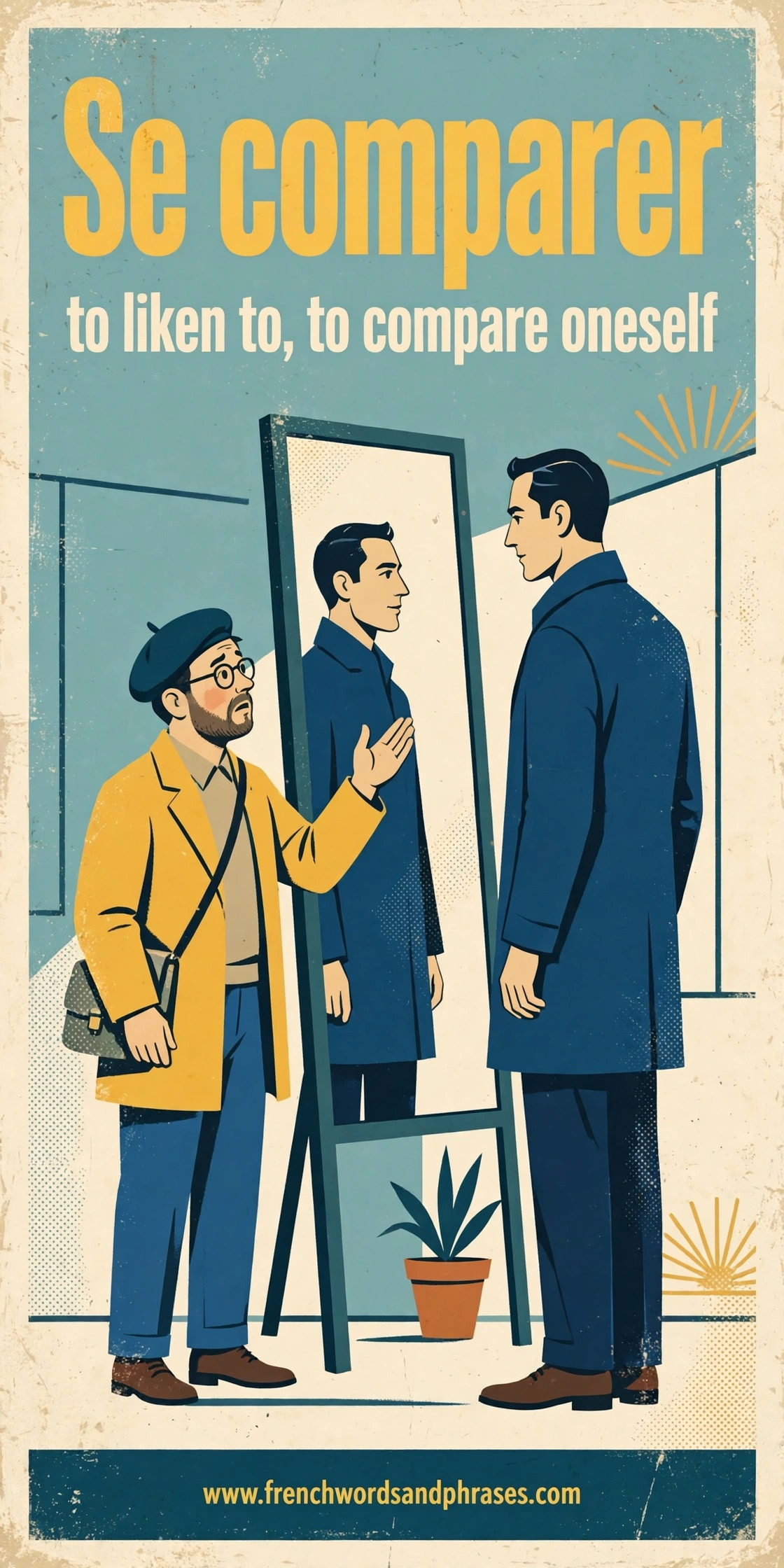
The preposition changes the job: comparer à likens one thing to another (comparer la vie à un voyage — to compare life to a journey: a metaphor), while comparer avec puts two real things side by side for inspection (comparer les deux devis avec soin — to compare the two quotes carefully). English speakers mix them freely; careful French keeps à for the image and avec for the examination. The verb itself is a regular -er: je compare, nous comparons.
Experience the Word
Comparer is the verb of the two hands — one holding this, one holding that, the mind weighing both before it chooses.
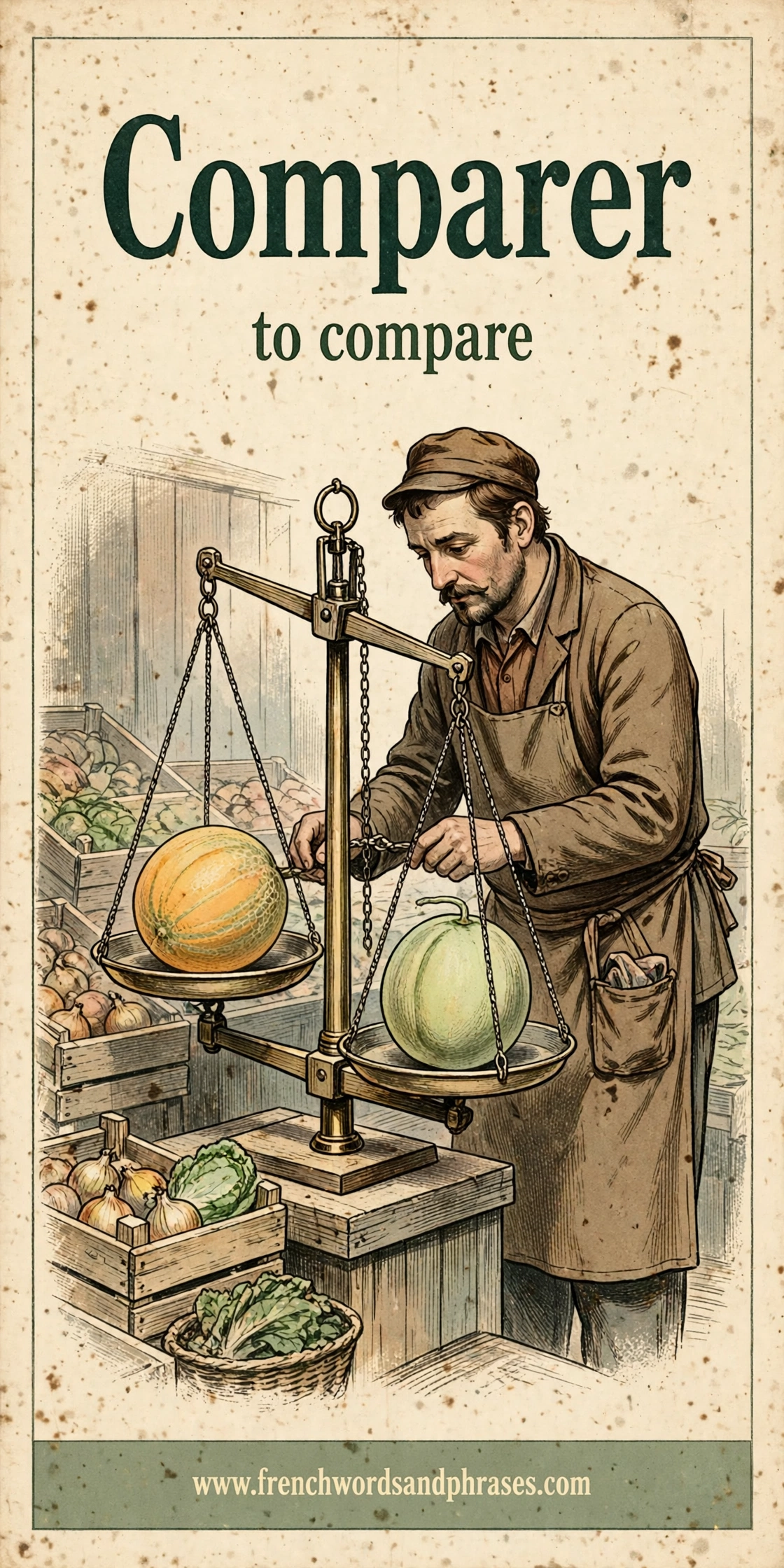
Imagine a grandfather at the market with a melon in each hand, eyes half closed, sniffing one, then the other. The stallholder waits, arms crossed. The old man compares — il compare — the weight, the smell, the deep sound of a fingertip tap, and only then points: celui-là.
He has bought a thousand melons this way. He has compared — il a comparé, and the choosing was the easy part.
How to Conjugate Comparer: Complete French Conjugation Guide
Let’s explore every major conjugation of comparer, beginning with the indicative mood.
How to Conjugate Comparer in the Indicative Mood
The indicative mood is used to express facts, observations, actions, and events.
How to Conjugate Comparer in the Present Tense (Présent)
Used for actions happening now, habitual actions, and general truths.
| Subject | Conjugation |
|---|---|
| je | compare |
| tu | compares |
| il / elle | compare |
| nous | comparons |
| vous | comparez |
| ils / elles | comparent |
Example
Je compare toujours les prix avant d’acheter.
I always compare prices before buying.
Quick Quiz 1
Complete the sentence:
Nous ______ les prix dans trois magasins.
Reveal the answer
comparons
Nous comparons les prix dans trois magasins.
We compare prices in three shops.
How to Conjugate Comparer in the Passé Composé
Used for completed actions in the past. Comparer takes the auxiliary verb avoir.
| Subject | Conjugation |
|---|---|
| j’ | ai comparé |
| tu | as comparé |
| il / elle | a comparé |
| nous | avons comparé |
| vous | avez comparé |
| ils / elles | ont comparé |
Example
Nous avons comparé les deux offres toute la soirée.
We compared the two offers all evening.
How to Conjugate Comparer in the Imparfait (Imperfect Tense)
Used for habitual past actions, descriptions, and ongoing situations in the past.
| Subject | Conjugation |
|---|---|
| je | comparais |
| tu | comparais |
| il / elle | comparait |
| nous | comparions |
| vous | compariez |
| ils / elles | comparaient |
Example
Elle comparait son fils à son frère à chaque repas.
She compared her son to his brother at every meal.
Quick Quiz 2
Choose the correct form:
We compared the offers.
Nous ______ les offres. (avons comparé / sommes comparés)
Reveal the answer
avons comparé
Nous avons comparé les offres.
Comparer takes avoir.
How to Conjugate Comparer in the Plus-que-parfait
Used to describe an action that had already been completed before another past event.
| Subject | Conjugation |
|---|---|
| j’ | avais comparé |
| tu | avais comparé |
| il / elle | avait comparé |
| nous | avions comparé |
| vous | aviez comparé |
| ils / elles | avaient comparé |
Example
Il avait comparé toutes les voitures avant de choisir.
He had compared all the cars before choosing.
How to Conjugate Comparer in the Passé Simple
Primarily used in formal writing, literature, and historical narratives. It is rarely used in everyday conversation.
| Subject | Conjugation |
|---|---|
| je | comparai |
| tu | comparas |
| il / elle | compara |
| nous | comparâmes |
| vous | comparâtes |
| ils / elles | comparèrent |
Example
Le poète compara la vie à un long fleuve.
The poet compared life to a long river.
How to Conjugate Comparer in the Passé Antérieur
A literary tense used to express an action completed immediately before another past action, generally in the passé simple.
| Subject | Conjugation |
|---|---|
| j’ | eus comparé |
| tu | eus comparé |
| il / elle | eut comparé |
| nous | eûmes comparé |
| vous | eûtes comparé |
| ils / elles | eurent comparé |
Example
Quand ils eurent comparé les devis, ils signèrent le moins cher.
When they had compared the quotes, they signed the cheapest.
How to Conjugate Comparer in the Future Tense (Futur Simple)
Used to describe actions that will take place in the future.
| Subject | Conjugation |
|---|---|
| je | comparerai |
| tu | compareras |
| il / elle | comparera |
| nous | comparerons |
| vous | comparerez |
| ils / elles | compareront |
Example
Demain, nous comparerons les résultats des deux laboratoires.
Tomorrow, we will compare the results from the two laboratories.
How to Conjugate Comparer in the Futur Antérieur (Future Perfect)
Used for an action that will have been completed before a particular point in the future.
| Subject | Conjugation |
|---|---|
| j’ | aurai comparé |
| tu | auras comparé |
| il / elle | aura comparé |
| nous | aurons comparé |
| vous | aurez comparé |
| ils / elles | auront comparé |
Example
À la fin du mois, tu auras comparé vingt appartements.
By the end of the month, you will have compared twenty flats.
How to Conjugate Comparer in the Near Future (Futur Proche)
Used to describe something that is going to happen soon. Formed with aller + infinitive.
| Subject | Conjugation |
|---|---|
| je | vais comparer |
| tu | vas comparer |
| il / elle | va comparer |
| nous | allons comparer |
| vous | allez comparer |
| ils / elles | vont comparer |
Example
Attends, je vais comparer avec l’autre modèle.
Wait, I am going to compare it with the other model.
How to Conjugate Comparer in the Conditional Mood
The conditional mood expresses what would happen under certain circumstances. It is also frequently used to make polite requests or express wishes.
How to Conjugate Comparer in the Present Conditional
| Subject | Conjugation |
|---|---|
| je | comparerais |
| tu | comparerais |
| il / elle | comparerait |
| nous | comparerions |
| vous | compareriez |
| ils / elles | compareraient |
Example
On comparerait mieux avec les chiffres exacts.
We would compare better with the exact figures.
How to Conjugate Comparer in the Past Conditional
| Subject | Conjugation |
|---|---|
| j’ | aurais comparé |
| tu | aurais comparé |
| il / elle | aurait comparé |
| nous | aurions comparé |
| vous | auriez comparé |
| ils / elles | auraient comparé |
Example
Elle aurait comparé les prix si elle avait eu le temps.
She would have compared the prices if she had had the time.
Comparer in the Literary Past Conditional Form
This less common literary form uses the imperfect subjunctive of avoir.
| Subject | Conjugation |
|---|---|
| j’ | eusse comparé |
| tu | eusses comparé |
| il / elle | eût comparé |
| nous | eussions comparé |
| vous | eussiez comparé |
| ils / elles | eussent comparé |
Example
Le sage eût comparé avant de juger.
The wise man would have compared before judging.
How to Conjugate Comparer in the Subjunctive Mood
The subjunctive is used to express wishes, emotions, doubts, necessity, and uncertainty. It frequently follows expressions such as il faut que (it is necessary that) or bien que (although).
How to Conjugate Comparer in the Present Subjunctive
| Subject | Conjugation |
|---|---|
| que je | compare |
| que tu | compares |
| qu’il / qu’elle | compare |
| que nous | comparions |
| que vous | compariez |
| qu’ils / qu’elles | comparent |
Example
Il faut que tu compares les deux contrats ligne par ligne.
You must compare the two contracts line by line.
Quick Quiz 3
Complete the sentence using the subjunctive:
Il faut que vous ______ les deux textes.
Reveal the answer
compariez
Il faut que vous compariez les deux textes.
You must compare the two texts.
How to Conjugate Comparer in the Imperfect Subjunctive
A literary tense, rarely encountered in modern spoken French.
| Subject | Conjugation |
|---|---|
| que je | comparasse |
| que tu | comparasses |
| qu’il / qu’elle | comparât |
| que nous | comparassions |
| que vous | comparassiez |
| qu’ils / qu’elles | comparassent |
Example
Elle voulait qu’on comparât son travail à celui des autres.
She wanted her work to be compared with the others’.
How to Conjugate Comparer in the Pluperfect Subjunctive
A literary construction used to express an action completed before another past action.
| Subject | Conjugation |
|---|---|
| que j’ | eusse comparé |
| que tu | eusses comparé |
| qu’il / qu’elle | eût comparé |
| que nous | eussions comparé |
| que vous | eussiez comparé |
| qu’ils / qu’elles | eussent comparé |
Example
On regretta qu’il eût comparé son frère à un héros.
People regretted that he had compared his brother to a hero.
How to Conjugate Comparer in the Past Subjunctive
| Subject | Conjugation |
|---|---|
| que j’ | aie comparé |
| que tu | aies comparé |
| qu’il / qu’elle | ait comparé |
| que nous | ayons comparé |
| que vous | ayez comparé |
| qu’ils / qu’elles | aient comparé |
Example
Je suis content que vous ayez comparé avant de décider.
I am glad you compared before deciding.
How to Conjugate Comparer in the Imperative
The imperative is used to give commands, instructions, invitations, or suggestions. Subject pronouns are omitted.
How to Conjugate Comparer in the Present Imperative
| Person | Conjugation |
|---|---|
| (tu) | compare |
| (nous) | comparons |
| (vous) | comparez |
Example
Comparez les deux textes et trouvez les différences.
Compare the two texts and find the differences.
Quick Quiz 4
How would you say Compare the prices (tu form)?
Reveal the answer
Compare les prix !
French Participles of Comparer
Participles are verb forms that can be used in compound tenses and other grammatical constructions.
Present Participle of Comparer
comparant
En comparant les prix, on économise plus qu’on ne croit.
By comparing prices, one saves more than one thinks.
Past Participle of Comparer
comparé
Comparées côte à côte, les deux photos révèlent tout.
Compared side by side, the two photos reveal everything.
Comparer in Everyday French: Real-Life Examples
Now that you know the conjugations, let’s see how comparer appears in everyday French.
Example 1 — Present
Je compare les prix avant d’acheter.
I compare prices before buying.
Example 2 — Passé composé
Nous avons comparé trois offres.
We compared three offers.
Example 3 — Imparfait
Il comparait tout à son enfance.
He compared everything to his childhood.
Example 4 — Future
Nous comparerons les résultats demain.
We will compare the results tomorrow.
Example 5 — Conditional
On comparerait mieux à tête reposée.
We would compare better with a clear head.
Example 6 — Imperative
Compare les deux modèles !
Compare the two models!
Beyond Translation: The Meaning of Comparer
Comparer splits its work between two prepositions, and French schoolchildren meet the split early: une comparaison, in grammar, is the figure that says la vie est comme un fleuve.
To compare is France’s national sport.
Prices, wines, villages, presidents — everything is weighed against something else, and the verdict il n’y a pas de comparaison (there is no comparison) is the highest praise the verb can deliver.
How to Remember the French Verb Comparer
Remember it this way: Comparer is about a melon in each hand at the market stall.
- Comparer à = likening (a metaphor); comparer avec = examining two real things side by side.
- Regular -er: je compare, nous comparons, past participle comparé.
- The noun comparaison is both a comparison and, in grammar, a simile.
The key idea is a melon in each hand at the market stall.
Test Your Knowledge of Comparer
Let’s see how much you’ve learned. Try answering these questions before revealing the answers.
Question 1
Comparer à or comparer avec — which one likens life to a journey?
Reveal the answer
Comparer à — comparer la vie à un voyage is a likeness, an image; comparer avec is for examining two real things.
Question 2
How do you say I always compare prices in French?
Reveal the answer
Je compare toujours les prix.
Question 3
Translate: We compared the two offers all evening.
Reveal the answer
Nous avons comparé les deux offres toute la soirée.
Question 4
What is the past participle of comparer?
Reveal the answer
Comparé.
Question 5
Complete the sentence:
Il faut que tu ______ les deux contrats ligne par ligne.
Reveal the answer
compares
Il faut que tu compares les deux contrats ligne par ligne.
You must compare the two contracts line by line.
Your Final Challenge
Can You Use It?
How would you say this in French?
Compare the two banks of the river: on one side your childhood, on the other your life, and the bridge between them is you.
Reveal the answer
Compare les deux rives du fleuve : d’un côté ton enfance, de l’autre ta vie, et le pont entre les deux, c’est toi.
Compare the two banks of the river: on one side your childhood, on the other your life, and the bridge between them is you.
A little French. A little curiosity. A richer everyday life.
LEARN FRENCH ONE WORD AT A TIME