A French Word to Live By
How to Conjugate Comparaître in French
/kɔ̃.pa.ʁɛtʁ/
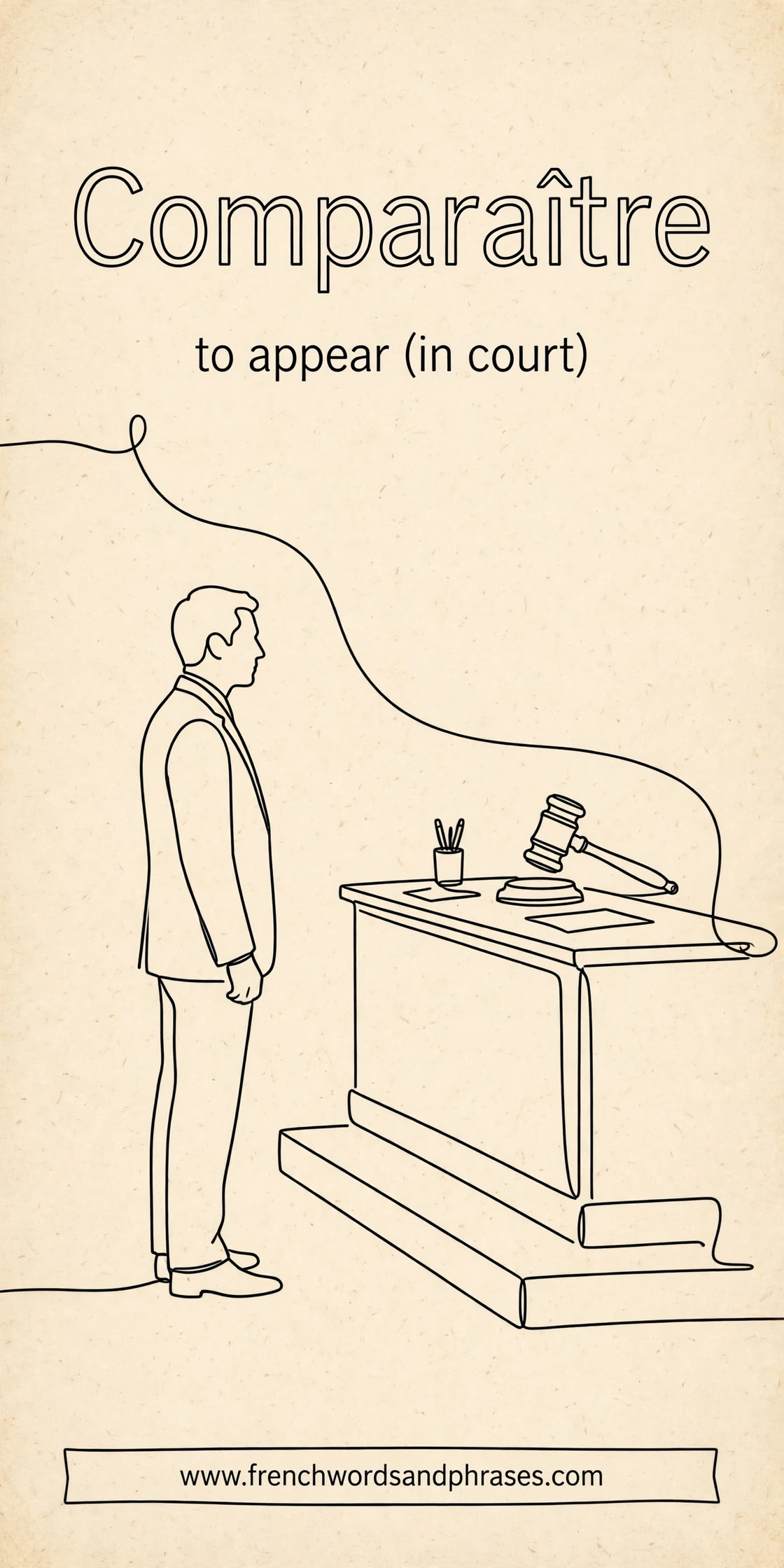
Comparaître means to appear — in the legal sense: to present oneself before a court, a judge or a tribunal when the law has summoned you.
A courtroom hush, a name called out by the clerk, a defendant rising slowly from the bench. Comparaître is the verb of the summons obeyed: appearing before a judge because the law has called you. Outside the courtroom it barely exists — and that is precisely its point.
In this guide, you’ll learn how to conjugate comparaître in all the major French tenses and moods. Explore complete conjugation tables, French examples, English translations, and practice quizzes.
Understanding the French Verb Comparaître
Comparaître is an irregular French verb ending in -aître, conjugated exactly like connaître.
It means to appear (in court). Comparaître belongs to legal procedure: defendants, witnesses and parties to a case comparaissent; everyone else appears with apparaître. A useful neighbour is the noun la comparution — la comparution immédiate is the fast-track hearing in which a suspect is brought before the court at once.
Verb classification: Irregular (-aître)
Auxiliary verb: Avoir
Past participle: comparu
Present participle: comparaissant
English equivalents: To appear (in court), to stand before; comparaître devant le tribunal — to appear before the court; comparaître devant le juge — to appear before the judge; une citation à comparaître — a summons to appear; comparaître libre — to appear in court while at liberty; faire comparaître un témoin — to have a witness brought before the court.
Comparaître follows connaître exactly. The î survives only where a t follows it in a closed syllable: il comparaît — but the past participle is plain comparu, with no accent at all, and the passé simple is built on that same stem: je comparus, il comparut, nous comparûmes. Mind the register, too: comparaître is courtroom French. For appearing on a stage or materialising in the street, French uses apparaître or se présenter.
Experience the Word
Comparaître is the verb of the called name — the moment a private citizen becomes, for an hour, a figure in a courtroom.
Imagine a young man in his best jacket, sitting on a hard bench since eight o’clock, rehearsing his first sentence under his breath. At eleven, the clerk opens the door and calls his name: he stands, walks to the bar, and comparaît — heart pounding, hands visible, exactly as the summons ordered.
He has not chosen the time, the room or the questions. He has appeared — il a comparu, because the law called and he answered.
How to Conjugate Comparaître: Complete French Conjugation Guide
Let’s explore every major conjugation of comparaître, beginning with the indicative mood.
How to Conjugate Comparaître in the Indicative Mood
The indicative mood is used to express facts, observations, actions, and events.
How to Conjugate Comparaître in the Present Tense (Présent)
Used for actions happening now, habitual actions, and general truths.
| Subject | Conjugation |
|---|---|
| je | comparais |
| tu | comparais |
| il / elle | comparaît |
| nous | comparaissons |
| vous | comparaissez |
| ils / elles | comparaissent |
Example
L’accusé comparaît devant le tribunal ce matin.
The accused is appearing before the court this morning.
Quick Quiz 1
Complete the sentence:
Les prévenus ______ un à un devant le juge.
Reveal the answer
comparaissent
Les prévenus comparaissent un à un devant le juge.
The defendants appear one by one before the judge.
How to Conjugate Comparaître in the Passé Composé
Used for completed actions in the past. Comparaître takes the auxiliary verb avoir.
| Subject | Conjugation |
|---|---|
| j’ | ai comparu |
| tu | as comparu |
| il / elle | a comparu |
| nous | avons comparu |
| vous | avez comparu |
| ils / elles | ont comparu |
Example
Le témoin a comparu trois fois dans cette affaire.
The witness has appeared three times in this case.
How to Conjugate Comparaître in the Imparfait (Imperfect Tense)
Used for habitual past actions, descriptions, and ongoing situations in the past.
| Subject | Conjugation |
|---|---|
| je | comparaissais |
| tu | comparaissais |
| il / elle | comparaissait |
| nous | comparaissions |
| vous | comparaissiez |
| ils / elles | comparaissaient |
Example
Chaque semaine, des dizaines de prévenus comparaissaient devant le même juge.
Every week, dozens of defendants appeared before the same judge.
Quick Quiz 2
Choose the correct form:
The witness appeared yesterday.
Le témoin ______ hier. (a comparu / est comparu)
Reveal the answer
a comparu
Le témoin a comparu hier.
Comparaître takes avoir.
How to Conjugate Comparaître in the Plus-que-parfait
Used to describe an action that had already been completed before another past event.
| Subject | Conjugation |
|---|---|
| j’ | avais comparu |
| tu | avais comparu |
| il / elle | avait comparu |
| nous | avions comparu |
| vous | aviez comparu |
| ils / elles | avaient comparu |
Example
Elle avait déjà comparu pour une affaire semblable.
She had already appeared in court for a similar case.
How to Conjugate Comparaître in the Passé Simple
Primarily used in formal writing, literature, and historical narratives. It is rarely used in everyday conversation.
| Subject | Conjugation |
|---|---|
| je | comparus |
| tu | comparus |
| il / elle | comparut |
| nous | comparûmes |
| vous | comparûtes |
| ils / elles | comparurent |
Example
Le prévenu comparut libre devant la cour.
The defendant appeared before the court as a free man.
How to Conjugate Comparaître in the Passé Antérieur
A literary tense used to express an action completed immediately before another past action, generally in the passé simple.
| Subject | Conjugation |
|---|---|
| j’ | eus comparu |
| tu | eus comparu |
| il / elle | eut comparu |
| nous | eûmes comparu |
| vous | eûtes comparu |
| ils / elles | eurent comparu |
Example
Dès qu’il eut comparu, l’audience fut suspendue.
As soon as he had appeared, the hearing was adjourned.
How to Conjugate Comparaître in the Future Tense (Futur Simple)
Used to describe actions that will take place in the future.
| Subject | Conjugation |
|---|---|
| je | comparaîtrai |
| tu | comparaîtras |
| il / elle | comparaîtra |
| nous | comparaîtrons |
| vous | comparaîtrez |
| ils / elles | comparaîtront |
Example
Vous comparaîtrez devant le juge lundi prochain.
You will appear before the judge next Monday.
How to Conjugate Comparaître in the Futur Antérieur (Future Perfect)
Used for an action that will have been completed before a particular point in the future.
| Subject | Conjugation |
|---|---|
| j’ | aurai comparu |
| tu | auras comparu |
| il / elle | aura comparu |
| nous | aurons comparu |
| vous | aurez comparu |
| ils / elles | auront comparu |
Example
À la fin du mois, tous les témoins auront comparu.
By the end of the month, all the witnesses will have appeared.
How to Conjugate Comparaître in the Near Future (Futur Proche)
Used to describe something that is going to happen soon. Formed with aller + infinitive.
| Subject | Conjugation |
|---|---|
| je | vais comparaître |
| tu | vas comparaître |
| il / elle | va comparaître |
| nous | allons comparaître |
| vous | allez comparaître |
| ils / elles | vont comparaître |
Example
Attention, l’accusé va comparaître dans quelques minutes.
Careful, the accused is going to appear in a few minutes.
How to Conjugate Comparaître in the Conditional Mood
The conditional mood expresses what would happen under certain circumstances. It is also frequently used to make polite requests or express wishes.
How to Conjugate Comparaître in the Present Conditional
| Subject | Conjugation |
|---|---|
| je | comparaîtrais |
| tu | comparaîtrais |
| il / elle | comparaîtrait |
| nous | comparaîtrions |
| vous | comparaîtriez |
| ils / elles | comparaîtraient |
Example
Sans cette convocation, il ne comparaîtrait jamais.
Without this summons, he would never appear.
How to Conjugate Comparaître in the Past Conditional
| Subject | Conjugation |
|---|---|
| j’ | aurais comparu |
| tu | aurais comparu |
| il / elle | aurait comparu |
| nous | aurions comparu |
| vous | auriez comparu |
| ils / elles | auraient comparu |
Example
Elle aurait comparu si elle avait reçu la citation à temps.
She would have appeared if she had received the summons in time.
Comparaître in the Literary Past Conditional Form
This less common literary form uses the imperfect subjunctive of avoir.
| Subject | Conjugation |
|---|---|
| j’ | eusse comparu |
| tu | eusses comparu |
| il / elle | eût comparu |
| nous | eussions comparu |
| vous | eussiez comparu |
| ils / elles | eussent comparu |
Example
Le témoin eût comparu malgré la peur.
The witness would have appeared despite his fear.
How to Conjugate Comparaître in the Subjunctive Mood
The subjunctive is used to express wishes, emotions, doubts, necessity, and uncertainty. It frequently follows expressions such as il faut que (it is necessary that) or bien que (although).
How to Conjugate Comparaître in the Present Subjunctive
| Subject | Conjugation |
|---|---|
| que je | comparaisse |
| que tu | comparaisses |
| qu’il / qu’elle | comparaisse |
| que nous | comparaissions |
| que vous | comparaissiez |
| qu’ils / qu’elles | comparaissent |
Example
Le juge exige que le prévenu comparaisse en personne.
The judge requires the defendant to appear in person.
Quick Quiz 3
Complete the sentence using the subjunctive:
Il faut que tu ______ devant le tribunal.
Reveal the answer
comparaisses
Il faut que tu comparaisses devant le tribunal.
You must appear before the court.
How to Conjugate Comparaître in the Imperfect Subjunctive
A literary tense, rarely encountered in modern spoken French.
| Subject | Conjugation |
|---|---|
| que je | comparusse |
| que tu | comparusses |
| qu’il / qu’elle | comparût |
| que nous | comparussions |
| que vous | comparussiez |
| qu’ils / qu’elles | comparussent |
Example
L’avocat demandait que son client comparût libre.
The lawyer asked that his client appear as a free man.
How to Conjugate Comparaître in the Pluperfect Subjunctive
A literary construction used to express an action completed before another past action.
| Subject | Conjugation |
|---|---|
| que j’ | eusse comparu |
| que tu | eusses comparu |
| qu’il / qu’elle | eût comparu |
| que nous | eussions comparu |
| que vous | eussiez comparu |
| qu’ils / qu’elles | eussent comparu |
Example
On s’étonna qu’il eût comparu sans avocat.
People were surprised he had appeared without a lawyer.
How to Conjugate Comparaître in the Past Subjunctive
| Subject | Conjugation |
|---|---|
| que j’ | aie comparu |
| que tu | aies comparu |
| qu’il / qu’elle | ait comparu |
| que nous | ayons comparu |
| que vous | ayez comparu |
| qu’ils / qu’elles | aient comparu |
Example
Je suis soulagé qu’elle ait comparu calmement.
I am relieved she appeared calmly.
How to Conjugate Comparaître in the Imperative
The imperative is used to give commands, instructions, invitations, or suggestions. Subject pronouns are omitted.
How to Conjugate Comparaître in the Present Imperative
| Person | Conjugation |
|---|---|
| (tu) | comparais |
| (nous) | comparaissons |
| (vous) | comparaissez |
Example
Comparaissez devant le tribunal lundi à neuf heures précises.
Appear before the court on Monday at nine o’clock sharp.
Quick Quiz 4
How would you say Appear before the judge (tu form)?
Reveal the answer
Comparais devant le juge !
French Participles of Comparaître
Participles are verb forms that can be used in compound tenses and other grammatical constructions.
Present Participle of Comparaître
comparaissant
En comparaissant libre, il a montré sa bonne foi.
By appearing as a free man, he showed his good faith.
Past Participle of Comparaître
comparu
Comparu devant la cour, le prévenu a tout nié.
Having appeared before the court, the defendant denied everything.
Comparaître in Everyday French: Real-Life Examples
Now that you know the conjugations, let’s see how comparaître appears in everyday French.
Example 1 — Present
L’accusé comparaît ce matin.
The accused is appearing this morning.
Example 2 — Passé composé
Elle a comparu devant le juge hier.
She appeared before the judge yesterday.
Example 3 — Imparfait
Les témoins comparaissaient un à un.
The witnesses appeared one by one.
Example 4 — Future
Il comparaîtra la semaine prochaine.
He will appear next week.
Example 5 — Conditional
Sans convocation, elle ne comparaîtrait pas.
Without a summons, she would not appear.
Example 6 — Imperative
Comparaissez à l’heure, je vous prie.
Please appear on time.
Beyond Translation: The Meaning of Comparaître
Comparaître is paraître (to appear, to seem) wearing a wig and gown: com- + paraître, appearing together with the other parties before authority.
Its family runs the courthouse.
La comparution is the appearance itself — la comparution immédiate sends a suspect straight from custody to the bench — while the old variant comparoir survives only in dusty legal formulas. For everything outside the courtroom, French prefers apparaître.
How to Remember the French Verb Comparaître
Remember it this way: Comparaître is about the clerk calling a name in the hushed courtroom.
- Conjugated exactly like connaître: je comparais, il comparaît, nous comparaissons, past participle comparu.
- Courtroom only: comparaître devant le juge, devant le tribunal; elsewhere, apparaître.
- The passé simple is built on comparu-: je comparus, nous comparûmes.
The key idea is the clerk calling a name in the hushed courtroom.
Test Your Knowledge of Comparaître
Let’s see how much you’ve learned. Try answering these questions before revealing the answers.
Question 1
Which common verb is comparaître conjugated exactly like?
Reveal the answer
Connaître — je comparais, il comparaît, nous comparaissons, past participle comparu.
Question 2
How do you say The accused is appearing before the court in French?
Reveal the answer
L’accusé comparaît devant le tribunal.
Question 3
Translate: She appeared before the judge yesterday.
Reveal the answer
Elle a comparu devant le juge hier.
Question 4
What is the past participle of comparaître?
Reveal the answer
Comparu — no circumflex and no î.
Question 5
Complete the sentence:
Le juge exige que le prévenu ______ en personne.
Reveal the answer
comparaisse
Le juge exige que le prévenu comparaisse en personne.
The judge requires the defendant to appear in person.
Your Final Challenge
Can You Use It?
How would you say this in French?
He appeared before the court, calm and upright, and the whole room held its breath.
Reveal the answer
Il a comparu devant le tribunal, calme et droit, et toute la salle a retenu son souffle.
He appeared before the court, calm and upright, and the whole room held its breath.
A little French. A little curiosity. A richer everyday life.
LEARN FRENCH ONE WORD AT A TIME