A French Word to Live By
How to Conjugate Se comparer in French
/sə kɔ̃.pa.ʁe/
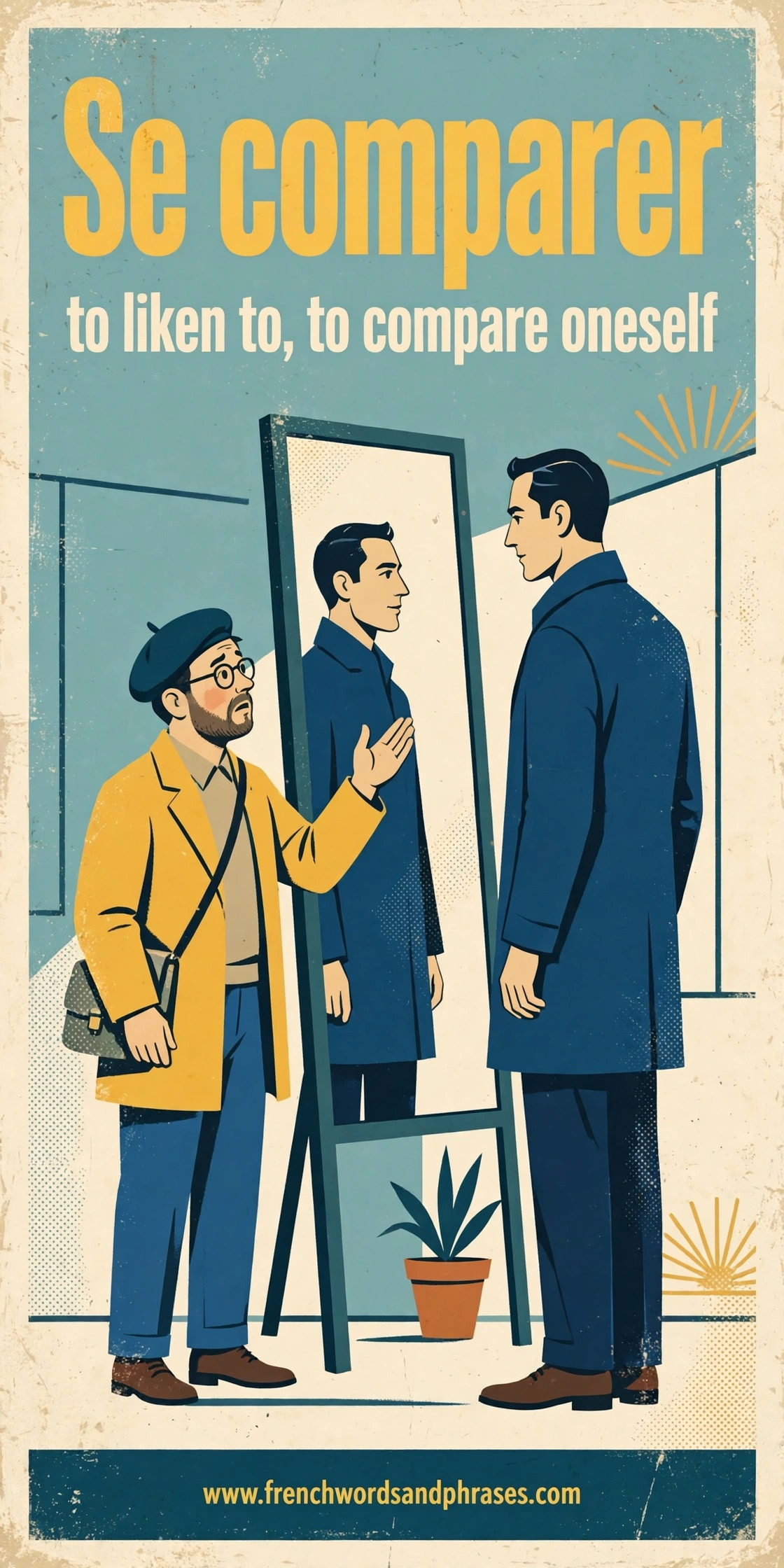
Se comparer means to liken to — above all, to compare oneself with someone else, that quiet measurement nobody escapes.
A teenager before the mirror measuring himself against a film star, a small town refusing to be measured against Paris — se comparer is comparer turned inward: the comparison where judge and accused are the same person.
In this guide, you’ll learn how to conjugate se comparer in all the major French tenses and moods. Explore complete conjugation tables, French examples, English translations, and practice quizzes.
Understanding the French Verb Se comparer
Se comparer is a regular French verb belonging to the first group of verbs, those ending in-er.
It means to liken to, to compare oneself. Se comparer is the social verb of comparison — mirrors, rankings, social media. Its reciprocal use weighs two things against each other (deux époques qui se comparent mal — two eras that compare badly), and its negative form is a compliment: un vin qui ne se compare à rien, a wine that compares to nothing.
Verb classification: First group (-er), reflexive
Auxiliary verb: Être
Past participle: comparé
Present participle: comparant
English equivalents: To compare oneself, to liken oneself; se comparer à quelqu’un — to compare oneself to someone; se comparer à un héros — to liken oneself to a hero; ça ne se compare pas — that is beyond comparison; ces deux villes ne se comparent pas — these two towns cannot be compared.
Se comparer always goes with à: se comparer à sa sœur, à un modèle, à Paris. Being reflexive, it takes être in every compound tense and the past participle agrees with the subject: elle s’est comparée à sa mère toute sa vie. In the negative it turns into praise: ça ne se compare pas — it cannot be compared, it is in a class of its own. And the tu imperative tucks the pronoun behind the verb: compare-toi à qui tu veux, mais…
Experience the Word
Se comparer is the verb of the mirror and the league table — the measurement everyone performs and nobody enjoys.
Imagine a young violinist backstage, listening through the curtain to the soloist before her. She is not hearing music; she is counting: faster, cleaner, surer. Elle se compare, note by note, and by the time her own turn comes she has already lost a contest that existed only in her head.
The rival never knew the contest existed. She compared herself — elle s’est comparée, alone, and the judge was merciless.
How to Conjugate Se comparer: Complete French Conjugation Guide
Let’s explore every major conjugation of se comparer, beginning with the indicative mood.
How to Conjugate Se comparer in the Indicative Mood
The indicative mood is used to express facts, observations, actions, and events.
How to Conjugate Se comparer in the Present Tense (Présent)
Used for actions happening now, habitual actions, and general truths.
| Subject | Conjugation |
|---|---|
| je | me compare |
| tu | te compares |
| il / elle | se compare |
| nous | nous comparons |
| vous | vous comparez |
| ils / elles | se comparent |
Example
Il se compare sans cesse à son frère aîné.
He constantly compares himself to his older brother.
Quick Quiz 1
Complete the sentence:
Nous nous ______ aux élèves des grandes écoles.
Reveal the answer
comparons
Nous nous comparons aux élèves des grandes écoles.
We compare ourselves to the pupils of the big schools.
How to Conjugate Se comparer in the Passé Composé
Used for completed actions in the past. Se comparer takes the auxiliary verb être.
| Subject | Conjugation |
|---|---|
| je | me suis comparé / me suis comparée |
| tu | t’es comparé / t’es comparée |
| il / elle | s’est comparé / s’est comparée |
| nous | nous sommes comparés / nous sommes comparées |
| vous | vous êtes comparés / vous êtes comparées / vous êtes comparé / vous êtes comparée |
| ils / elles | se sont comparés / se sont comparées |
Example
Elle s’est comparée à toutes les candidates et s’est découragée.
She compared herself to all the candidates and lost heart.
How to Conjugate Se comparer in the Imparfait (Imperfect Tense)
Used for habitual past actions, descriptions, and ongoing situations in the past.
| Subject | Conjugation |
|---|---|
| je | me comparais |
| tu | te comparais |
| il / elle | se comparait |
| nous | nous comparions |
| vous | vous compariez |
| ils / elles | se comparaient |
Example
Autrefois, le village se comparait fièrement à la ville voisine.
In the old days, the village proudly compared itself to the neighbouring town.
Quick Quiz 2
Choose the correct form:
She compared herself to her mother.
Elle ______ à sa mère. (s’est comparée / a comparée)
Reveal the answer
s’est comparée
Elle s’est comparée à sa mère.
Se comparer is reflexive, takes être, and the participle agrees: comparée.
How to Conjugate Se comparer in the Plus-que-parfait
Used to describe an action that had already been completed before another past event.
| Subject | Conjugation |
|---|---|
| je | m’étais comparé / m’étais comparée |
| tu | t’étais comparé / t’étais comparée |
| il / elle | s’était comparé / s’était comparée |
| nous | nous étions comparés / nous étions comparées |
| vous | vous étiez comparés / vous étiez comparées / vous étiez comparé / vous étiez comparée |
| ils / elles | s’étaient comparés / s’étaient comparées |
Example
Ils s’étaient comparés à des héros avant même de partir.
They had likened themselves to heroes before even setting out.
How to Conjugate Se comparer in the Passé Simple
Primarily used in formal writing, literature, and historical narratives. It is rarely used in everyday conversation.
| Subject | Conjugation |
|---|---|
| je | me comparai |
| tu | te comparas |
| il / elle | se compara |
| nous | nous comparâmes |
| vous | vous comparâtes |
| ils / elles | se comparèrent |
Example
Le jeune poète se compara à Hugo et rougit de honte.
The young poet compared himself to Hugo and blushed with shame.
How to Conjugate Se comparer in the Passé Antérieur
A literary tense used to express an action completed immediately before another past action, generally in the passé simple.
| Subject | Conjugation |
|---|---|
| je | me fus comparé / me fus comparée |
| tu | te fus comparé / te fus comparée |
| il / elle | se fut comparé / se fut comparée |
| nous | nous fûmes comparés / nous fûmes comparées |
| vous | vous fûtes comparés / vous fûtes comparées / vous fûtes comparé / vous fûtes comparée |
| ils / elles | se furent comparés / se furent comparées |
Example
Dès qu’elle se fut comparée à sa rivale, elle comprit ses chances.
As soon as she had compared herself to her rival, she understood her chances.
How to Conjugate Se comparer in the Future Tense (Futur Simple)
Used to describe actions that will take place in the future.
| Subject | Conjugation |
|---|---|
| je | me comparerai |
| tu | te compareras |
| il / elle | se comparera |
| nous | nous comparerons |
| vous | vous comparerez |
| ils / elles | se compareront |
Example
Tu te compareras moins aux autres avec l’âge.
You will compare yourself less to others as you grow older.
How to Conjugate Se comparer in the Futur Antérieur (Future Perfect)
Used for an action that will have been completed before a particular point in the future.
| Subject | Conjugation |
|---|---|
| je | me serai comparé / me serai comparée |
| tu | te seras comparé / te seras comparée |
| il / elle | se sera comparé / se sera comparée |
| nous | nous serons comparés / nous serons comparées |
| vous | vous serez comparés / vous serez comparées / vous serez comparé / vous serez comparée |
| ils / elles | se seront comparés / se seront comparées |
Example
À vingt ans, il se sera comparé à tous ses camarades.
By twenty, he will have compared himself to all his classmates.
How to Conjugate Se comparer in the Near Future (Futur Proche)
Used to describe something that is going to happen soon. Formed with aller + infinitive.
| Subject | Conjugation |
|---|---|
| je | vais me comparer |
| tu | vas te comparer |
| il / elle | va se comparer |
| nous | allons nous comparer |
| vous | allez vous comparer |
| ils / elles | vont se comparer |
Example
Ne commence pas : tu vas encore te comparer à ton cousin.
Don’t start: you are going to compare yourself to your cousin again.
How to Conjugate Se comparer in the Conditional Mood
The conditional mood expresses what would happen under certain circumstances. It is also frequently used to make polite requests or express wishes.
How to Conjugate Se comparer in the Present Conditional
| Subject | Conjugation |
|---|---|
| je | me comparerais |
| tu | te comparerais |
| il / elle | se comparerait |
| nous | nous comparerions |
| vous | vous compareriez |
| ils / elles | se compareraient |
Example
On se comparerait moins sans les réseaux sociaux.
We would compare ourselves less without social media.
How to Conjugate Se comparer in the Past Conditional
| Subject | Conjugation |
|---|---|
| je | me serais comparé / me serais comparée |
| tu | te serais comparé / te serais comparée |
| il / elle | se serait comparé / se serait comparée |
| nous | nous serions comparés / nous serions comparées |
| vous | vous seriez comparés / vous seriez comparées / vous seriez comparé / vous seriez comparée |
| ils / elles | se seraient comparés / se seraient comparées |
Example
Elle se serait comparée à sa mère, autrefois.
She would have compared herself to her mother, in the old days.
Se comparer in the Literary Past Conditional Form
This less common literary form uses the imperfect subjunctive of être.
| Subject | Conjugation |
|---|---|
| je | me fusse comparé / me fusse comparée |
| tu | te fusses comparé / te fusses comparée |
| il / elle | se fût comparé / se fût comparée |
| nous | nous fussions comparés / nous fussions comparées |
| vous | vous fussiez comparés / vous fussiez comparées / vous fussiez comparé / vous fussiez comparée |
| ils / elles | se fussent comparés / se fussent comparées |
Example
Le héros se fût comparé aux dieux sans sourire.
The hero would have likened himself to the gods without smiling.
How to Conjugate Se comparer in the Subjunctive Mood
The subjunctive is used to express wishes, emotions, doubts, necessity, and uncertainty. It frequently follows expressions such as il faut que (it is necessary that) or bien que (although).
How to Conjugate Se comparer in the Present Subjunctive
| Subject | Conjugation |
|---|---|
| que je | me compare |
| que tu | te compares |
| qu’il / qu’elle | se compare |
| que nous | nous comparions |
| que vous | vous compariez |
| qu’ils / qu’elles | se comparent |
Example
Je ne veux pas que tu te compares à ton frère.
I do not want you to compare yourself to your brother.
Quick Quiz 3
Complete the sentence using the subjunctive:
Il faut que vous vous ______ à vos propres progrès.
Reveal the answer
compariez
Il faut que vous vous compariez à vos propres progrès.
You must compare yourselves to your own progress.
How to Conjugate Se comparer in the Imperfect Subjunctive
A literary tense, rarely encountered in modern spoken French.
| Subject | Conjugation |
|---|---|
| que je | me comparasse |
| que tu | te comparasses |
| qu’il / qu’elle | se comparât |
| que nous | nous comparassions |
| que vous | vous comparassiez |
| qu’ils / qu’elles | se comparassent |
Example
Il fallait qu’elle se comparât aux meilleures pour progresser.
She had to measure herself against the best in order to progress.
How to Conjugate Se comparer in the Pluperfect Subjunctive
A literary construction used to express an action completed before another past action.
| Subject | Conjugation |
|---|---|
| que je | me fusse comparé / me fusse comparée |
| que tu | te fusses comparé / te fusses comparée |
| qu’il / qu’elle | se fût comparé / se fût comparée |
| que nous | nous fussions comparés / nous fussions comparées |
| que vous | vous fussiez comparés / vous fussiez comparées / vous fussiez comparé / vous fussiez comparée |
| qu’ils / qu’elles | se fussent comparés / se fussent comparées |
Example
On racontait qu’ils se fussent comparés aux apôtres.
It was said they had likened themselves to the apostles.
How to Conjugate Se comparer in the Past Subjunctive
| Subject | Conjugation |
|---|---|
| que je | me sois comparé / me sois comparée |
| que tu | te sois comparé / te sois comparée |
| qu’il / qu’elle | se soit comparé / se soit comparée |
| que nous | nous soyons comparés / nous soyons comparées |
| que vous | vous soyez comparés / vous soyez comparées / vous soyez comparé / vous soyez comparée |
| qu’ils / qu’elles | se soient comparés / se soient comparées |
Example
Je suis étonné qu’il se soit comparé à un génie.
I am amazed he compared himself to a genius.
How to Conjugate Se comparer in the Imperative
The imperative is used to give commands, instructions, invitations, or suggestions. Subject pronouns are omitted.
How to Conjugate Se comparer in the Present Imperative
| Person | Conjugation |
|---|---|
| (tu) | compare-toi |
| (nous) | comparons-nous |
| (vous) | comparez-vous |
Example
Ne te compare pas aux autres, avance à ton rythme.
Do not compare yourself to others, go at your own pace.
Quick Quiz 4
How would you say Do not compare yourself to him (tu form)?
Reveal the answer
Ne te compare pas à lui !
French Participles of Se comparer
Participles are verb forms that can be used in compound tenses and other grammatical constructions.
Present Participle of Se comparer
comparant
En se comparant aux autres, on finit toujours perdant.
By comparing oneself to others, one always ends up losing.
Past Participle of Se comparer
comparé
Comparée à sa sœur toute son enfance, elle a fini par partir.
Compared to her sister throughout her childhood, she ended up leaving.
Se comparer in Everyday French: Real-Life Examples
Now that you know the conjugations, let’s see how se comparer appears in everyday French.
Example 1 — Present
Il se compare toujours à son frère.
He always compares himself to his brother.
Example 2 — Passé composé
Elle s’est comparée aux autres candidates.
She compared herself to the other candidates.
Example 3 — Imparfait
Nous nous comparions aux élèves des autres écoles.
We used to compare ourselves to pupils from other schools.
Example 4 — Future
Tu te compareras moins en grandissant.
You will compare yourself less as you grow up.
Example 5 — Conditional
On se comparerait moins sans internet.
We would compare ourselves less without the internet.
Example 6 — Imperative
Ne te compare pas à lui !
Do not compare yourself to him!
Beyond Translation: The Meaning of Se comparer
Se comparer is the reflexive that built the modern world of rankings — and French keeps the proverb ready: comparaison n’est pas raison, comparison is not proof.
And its negative is pure praise.
Say of a wine, a voice or a sunset ça ne se compare pas, and you have placed it beyond all rivals: the verb of measurement bowing before the immeasurable.
How to Remember the French Verb Se comparer
Remember it this way: Se comparer is about the violinist backstage, counting someone else’s notes.
- Se comparer à + person: se comparer à son frère, à un modèle — the à is compulsory.
- Reflexive, so être and agreement: elle s’est comparée à sa mère.
- Ça ne se compare pas = it is beyond comparison — a compliment, not a refusal.
The key idea is the violinist backstage, counting someone else’s notes.
Test Your Knowledge of Se comparer
Let’s see how much you’ve learned. Try answering these questions before revealing the answers.
Question 1
Which preposition follows se comparer, and which auxiliary does it use?
Reveal the answer
À, and être — elle s’est comparée à sa sœur.
Question 2
How do you say He always compares himself to his brother in French?
Reveal the answer
Il se compare toujours à son frère.
Question 3
Translate: She compared herself to all the candidates.
Reveal the answer
Elle s’est comparée à toutes les candidates.
Question 4
What does Ça ne se compare pas mean?
Reveal the answer
It is beyond comparison — in a class of its own.
Question 5
Complete the sentence:
Je ne veux pas que tu te ______ à ton frère.
Reveal the answer
compares
Je ne veux pas que tu te compares à ton frère.
I do not want you to compare yourself to your brother.
Your Final Challenge
Can You Use It?
How would you say this in French?
He compared himself to everyone else all his life; the day he measured himself against himself, he finally breathed.
Reveal the answer
Il s’est comparé à tous les autres toute sa vie ; le jour où il s’est mesuré à lui-même, il a enfin respiré.
He compared himself to everyone else all his life; the day he measured himself against himself, he finally breathed.
A little French. A little curiosity. A richer everyday life.
LEARN FRENCH ONE WORD AT A TIME