A French Word to Live By
How to Conjugate Commuter in French
/kɔ.my.te/
Commuter means to commute — in the older, technical sense: to switch a current from one path to another, or to swap the order of things without changing the result.
A railway junction at dawn, points clicking as a train changes track; an electrician’s switchboard; a schoolchild discovering that three plus five equals five plus three. Commuter is the verb of switching and swapping: current changing circuit, terms changing places, the result unchanged.
In this guide, you’ll learn how to conjugate commuter in all the major French tenses and moods. Explore complete conjugation tables, French examples, English translations, and practice quizzes.
Understanding the French Verb Commuter
Commuter is a regular French verb belonging to the first group of verbs, those ending in-er.
It means to commute, to switch. Commuter lives in technical French — electricity (commuter un circuit; un commutateur is a switch or an old telephone exchange), mathematics and logic (des opérations qui commutent), and linguistics (le test de commutation, swapping one sound for another to test meaning). Outside those worlds it is rare, and that rarity is exactly what this page teaches.
Verb classification: First group (-er)
Auxiliary verb: Avoir
Past participle: commuté
Present participle: commutant
English equivalents: To switch, to commute (technical); commuter un circuit — to switch a circuit; commuter le courant — to switch the current; en mathématiques, des termes qui commutent — in mathematics, terms that commute; un commutateur — a switch; not to be confused with commuer une peine — to commute (reduce) a sentence.
The great trap: English to commute has three lives — travelling to work, reducing a prison sentence, and the mathematical sense. French commuter covers only the mathematical one, plus electrical switching: l’addition est commutative, trois plus cinq commute avec cinq plus trois. Reducing a sentence is commuer, a different verb from this same corner of the dictionary, and the daily train journey is faire la navette. The verb itself is a regular -er: je commute, nous commutons.
Experience the Word
Commuter is the verb of the switch — the moment a current, a train or a pair of numbers changes path or place and everything still works.
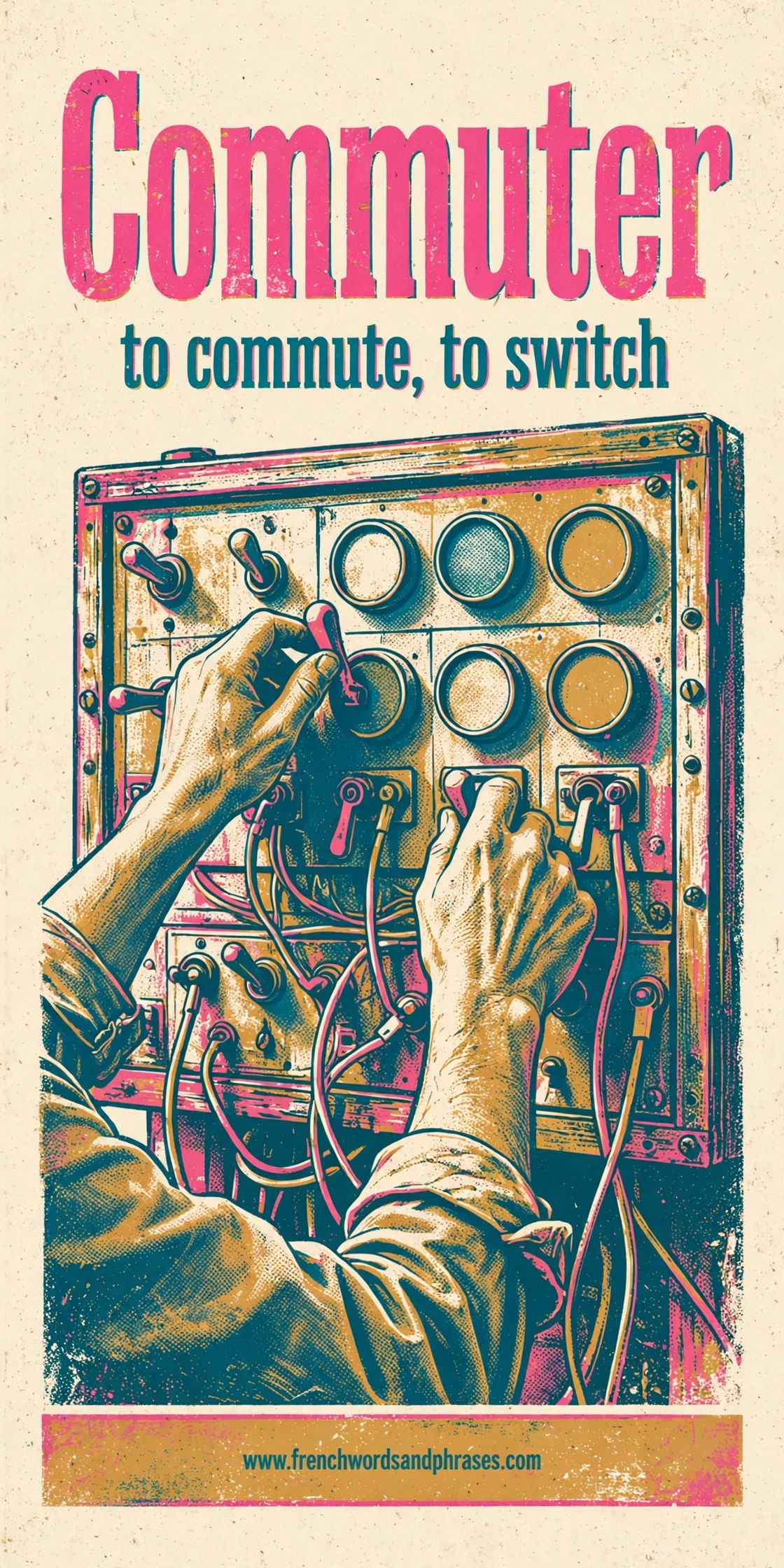
Imagine the old telephone exchange of a French town, rows of cords and sockets reaching to the ceiling. The operator pulls one plug, pushes in another — elle commute les lignes — and suddenly the baker is talking to the doctor: the whole town rewired by two quick hands.
Nothing was created or destroyed. The lines have simply been switched — commutées — and the conversation flows another way.
How to Conjugate Commuter: Complete French Conjugation Guide
Let’s explore every major conjugation of commuter, beginning with the indicative mood.
How to Conjugate Commuter in the Indicative Mood
The indicative mood is used to express facts, observations, actions, and events.
How to Conjugate Commuter in the Present Tense (Présent)
Used for actions happening now, habitual actions, and general truths.
| Subject | Conjugation |
|---|---|
| je | commute |
| tu | commutes |
| il / elle | commute |
| nous | commutons |
| vous | commutez |
| ils / elles | commutent |
Example
Cet interrupteur commute le courant entre les deux circuits.
This switch commutes the current between the two circuits.
Quick Quiz 1
Complete the sentence:
Nous ______ le courant entre les deux circuits.
Reveal the answer
commutons
Nous commutons le courant entre les deux circuits.
We switch the current between the two circuits.
How to Conjugate Commuter in the Passé Composé
Used for completed actions in the past. Commuter takes the auxiliary verb avoir.
| Subject | Conjugation |
|---|---|
| j’ | ai commuté |
| tu | as commuté |
| il / elle | a commuté |
| nous | avons commuté |
| vous | avez commuté |
| ils / elles | ont commuté |
Example
L’électricien a commuté l’installation sur le groupe de secours.
The electrician switched the installation over to the emergency generator.
How to Conjugate Commuter in the Imparfait (Imperfect Tense)
Used for habitual past actions, descriptions, and ongoing situations in the past.
| Subject | Conjugation |
|---|---|
| je | commutais |
| tu | commutais |
| il / elle | commutait |
| nous | commutions |
| vous | commutiez |
| ils / elles | commutaient |
Example
Autrefois, une opératrice commutait les appels à la main.
In the old days, an operator switched the calls by hand.
Quick Quiz 2
Choose the correct form:
The operator switched the call.
L’opératrice ______ l’appel. (a commuté / est commutée)
Reveal the answer
a commuté
L’opératrice a commuté l’appel.
Commuter takes avoir.
How to Conjugate Commuter in the Plus-que-parfait
Used to describe an action that had already been completed before another past event.
| Subject | Conjugation |
|---|---|
| j’ | avais commuté |
| tu | avais commuté |
| il / elle | avait commuté |
| nous | avions commuté |
| vous | aviez commuté |
| ils / elles | avaient commuté |
Example
Le technicien avait commuté les lignes avant la panne.
The technician had switched the lines before the breakdown.
How to Conjugate Commuter in the Passé Simple
Primarily used in formal writing, literature, and historical narratives. It is rarely used in everyday conversation.
| Subject | Conjugation |
|---|---|
| je | commutai |
| tu | commutas |
| il / elle | commuta |
| nous | commutâmes |
| vous | commutâtes |
| ils / elles | commutèrent |
Example
D’un geste, l’aiguilleur commuta le train vers la voie deux.
With one movement, the signalman switched the train to track two.
How to Conjugate Commuter in the Passé Antérieur
A literary tense used to express an action completed immediately before another past action, generally in the passé simple.
| Subject | Conjugation |
|---|---|
| j’ | eus commuté |
| tu | eus commuté |
| il / elle | eut commuté |
| nous | eûmes commuté |
| vous | eûtes commuté |
| ils / elles | eurent commuté |
Example
Quand il eut commuté le courant, les machines repartirent.
When he had switched the current, the machines started again.
How to Conjugate Commuter in the Future Tense (Futur Simple)
Used to describe actions that will take place in the future.
| Subject | Conjugation |
|---|---|
| je | commuterai |
| tu | commuteras |
| il / elle | commutera |
| nous | commuterons |
| vous | commuterez |
| ils / elles | commuteront |
Example
Demain, on commutera tout le réseau sur la nouvelle centrale.
Tomorrow, the whole network will be switched over to the new power station.
How to Conjugate Commuter in the Futur Antérieur (Future Perfect)
Used for an action that will have been completed before a particular point in the future.
| Subject | Conjugation |
|---|---|
| j’ | aurai commuté |
| tu | auras commuté |
| il / elle | aura commuté |
| nous | aurons commuté |
| vous | aurez commuté |
| ils / elles | auront commuté |
Example
À huit heures, le technicien aura commuté toutes les lignes.
By eight o’clock, the technician will have switched all the lines.
How to Conjugate Commuter in the Near Future (Futur Proche)
Used to describe something that is going to happen soon. Formed with aller + infinitive.
| Subject | Conjugation |
|---|---|
| je | vais commuter |
| tu | vas commuter |
| il / elle | va commuter |
| nous | allons commuter |
| vous | allez commuter |
| ils / elles | vont commuter |
Example
Attention, je vais commuter le courant dans dix secondes.
Careful, I am going to switch the current in ten seconds.
How to Conjugate Commuter in the Conditional Mood
The conditional mood expresses what would happen under certain circumstances. It is also frequently used to make polite requests or express wishes.
How to Conjugate Commuter in the Present Conditional
| Subject | Conjugation |
|---|---|
| je | commuterais |
| tu | commuterais |
| il / elle | commuterait |
| nous | commuterions |
| vous | commuteriez |
| ils / elles | commuteraient |
Example
Avec un tableau moderne, on commuterait les circuits à distance.
With a modern panel, one would switch the circuits remotely.
How to Conjugate Commuter in the Past Conditional
| Subject | Conjugation |
|---|---|
| j’ | aurais commuté |
| tu | aurais commuté |
| il / elle | aurait commuté |
| nous | aurions commuté |
| vous | auriez commuté |
| ils / elles | auraient commuté |
Example
Elle aurait commuté plus vite avec un assistant.
She would have switched faster with an assistant.
Commuter in the Literary Past Conditional Form
This less common literary form uses the imperfect subjunctive of avoir.
| Subject | Conjugation |
|---|---|
| j’ | eusse commuté |
| tu | eusses commuté |
| il / elle | eût commuté |
| nous | eussions commuté |
| vous | eussiez commuté |
| ils / elles | eussent commuté |
Example
L’opératrice eût commuté l’appel sans hésiter.
The operator would have switched the call without hesitating.
How to Conjugate Commuter in the Subjunctive Mood
The subjunctive is used to express wishes, emotions, doubts, necessity, and uncertainty. It frequently follows expressions such as il faut que (it is necessary that) or bien que (although).
How to Conjugate Commuter in the Present Subjunctive
| Subject | Conjugation |
|---|---|
| que je | commute |
| que tu | commutes |
| qu’il / qu’elle | commute |
| que nous | commutions |
| que vous | commutiez |
| qu’ils / qu’elles | commutent |
Example
Il faut que tu commutes les deux fils pour inverser le sens.
You must swap the two wires to reverse the direction.
Quick Quiz 3
Complete the sentence using the subjunctive:
Il faut que vous ______ l’appareil avant l’essai.
Reveal the answer
commutiez
Il faut que vous commutiez l’appareil avant l’essai.
You must switch the device before the test.
How to Conjugate Commuter in the Imperfect Subjunctive
A literary tense, rarely encountered in modern spoken French.
| Subject | Conjugation |
|---|---|
| que je | commutasse |
| que tu | commutasses |
| qu’il / qu’elle | commutât |
| que nous | commutassions |
| que vous | commutassiez |
| qu’ils / qu’elles | commutassent |
Example
Le manuel exigeait qu’on commutât l’appareil avant l’essai.
The manual required the device to be switched before the test.
How to Conjugate Commuter in the Pluperfect Subjunctive
A literary construction used to express an action completed before another past action.
| Subject | Conjugation |
|---|---|
| que j’ | eusse commuté |
| que tu | eusses commuté |
| qu’il / qu’elle | eût commuté |
| que nous | eussions commuté |
| que vous | eussiez commuté |
| qu’ils / qu’elles | eussent commuté |
Example
On vérifia qu’il eût commuté les lignes dans le bon ordre.
They checked that he had switched the lines in the right order.
How to Conjugate Commuter in the Past Subjunctive
| Subject | Conjugation |
|---|---|
| que j’ | aie commuté |
| que tu | aies commuté |
| qu’il / qu’elle | ait commuté |
| que nous | ayons commuté |
| que vous | ayez commuté |
| qu’ils / qu’elles | aient commuté |
Example
Je suis content que vous ayez commuté sans couper le service.
I am glad you switched over without cutting the service.
How to Conjugate Commuter in the Imperative
The imperative is used to give commands, instructions, invitations, or suggestions. Subject pronouns are omitted.
How to Conjugate Commuter in the Present Imperative
| Person | Conjugation |
|---|---|
| (tu) | commute |
| (nous) | commutons |
| (vous) | commutez |
Example
Commutez les deux fils, puis rallumez l’appareil.
Swap the two wires, then switch the device back on.
Quick Quiz 4
How would you say Swap the two wires (tu form)?
Reveal the answer
Commute les deux fils !
French Participles of Commuter
Participles are verb forms that can be used in compound tenses and other grammatical constructions.
Present Participle of Commuter
commutant
En commutant les termes, on voit que le résultat ne change pas.
By commuting the terms, one sees that the result does not change.
Past Participle of Commuter
commuté
Les lignes, une fois commutées, ont rétabli les appels.
The lines, once switched, restored the calls.
Commuter in Everyday French: Real-Life Examples
Now that you know the conjugations, let’s see how commuter appears in everyday French.
Example 1 — Present
En algèbre, l’addition commute : trois plus cinq égale cinq plus trois.
In algebra, addition commutes: three plus five equals five plus three.
Example 2 — Passé composé
L’électricien a commuté le courant ce matin.
The electrician switched the current this morning.
Example 3 — Imparfait
Les opératrices commutaient les appels à la main.
The operators used to switch calls by hand.
Example 4 — Future
On commutera le réseau demain matin.
The network will be switched tomorrow morning.
Example 5 — Conditional
Un relais commuterait le circuit automatiquement.
A relay would switch the circuit automatically.
Example 6 — Imperative
Commute les deux fils !
Swap the two wires!
Beyond Translation: The Meaning of Commuter
Commuter and commuer are neighbours in the dictionary and enemies in the exam hall: commuter switches circuits and swaps terms; commuer reduces sentences — commuer une peine de mort en réclusion à perpétuité.
One letter changes a prisoner’s fate.
Both come from Latin commutare, to exchange: the electrician exchanges paths for the current, the judge exchanges one punishment for another, and the mathematician exchanges the order of the terms.
How to Remember the French Verb Commuter
Remember it this way: Commuter is about the operator’s switchboard — plugs swapped, current rerouted.
- Commuter = switching and swapping only: circuits, lines, terms in mathematics.
- NOT the prison sense — reducing a sentence is commuer; the daily trip to work is faire la navette.
- Regular -er: je commute, nous commutons, past participle commuté; its noun is un commutateur, a switch.
The key idea is the operator’s switchboard — plugs swapped, current rerouted.
Test Your Knowledge of Commuter
Let’s see how much you’ve learned. Try answering these questions before revealing the answers.
Question 1
How do you reduce a prison sentence in French — with commuter or with commuer?
Reveal the answer
Commuer — commuer une peine. Commuter only switches circuits or swaps terms.
Question 2
How do you say The electrician switched the current in French?
Reveal the answer
L’électricien a commuté le courant.
Question 3
Translate: In algebra, addition commutes.
Reveal the answer
En algèbre, l’addition commute.
Question 4
What is the past participle of commuter?
Reveal the answer
Commuté.
Question 5
Complete the sentence:
Il faut que tu ______ les deux fils pour inverser le sens.
Reveal the answer
commutes
Il faut que tu commutes les deux fils pour inverser le sens.
You must swap the two wires to reverse the direction.
Your Final Challenge
Can You Use It?
How would you say this in French?
Three plus five, five plus three: the numbers commute, and the result couldn’t care less.
Reveal the answer
Trois plus cinq, cinq plus trois : les nombres commutent, et le résultat s’en moque.
Three plus five, five plus three: the numbers commute, and the result couldn’t care less.
A little French. A little curiosity. A richer everyday life.
LEARN FRENCH ONE WORD AT A TIME