A French Word to Live By
Translate Tristesse to English
/tʁis.tɛs/
La tristesse means sadness.
The train pulls away from the platform and the hand that was waving slowly comes down. Nobody says a word, but the feeling has a name in French, and it settles quietly on the whole carriage — la tristesse.
In this guide, you’ll learn what tristesse means in English, how to use it with its articles, how to form its plural, and how it appears in everyday French. Explore French examples, English translations, and practice quizzes.
Understanding the French Noun Tristesse
Tristesse is a feminine French noun. It is learned together with its article: la tristesse, une tristesse. It is built on the adjective triste (sad) with the suffix -esse, the ending French uses to turn a quality into a state: tristesse is sadness itself, the state of being sad.
It means sadness — the quiet, heavy feeling that comes with a farewell, a disappointment or a grey November afternoon. French reaches for it where English might say sadness, sorrow or the blues: une profonde tristesse (a deep sadness), la tristesse du soir (the sadness of the evening). It is gentler than le chagrin, which is grief with tears in it, and less literary than la mélancolie.
Gender: Feminine
Definite article: la — la tristesse (the sadness)
Indefinite article: une — une tristesse (a sadness)
Plural: les tristesses
English equivalents: Sadness, sorrow; the blues.
One important usage detail: French often names the feeling with the partitive — éprouver de la tristesse, to feel (some) sadness — and with the verb avoir in everyday speech you will more often hear the adjective: je suis triste, I am sad. Tristesse itself shines when the sadness is described, weighed and qualified: une tristesse infinie, an endless sadness.
Experience the Word
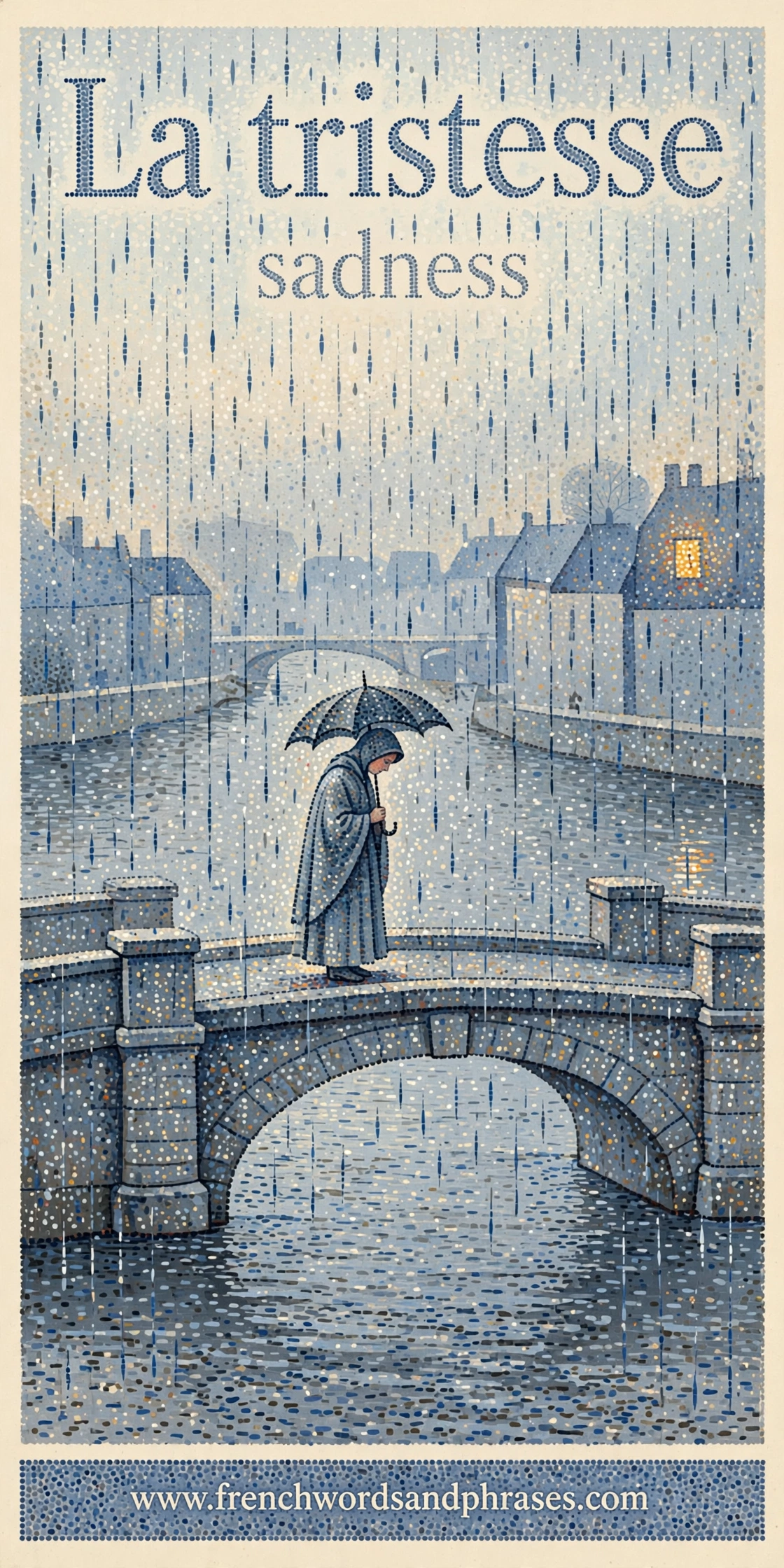
Tristesse is more than feeling low. It is the name French gives to the weather inside — the grey light that falls on a room after bad news, or on a station platform after a goodbye.
Imagine the last evening of a holiday by the sea: the bags are packed, the house is quiet, and even the children have stopped arguing. Nobody is crying; the sadness is simply there, sitting at the table with everyone.
You have not just felt down. You have recognised the tristesse — and named it.
How to Use Tristesse in French: Complete Guide
Let’s explore how tristesse works in French, beginning with its articles.
Tristesse with the Definite Article (La, Les)
Used for the sadness everyone in the conversation can feel — the one in this room, on this platform.
| Number | French |
|---|---|
| Singular | la tristesse |
| Plural | les tristesses |
Example
La tristesse se lisait sur tous les visages.
The sadness could be read on every face.
Tristesse with the Indefinite Article (Une, Des)
Used for a sadness in general — one kind of sadness among others, named and qualified.
| Number | French |
|---|---|
| Singular | une tristesse |
| Plural | des tristesses |
Example
Une tristesse douce l’envahit en écoutant cette chanson.
A gentle sadness came over her as she listened to that song.
The Shades of Tristesse
Sadness is rarely named alone — French qualifies it, and each qualifier changes the picture.
| French | In English |
|---|---|
| une profonde tristesse | a deep sadness |
| une tristesse infinie | an endless sadness |
| une douce tristesse | a gentle, sweet sadness |
| une tristesse passagère | a passing sadness |
| la tristesse du soir | the sadness of the evening |
| une tristesse sans larmes | a sadness without tears |
Example
Après son départ, une tristesse infinie a rempli la maison.
After his departure, an endless sadness filled the house.
Quick Quiz 1
What does « une tristesse passagère » mean?
Reveal the answer
A passing sadness — one that will lift, like weather.
Ce n’est qu’une tristesse passagère, le printemps reviendra.
It is only a passing sadness, spring will come back.
The Plural of Tristesse
Tristesse adds an -s in the plural — les tristesses, the many sorrows of a life, though the singular is far more common.
| Number | French |
|---|---|
| Singular | la tristesse |
| Plural | les tristesses |
Example
Les petites tristesses de l’enfance s’oublient vite.
The little sorrows of childhood are quickly forgotten.
Tristesse with Possessive Adjectives (Ma, Ta, Sa…)
Possessives agree with the noun, not with the owner — and tristesse is feminine, so it takes ma, ta, sa.
| Owner | French |
|---|---|
| my | ma tristesse |
| your (tu) | ta tristesse |
| his / her | sa tristesse |
| our | notre tristesse |
| your (vous) | votre tristesse |
| their | leur tristesse |
Example
Elle cache sa tristesse derrière un sourire.
She hides her sadness behind a smile.
Quick Quiz 2
Complete the sentence:
Il ne montre jamais ______ tristesse. (his)
Reveal the answer
sa
Il ne montre jamais sa tristesse.
He never shows his sadness.
Tristesse with Demonstrative Adjectives (Cette, Ces)
Used to point: this sadness here, those sorrows there.
| Number | French |
|---|---|
| Singular | cette tristesse |
| Plural | ces tristesses |
Example
Cette tristesse finira par passer, comme les autres.
This sadness will end up passing, like the others.
Tristesse with Adjectives
Adjectives agree with tristesse, feminine — grande, profonde, immense.
| Adjective | With Tristesse |
|---|---|
| grande (great) | une grande tristesse |
| profonde (deep) | une profonde tristesse |
| immense (immense) | une tristesse immense |
| passagère (passing) | une tristesse passagère |
| douce (gentle) | une douce tristesse |
Example
Une profonde tristesse a suivi l’annonce de la nouvelle.
A deep sadness followed the announcement of the news.
Quick Quiz 3
Complete the sentence:
Une ______ tristesse se lisait dans ses yeux. (deep)
Reveal the answer
profonde
Une profonde tristesse se lisait dans ses yeux.
A deep sadness could be read in her eyes.
Everyday Expressions with Tristesse
Hiding it, feeling it, chasing it away — the tristesse phrases of daily life.
| Expression | In English |
|---|---|
| éprouver de la tristesse | to feel sadness |
| cacher sa tristesse | to hide your sadness |
| être envahi par la tristesse | to be overcome by sadness |
| chasser la tristesse | to chase the sadness away |
| la tristesse dans les yeux | the sadness in someone’s eyes |
| malgré la tristesse | despite the sadness |
Example
Un air de musique suffit parfois à chasser la tristesse.
A snatch of music is sometimes enough to chase the sadness away.
Words from the Same Family as Tristesse
Sadness and its neighbours — the words that travel with tristesse.
| French | In English |
|---|---|
| triste | sad |
| attrister | to sadden |
| le chagrin | grief, sorrow |
| la mélancolie | melancholy |
| pleurer | to cry |
| les larmes | the tears |
Example
Le chagrin est une tristesse qui pleure.
Grief is a sadness that cries.
Quick Quiz 4
What is the difference between la tristesse and le chagrin?
Reveal the answer
Le chagrin is heavier — grief, sorrow with tears; la tristesse is the wider, quieter sadness of everyday life.
Elle pleure de chagrin, puis la tristesse reste.
She cries with grief, then the sadness remains.
Tristesse in Everyday French: Real-Life Examples
Now that you know the word, let’s see how tristesse appears in everyday French.
Example 1 — At the station
La tristesse des adieux se lisait sur le quai.
The sadness of the farewells could be read on the platform.
Example 2 — After the news
Une grande tristesse a suivi l’annonce.
A great sadness followed the announcement.
Example 3 — Hiding feelings
Il sourit pour cacher sa tristesse.
He smiles to hide his sadness.
Example 4 — Autumn mood
La tristesse de novembre s’installe avec la pluie.
The sadness of November settles in with the rain.
Example 5 — In a letter
C’est avec tristesse que je vous annonce mon départ.
It is with sadness that I announce my departure.
Example 6 — Comforting a friend
Ta tristesse passera, je te le promets.
Your sadness will pass, I promise you.
Beyond Translation: The Meaning of Tristesse
French song is full of tristesse — the chansons of Barbara and Aznavour made it almost a national art — yet the word itself stays modest, a everyday word for an everyday weather of the heart.
To say tristesse is to give the grey day its proper name.
It evokes the platform after the train, the house after the guests, the letter that begins « c’est avec tristesse… » — sadness not as drama, but as the quiet price of having loved, hoped and said goodbye.
How to Remember the French Noun Tristesse
Remember it this way: Tristesse is sadness — feminine, built on triste with the -esse ending that turns a quality into a state.
- You build the word — triste plus -esse, the state of being sad.
- You weigh it — une profonde tristesse, une tristesse infinie, une tristesse passagère.
- You separate the cousins — le chagrin pleure, la tristesse reste.
The key idea is la tristesse is triste turned into a state.
Test Your Knowledge of Tristesse
Let’s see how much you’ve learned. Try answering these questions before revealing the answers.
Question 1
Is tristesse masculine or feminine?
Reveal the answer
Feminine — la tristesse, une tristesse.
Question 2
What adjective is tristesse built on?
Reveal the answer
Triste — sad. The suffix -esse turns the quality into a state.
Question 3
Translate: She hides her sadness behind a smile.
Reveal the answer
Elle cache sa tristesse derrière un sourire.
Question 4
What is le chagrin?
Reveal the answer
Grief, sorrow — a heavier sadness, the kind with tears in it.
Question 5
Complete the sentence:
Une profonde ______ se lisait dans ses yeux.
Reveal the answer
tristesse
Une profonde tristesse se lisait dans ses yeux.
A deep sadness could be read in her eyes.
Your Final Challenge
Can You Use It?
How would you say this in French?
“A deep sadness filled the house after his departure.”
Reveal the answer
Une profonde tristesse a rempli la maison après son départ.
A deep sadness filled the house after his departure.
A little French. A little curiosity. A richer everyday life.
LEARN FRENCH ONE WORD AT A TIME