A French Word to Live By
How to Conjugate Cheminer in French
/ʃə.mi.ne/
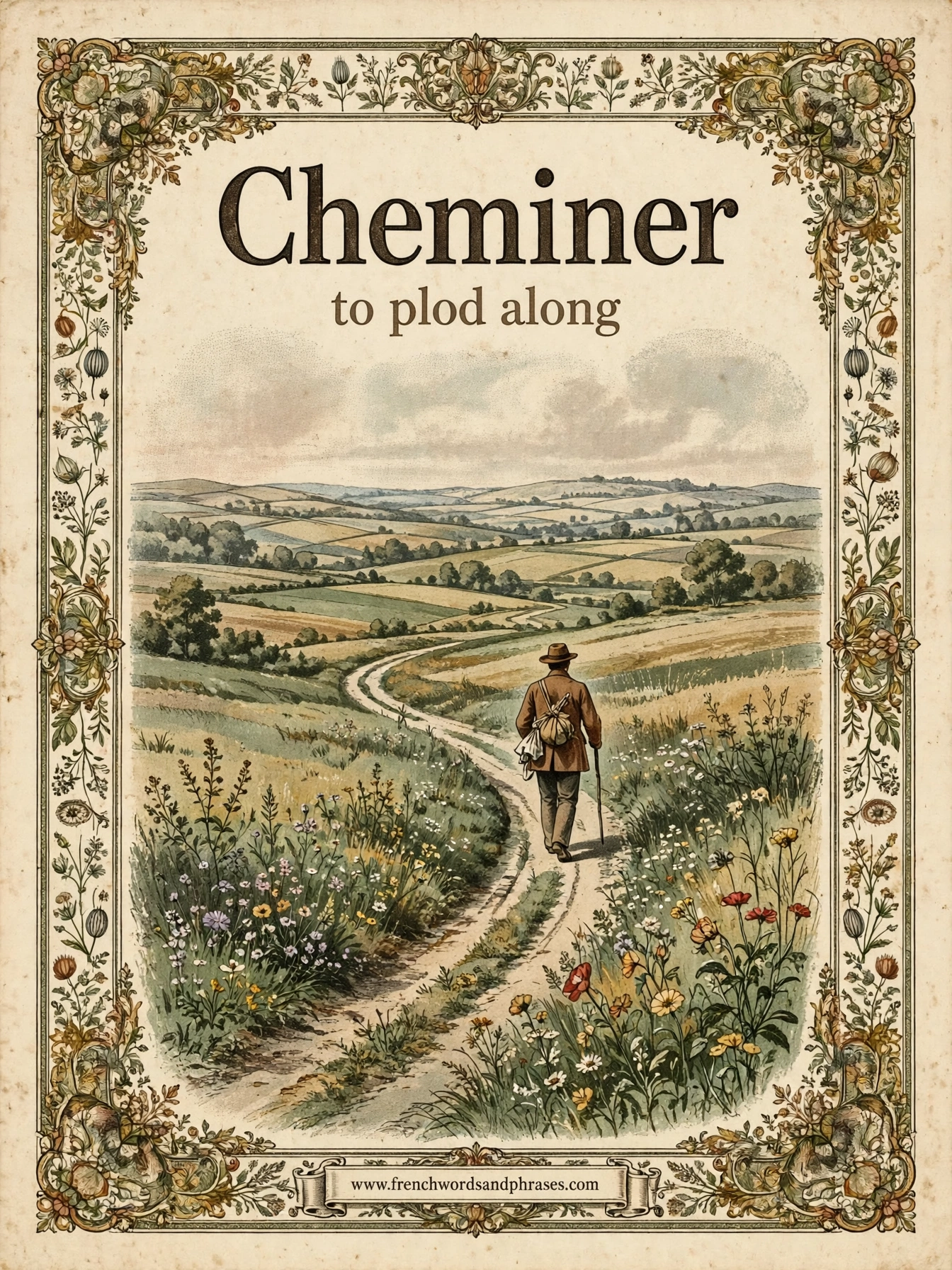
Cheminer means to plod along — to make your way slowly on foot, and by extension to progress step by step.
Pilgrims on a dusty track, a shepherd behind his flock, a file making its slow way through an office — cheminer is the verb of the long way taken slowly: feet on a path, or an idea, a project, a dossier advancing step by step towards its goal.
In this guide, you’ll learn how to conjugate cheminer in all the major French tenses and moods. Explore complete conjugation tables, French examples, English translations, and practice quizzes.
Understanding the French Verb Cheminer
Cheminer is a regular French verb belonging to the first group of verbs, those ending in-er.
It means to plod along. It is used of walkers, pilgrims and travellers covering long distances at walking pace, and just as often, figuratively, of anything that advances gradually: une idée qui chemine (an idea gaining ground), un projet qui chemine (a project moving forward), le cheminement d’un dossier (the progress of a file).
Verb classification: First group (-er)
Auxiliary verb: Avoir
Past participle: cheminé
Present participle: cheminant
English equivalents: To plod along, to make one’s way; cheminer vers — to make one’s way towards; cheminer lentement — to progress slowly; une idée qui chemine — an idea making its way; le cheminement — progress, the path taken (by an idea, a file).
One important detail: cheminer is simply the verb of un chemin, a path — to cheminer is to follow one, slowly and on foot. It is a regular -er verb with avoir, with no stem change: the quiet e of chemin stays put through the whole conjugation: je chemine, nous cheminons, ils cheminent. Watch for its second, figurative life: ideas, projects and paperwork cheminent too — le dossier chemine, the file is making its way (slowly) through the system.
Experience the Word
Cheminer is the verb of slow distance — no speed, no vehicle, just a path and the patience to follow it.
Imagine the road to Compostela at dawn. Backpacks rise one by one from the refuge, and the pilgrims cheminent — through mist, through villages, through their own thoughts — twenty-five kilometres of path between them and the evening’s soup.
Nobody is hurrying, nobody is lost. They are plodding — cheminant — and the road is doing the work.
How to Conjugate Cheminer: Complete French Conjugation Guide
Let’s explore every major conjugation of cheminer, beginning with the indicative mood.
How to Conjugate Cheminer in the Indicative Mood
The indicative mood is used to express facts, observations, actions, and events.
How to Conjugate Cheminer in the Present Tense (Présent)
Used for actions happening now, habitual actions, and general truths.
| Subject | Conjugation |
|---|---|
| je | chemine |
| tu | chemines |
| il / elle | chemine |
| nous | cheminons |
| vous | cheminez |
| ils / elles | cheminent |
Example
Les pèlerins cheminent vers Compostelle.
The pilgrims are plodding along towards Compostela.
Quick Quiz 1
Complete the sentence:
Nous ______ le long du canal.
Reveal the answer
cheminons
Nous cheminons le long du canal.
We are plodding along the canal.
How to Conjugate Cheminer in the Passé Composé
Used for completed actions in the past. Cheminer takes the auxiliary verb avoir.
| Subject | Conjugation |
|---|---|
| j’ | ai cheminé |
| tu | as cheminé |
| il / elle | a cheminé |
| nous | avons cheminé |
| vous | avez cheminé |
| ils / elles | ont cheminé |
Example
Nous avons cheminé trois heures dans la neige.
We plodded along for three hours in the snow.
How to Conjugate Cheminer in the Imparfait (Imperfect Tense)
Used for habitual past actions, descriptions, and ongoing situations in the past.
| Subject | Conjugation |
|---|---|
| je | cheminais |
| tu | cheminais |
| il / elle | cheminait |
| nous | cheminions |
| vous | cheminiez |
| ils / elles | cheminaient |
Example
Il cheminait lentement sur la route de campagne.
He used to plod slowly along the country road.
Quick Quiz 2
Choose the correct form:
She plodded all night.
Elle ______ toute la nuit. (a cheminé / est cheminée)
Reveal the answer
a cheminé
Elle a cheminé toute la nuit.
Cheminer takes avoir.
How to Conjugate Cheminer in the Plus-que-parfait
Used to describe an action that had already been completed before another past event.
| Subject | Conjugation |
|---|---|
| j’ | avais cheminé |
| tu | avais cheminé |
| il / elle | avait cheminé |
| nous | avions cheminé |
| vous | aviez cheminé |
| ils / elles | avaient cheminé |
Example
Elle avait cheminé toute la nuit avant d’atteindre le village.
She had plodded along all night before reaching the village.
How to Conjugate Cheminer in the Passé Simple
Primarily used in formal writing, literature, and historical narratives. It is rarely used in everyday conversation.
| Subject | Conjugation |
|---|---|
| je | cheminai |
| tu | cheminas |
| il / elle | chemina |
| nous | cheminâmes |
| vous | cheminâtes |
| ils / elles | cheminèrent |
Example
Les voyageurs cheminèrent jusqu’au soir sans se reposer.
The travellers plodded on until evening without resting.
How to Conjugate Cheminer in the Passé Antérieur
A literary tense used to express an action completed immediately before another past action, generally in the passé simple.
| Subject | Conjugation |
|---|---|
| j’ | eus cheminé |
| tu | eus cheminé |
| il / elle | eut cheminé |
| nous | eûmes cheminé |
| vous | eûtes cheminé |
| ils / elles | eurent cheminé |
Example
Quand ils eurent cheminé deux jours, ils aperçurent la mer.
When they had plodded along for two days, they caught sight of the sea.
How to Conjugate Cheminer in the Future Tense (Futur Simple)
Used to describe actions that will take place in the future.
| Subject | Conjugation |
|---|---|
| je | cheminerai |
| tu | chemineras |
| il / elle | cheminera |
| nous | cheminerons |
| vous | cheminerez |
| ils / elles | chemineront |
Example
Demain, nous cheminerons le long du canal.
Tomorrow, we will plod along the canal.
How to Conjugate Cheminer in the Futur Antérieur (Future Perfect)
Used for an action that will have been completed before a particular point in the future.
| Subject | Conjugation |
|---|---|
| j’ | aurai cheminé |
| tu | auras cheminé |
| il / elle | aura cheminé |
| nous | aurons cheminé |
| vous | aurez cheminé |
| ils / elles | auront cheminé |
Example
À la fin de la semaine, ils auront cheminé cent kilomètres.
By the end of the week, they will have covered a hundred kilometres on foot.
How to Conjugate Cheminer in the Near Future (Futur Proche)
Used to describe something that is going to happen soon. Formed with aller + infinitive.
| Subject | Conjugation |
|---|---|
| je | vais cheminer |
| tu | vas cheminer |
| il / elle | va cheminer |
| nous | allons cheminer |
| vous | allez cheminer |
| ils / elles | vont cheminer |
Example
Le dossier va cheminer lentement dans l’administration.
The file is going to make its slow way through the administration.
How to Conjugate Cheminer in the Conditional Mood
The conditional mood expresses what would happen under certain circumstances. It is also frequently used to make polite requests or express wishes.
How to Conjugate Cheminer in the Present Conditional
| Subject | Conjugation |
|---|---|
| je | cheminerais |
| tu | cheminerais |
| il / elle | cheminerait |
| nous | cheminerions |
| vous | chemineriez |
| ils / elles | chemineraient |
Example
Sans la pluie, nous cheminerions plus vite.
Without the rain, we would plod along faster.
How to Conjugate Cheminer in the Past Conditional
| Subject | Conjugation |
|---|---|
| j’ | aurais cheminé |
| tu | aurais cheminé |
| il / elle | aurait cheminé |
| nous | aurions cheminé |
| vous | auriez cheminé |
| ils / elles | auraient cheminé |
Example
Tu aurais cheminé moins longtemps avec une carte.
You would have walked for less long with a map.
Cheminer in the Literary Past Conditional Form
This less common literary form uses the imperfect subjunctive of avoir.
| Subject | Conjugation |
|---|---|
| j’ | eusse cheminé |
| tu | eusses cheminé |
| il / elle | eût cheminé |
| nous | eussions cheminé |
| vous | eussiez cheminé |
| ils / elles | eussent cheminé |
Example
Il eût cheminé toute la nuit sans la tempête.
He would have plodded on all night if not for the storm.
How to Conjugate Cheminer in the Subjunctive Mood
The subjunctive is used to express wishes, emotions, doubts, necessity, and uncertainty. It frequently follows expressions such as il faut que (it is necessary that) or bien que (although).
How to Conjugate Cheminer in the Present Subjunctive
| Subject | Conjugation |
|---|---|
| que je | chemine |
| que tu | chemines |
| qu’il / qu’elle | chemine |
| que nous | cheminions |
| que vous | cheminiez |
| qu’ils / qu’elles | cheminent |
Example
Il faut que l’idée chemine dans les esprits.
The idea must make its way into people’s minds.
Quick Quiz 3
Complete the sentence using the subjunctive:
Il faut que vous ______ plus lentement.
Reveal the answer
cheminiez
Il faut que vous cheminiez plus lentement.
You must walk more slowly.
How to Conjugate Cheminer in the Imperfect Subjunctive
A literary tense, rarely encountered in modern spoken French.
| Subject | Conjugation |
|---|---|
| que je | cheminasse |
| que tu | cheminasses |
| qu’il / qu’elle | cheminât |
| que nous | cheminassions |
| que vous | cheminassiez |
| qu’ils / qu’elles | cheminassent |
Example
Je doutais qu’il cheminât encore à cette heure.
I doubted he was still on the road at that hour.
How to Conjugate Cheminer in the Pluperfect Subjunctive
A literary construction used to express an action completed before another past action.
| Subject | Conjugation |
|---|---|
| que j’ | eusse cheminé |
| que tu | eusses cheminé |
| qu’il / qu’elle | eût cheminé |
| que nous | eussions cheminé |
| que vous | eussiez cheminé |
| qu’ils / qu’elles | eussent cheminé |
Example
On racontait qu’ils eussent cheminé des jours dans le désert.
People said they had plodded for days through the desert.
How to Conjugate Cheminer in the Past Subjunctive
| Subject | Conjugation |
|---|---|
| que j’ | aie cheminé |
| que tu | aies cheminé |
| qu’il / qu’elle | ait cheminé |
| que nous | ayons cheminé |
| que vous | ayez cheminé |
| qu’ils / qu’elles | aient cheminé |
Example
Je suis content que le projet ait cheminé jusqu’ici.
I am glad the project has made its way this far.
How to Conjugate Cheminer in the Imperative
The imperative is used to give commands, instructions, invitations, or suggestions. Subject pronouns are omitted.
How to Conjugate Cheminer in the Present Imperative
| Person | Conjugation |
|---|---|
| (tu) | chemine |
| (nous) | cheminons |
| (vous) | cheminez |
Example
Cheminez doucement, le chemin est glissant !
Walk slowly, the path is slippery!
Quick Quiz 4
How would you say Walk slowly (tu form)?
Reveal the answer
Chemine doucement !
French Participles of Cheminer
Participles are verb forms that can be used in compound tenses and other grammatical constructions.
Present Participle of Cheminer
cheminant
En cheminant, ils discutaient de tout et de rien.
As they plodded along, they chatted about everything and nothing.
Past Participle of Cheminer
cheminé
Cheminé tout le jour, le pèlerin s’endormit au refuge.
After plodding all day, the pilgrim fell asleep at the refuge.
Cheminer in Everyday French: Real-Life Examples
Now that you know the conjugations, let’s see how cheminer appears in everyday French.
Example 1 — Present
Les pèlerins cheminent vers Compostelle.
The pilgrims are plodding towards Compostela.
Example 2 — Passé composé
Nous avons cheminé trois heures dans la neige.
We plodded along for three hours in the snow.
Example 3 — Imparfait
Il cheminait lentement sur la route.
He used to plod slowly along the road.
Example 4 — Future
Nous cheminerons le long du canal.
We will plod along the canal.
Example 5 — Conditional
Nous cheminerions plus vite sans la pluie.
We would plod along faster without the rain.
Example 6 — Imperative
Chemine doucement, le chemin est glissant !
Walk slowly, the path is slippery!
Beyond Translation: The Meaning of Cheminer
English plod catches the feet but misses the second life of cheminer: in French, thoughts travel too.
An idea chemine like a pilgrim.
Le cheminement de la pensée — the slow progress of a thought — is a phrase of French essays and examinations, and faire son chemin, to make one’s way, is what every career and every dossier is quietly doing.
How to Remember the French Verb Cheminer
Remember it this way: Cheminer is about pilgrims on the long road — and ideas travelling at the same pace.
- Un chemin is a path; cheminer is following it — slowly, on foot, step by step.
- Ideas and files cheminent too: l’idée chemine, le dossier chemine — progress at walking pace.
- Regular -er with avoir: je chemine, nous cheminons, past participle cheminé.
The key idea is pilgrims on the long road — and ideas travelling at the same pace.
Test Your Knowledge of Cheminer
Let’s see how much you’ve learned. Try answering these questions before revealing the answers.
Question 1
What noun is cheminer built on?
Reveal the answer
Le chemin — a path; to cheminer is to follow it slowly, on foot.
Question 2
How do you say The pilgrims are plodding towards Compostela in French?
Reveal the answer
Les pèlerins cheminent vers Compostelle.
Question 3
Translate: We plodded along for three hours in the snow.
Reveal the answer
Nous avons cheminé trois heures dans la neige.
Question 4
What is the past participle of cheminer?
Reveal the answer
Cheminé.
Question 5
Complete the sentence:
Il faut que l’idée ______ dans les esprits.
Reveal the answer
chemine
Il faut que l’idée chemine dans les esprits.
The idea must make its way into people’s minds.
Your Final Challenge
Can You Use It?
How would you say this in French?
They plod slowly towards the village, and evening falls without hurrying them.
Reveal the answer
Ils cheminent lentement vers le village, et le soir tombe sans les presser.
They plod slowly towards the village, and evening falls without hurrying them.
A little French. A little curiosity. A richer everyday life.
LEARN FRENCH ONE WORD AT A TIME