A French Word to Live By
How to Conjugate Chelinguer in French
/ʃə.lɛ̃.ɡe/
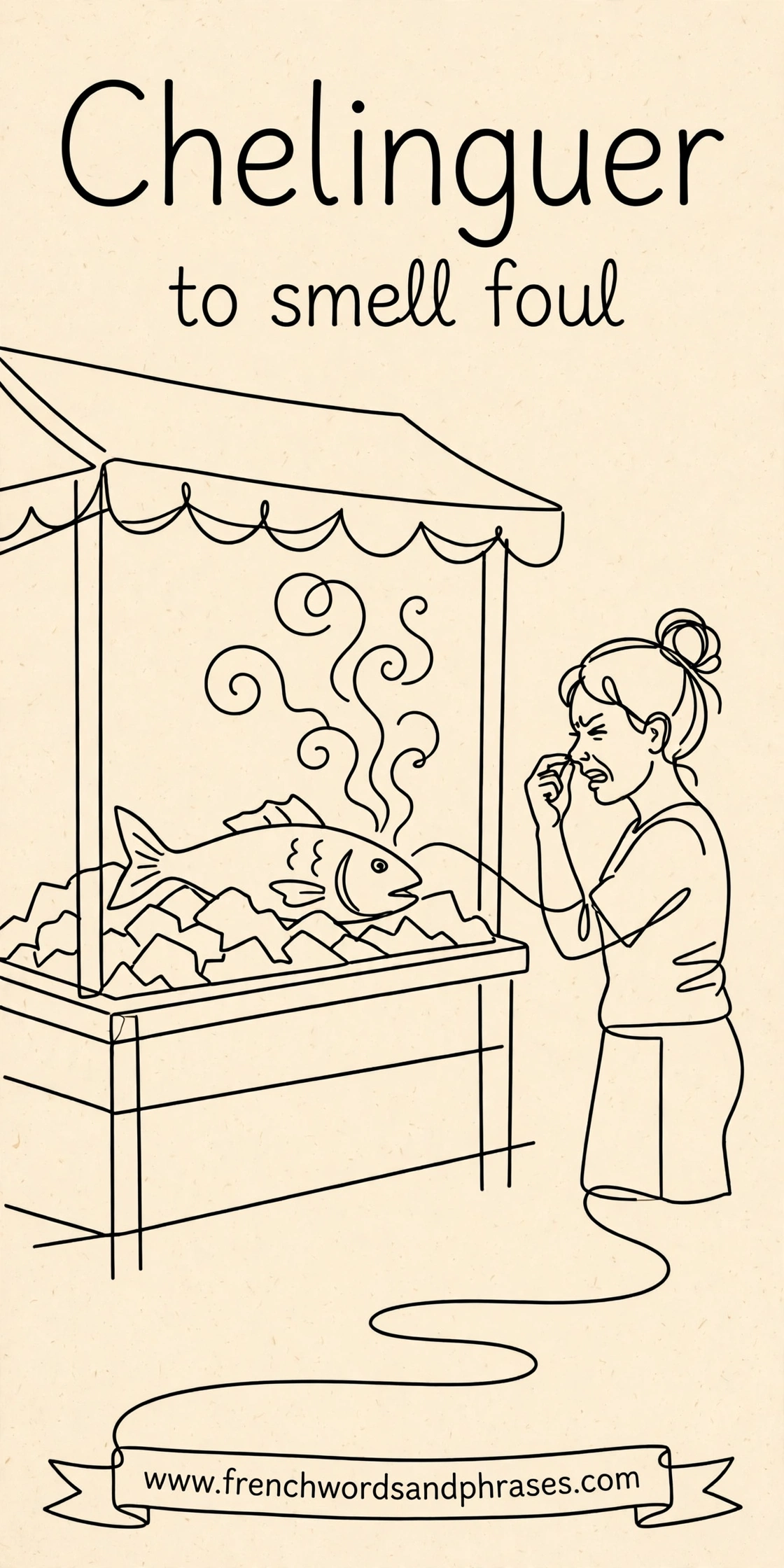
Chelinguer means to smell foul — familiar French for to stink, to reek, said with a wrinkled nose.
A bin left in the sun, a forgotten cheese at the back of the fridge, a pair of trainers after the match — chelinguer is the slang verb of the bad smell itself: not the person, not the nose, but the thing that stinks, and everybody in the room knows it.
In this guide, you’ll learn how to conjugate chelinguer in all the major French tenses and moods. Explore complete conjugation tables, French examples, English translations, and practice quizzes.
Understanding the French Verb Chelinguer
Chelinguer is a regular French verb belonging to the first group of verbs, those ending in-er.
It means to smell foul. It is used of bins, fridges, cellars, cheeses, feet and trainers — anything whose smell fills a room — usually with a laugh or a groan, and very often in the cry ça chelingue ! It describes the smell, never the person smelling it, and it belongs to spoken, friendly French.
Verb classification: First group (-er)
Auxiliary verb: Avoir
Past participle: chelingué
Present participle: chelinguant
English equivalents: To stink, to reek (familiar); ça chelingue ! — it stinks!; chelinguer des pieds — to have smelly feet; une poubelle qui chelingue — a bin that reeks; schlinguer — the commoner synonym, same meaning.
One important detail: chelinguer is familiar register — slang, the word of the playground, the locker room and the family kitchen, never of a formal letter. For careful French, say puer or sentir mauvais. The spelling itself wanders: the dictionary writes it ch(e)linguer, you will also see chlinguer, and the form most people actually say is its synonym schlinguer — all three mean exactly the same wrinkled nose. The subject is always the smelly thing itself: ce fromage chelingue, tes baskets chelinguent.
Experience the Word
Chelinguer is the verb of the opened fridge door — one second of silence, and then everybody says it at once.
Imagine a student kitchen in June. Someone opens the fridge, steps back, and announces to the whole flat: ça chelingue ! The forgotten cheese is found, wrapped, and carried to the bin outside at arm’s length, like a tiny, heroic bomb disposal.
Nothing was rotten beyond repair, nobody was ill. It had simply stunk — chelingué — and the word did the rest.
How to Conjugate Chelinguer: Complete French Conjugation Guide
Let’s explore every major conjugation of chelinguer, beginning with the indicative mood.
How to Conjugate Chelinguer in the Indicative Mood
The indicative mood is used to express facts, observations, actions, and events.
How to Conjugate Chelinguer in the Present Tense (Présent)
Used for actions happening now, habitual actions, and general truths.
| Subject | Conjugation |
|---|---|
| je | chelingue |
| tu | chelingues |
| il / elle | chelingue |
| nous | chelinguons |
| vous | chelinguez |
| ils / elles | chelinguent |
Example
Cette poubelle chelingue depuis hier.
This bin stinks since yesterday.
Quick Quiz 1
Complete the sentence:
Cette poubelle ______ depuis hier.
Reveal the answer
chelingue
Cette poubelle chelingue depuis hier.
This bin stinks since yesterday.
How to Conjugate Chelinguer in the Passé Composé
Used for completed actions in the past. Chelinguer takes the auxiliary verb avoir.
| Subject | Conjugation |
|---|---|
| j’ | ai chelingué |
| tu | as chelingué |
| il / elle | a chelingué |
| nous | avons chelingué |
| vous | avez chelingué |
| ils / elles | ont chelingué |
Example
Le fromage oublié a chelingué dans tout le frigo.
The forgotten cheese stank out the whole fridge.
How to Conjugate Chelinguer in the Imparfait (Imperfect Tense)
Used for habitual past actions, descriptions, and ongoing situations in the past.
| Subject | Conjugation |
|---|---|
| je | chelinguais |
| tu | chelinguais |
| il / elle | chelinguait |
| nous | chelinguions |
| vous | chelinguiez |
| ils / elles | chelinguaient |
Example
Ses vieilles baskets chelinguaient dans l’entrée.
His old trainers used to stink in the hallway.
Quick Quiz 2
Choose the correct form:
The cheese stank out the fridge.
Le fromage ______ tout le frigo. (a chelingué / est chelingué)
Reveal the answer
a chelingué
Le fromage a chelingué tout le frigo.
Chelinguer takes avoir.
How to Conjugate Chelinguer in the Plus-que-parfait
Used to describe an action that had already been completed before another past event.
| Subject | Conjugation |
|---|---|
| j’ | avais chelingué |
| tu | avais chelingué |
| il / elle | avait chelingué |
| nous | avions chelingué |
| vous | aviez chelingué |
| ils / elles | avaient chelingué |
Example
La cave avait chelingué tout l’été à cause de l’humidité.
The cellar had smelled foul all summer because of the damp.
How to Conjugate Chelinguer in the Passé Simple
Primarily used in formal writing, literature, and historical narratives. It is rarely used in everyday conversation.
| Subject | Conjugation |
|---|---|
| je | chelinguai |
| tu | chelinguas |
| il / elle | chelingua |
| nous | chelinguâmes |
| vous | chelinguâtes |
| ils / elles | chelinguèrent |
Example
Dès l’ouverture de la porte, la pièce chelingua terriblement.
As soon as the door opened, the room stank terribly.
How to Conjugate Chelinguer in the Passé Antérieur
A literary tense used to express an action completed immediately before another past action, generally in the passé simple.
| Subject | Conjugation |
|---|---|
| j’ | eus chelingué |
| tu | eus chelingué |
| il / elle | eut chelingué |
| nous | eûmes chelingué |
| vous | eûtes chelingué |
| ils / elles | eurent chelingué |
Example
Quand le lait eut chelingué toute la cuisine, elle le jeta.
When the milk had stunk out the whole kitchen, she threw it away.
How to Conjugate Chelinguer in the Future Tense (Futur Simple)
Used to describe actions that will take place in the future.
| Subject | Conjugation |
|---|---|
| je | chelinguerai |
| tu | chelingueras |
| il / elle | chelinguera |
| nous | chelinguerons |
| vous | chelinguerez |
| ils / elles | chelingueront |
Example
Si tu laisses ce poisson là, il chelinguera demain.
If you leave that fish there, it will stink tomorrow.
How to Conjugate Chelinguer in the Futur Antérieur (Future Perfect)
Used for an action that will have been completed before a particular point in the future.
| Subject | Conjugation |
|---|---|
| j’ | aurai chelingué |
| tu | auras chelingué |
| il / elle | aura chelingué |
| nous | aurons chelingué |
| vous | aurez chelingué |
| ils / elles | auront chelingué |
Example
À ton retour, les poubelles auront chelingué au soleil toute la journée.
By the time you get back, the bins will have been stinking in the sun all day.
How to Conjugate Chelinguer in the Near Future (Futur Proche)
Used to describe something that is going to happen soon. Formed with aller + infinitive.
| Subject | Conjugation |
|---|---|
| je | vais chelinguer |
| tu | vas chelinguer |
| il / elle | va chelinguer |
| nous | allons chelinguer |
| vous | allez chelinguer |
| ils / elles | vont chelinguer |
Example
Ouvre la fenêtre, ça va chelinguer avec ce fromage !
Open the window, it is going to stink with that cheese!
How to Conjugate Chelinguer in the Conditional Mood
The conditional mood expresses what would happen under certain circumstances. It is also frequently used to make polite requests or express wishes.
How to Conjugate Chelinguer in the Present Conditional
| Subject | Conjugation |
|---|---|
| je | chelinguerais |
| tu | chelinguerais |
| il / elle | chelinguerait |
| nous | chelinguerions |
| vous | chelingueriez |
| ils / elles | chelingueraient |
Example
Sans aération, la cave chelinguerait encore plus.
Without ventilation, the cellar would smell even worse.
How to Conjugate Chelinguer in the Past Conditional
| Subject | Conjugation |
|---|---|
| j’ | aurais chelingué |
| tu | aurais chelingué |
| il / elle | aurait chelingué |
| nous | aurions chelingué |
| vous | auriez chelingué |
| ils / elles | auraient chelingué |
Example
Le frigo aurait moins chelingué si tu l’avais nettoyé.
The fridge would have smelled less if you had cleaned it.
Chelinguer in the Literary Past Conditional Form
This less common literary form uses the imperfect subjunctive of avoir.
| Subject | Conjugation |
|---|---|
| j’ | eusse chelingué |
| tu | eusses chelingué |
| il / elle | eût chelingué |
| nous | eussions chelingué |
| vous | eussiez chelingué |
| ils / elles | eussent chelingué |
Example
La poubelle eût chelingué sans le ramassage du matin.
The bin would have stunk if not for the morning collection.
How to Conjugate Chelinguer in the Subjunctive Mood
The subjunctive is used to express wishes, emotions, doubts, necessity, and uncertainty. It frequently follows expressions such as il faut que (it is necessary that) or bien que (although).
How to Conjugate Chelinguer in the Present Subjunctive
| Subject | Conjugation |
|---|---|
| que je | chelingue |
| que tu | chelingues |
| qu’il / qu’elle | chelingue |
| que nous | chelinguions |
| que vous | chelinguiez |
| qu’ils / qu’elles | chelinguent |
Example
Il est possible que ça chelingue dans la cave.
It is possible that it stinks in the cellar.
Quick Quiz 3
Complete the sentence using the subjunctive:
Il est possible que ça ______ dans la cave.
Reveal the answer
chelingue
Il est possible que ça chelingue dans la cave.
It is possible that it stinks in the cellar.
How to Conjugate Chelinguer in the Imperfect Subjunctive
A literary tense, rarely encountered in modern spoken French.
| Subject | Conjugation |
|---|---|
| que je | chelinguasse |
| que tu | chelinguasses |
| qu’il / qu’elle | chelinguât |
| que nous | chelinguassions |
| que vous | chelinguassiez |
| qu’ils / qu’elles | chelinguassent |
Example
On ouvrit la fenêtre avant que la pièce ne chelinguât davantage.
They opened the window before the room smelled any worse.
How to Conjugate Chelinguer in the Pluperfect Subjunctive
A literary construction used to express an action completed before another past action.
| Subject | Conjugation |
|---|---|
| que j’ | eusse chelingué |
| que tu | eusses chelingué |
| qu’il / qu’elle | eût chelingué |
| que nous | eussions chelingué |
| que vous | eussiez chelingué |
| qu’ils / qu’elles | eussent chelingué |
Example
On se plaignait que la cour eût chelingué tout l’été.
People complained that the yard had stunk all summer.
How to Conjugate Chelinguer in the Past Subjunctive
| Subject | Conjugation |
|---|---|
| que j’ | aie chelingué |
| que tu | aies chelingué |
| qu’il / qu’elle | ait chelingué |
| que nous | ayons chelingué |
| que vous | ayez chelingué |
| qu’ils / qu’elles | aient chelingué |
Example
Je suis étonné que le fromage ait autant chelingué.
I am surprised the cheese smelled so bad.
How to Conjugate Chelinguer in the Imperative
The imperative is used to give commands, instructions, invitations, or suggestions. Subject pronouns are omitted.
How to Conjugate Chelinguer in the Present Imperative
| Person | Conjugation |
|---|---|
| (tu) | chelingue |
| (nous) | chelinguons |
| (vous) | chelinguez |
Example
Ne chelingue pas ici, dehors !
Do not stink in here, outside with you!
Quick Quiz 4
How would you say Do not stink in here (tu form)?
Reveal the answer
Ne chelingue pas ici !
French Participles of Chelinguer
Participles are verb forms that can be used in compound tenses and other grammatical constructions.
Present Participle of Chelinguer
chelinguant
En chelinguant ainsi, ce fromage éloigne tous les invités.
Smelling like that, this cheese drives all the guests away.
Past Participle of Chelinguer
chelingué
Chelingué après une semaine, le poisson fut jeté à la poubelle.
Stinking after a week, the fish was thrown in the bin.
Chelinguer in Everyday French: Real-Life Examples
Now that you know the conjugations, let’s see how chelinguer appears in everyday French.
Example 1 — Present
Cette poubelle chelingue depuis hier.
This bin stinks since yesterday.
Example 2 — Passé composé
Le fromage a chelingué dans tout le frigo.
The cheese stank out the whole fridge.
Example 3 — Imparfait
Ses baskets chelinguaient dans l’entrée.
His trainers used to stink in the hallway.
Example 4 — Future
Ce poisson chelinguera demain.
That fish will stink tomorrow.
Example 5 — Conditional
La cave chelinguerait encore plus sans aération.
The cellar would smell even worse without ventilation.
Example 6 — Imperative
Ne chelingue pas dans la maison !
Do not stink in the house!
Beyond Translation: The Meaning of Chelinguer
French keeps three registers for a bad smell, and the choice says everything about the speaker: sentir mauvais is polite, puer is blunt, and chelinguer — or its commoner twin schlinguer — is the laugh that goes with the wrinkled nose.
Ça chelingue ! is a verdict, not a description.
It is never written in a report and always said out loud, usually while opening a window — slang doing exactly the job slang exists for.
How to Remember the French Verb Chelinguer
Remember it this way: Chelinguer is about the forgotten cheese at the back of the fridge — ça chelingue !.
- Familiar register: say ça chelingue ! with friends; write sentir mauvais or puer in careful French.
- Three spellings, one smell: chelinguer, chlinguer, and the common synonym schlinguer.
- Regular -er with avoir, and the subject is the smelly thing: le fromage chelingue, les baskets chelinguent.
The key idea is the forgotten cheese at the back of the fridge — ça chelingue !.
Test Your Knowledge of Chelinguer
Let’s see how much you’ve learned. Try answering these questions before revealing the answers.
Question 1
What register is chelinguer, and what would you write in careful French?
Reveal the answer
Familiar — slang. In careful French, write puer or sentir mauvais.
Question 2
How do you say It stinks in here in familiar French?
Reveal the answer
Ça chelingue ici !
Question 3
Translate: His old trainers stink in the hallway.
Reveal the answer
Ses vieilles baskets chelinguent dans l’entrée.
Question 4
What is the past participle of chelinguer?
Reveal the answer
Chelingué.
Question 5
Complete the sentence:
Ouvre la fenêtre, ça ______ avec ce fromage !
Reveal the answer
chelingue
Ouvre la fenêtre, ça chelingue avec ce fromage !
Open the window, it stinks with that cheese!
Your Final Challenge
Can You Use It?
How would you say this in French?
The cheese stinks in the fridge, but how good it is!
Reveal the answer
Le fromage chelingue dans le frigo, mais qu’il est bon !
The cheese stinks in the fridge, but how good it is!
A little French. A little curiosity. A richer everyday life.
LEARN FRENCH ONE WORD AT A TIME