A French Word to Live By
How to Conjugate Chemiser in French
/ʃə.mi.ze/
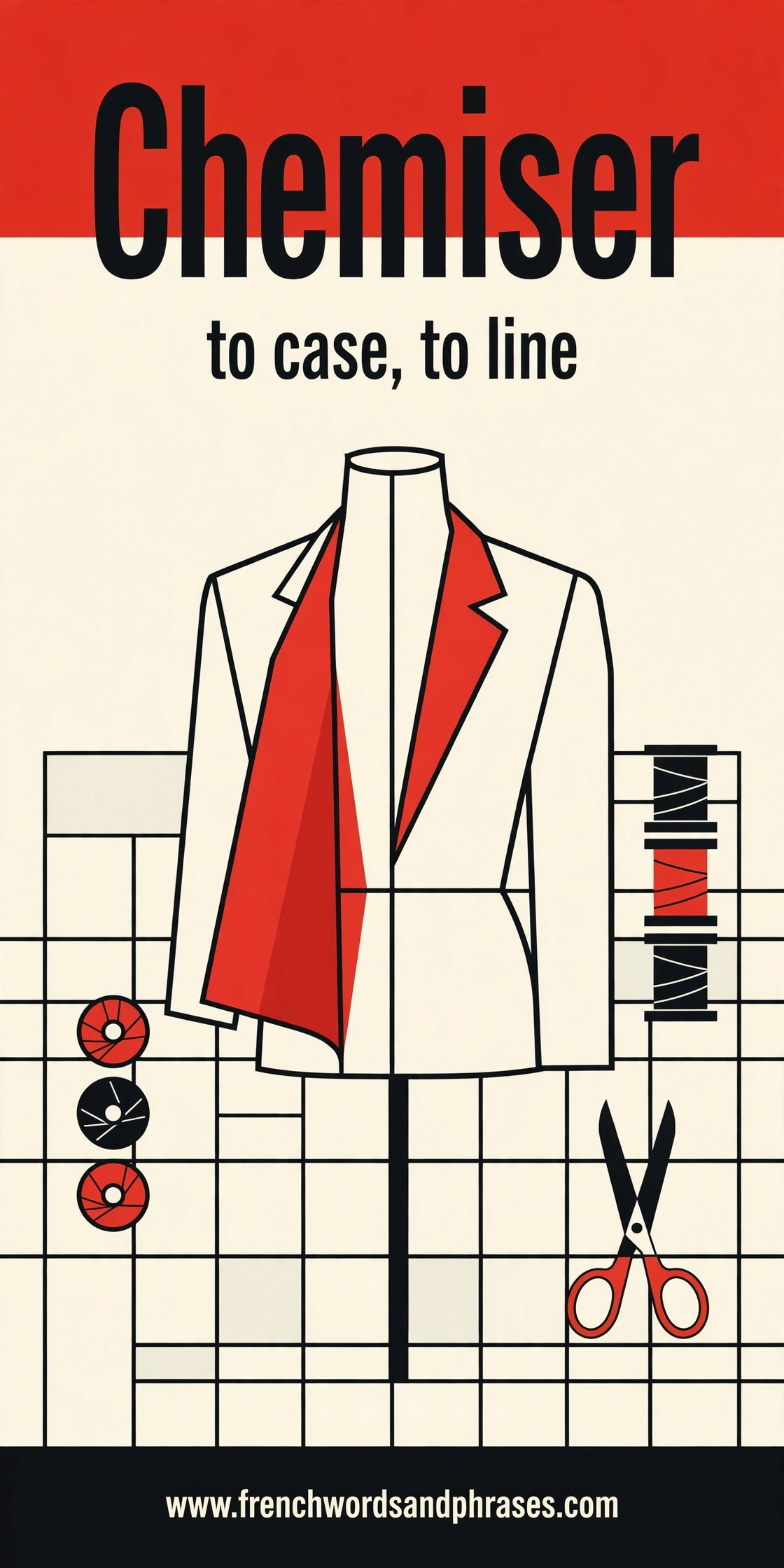
Chemiser means to case, to line — to cover or line something with a protective layer, in the kitchen, the workshop and the bookbinder’s craft.
A pastry chef buttering a mould and lining it with paper, a mechanic fitting a sleeve inside a cylinder, a bookbinder wrapping a volume in marbled paper — chemiser is the craftsman’s verb of the protective lining: whatever is precious gets a shirt before it meets the world.
In this guide, you’ll learn how to conjugate chemiser in all the major French tenses and moods. Explore complete conjugation tables, French examples, English translations, and practice quizzes.
Understanding the French Verb Chemiser
Chemiser is a regular French verb belonging to the first group of verbs, those ending in-er.
It means to case, to line. It is a technical verb of three workshops: the kitchen (lining moulds and tins), engineering (fitting liners and sleeves, chemiser un tuyau, un pieu — casing a pipe, a pile), and bookbinding and publishing, where a book’s protective jacket is literally its chemise.
Verb classification: First group (-er)
Auxiliary verb: Avoir
Past participle: chemisé
Present participle: chemisant
English equivalents: To case, to line, to jacket; chemiser un moule — to line a mould; chemiser un livre — to put a jacket on a book; chemiser un cylindre — to fit a liner to a cylinder; une chemise — a shirt, a folder, a jacket (of a book).
One important detail: chemiser is the verb of une chemise — a shirt, and also a folder or a book’s jacket. To chemiser is to give something a shirt: a lining layer that protects it and lets it be handled. It is a regular -er verb with avoir, and each trade keeps its own object: cooks chemisent moulds so cakes turn out cleanly, mechanics chemisent cylinders with a fresh sleeve, bookbinders chemisent volumes. Do not confuse it with its look-alike neighbour cheminer — one lines, the other plods.
Experience the Word
Chemiser is the verb of the protective layer — nothing delicate faces the world without its shirt on.
Imagine a pastry kitchen before dawn. The chef chemise chaque moule — butter, paper, a practised turn of the wrist — because in six hours a dozen cakes must slide out flawless, and the lining she fits now is the difference between triumph and crumbs.
The cakes are not even mixed yet. She has lined — chemisé — their future, one mould at a time.
How to Conjugate Chemiser: Complete French Conjugation Guide
Let’s explore every major conjugation of chemiser, beginning with the indicative mood.
How to Conjugate Chemiser in the Indicative Mood
The indicative mood is used to express facts, observations, actions, and events.
How to Conjugate Chemiser in the Present Tense (Présent)
Used for actions happening now, habitual actions, and general truths.
| Subject | Conjugation |
|---|---|
| je | chemise |
| tu | chemises |
| il / elle | chemise |
| nous | chemisons |
| vous | chemisez |
| ils / elles | chemisent |
Example
Le pâtissier chemise le moule de papier sulfurisé.
The pastry chef lines the mould with baking parchment.
Quick Quiz 1
Complete the sentence:
Nous ______ les moules avant de commencer.
Reveal the answer
chemisons
Nous chemisons les moules avant de commencer.
We line the moulds before starting.
How to Conjugate Chemiser in the Passé Composé
Used for completed actions in the past. Chemiser takes the auxiliary verb avoir.
| Subject | Conjugation |
|---|---|
| j’ | ai chemisé |
| tu | as chemisé |
| il / elle | a chemisé |
| nous | avons chemisé |
| vous | avez chemisé |
| ils / elles | ont chemisé |
Example
Elle a chemisé le livre d’une couverture en cuir.
She fitted the book with a leather jacket.
How to Conjugate Chemiser in the Imparfait (Imperfect Tense)
Used for habitual past actions, descriptions, and ongoing situations in the past.
| Subject | Conjugation |
|---|---|
| je | chemisais |
| tu | chemisais |
| il / elle | chemisait |
| nous | chemisions |
| vous | chemisiez |
| ils / elles | chemisaient |
Example
Autrefois, on chemisait les moules de beurre et de farine.
In the old days, moulds were lined with butter and flour.
Quick Quiz 2
Choose the correct form:
He lined the mould.
Il ______ le moule. (a chemisé / est chemisé)
Reveal the answer
a chemisé
Il a chemisé le moule.
Chemiser takes avoir.
How to Conjugate Chemiser in the Plus-que-parfait
Used to describe an action that had already been completed before another past event.
| Subject | Conjugation |
|---|---|
| j’ | avais chemisé |
| tu | avais chemisé |
| il / elle | avait chemisé |
| nous | avions chemisé |
| vous | aviez chemisé |
| ils / elles | avaient chemisé |
Example
Il avait chemisé le cylindre avant de remonter le moteur.
He had fitted a liner to the cylinder before reassembling the engine.
How to Conjugate Chemiser in the Passé Simple
Primarily used in formal writing, literature, and historical narratives. It is rarely used in everyday conversation.
| Subject | Conjugation |
|---|---|
| je | chemisai |
| tu | chemisas |
| il / elle | chemisa |
| nous | chemisâmes |
| vous | chemisâtes |
| ils / elles | chemisèrent |
Example
Le relieur chemisa le volume d’un beau papier marbré.
The bookbinder fitted the volume with a beautiful marbled-paper jacket.
How to Conjugate Chemiser in the Passé Antérieur
A literary tense used to express an action completed immediately before another past action, generally in the passé simple.
| Subject | Conjugation |
|---|---|
| j’ | eus chemisé |
| tu | eus chemisé |
| il / elle | eut chemisé |
| nous | eûmes chemisé |
| vous | eûtes chemisé |
| ils / elles | eurent chemisé |
Example
Quand elle eut chemisé le moule, elle versa la pâte.
When she had lined the mould, she poured in the batter.
How to Conjugate Chemiser in the Future Tense (Futur Simple)
Used to describe actions that will take place in the future.
| Subject | Conjugation |
|---|---|
| je | chemiserai |
| tu | chemiseras |
| il / elle | chemisera |
| nous | chemiserons |
| vous | chemiserez |
| ils / elles | chemiseront |
Example
Demain, tu chemiseras les ramequins avant de préparer les flans.
Tomorrow, you will line the ramekins before making the flans.
How to Conjugate Chemiser in the Futur Antérieur (Future Perfect)
Used for an action that will have been completed before a particular point in the future.
| Subject | Conjugation |
|---|---|
| j’ | aurai chemisé |
| tu | auras chemisé |
| il / elle | aura chemisé |
| nous | aurons chemisé |
| vous | aurez chemisé |
| ils / elles | auront chemisé |
Example
À midi, le pâtissier aura chemisé tous les moules.
By noon, the pastry chef will have lined all the moulds.
How to Conjugate Chemiser in the Near Future (Futur Proche)
Used to describe something that is going to happen soon. Formed with aller + infinitive.
| Subject | Conjugation |
|---|---|
| je | vais chemiser |
| tu | vas chemiser |
| il / elle | va chemiser |
| nous | allons chemiser |
| vous | allez chemiser |
| ils / elles | vont chemiser |
Example
Je vais chemiser ce moule de film alimentaire.
I am going to line this mould with cling film.
How to Conjugate Chemiser in the Conditional Mood
The conditional mood expresses what would happen under certain circumstances. It is also frequently used to make polite requests or express wishes.
How to Conjugate Chemiser in the Present Conditional
| Subject | Conjugation |
|---|---|
| je | chemiserais |
| tu | chemiserais |
| il / elle | chemiserait |
| nous | chemiserions |
| vous | chemiseriez |
| ils / elles | chemiseraient |
Example
Avec du papier cuisson, tu chemiserais le moule plus vite.
With baking paper, you would line the mould faster.
How to Conjugate Chemiser in the Past Conditional
| Subject | Conjugation |
|---|---|
| j’ | aurais chemisé |
| tu | aurais chemisé |
| il / elle | aurait chemisé |
| nous | aurions chemisé |
| vous | auriez chemisé |
| ils / elles | auraient chemisé |
Example
Il aurait chemisé le cylindre si la pièce était arrivée.
He would have fitted the cylinder liner if the part had arrived.
Chemiser in the Literary Past Conditional Form
This less common literary form uses the imperfect subjunctive of avoir.
| Subject | Conjugation |
|---|---|
| j’ | eusse chemisé |
| tu | eusses chemisé |
| il / elle | eût chemisé |
| nous | eussions chemisé |
| vous | eussiez chemisé |
| ils / elles | eussent chemisé |
Example
Elle eût chemisé tous les moules sans cet appel urgent.
She would have lined all the moulds if not for that urgent call.
How to Conjugate Chemiser in the Subjunctive Mood
The subjunctive is used to express wishes, emotions, doubts, necessity, and uncertainty. It frequently follows expressions such as il faut que (it is necessary that) or bien que (although).
How to Conjugate Chemiser in the Present Subjunctive
| Subject | Conjugation |
|---|---|
| que je | chemise |
| que tu | chemises |
| qu’il / qu’elle | chemise |
| que nous | chemisions |
| que vous | chemisiez |
| qu’ils / qu’elles | chemisent |
Example
Il faut que tu chemises le moule avant de verser la préparation.
You must line the mould before pouring in the mixture.
Quick Quiz 3
Complete the sentence using the subjunctive:
Il faut que vous ______ chaque moule.
Reveal the answer
chemisiez
Il faut que vous chemisiez chaque moule.
You must line every mould.
How to Conjugate Chemiser in the Imperfect Subjunctive
A literary tense, rarely encountered in modern spoken French.
| Subject | Conjugation |
|---|---|
| que je | chemisasse |
| que tu | chemisasses |
| qu’il / qu’elle | chemisât |
| que nous | chemisassions |
| que vous | chemisassiez |
| qu’ils / qu’elles | chemisassent |
Example
Le chef exigeait que l’apprenti chemisât chaque moule.
The chef required the apprentice to line every mould.
How to Conjugate Chemiser in the Pluperfect Subjunctive
A literary construction used to express an action completed before another past action.
| Subject | Conjugation |
|---|---|
| que j’ | eusse chemisé |
| que tu | eusses chemisé |
| qu’il / qu’elle | eût chemisé |
| que nous | eussions chemisé |
| que vous | eussiez chemisé |
| qu’ils / qu’elles | eussent chemisé |
Example
On admirait qu’il eût chemisé le volume avec tant de soin.
People admired that he had jacketed the volume with such care.
How to Conjugate Chemiser in the Past Subjunctive
| Subject | Conjugation |
|---|---|
| que j’ | aie chemisé |
| que tu | aies chemisé |
| qu’il / qu’elle | ait chemisé |
| que nous | ayons chemisé |
| que vous | ayez chemisé |
| qu’ils / qu’elles | aient chemisé |
Example
Je suis content que tu aies chemisé le moule.
I am glad you lined the mould.
How to Conjugate Chemiser in the Imperative
The imperative is used to give commands, instructions, invitations, or suggestions. Subject pronouns are omitted.
How to Conjugate Chemiser in the Present Imperative
| Person | Conjugation |
|---|---|
| (tu) | chemise |
| (nous) | chemisons |
| (vous) | chemisez |
Example
Chemise le moule avant de commencer !
Line the mould before you start!
Quick Quiz 4
How would you say Line the mould (tu form)?
Reveal the answer
Chemise le moule !
French Participles of Chemiser
Participles are verb forms that can be used in compound tenses and other grammatical constructions.
Present Participle of Chemiser
chemisant
En chemisant le moule, elle évite que le gâteau attache.
By lining the mould, she stops the cake from sticking.
Past Participle of Chemiser
chemisé
Chemisé de papier sulfurisé, le moule est prêt.
Lined with baking parchment, the mould is ready.
Chemiser in Everyday French: Real-Life Examples
Now that you know the conjugations, let’s see how chemiser appears in everyday French.
Example 1 — Present
Le pâtissier chemise le moule.
The pastry chef lines the mould.
Example 2 — Passé composé
Elle a chemisé le livre d’une couverture en cuir.
She fitted the book with a leather jacket.
Example 3 — Imparfait
On chemisait les moules de beurre et de farine.
Moulds were lined with butter and flour.
Example 4 — Future
Tu chemiseras les ramequins demain.
You will line the ramekins tomorrow.
Example 5 — Conditional
Tu chemiserais le moule plus vite avec du papier cuisson.
You would line the mould faster with baking paper.
Example 6 — Imperative
Chemise le moule avant de commencer !
Line the mould before you start!
Beyond Translation: The Meaning of Chemiser
The image is pure French practicality: une chemise is the shirt on your back, the folder on a desk and the jacket on a book — and chemiser dresses anything that needs a protective skin.
To chemiser is to give something its shirt.
A cake mould, an engine cylinder, a precious volume: each is sent into the world lined, cased and protected, wearing its chemise like everyone else leaving the house.
How to Remember the French Verb Chemiser
Remember it this way: Chemiser is about the mould, the cylinder and the book, each wearing its protective shirt.
- Une chemise is a shirt — chemiser gives a mould, a cylinder or a book its shirt: a lining layer.
- Three workshops, one verb: cooks line moulds, mechanics fit liners, bookbinders add jackets.
- Regular -er with avoir: je chemise, nous chemisons, past participle chemisé.
The key idea is the mould, the cylinder and the book, each wearing its protective shirt.
Test Your Knowledge of Chemiser
Let’s see how much you’ve learned. Try answering these questions before revealing the answers.
Question 1
What everyday noun gives chemiser its image?
Reveal the answer
La chemise — a shirt: to chemiser is to give something a shirt, a protective lining.
Question 2
How do you say The pastry chef lines the mould in French?
Reveal the answer
Le pâtissier chemise le moule.
Question 3
Translate: She fitted the book with a leather jacket.
Reveal the answer
Elle a chemisé le livre d’une couverture en cuir.
Question 4
What is the past participle of chemiser?
Reveal the answer
Chemisé.
Question 5
Complete the sentence:
Il faut que tu ______ le moule avant de verser la pâte.
Reveal the answer
chemises
Il faut que tu chemises le moule avant de verser la pâte.
You must line the mould before pouring in the batter.
Your Final Challenge
Can You Use It?
How would you say this in French?
She lines the mould carefully, and the cake will turn out without a wrinkle.
Reveal the answer
Elle chemise le moule avec soin, et le gâteau se démoulera sans un pli.
She lines the mould carefully, and the cake will turn out without a wrinkle.
A little French. A little curiosity. A richer everyday life.
LEARN FRENCH ONE WORD AT A TIME