A French Word to Live By
How to Conjugate Se chausser in French
/sə ʃo.se/
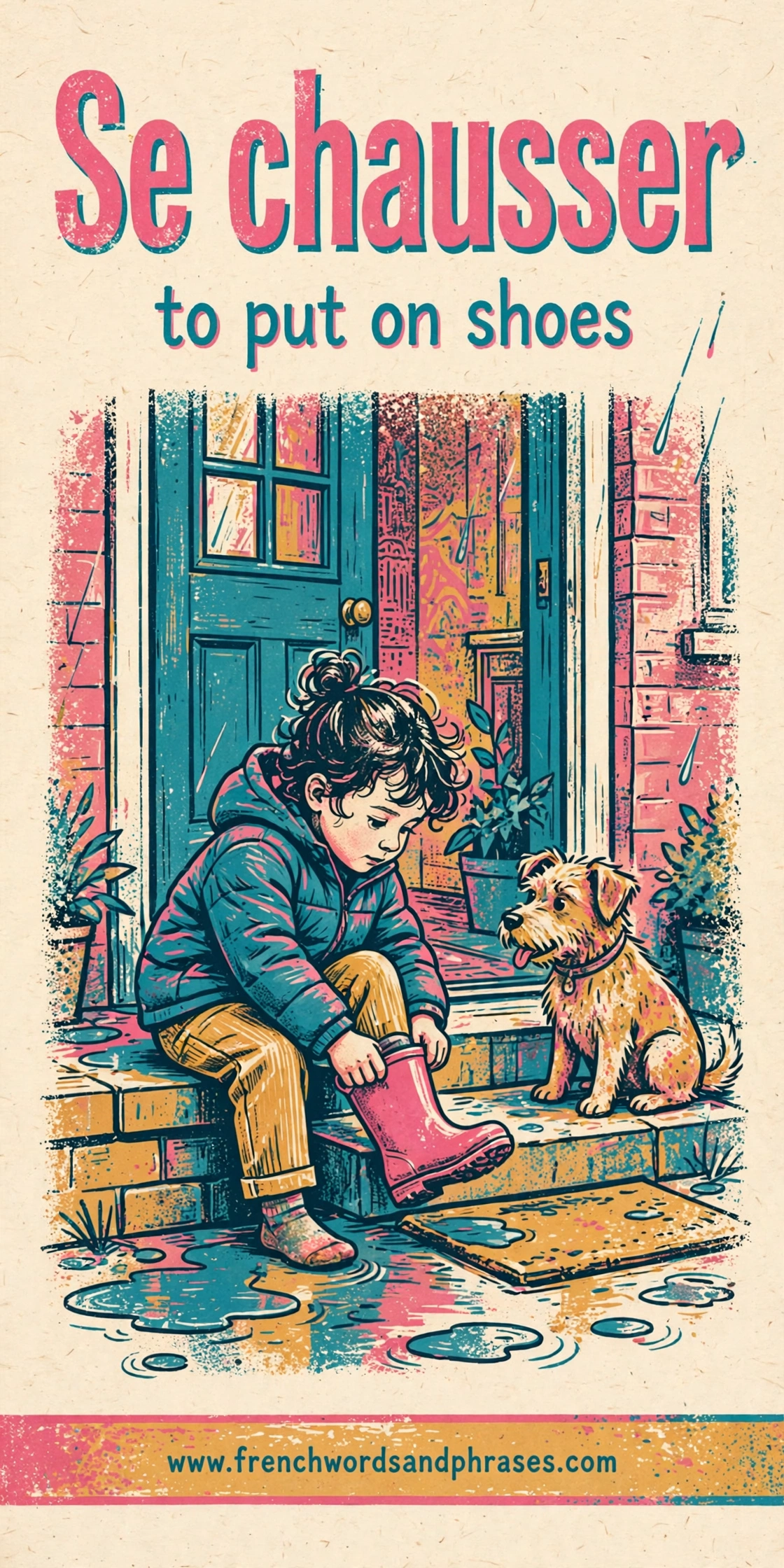
Se chausser means to put on shoes — your own shoes, on your own feet, the reflexive of the doorstep.
A child sitting on the stairs concentrating on a lace, a hiker pulling on boots at the refuge door, a dancer slipping into her shoes before the class — se chausser is the everyday reflexive of getting your own footwear on, the small ceremony that starts every outing.
In this guide, you’ll learn how to conjugate se chausser in all the major French tenses and moods. Explore complete conjugation tables, French examples, English translations, and practice quizzes.
Understanding the French Verb Se chausser
Se chausser is a regular French verb belonging to the first group of verbs, those ending in-er.
It means to put on shoes. It is the standard verb of the hallway and the trailhead — children learning to se chausser tout seuls (put their shoes on all by themselves) is a milestone of French childhood, and bien se chausser is the first advice of every hiking guide: wear the right shoes for the ground.
Verb classification: First group (-er), reflexive
Auxiliary verb: Être
Past participle: chaussé
Present participle: chaussant
English equivalents: To put on one’s shoes, to put one’s shoes on; se chausser vite — to put one’s shoes on quickly; se chausser pour sortir — to put one’s shoes on to go out; bien se chausser pour la montagne — to wear proper footwear for the mountains.
One important detail: se chausser is the reflexive of chausser, so it takes être in every compound tense and the past participle agrees with the subject: elle s’est chaussée, ils se sont chaussés. The pair divides the doorstep neatly: chausser puts shoes on someone else (chausser un enfant), se chausser puts them on yourself. You can name the footwear with de: se chausser de bottes — to put on boots. The tu imperative tucks the pronoun behind the verb: chausse-toi !
Experience the Word
Se chausser is the verb of the threshold — nothing outdoors begins until it has happened.
Imagine a small boy on the bottom stair, tongue out in concentration, one lace in each hand. Yesterday his mother did it; this morning, lentement, tout seul, il se chausse — and stands up a little taller than he sat down.
The shoes are ordinary, the laces are crooked. He has shod himself — chaussé, all alone — and the day is his.
How to Conjugate Se chausser: Complete French Conjugation Guide
Let’s explore every major conjugation of se chausser, beginning with the indicative mood.
How to Conjugate Se chausser in the Indicative Mood
The indicative mood is used to express facts, observations, actions, and events.
How to Conjugate Se chausser in the Present Tense (Présent)
Used for actions happening now, habitual actions, and general truths.
| Subject | Conjugation |
|---|---|
| je | me chausse |
| tu | te chausses |
| il / elle | se chausse |
| nous | nous chaussons |
| vous | vous chaussez |
| ils / elles | se chaussent |
Example
Les enfants se chaussent tout seuls maintenant.
The children put their own shoes on by themselves now.
Quick Quiz 1
Complete the sentence:
Nous nous ______ avant de partir.
Reveal the answer
chaussons
Nous nous chaussons avant de partir.
We put our shoes on before leaving.
How to Conjugate Se chausser in the Passé Composé
Used for completed actions in the past. Se chausser takes the auxiliary verb être.
| Subject | Conjugation |
|---|---|
| je | me suis chaussé / me suis chaussée |
| tu | t’es chaussé / t’es chaussée |
| il / elle | s’est chaussé / s’est chaussée |
| nous | nous sommes chaussés / nous sommes chaussées |
| vous | vous êtes chaussés / vous êtes chaussées / vous êtes chaussé / vous êtes chaussée |
| ils / elles | se sont chaussés / se sont chaussées |
Example
Elle s’est chaussée en deux minutes et elle est sortie.
She put her shoes on in two minutes and went out.
How to Conjugate Se chausser in the Imparfait (Imperfect Tense)
Used for habitual past actions, descriptions, and ongoing situations in the past.
| Subject | Conjugation |
|---|---|
| je | me chaussais |
| tu | te chaussais |
| il / elle | se chaussait |
| nous | nous chaussions |
| vous | vous chaussiez |
| ils / elles | se chaussaient |
Example
Autrefois, on se chaussait de sabots en bois.
In the old days, people put on wooden clogs.
Quick Quiz 2
Choose the correct form:
He put his shoes on.
Il ______. (s’est chaussé / a chaussé)
Reveal the answer
s’est chaussé
Il s’est chaussé.
His own shoes: reflexive, with être. A chaussé would mean he shod someone else.
How to Conjugate Se chausser in the Plus-que-parfait
Used to describe an action that had already been completed before another past event.
| Subject | Conjugation |
|---|---|
| je | m’étais chaussé / m’étais chaussée |
| tu | t’étais chaussé / t’étais chaussée |
| il / elle | s’était chaussé / s’était chaussée |
| nous | nous étions chaussés / nous étions chaussées |
| vous | vous étiez chaussés / vous étiez chaussées / vous étiez chaussé / vous étiez chaussée |
| ils / elles | s’étaient chaussés / s’étaient chaussées |
Example
Ils s’étaient chaussés de bottes avant de traverser le ruisseau.
They had put on boots before crossing the stream.
How to Conjugate Se chausser in the Passé Simple
Primarily used in formal writing, literature, and historical narratives. It is rarely used in everyday conversation.
| Subject | Conjugation |
|---|---|
| je | me chaussai |
| tu | te chaussas |
| il / elle | se chaussa |
| nous | nous chaussâmes |
| vous | vous chaussâtes |
| ils / elles | se chaussèrent |
Example
Il se chaussa rapidement et courut à la gare.
He quickly put his shoes on and ran to the station.
How to Conjugate Se chausser in the Passé Antérieur
A literary tense used to express an action completed immediately before another past action, generally in the passé simple.
| Subject | Conjugation |
|---|---|
| je | me fus chaussé / me fus chaussée |
| tu | te fus chaussé / te fus chaussée |
| il / elle | se fut chaussé / se fut chaussée |
| nous | nous fûmes chaussés / nous fûmes chaussées |
| vous | vous fûtes chaussés / vous fûtes chaussées / vous fûtes chaussé / vous fûtes chaussée |
| ils / elles | se furent chaussés / se furent chaussées |
Example
Dès qu’elle se fut chaussée, elle ouvrit la porte.
As soon as she had put her shoes on, she opened the door.
How to Conjugate Se chausser in the Future Tense (Futur Simple)
Used to describe actions that will take place in the future.
| Subject | Conjugation |
|---|---|
| je | me chausserai |
| tu | te chausseras |
| il / elle | se chaussera |
| nous | nous chausserons |
| vous | vous chausserez |
| ils / elles | se chausseront |
Example
Demain, nous nous chausserons de chaussures de marche.
Tomorrow, we will put on walking shoes.
How to Conjugate Se chausser in the Futur Antérieur (Future Perfect)
Used for an action that will have been completed before a particular point in the future.
| Subject | Conjugation |
|---|---|
| je | me serai chaussé / me serai chaussée |
| tu | te seras chaussé / te seras chaussée |
| il / elle | se sera chaussé / se sera chaussée |
| nous | nous serons chaussés / nous serons chaussées |
| vous | vous serez chaussés / vous serez chaussées / vous serez chaussé / vous serez chaussée |
| ils / elles | se seront chaussés / se seront chaussées |
Example
À sept heures, ils se seront chaussés et seront prêts à partir.
By seven o’clock, they will have put their shoes on and be ready to leave.
How to Conjugate Se chausser in the Near Future (Futur Proche)
Used to describe something that is going to happen soon. Formed with aller + infinitive.
| Subject | Conjugation |
|---|---|
| je | vais me chausser |
| tu | vas te chausser |
| il / elle | va se chausser |
| nous | allons nous chausser |
| vous | allez vous chausser |
| ils / elles | vont se chausser |
Example
Attends, je vais me chausser et je te suis.
Wait, I am going to put my shoes on and I will follow you.
How to Conjugate Se chausser in the Conditional Mood
The conditional mood expresses what would happen under certain circumstances. It is also frequently used to make polite requests or express wishes.
How to Conjugate Se chausser in the Present Conditional
| Subject | Conjugation |
|---|---|
| je | me chausserais |
| tu | te chausserais |
| il / elle | se chausserait |
| nous | nous chausserions |
| vous | vous chausseriez |
| ils / elles | se chausseraient |
Example
Avec des chaussures à scratch, elle se chausserait toute seule.
With Velcro shoes, she would put her shoes on all by herself.
How to Conjugate Se chausser in the Past Conditional
| Subject | Conjugation |
|---|---|
| je | me serais chaussé / me serais chaussée |
| tu | te serais chaussé / te serais chaussée |
| il / elle | se serait chaussé / se serait chaussée |
| nous | nous serions chaussés / nous serions chaussées |
| vous | vous seriez chaussés / vous seriez chaussées / vous seriez chaussé / vous seriez chaussée |
| ils / elles | se seraient chaussés / se seraient chaussées |
Example
Tu te serais chaussé plus vite avec des lacets élastiques.
You would have put your shoes on faster with elastic laces.
Se chausser in the Literary Past Conditional Form
This less common literary form uses the imperfect subjunctive of être.
| Subject | Conjugation |
|---|---|
| je | me fusse chaussé / me fusse chaussée |
| tu | te fusses chaussé / te fusses chaussée |
| il / elle | se fût chaussé / se fût chaussée |
| nous | nous fussions chaussés / nous fussions chaussées |
| vous | vous fussiez chaussés / vous fussiez chaussées / vous fussiez chaussé / vous fussiez chaussée |
| ils / elles | se fussent chaussés / se fussent chaussées |
Example
Il se fût chaussé de bottes sans la chaleur de ce jour-là.
He would have put on boots if not for the heat that day.
How to Conjugate Se chausser in the Subjunctive Mood
The subjunctive is used to express wishes, emotions, doubts, necessity, and uncertainty. It frequently follows expressions such as il faut que (it is necessary that) or bien que (although).
How to Conjugate Se chausser in the Present Subjunctive
| Subject | Conjugation |
|---|---|
| que je | me chausse |
| que tu | te chausses |
| qu’il / qu’elle | se chausse |
| que nous | nous chaussions |
| que vous | vous chaussiez |
| qu’ils / qu’elles | se chaussent |
Example
Il faut que tu te chausses avant de sortir.
You must put your shoes on before going out.
Quick Quiz 3
Complete the sentence using the subjunctive:
Il faut que vous vous ______ vite.
Reveal the answer
chaussiez
Il faut que vous vous chaussiez vite.
You must put your shoes on quickly.
How to Conjugate Se chausser in the Imperfect Subjunctive
A literary tense, rarely encountered in modern spoken French.
| Subject | Conjugation |
|---|---|
| que je | me chaussasse |
| que tu | te chaussasses |
| qu’il / qu’elle | se chaussât |
| que nous | nous chaussassions |
| que vous | vous chaussassiez |
| qu’ils / qu’elles | se chaussassent |
Example
Sa mère voulait qu’il se chaussât tout seul.
His mother wanted him to put his shoes on by himself.
How to Conjugate Se chausser in the Pluperfect Subjunctive
A literary construction used to express an action completed before another past action.
| Subject | Conjugation |
|---|---|
| que je | me fusse chaussé / me fusse chaussée |
| que tu | te fusses chaussé / te fusses chaussée |
| qu’il / qu’elle | se fût chaussé / se fût chaussée |
| que nous | nous fussions chaussés / nous fussions chaussées |
| que vous | vous fussiez chaussés / vous fussiez chaussées / vous fussiez chaussé / vous fussiez chaussée |
| qu’ils / qu’elles | se fussent chaussés / se fussent chaussées |
Example
On racontait qu’ils se fussent chaussés de sabots tout l’hiver.
People said they had worn clogs all winter.
How to Conjugate Se chausser in the Past Subjunctive
| Subject | Conjugation |
|---|---|
| que je | me sois chaussé / me sois chaussée |
| que tu | te sois chaussé / te sois chaussée |
| qu’il / qu’elle | se soit chaussé / se soit chaussée |
| que nous | nous soyons chaussés / nous soyons chaussées |
| que vous | vous soyez chaussés / vous soyez chaussées / vous soyez chaussé / vous soyez chaussée |
| qu’ils / qu’elles | se soient chaussés / se soient chaussées |
Example
Je suis fier qu’elle se soit chaussée toute seule.
I am proud that she put her shoes on all by herself.
How to Conjugate Se chausser in the Imperative
The imperative is used to give commands, instructions, invitations, or suggestions. Subject pronouns are omitted.
How to Conjugate Se chausser in the Present Imperative
| Person | Conjugation |
|---|---|
| (tu) | chausse-toi |
| (nous) | chaussons-nous |
| (vous) | chaussez-vous |
Example
Chausse-toi vite, on part !
Put your shoes on quickly, we are leaving!
Quick Quiz 4
How would you say Put your shoes on (tu form)?
Reveal the answer
Chausse-toi !
French Participles of Se chausser
Participles are verb forms that can be used in compound tenses and other grammatical constructions.
Present Participle of Se chausser
chaussant
En se chaussant, il a cassé son lacet.
While putting his shoes on, he broke his lace.
Past Participle of Se chausser
chaussé
Chaussée de ses bottes rouges, elle sauta dans les flaques.
With her red boots on, she jumped into the puddles.
Se chausser in Everyday French: Real-Life Examples
Now that you know the conjugations, let’s see how se chausser appears in everyday French.
Example 1 — Present
Les enfants se chaussent tout seuls.
The children put their own shoes on by themselves.
Example 2 — Passé composé
Elle s’est chaussée en deux minutes.
She put her shoes on in two minutes.
Example 3 — Imparfait
On se chaussait de sabots autrefois.
People used to put on clogs in the old days.
Example 4 — Future
Nous nous chausserons de bottes demain.
We will put on boots tomorrow.
Example 5 — Conditional
Elle se chausserait toute seule avec des scratchs.
She would put her shoes on all by herself with Velcro straps.
Example 6 — Imperative
Chausse-toi vite, on part !
Put your shoes on quickly, we are leaving!
Beyond Translation: The Meaning of Se chausser
The reflexive carries a whole philosophy of the doorstep: se chausser is something you graduate to.
To se chausser tout seul is to grow up.
French marks the moment precisely — the day a child stops being chaussé by others and starts se chaussant alone, laces crooked, standing taller on the bottom stair.
How to Remember the French Verb Se chausser
Remember it this way: Se chausser is about the child on the stairs, putting his own shoes on at last.
- Always reflexive for your own feet: je me chausse, elle s’est chaussée — être, and the participle agrees.
- Chausser is for someone else’s feet (chausser un enfant); se chausser is for yours.
- Se chausser de bottes, de sabots, de chaussures de marche — de names the footwear.
The key idea is the child on the stairs, putting his own shoes on at last.
Test Your Knowledge of Se chausser
Let’s see how much you’ve learned. Try answering these questions before revealing the answers.
Question 1
Which auxiliary does se chausser use, and why?
Reveal the answer
Être — it is a reflexive verb: elle s’est chaussée en deux minutes.
Question 2
How do you say Put your shoes on, we are leaving in French?
Reveal the answer
Chausse-toi, on part !
Question 3
Translate: She put her shoes on all by herself.
Reveal the answer
Elle s’est chaussée toute seule.
Question 4
What is the past participle of se chausser?
Reveal the answer
Chaussé — agreeing: chaussée, chaussés, chaussées.
Question 5
Complete the sentence:
Il faut que tu te ______ avant de sortir.
Reveal the answer
chausses
Il faut que tu te chausses avant de sortir.
You must put your shoes on before going out.
Your Final Challenge
Can You Use It?
How would you say this in French?
This morning, he put his shoes on all by himself for the first time.
Reveal the answer
Ce matin, il s’est chaussé tout seul pour la première fois.
This morning, he put his shoes on all by himself for the first time.
A little French. A little curiosity. A richer everyday life.
LEARN FRENCH ONE WORD AT A TIME