A French Word to Live By
Translate Celles to English
/sɛl/
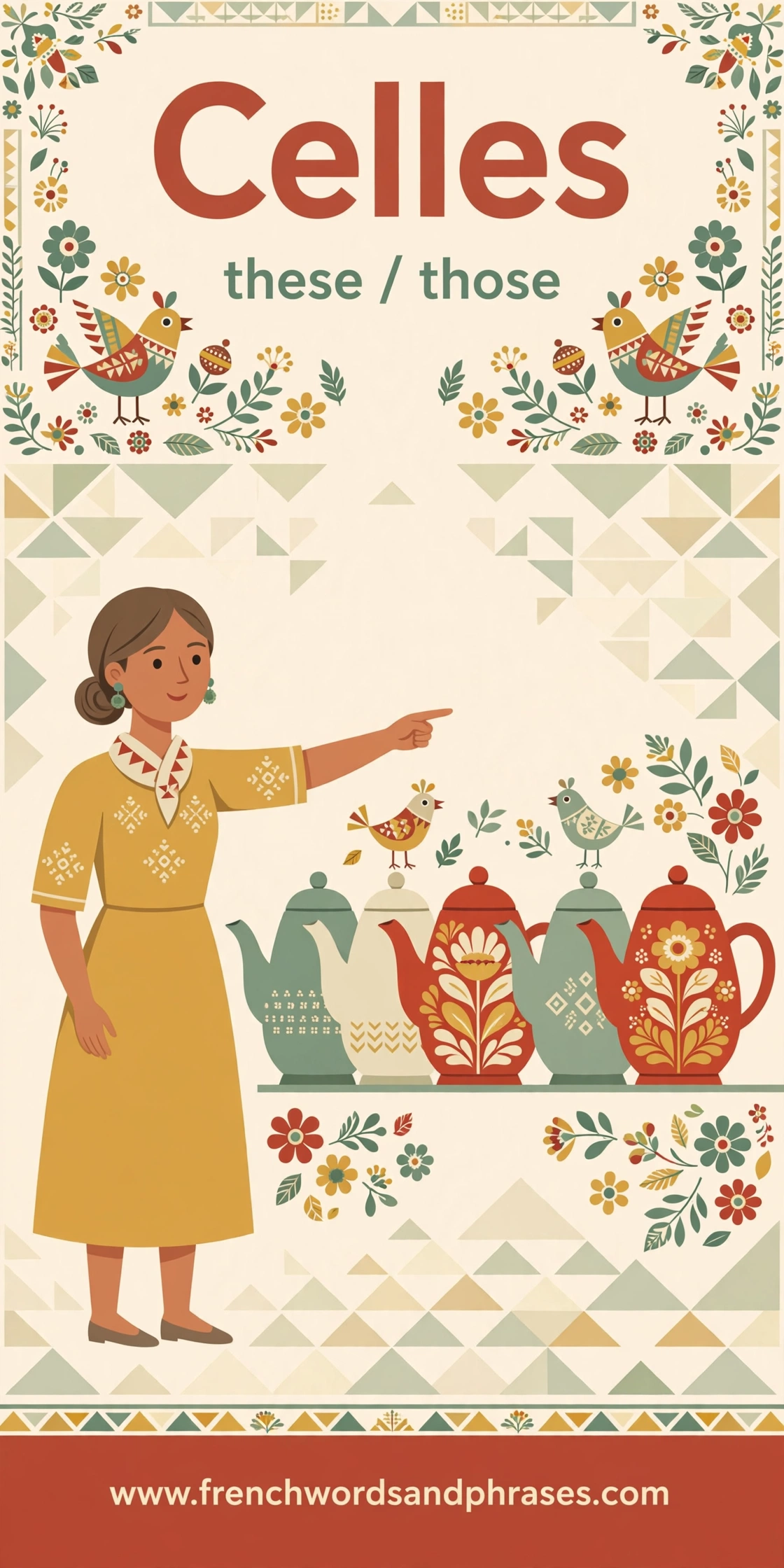
Celles means these / those.
A florist arranges roses in buckets along her stall, red ones, white ones, pink ones. « Vous prenez lesquelles ? — Celles-ci, les rouges. » — Which ones are you taking? — These, the red ones. Celles is the plural sister of celle: it steps into the place of a feminine plural noun and points — these ones, those ones, the very ones you mean.
Let’s explore how celles works in French, beginning with the whole word on one card.
Understanding the French Pronoun Celles
Celles is a French demonstrative pronoun — the feminine plural of the set celui / celle / ceux / celles. It replaces a feminine plural noun that has already been mentioned, so the noun never has to be repeated.
It means these ones or those ones. The picture it paints is an open hand over a group: a bouquet of roses, a row of dresses — celles picks out the feminine ones you mean and gathers them up in a single word.
Type: Demonstrative pronoun — feminine plural
Answers the question: Lesquelles ? — Which ones?
What follows it: -ci or -là, de + noun, or a relative pronoun: celles-ci, celles de Marie, celles qui chantent
Watch the pair: celles (feminine plural) vs ceux (masculine plural) — celles-ci = these ones (f.), ceux-ci = these ones (m.)
One important usage detail: celles is only for a purely feminine group — the moment a group mixes masculine and feminine nouns, French gathers the whole set with ceux instead. Les fleurs take celles; les fleurs et les vases together take ceux.
Experience the Word
Celles is the pronoun of the gathered bouquet — it exists for the moment when a whole group is on display and only some of them will do.
Imagine a stall of strawberries at the market. You sort through the punnets with your eyes: celles-ci sont rouges, celles-là sont pour la confiture — these ones are red, those ones are for jam.
You have not just replaced a noun. You have gathered a whole group into one word — and everyone knows exactly which ones you mean.
How to Use Celles in French: Complete Guide
Let’s explore how celles works in French, beginning with the whole word on one card.
Celles at a Glance
The Whole Word on One Card
Meaning, job, pattern and pair — celles in four lines.
| Point | Celles |
|---|---|
| Meaning | these ones / those ones (feminine) |
| Job | stands in for a feminine plural noun already mentioned |
| What it stands for | feminine things named just before: les fleurs → celles |
| Its own forms | celles-ci (these ones, nearer) — celles-là (those ones, farther) |
Example
Je prends celles-ci, pas celles-là.
I will take these ones, not those ones.
The Pattern in Action: Pointing at a Group Without Naming It
Celles connects a sentence to a group of nouns already on the table — and quietly takes their place.
| Pattern | Example |
|---|---|
| pointing at things | celles-ci sont plus fraîches — these ones are fresher |
| celles de + owner | celles de Marie sont rouges — Marie’s ones are red |
| celles qui + verb | celles qui chantent sont mes cousines — the ones who are singing are my cousins |
| celles que + clause | celles que tu vois là-bas — the ones that you see over there |
Example
Celles qui arrivent en retard paient le café.
The ones who arrive late pay for the coffee.
Quick Quiz 1
Can you use celles completely on its own to mean “these ones”?
Reveal the answer
No — celles never stands alone; it needs -ci, -là, de + noun, or a relative clause beside it.
Celles-ci sont à moi.
These ones are mine.
The Tricky Bit: Celles Never Stands Alone
Celles is a pronoun with a rule: it must always lean on something that says which ones it means.
| Celles needs | How it works |
|---|---|
| -ci for the nearer ones | celles-ci — these ones here, close to the speaker |
| -là for the farther ones | celles-là — those ones there, farther away |
| de + noun for belonging | celles de ma sœur — my sister’s ones, the ones belonging to my sister |
| a relative clause | celles qui rient, celles que je préfère, celles dont je parle — the ones who laugh, the ones I prefer, the ones I am talking about |
Example
Celles dont je te parle sont déjà vendues.
The ones I am telling you about are already sold.
Where It Goes: In the Noun’s Old Place
Celles simply takes the seat of the noun it replaces — subject, object, or after a preposition.
| Position / pattern | Example |
|---|---|
| subject, before the verb | celles-ci coûtent cinq euros — these ones cost five euros |
| after a preposition | je parle de celles-là — I am talking about those ones |
| celles de + name replaces a possessive | celles de Marie sont neuves — Marie’s ones are new |
| in comparisons | celles-ci sont plus belles que celles-là — these ones are more beautiful than those ones |
Example
Entre toutes ces robes, je choisis celles-ci.
Among all these dresses, I choose these ones.
Quick Quiz 2
How do you say “those ones” — the farther ones — with celles?
Reveal the answer
celles-là — the -là ending pushes them farther away; -ci keeps them near.
Non, pas celles-ci — celles-là !
No, not these ones — those ones!
Everyday Expressions with Celles
Celles turns up whenever French speakers point, choose and compare in shops and markets.
| Expression | In English |
|---|---|
| celles-ci, s’il vous plaît | these ones, please |
| celles de gauche / celles de droite | the ones on the left / the ones on the right |
| pas celles-ci, celles-là | not these ones, those ones |
| celles que je veux | the ones I want |
| celles qui… | the ones who… / the ones that… |
Example
Je voudrais celles de gauche, s’il vous plaît.
I would like the ones on the left, please.
Close Cousins: Celles, Ceux, Ces, Cela
Four look-alikes that point in different ways — here is who does what.
| Word | The difference |
|---|---|
| ceux | the masculine twin: ceux = these/those ones (m. pl.), and the form for mixed groups — les livres → ceux-ci |
| ces | the determiner — it stands BEFORE a noun, never instead of it: ces fleurs (these flowers) |
| ceci / cela | the neutral pronouns for ideas and statements: cela est vrai — that is true |
| celles | the pronoun for one specific feminine group: les fleurs → celles-ci |
Example
Ces fleurs sont fraîches, mais celles-ci sont plus parfumées.
These flowers are fresh, but these ones smell sweeter.
Quick Quiz 3
You are holding some roses (des roses) and say “these ones are mine”. Do you use ces or celles-ci?
Reveal the answer
celles-ci — ces must be followed by the noun itself; celles-ci replaces it.
Celles-ci sont à moi.
These ones are mine.
Celles and Its Neighbours
The pointing shelf: the whole demonstrative family, near and far.
| French | In English |
|---|---|
| celles-ci | these ones (feminine) |
| celles-là | those ones (feminine) |
| ceux-ci / ceux-là | these ones / those ones (masculine) |
| celle-ci / celle-là | this one / that one (feminine) |
| celui-ci / celui-là | this one / that one (masculine) |
Example
Celles-ci sont rouges, celles-là sont blanches.
These ones are red, those ones are white.
Watch Out: The Traps Around Celles
The traps: the lonely celles, the mixed group, and the idea that needs cela instead.
| Trap | The truth |
|---|---|
| saying ‘celles’ completely alone | celles needs a partner: -ci, -là, de + noun, or qui / que / dont |
| using celles for a mixed group | a group with any masculine noun takes ceux: les fleurs et les vases → ceux-ci |
| using celles for a whole idea | ideas take ceci or cela: cela est vrai — never celles |
| forgetting the singular | one single thing takes celle: la fleur → celle-ci |
Example
Pour les robes, je préfère celles-ci ; pour les livres, ceux-là.
For the dresses, I prefer these ones; for the books, those ones.
Quick Quiz 4
Complete: Je veux ______ qui sont près de la fenêtre. (the ones that are near the window)
Reveal the answer
celles — the relative clause qui sont près de la fenêtre gives celles its support.
Je veux celles qui sont près de la fenêtre.
I want the ones that are near the window.
Celles in Everyday French: Real-Life Examples
Now that you know the word, let’s see how celles appears in everyday French.
Example Example 1 — Shopping
Je prends celles-ci, elles sont moins chères.
I will take these ones, they are cheaper.
Example Example 2 — At the market
Celles de gauche sont plus mûres.
The ones on the left are riper.
Example Example 3 — Family
Celles qui rient sur la photo sont mes tantes.
The ones laughing in the photo are my aunts.
Example Example 4 — Choosing
Tu préfères celles-ci ou celles-là ?
Do you prefer these ones or those ones?
Example Example 5 — Keepsakes
Celles de grand-mère sont rangées dans une boîte.
Grandmother’s ones are kept in a box.
Example Example 6 — Shoes
Celles-ci sont confortables, celles-là sont trop petites.
These ones are comfortable, those ones are too small.
Beyond Translation: The Meaning of Celles
English points at groups with two small words and a gap: “these ones”, “those ones” — the real nouns have vanished, but nothing remembers what they were. French builds the memory into the pronoun itself: celles carries the feminine plural shape of the nouns it replaces, so one word gathers a whole bouquet of roses or a whole row of dresses.
To say celles is to gather without repeating — the nouns step aside, and the pronoun keeps their shape.
And with -ci and -là, celles even measures distance: celles-ci rest near your hand, celles-là wait across the room — grammar with a sense of space built in.
How to Remember the French Pronoun Celles
Remember it this way: Remember it this way: Celles is a gathered bouquet in pronoun form — it never stands alone, it always leans on -ci, -là, de, or a relative clause.
- You never leave it bare — celles-ci, celles-là, celles de Marie, celles qui rient.
- You match the nouns it replaces — les fleurs → celles; a mixed group takes ceux.
- You read the distance — -ci is near (these ones), -là is far (those ones).
The key idea is celles means these ones / those ones for a purely feminine group, and it always needs -ci, -là, de or a relative clause beside it.
Test Your Knowledge of Celles
Let’s see how much you’ve learned. Try answering these questions before revealing the answers.
Question 1
What does celles mean?
Reveal the answer
These ones / those ones — the feminine plural demonstrative pronoun.
Question 2
Why can celles never stand completely alone?
Reveal the answer
It needs support — -ci or -là, de + a noun, or a relative clause (qui, que, dont) to say which ones it means.
Question 3
Translate: These ones are mine, those ones are yours.
Reveal the answer
Celles-ci sont à moi, celles-là sont à toi.
Question 4
What is the masculine twin of celles?
Reveal the answer
Ceux — les livres give ceux-ci (these ones), just as les fleurs give celles-ci.
Question 5
Complete the sentence:
Je cherche ______ que tu m’as montrées hier. (the ones that you showed me yesterday)
Reveal the answer
celles
Je cherche celles que tu m’as montrées hier.
I am looking for the ones that you showed me yesterday.
Your Final Challenge
Can You Use It?
How would you say this in French?
“How would you say this in French?”
Reveal the answer
Celles qui sont sur la table sont à moi.
The ones on the table are mine.
A little French. A little curiosity. A richer everyday life.
LEARN FRENCH ONE WORD AT A TIME