A French Word to Live By
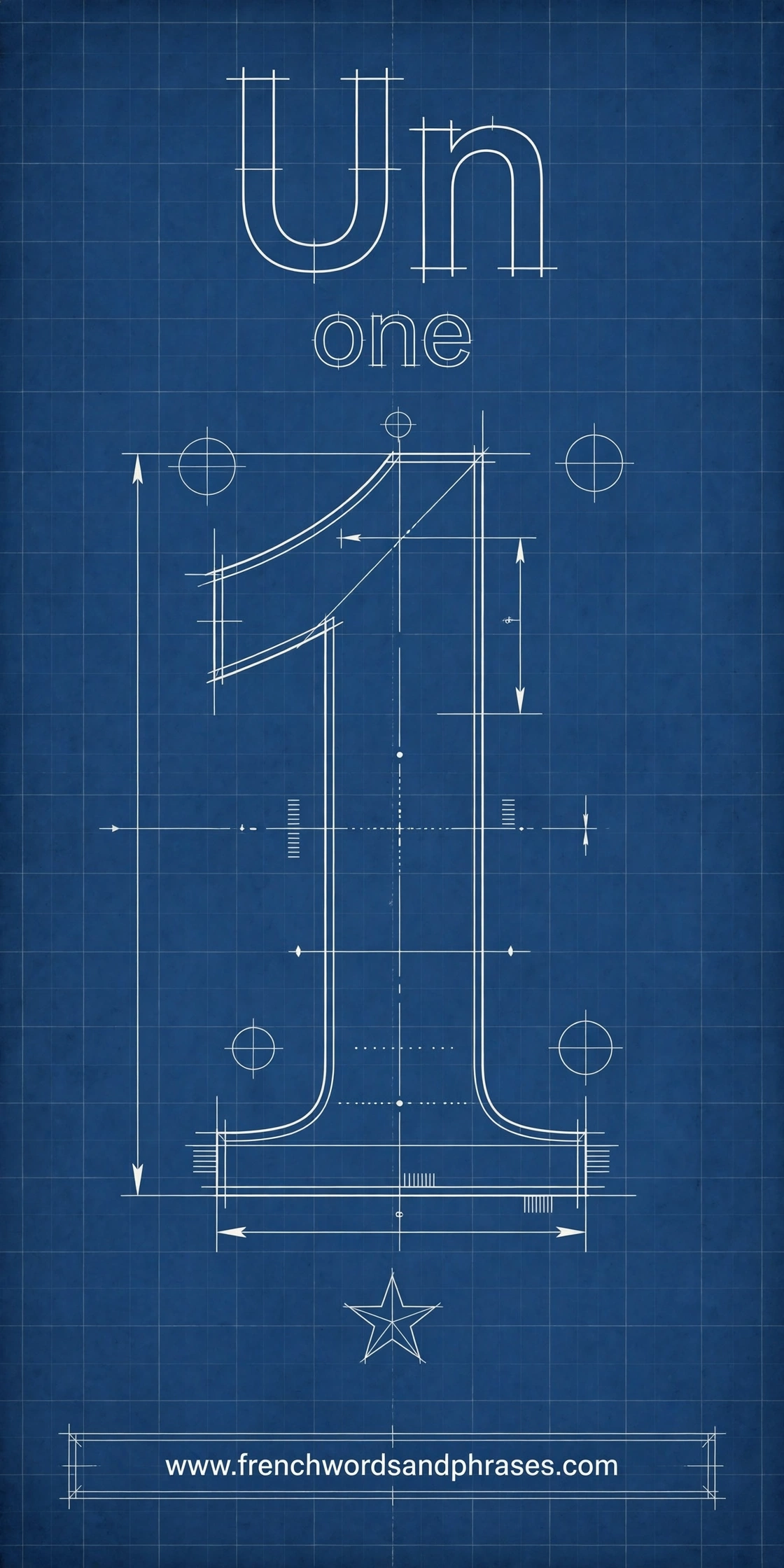
Translate Un to English
/œ̃/
Un means a / an.
A baker unlocks his shop at dawn and chalks the day’s bread on a small board. « Un client entre, puis un autre » — one customer comes in, then another. Un is the French word for a single, new thing: a man, a book, an idea never mentioned before — and it is also the number one itself.
Let’s explore how un works in French, beginning with the whole word on one card.
Understanding the French Determiner Un
Un is a French indefinite article — the masculine singular form of ‘a’ or ‘an’. It stands in front of a noun and announces that the thing is new to the conversation: one of them, not yet identified. Un is also, word for word, the number one.
It means a or an — and one. The picture it paints is a door opening: un homme entre (a man comes in) — we have never met him before, and un introduces him. English ‘a’ never counts; French un always carries a whisper of the number one inside it.
Type: Indefinite article — masculine singular (also the number one)
Answers the question: Combien ? — How many? (Answer: one, newly mentioned)
What follows it: A masculine singular countable noun: un livre, un chien, un arbre
Watch the pair: un (a, unspecified) vs le (the, specific) — un train = a train, le train = the train
One important usage detail: in a negative sentence, un vanishes into de — je n’ai pas de frère (I do not have a brother), il n’y a pas de problème. The same happens to une and des: pas de is the shadow of all three.
Experience the Word
Un is the article of first meetings — a stranger, a new idea, a thing the listener has never heard of before.
Imagine a storyteller beginning a tale by the fire: il était une fois un roi, un château, un dragon — once upon a time there was a king, a castle, a dragon; everything is new, and un opens each door.
You have not just counted a thing. You have introduced it: here is one, it exists, now we can talk about it.
How to Use Un in French: Complete Guide
Let’s explore how un works in French, beginning with the whole word on one card.
Un at a Glance
The Whole Word on One Card
Meaning, job, family and signal — un in four lines.
| Point | Un |
|---|---|
| Meaning | a / an — and the number one |
| Job | indefinite article — introduces a new, unspecified noun |
| The family | un (masc. sg.), une (fem. sg.), des (plural) |
| What it signals | one of them, mentioned for the first time — not yet identified |
Example
Un oiseau chante dans le jardin.
A bird is singing in the garden.
The Pattern in Action: Something New Walks In
Un connects a noun to the listener’s curiosity — something new, something single, something about to matter.
| Pattern | Example |
|---|---|
| introducing a new thing | il y a un chat sur le toit — there is a cat on the roof (first mention) |
| one single one | un seul verre suffit — one single glass is enough |
| a certain person | un ami m’a téléphoné hier — a friend called me yesterday (one particular, unnamed) |
| in stories | il était une fois un roi — once upon a time there was a king |
Example
Un inconnu m’a demandé le chemin.
A stranger asked me the way.
Quick Quiz 1
In il y a un chat sur le toit, do we already know this cat?
Reveal the answer
No — un introduces it for the first time; it is any cat, a new one.
Il y a un chat sur le toit.
There is a cat on the roof.
The Tricky Bit: When Un Disappears
Un is not always there — negatives swallow it, and professions politely refuse it.
| Situation | What happens |
|---|---|
| in a negative, un becomes de | je n’ai pas de frère — I do not have a brother |
| professions take no article | il est médecin — he is a doctor; elle est professeur — she is a teacher |
| but c’est brings un back | c’est un médecin — he is a doctor; c’est un bon médecin — he is a good doctor |
| un is also the number one | vingt et un — twenty-one; un, deux, trois — one, two, three |
Example
Il est médecin, mais son frère est un médecin très connu.
He is a doctor, but his brother is a very well-known doctor.
Where It Goes: Stuck to the Front of the Noun
Un stands at the very front of its noun phrase: article first, then any adjective, then the noun.
| Position / pattern | Example |
|---|---|
| directly before the noun | un livre, un jardin, un matin — the article leads, the noun follows |
| before an adjective + noun | un petit chien, un grand arbre — un still stands first |
| agreement in gender | masculine takes un; feminine takes une: un frère, une sœur |
| after il y a and c’est | il y a un problème, c’est un secret — un introduces what exists |
Example
Un vieux château domine le village.
An old castle overlooks the village.
Quick Quiz 2
“He is a doctor” — il est un médecin or il est médecin?
Reveal the answer
il est médecin — after être, a profession takes no article.
Il est médecin.
He is a doctor.
Everyday Expressions with Un
Un measures out the small change of daily life — a little, a day, a moment, a glass of water.
| Expression | In English |
|---|---|
| un peu | a little |
| un jour | one day / some day |
| un instant | one moment |
| un verre d’eau | a glass of water |
| un de ces jours | one of these days |
Example
Un jour, je visiterai le Japon.
One day, I will visit Japan.
Close Cousins: Un, Le, Du
Three small words before a masculine noun — the difference is how well you know the thing, and whether you can count it.
| Word | The difference |
|---|---|
| un | a / an — one of many, not yet identified: un gâteau (a cake, any cake) |
| le | the — a specific, known thing: le gâteau sur la table (the cake on the table) |
| du | some — an uncountable amount: du gâteau (some cake, a portion of it) |
| une / des | the same ‘a’ in other shapes: une (feminine singular), des (plural) |
Example
Je voudrais un gâteau, le même que la dernière fois.
I would like a cake, the same one as last time.
Quick Quiz 3
Which cousin means “the” — un or le?
Reveal the answer
le — le points to a known thing; un introduces a new one.
Le gâteau est sur la table.
The cake is on the table.
Un and Its Neighbours
The article shelf: the indefinites on one side, the definites and partitives on the other.
| French | In English |
|---|---|
| un | a / an (masculine singular) |
| une | a / an (feminine singular) |
| des | some (plural) |
| le / la / les | the (definite) |
| du / de la | some (partitive, uncountable) |
Example
Un enfant, une femme et des amis arrivent à la fête.
A child, a woman and some friends are arriving at the party.
Watch Out: The Traps Around Un
The traps: an un where French drops it, and a missing de where French demands it.
| Trap | The truth |
|---|---|
| adding un before a profession | French drops it: il est médecin, elle est actrice — the article returns only with c’est or an adjective |
| keeping un in a negative | absence takes de: je n’ai pas de frère — the un disappears completely |
| using un for uncountable ‘some’ | bread and water take du: du pain, de l’eau — un pain means one whole loaf |
| dropping un where English has ‘a’ | French keeps it in introductions: il y a un chat — never just ‘il y a chat’ |
Example
Il n’a pas de voiture, mais il a un vélo.
He does not have a car, but he has a bike.
Quick Quiz 4
Complete: Je n’ai pas ______ chat. (I do not have a cat.)
Reveal the answer
de — in a negative, un becomes de.
Je n’ai pas de chat.
I do not have a cat.
Un in Everyday French: Real-Life Examples
Now that you know the word, let’s see how un appears in everyday French.
Example Example 1 — In the park
Un chien court après un ballon.
A dog is running after a ball.
Example Example 2 — Morning
Je bois un café avant de partir.
I drink a coffee before leaving.
Example Example 3 — An old friend
Un ami d’enfance m’a écrit une lettre.
A childhood friend wrote me a letter.
Example Example 4 — Travel
Un train arrive dans cinq minutes.
A train arrives in five minutes.
Example Example 5 — A secret garden
Derrière la maison, il y a un jardin secret.
Behind the house, there is a secret garden.
Example Example 6 — Reading
Un livre ancien raconte l’histoire du village.
An old book tells the story of the village.
Beyond Translation: The Meaning of Un
English “a” is a modest little word, but French un carries a double life: it is both the indefinite article and the number one, so every introduction is also a small act of counting — here is one, a single one, the first one.
To say un is to open a door: something new exists now, and the story can begin.
That is why tales begin with it — un roi, un château, un dragon — and why French counts with the same breath it introduces with: un, deux, trois.
How to Remember the French Determiner Un
Remember it this way: Remember it this way: Un is the knock on the door — it introduces one new thing that nobody has mentioned yet.
- You ask have we met it? — if the thing is brand new and masculine, the word is un.
- You let it vanish in negatives — pas de frère, pas de voiture, never pas un for simple absence.
- You drop it for professions — il est médecin — and bring it back with c’est or an adjective: c’est un bon médecin.
The key idea is un means a / an and the number one — it becomes de in negatives and disappears before professions after être.
Test Your Knowledge of Un
Let’s see how much you’ve learned. Try answering these questions before revealing the answers.
Question 1
What does un mean?
Reveal the answer
A / an — the indefinite article for a masculine singular noun; it is also the number one.
Question 2
What are the three indefinite articles in French?
Reveal the answer
Un, une and des — un (masculine singular), une (feminine singular), des (plural).
Question 3
Translate: There is a dog in the garden.
Reveal the answer
Il y a un chien dans le jardin.
Question 4
What happens to un in a negative sentence?
Reveal the answer
It becomes de — je n’ai pas de chien (I do not have a dog).
Question 5
Complete the sentence:
Il y a ______ livre sur la table. (There is a book on the table.)
Reveal the answer
un
Il y a un livre sur la table.
There is a book on the table.
Your Final Challenge
Can You Use It?
How would you say this in French?
“How would you say this in French?”
Reveal the answer
Il y a un chat sur le toit.
There is a cat on the roof.
A little French. A little curiosity. A richer everyday life.
LEARN FRENCH ONE WORD AT A TIME