A French Word to Live By
How to Conjugate Cautériser in French
/ko.te.ʁi.ze/
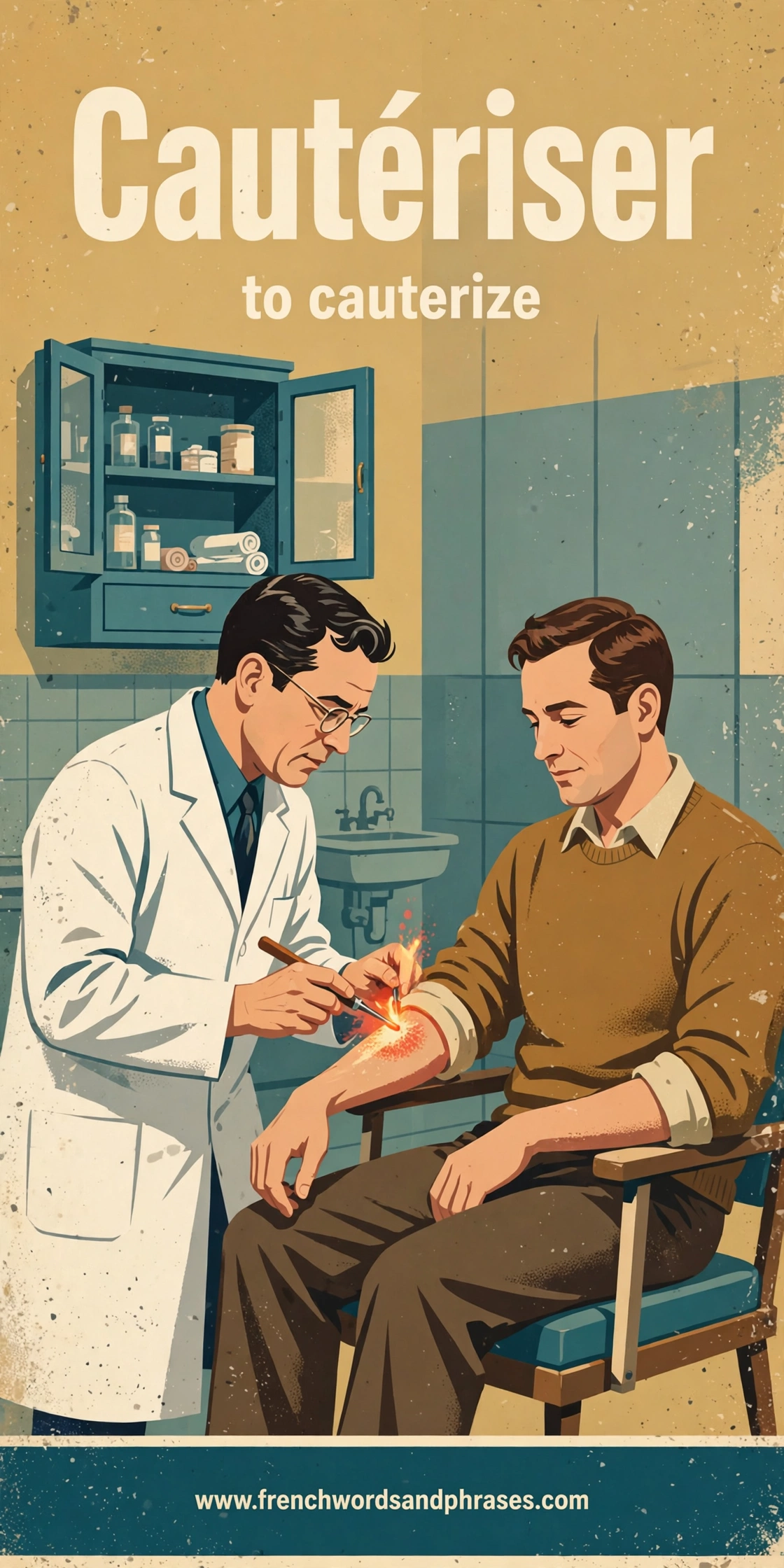
Cautériser means to cauterize — to seal a wound or a blood vessel by burning it, so that the bleeding stops and the flesh can heal.
A battlefield surgeon with a red-hot iron, a modern doctor with a fine electric probe — cautériser is the drastic verb of sealing flesh: burning a wound shut to stop the blood and kill infection before it spreads.
In this guide, you’ll learn how to conjugate cautériser in all the major French tenses and moods. Explore complete conjugation tables, French examples, English translations, and practice quizzes.
Understanding the French Verb Cautériser
Cautériser is a regular French verb belonging to the first group of verbs, those ending in-er.
It means to cauterize. It is used of wounds, blood vessels and small lesions sealed by heat, electricity or a chemical such as silver nitrate, and it belongs to the written, clinical register: a doctor cautérise, a patient subit une cautérisation.
Verb classification: First group (-er)
Auxiliary verb: Avoir
Past participle: cautérisé
Present participle: cautérisant
English equivalents: To cauterize, to sear shut; cautériser une plaie — to cauterize a wound; cautériser un vaisseau — to seal a blood vessel; cautériser au fer rouge — to cauterize with a red-hot iron; un cautère — a cautery, the instrument itself.
One important detail: cautériser is a technical, medical word, and perfectly regular: je cautérise, nous cautérisons, ils cautérisent, past participle cautérisé. Do not confuse the verb with the noun un cautère, the heated instrument a surgeon applies. The word comes from the Greek for a branding iron, and French keeps it strictly in the operating theatre and in histories of old surgery — nobody cautérise anything in a kitchen.
Experience the Word
Cautériser is the verb of the wound closed by fire — brutal, ancient, and still, in skilled hands, a way of saving life.
Imagine a field hospital two centuries ago. The surgeon wipes the blade, lifts the iron from the coals until it glows, and presses it once, precisely, to the wound. The bleeding stops. The soldier will live — because someone knew how to cautériser.
The method has changed, the gesture has not. The wound is sealed — cautérisée — and the blood stays where it belongs.
How to Conjugate Cautériser: Complete French Conjugation Guide
Let’s explore every major conjugation of cautériser, beginning with the indicative mood.
How to Conjugate Cautériser in the Indicative Mood
The indicative mood is used to express facts, observations, actions, and events.
How to Conjugate Cautériser in the Present Tense (Présent)
Used for actions happening now, habitual actions, and general truths.
| Subject | Conjugation |
|---|---|
| je | cautérise |
| tu | cautérises |
| il / elle | cautérise |
| nous | cautérisons |
| vous | cautérisez |
| ils / elles | cautérisent |
Example
Le chirurgien cautérise le vaisseau qui saigne.
The surgeon cauterizes the bleeding vessel.
Quick Quiz 1
Complete the sentence:
Nous ______ la plaie avec précaution.
Reveal the answer
cautérisons
Nous cautérisons la plaie avec précaution.
We are cauterizing the wound carefully.
How to Conjugate Cautériser in the Passé Composé
Used for completed actions in the past. Cautériser takes the auxiliary verb avoir.
| Subject | Conjugation |
|---|---|
| j’ | ai cautérisé |
| tu | as cautérisé |
| il / elle | a cautérisé |
| nous | avons cautérisé |
| vous | avez cautérisé |
| ils / elles | ont cautérisé |
Example
Le médecin a cautérisé la plaie pour arrêter le sang.
The doctor cauterized the wound to stop the blood.
How to Conjugate Cautériser in the Imparfait (Imperfect Tense)
Used for habitual past actions, descriptions, and ongoing situations in the past.
| Subject | Conjugation |
|---|---|
| je | cautérisais |
| tu | cautérisais |
| il / elle | cautérisait |
| nous | cautérisions |
| vous | cautérisiez |
| ils / elles | cautérisaient |
Example
Autrefois, on cautérisait les blessures avec un fer rouge.
In the old days, wounds were cauterized with a red-hot iron.
Quick Quiz 2
Choose the correct form:
The doctor cauterized the wound.
Le médecin ______ la plaie. (a cautérisé / est cautérisé)
Reveal the answer
a cautérisé
Le médecin a cautérisé la plaie.
Cautériser takes avoir.
How to Conjugate Cautériser in the Plus-que-parfait
Used to describe an action that had already been completed before another past event.
| Subject | Conjugation |
|---|---|
| j’ | avais cautérisé |
| tu | avais cautérisé |
| il / elle | avait cautérisé |
| nous | avions cautérisé |
| vous | aviez cautérisé |
| ils / elles | avaient cautérisé |
Example
Le vétérinaire avait cautérisé la petite plaie avant de bander la patte.
The vet had cauterized the small wound before bandaging the paw.
How to Conjugate Cautériser in the Passé Simple
Primarily used in formal writing, literature, and historical narratives. It is rarely used in everyday conversation.
| Subject | Conjugation |
|---|---|
| je | cautérisai |
| tu | cautérisas |
| il / elle | cautérisa |
| nous | cautérisâmes |
| vous | cautérisâtes |
| ils / elles | cautérisèrent |
Example
Le chirurgien cautérisa l’artère d’un geste précis.
The surgeon cauterized the artery with a precise movement.
How to Conjugate Cautériser in the Passé Antérieur
A literary tense used to express an action completed immediately before another past action, generally in the passé simple.
| Subject | Conjugation |
|---|---|
| j’ | eus cautérisé |
| tu | eus cautérisé |
| il / elle | eut cautérisé |
| nous | eûmes cautérisé |
| vous | eûtes cautérisé |
| ils / elles | eurent cautérisé |
Example
Quand il eut cautérisé la plaie, le saignement cessa enfin.
When he had cauterized the wound, the bleeding finally stopped.
How to Conjugate Cautériser in the Future Tense (Futur Simple)
Used to describe actions that will take place in the future.
| Subject | Conjugation |
|---|---|
| je | cautériserai |
| tu | cautériseras |
| il / elle | cautérisera |
| nous | cautériserons |
| vous | cautériserez |
| ils / elles | cautériseront |
Example
Demain, on cautérisera cette petite lésion au laser.
Tomorrow, they will cauterize this small lesion with a laser.
How to Conjugate Cautériser in the Futur Antérieur (Future Perfect)
Used for an action that will have been completed before a particular point in the future.
| Subject | Conjugation |
|---|---|
| j’ | aurai cautérisé |
| tu | auras cautérisé |
| il / elle | aura cautérisé |
| nous | aurons cautérisé |
| vous | aurez cautérisé |
| ils / elles | auront cautérisé |
Example
À la fin de l’opération, le chirurgien aura cautérisé tous les petits vaisseaux.
By the end of the operation, the surgeon will have cauterized all the small vessels.
How to Conjugate Cautériser in the Near Future (Futur Proche)
Used to describe something that is going to happen soon. Formed with aller + infinitive.
| Subject | Conjugation |
|---|---|
| je | vais cautériser |
| tu | vas cautériser |
| il / elle | va cautériser |
| nous | allons cautériser |
| vous | allez cautériser |
| ils / elles | vont cautériser |
Example
Le médecin va cautériser la plaie tout de suite.
The doctor is going to cauterize the wound right away.
How to Conjugate Cautériser in the Conditional Mood
The conditional mood expresses what would happen under certain circumstances. It is also frequently used to make polite requests or express wishes.
How to Conjugate Cautériser in the Present Conditional
| Subject | Conjugation |
|---|---|
| je | cautériserais |
| tu | cautériserais |
| il / elle | cautériserait |
| nous | cautériserions |
| vous | cautériseriez |
| ils / elles | cautériseraient |
Example
Sans électricité, on cautériserait encore au fer chauffé.
Without electricity, people would still cauterize with a heated iron.
How to Conjugate Cautériser in the Past Conditional
| Subject | Conjugation |
|---|---|
| j’ | aurais cautérisé |
| tu | aurais cautérisé |
| il / elle | aurait cautérisé |
| nous | aurions cautérisé |
| vous | auriez cautérisé |
| ils / elles | auraient cautérisé |
Example
Il aurait cautérisé la plaie plus tôt si l’instrument avait été prêt.
He would have cauterized the wound sooner if the instrument had been ready.
Cautériser in the Literary Past Conditional Form
This less common literary form uses the imperfect subjunctive of avoir.
| Subject | Conjugation |
|---|---|
| j’ | eusse cautérisé |
| tu | eusses cautérisé |
| il / elle | eût cautérisé |
| nous | eussions cautérisé |
| vous | eussiez cautérisé |
| ils / elles | eussent cautérisé |
Example
Le médecin eût cautérisé la blessure sans hésiter, malgré la douleur.
The doctor would have cauterized the wound without hesitating, despite the pain.
How to Conjugate Cautériser in the Subjunctive Mood
The subjunctive is used to express wishes, emotions, doubts, necessity, and uncertainty. It frequently follows expressions such as il faut que (it is necessary that) or bien que (although).
How to Conjugate Cautériser in the Present Subjunctive
| Subject | Conjugation |
|---|---|
| que je | cautérise |
| que tu | cautérises |
| qu’il / qu’elle | cautérise |
| que nous | cautérisions |
| que vous | cautérisiez |
| qu’ils / qu’elles | cautérisent |
Example
Il faut que le chirurgien cautérise ce vaisseau avant de refermer.
The surgeon must cauterize this vessel before closing up.
Quick Quiz 3
Complete the sentence using the subjunctive:
Il faut que vous ______ ce vaisseau tout de suite.
Reveal the answer
cautérisiez
Il faut que vous cautérisiez ce vaisseau tout de suite.
You must cauterize this vessel right away.
How to Conjugate Cautériser in the Imperfect Subjunctive
A literary tense, rarely encountered in modern spoken French.
| Subject | Conjugation |
|---|---|
| que je | cautérisasse |
| que tu | cautérisasses |
| qu’il / qu’elle | cautérisât |
| que nous | cautérisassions |
| que vous | cautérisassiez |
| qu’ils / qu’elles | cautérisassent |
Example
Le patient craignait que le médecin cautérisât la plaie sans anesthésie.
The patient feared the doctor might cauterize the wound without anaesthetic.
How to Conjugate Cautériser in the Pluperfect Subjunctive
A literary construction used to express an action completed before another past action.
| Subject | Conjugation |
|---|---|
| que j’ | eusse cautérisé |
| que tu | eusses cautérisé |
| qu’il / qu’elle | eût cautérisé |
| que nous | eussions cautérisé |
| que vous | eussiez cautérisé |
| qu’ils / qu’elles | eussent cautérisé |
Example
On racontait que les chirurgiens eussent cautérisé les plaies des soldats sur le champ de bataille.
It was said that the surgeons had cauterized the soldiers’ wounds on the battlefield.
How to Conjugate Cautériser in the Past Subjunctive
| Subject | Conjugation |
|---|---|
| que j’ | aie cautérisé |
| que tu | aies cautérisé |
| qu’il / qu’elle | ait cautérisé |
| que nous | ayons cautérisé |
| que vous | ayez cautérisé |
| qu’ils / qu’elles | aient cautérisé |
Example
Je suis soulagé que le médecin ait cautérisé la plaie à temps.
I am relieved the doctor cauterized the wound in time.
How to Conjugate Cautériser in the Imperative
The imperative is used to give commands, instructions, invitations, or suggestions. Subject pronouns are omitted.
How to Conjugate Cautériser in the Present Imperative
| Person | Conjugation |
|---|---|
| (tu) | cautérise |
| (nous) | cautérisons |
| (vous) | cautérisez |
Example
Cautérisez ce vaisseau avant qu’il ne saigne davantage !
Cauterize this vessel before it bleeds any more!
Quick Quiz 4
How would you say Cauterize this vessel, quickly (tu form)?
Reveal the answer
Cautérise ce vaisseau, vite !
French Participles of Cautériser
Participles are verb forms that can be used in compound tenses and other grammatical constructions.
Present Participle of Cautériser
cautérisant
En cautérisant la plaie, le médecin évite l’infection.
By cauterizing the wound, the doctor prevents infection.
Past Participle of Cautériser
cautérisé
Cautérisée à temps, la plaie a guéri sans infection.
Cauterized in time, the wound healed without infection.
Cautériser in Everyday French: Real-Life Examples
Now that you know the conjugations, let’s see how cautériser appears in everyday French.
Example 1 — Present
Le chirurgien cautérise le vaisseau.
The surgeon cauterizes the vessel.
Example 2 — Passé composé
Le médecin a cautérisé la plaie.
The doctor cauterized the wound.
Example 3 — Imparfait
On cautérisait les blessures au fer rouge.
Wounds were cauterized with a red-hot iron.
Example 4 — Future
On cautérisera la lésion au laser.
They will cauterize the lesion with a laser.
Example 5 — Conditional
Il cautériserait la plaie si l’appareil marchait.
He would cauterize the wound if the machine worked.
Example 6 — Imperative
Cautérise ce vaisseau, vite !
Cauterize this vessel, quickly!
Beyond Translation: The Meaning of Cautériser
English cauterize and caustic are close cousins — all go back to the Greek kautêrion, a branding iron.
French keeps the word behind glass, in the museum of medicine.
It survives in surgery, in veterinary practice and in history books, a reminder that for most of human history the answer to bleeding was fire — applied quickly, and by a steady hand.
How to Remember the French Verb Cautériser
Remember it this way: Cautériser is about the surgeon’s glowing iron sealing the wound shut.
- A medical word only: cautériser une plaie, cautériser un vaisseau — wounds and vessels, nothing else.
- Regular -er: je cautérise, nous cautérisons, past participle cautérisé.
- The instrument is un cautère; the operation is une cautérisation.
The key idea is the surgeon’s glowing iron sealing the wound shut.
Test Your Knowledge of Cautériser
Let’s see how much you’ve learned. Try answering these questions before revealing the answers.
Question 1
What does a surgeon cautérise, most often?
Reveal the answer
A wound or a blood vessel — cautériser une plaie, cautériser un vaisseau.
Question 2
How do you say The doctor cauterized the wound in French?
Reveal the answer
Le médecin a cautérisé la plaie.
Question 3
Translate: In the old days, wounds were cauterized with a red-hot iron.
Reveal the answer
Autrefois, on cautérisait les blessures avec un fer rouge.
Question 4
What is the past participle of cautériser?
Reveal the answer
Cautérisé.
Question 5
Complete the sentence:
Il faut que le chirurgien ______ ce vaisseau avant de refermer.
Reveal the answer
cautérise
Il faut que le chirurgien cautérise ce vaisseau avant de refermer.
The surgeon must cauterize this vessel before closing up.
Your Final Challenge
Can You Use It?
How would you say this in French?
The surgeon cauterizes the wound, and silence falls again over the operating theatre.
Reveal the answer
Le chirurgien cautérise la plaie, et le silence retombe sur la salle d’opération.
The surgeon cauterizes the wound, and silence falls again over the operating theatre.
A little French. A little curiosity. A richer everyday life.
LEARN FRENCH ONE WORD AT A TIME