A French Word to Live By
How to Conjugate Cautionner in French
/ko.sjɔ.ne/
Cautionner means to answer for, to go bail for — to put your own name and money behind someone else, promising the court, the bank or the landlord that you will pay if they cannot.
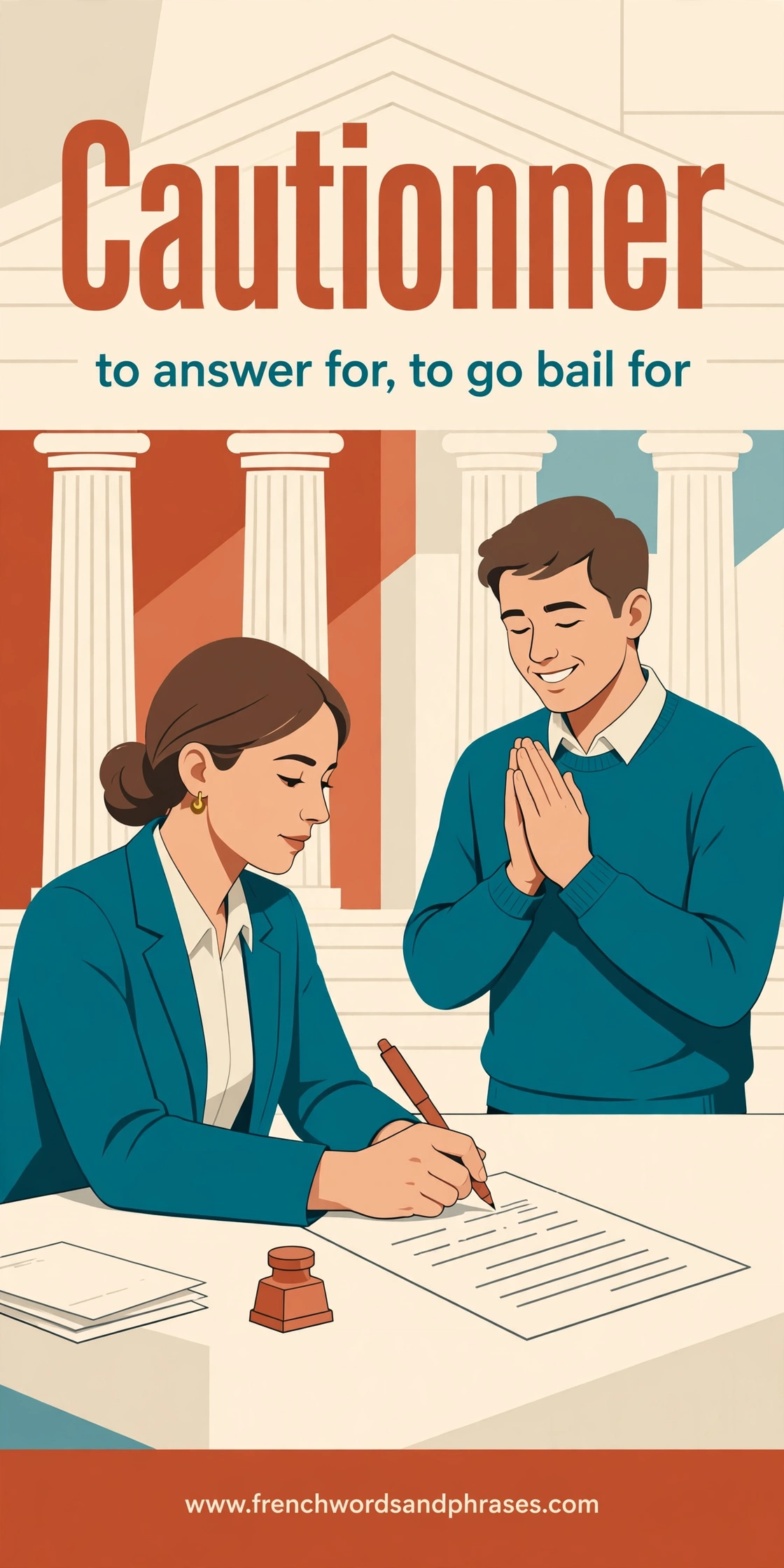
A father signing at the bottom of his daughter’s first lease, a friend standing surety at the courthouse — cautionner is the verb of the guarantor: lending your signature, and your credit, to someone whose word alone is not yet enough.
In this guide, you’ll learn how to conjugate cautionner in all the major French tenses and moods. Explore complete conjugation tables, French examples, English translations, and practice quizzes.
Understanding the French Verb Cautionner
Cautionner is a regular French verb belonging to the first group of verbs, those ending in-er.
It means to answer for, to go bail for. It is used in law and finance for standing bail and guaranteeing loans, in daily life for the parent who guarantees a student’s flat, and figuratively, in politics and the press, for lending your moral backing to a person, a policy or a claim.
Verb classification: First group (-er)
Auxiliary verb: Avoir
Past participle: cautionné
Present participle: cautionnant
English equivalents: To answer for, to stand surety for, to go bail for; cautionner quelqu’un — to vouch for someone, to stand bail for them; cautionner un emprunt — to guarantee a loan; cautionner une politique — to endorse a policy; se porter caution pour quelqu’un — to act as guarantor for someone; une caution — a guarantee, a deposit, bail.
One important detail: cautionner keeps the double n of caution everywhere — je cautionne, nous cautionnons, ils cautionnent — and it is perfectly regular. Its everyday home is the French rental market: a young tenant needs someone who cautionne, a garant. But watch for the figurative sense, common in newspapers: je ne cautionne pas cette décision means I refuse to endorse it, with no money involved at all.
Experience the Word
Cautionner is the verb of borrowed trust — your signature says: this person is good for it, and if not, I am.
Imagine a student in Paris with her first lease on the table. The landlord slides the pen not to her but to her father, who reads the clause, sighs, and signs. He has cautionné his daughter — and with one signature, his twenty years of solvency move in behind her thin student budget.
No money has changed hands. He has answered for her — cautionné — and his name now stands where hers could not.
How to Conjugate Cautionner: Complete French Conjugation Guide
Let’s explore every major conjugation of cautionner, beginning with the indicative mood.
How to Conjugate Cautionner in the Indicative Mood
The indicative mood is used to express facts, observations, actions, and events.
How to Conjugate Cautionner in the Present Tense (Présent)
Used for actions happening now, habitual actions, and general truths.
| Subject | Conjugation |
|---|---|
| je | cautionne |
| tu | cautionnes |
| il / elle | cautionne |
| nous | cautionnons |
| vous | cautionnez |
| ils / elles | cautionnent |
Example
Ses parents cautionnent son premier appartement.
His parents are standing surety for his first flat.
Quick Quiz 1
Complete the sentence:
Nous ______ son frère pour le prêt.
Reveal the answer
cautionnons
Nous cautionnons son frère pour le prêt.
We are standing surety for his brother for the loan.
How to Conjugate Cautionner in the Passé Composé
Used for completed actions in the past. Cautionner takes the auxiliary verb avoir.
| Subject | Conjugation |
|---|---|
| j’ | ai cautionné |
| tu | as cautionné |
| il / elle | a cautionné |
| nous | avons cautionné |
| vous | avez cautionné |
| ils / elles | ont cautionné |
Example
Elle a cautionné son frère pour l’achat de la voiture.
She went guarantor for her brother for the car purchase.
How to Conjugate Cautionner in the Imparfait (Imperfect Tense)
Used for habitual past actions, descriptions, and ongoing situations in the past.
| Subject | Conjugation |
|---|---|
| je | cautionnais |
| tu | cautionnais |
| il / elle | cautionnait |
| nous | cautionnions |
| vous | cautionniez |
| ils / elles | cautionnaient |
Example
À l’époque, l’oncle cautionnait tous les jeunes de la famille.
At the time, the uncle used to stand surety for all the young people in the family.
Quick Quiz 2
Choose the correct form:
She went guarantor for her brother.
Elle ______ son frère. (a cautionné / est cautionnée)
Reveal the answer
a cautionné
Elle a cautionné son frère.
Cautionner takes avoir.
How to Conjugate Cautionner in the Plus-que-parfait
Used to describe an action that had already been completed before another past event.
| Subject | Conjugation |
|---|---|
| j’ | avais cautionné |
| tu | avais cautionné |
| il / elle | avait cautionné |
| nous | avions cautionné |
| vous | aviez cautionné |
| ils / elles | avaient cautionné |
Example
Il avait cautionné son ami avant de connaître ses dettes.
He had answered for his friend before learning of his debts.
How to Conjugate Cautionner in the Passé Simple
Primarily used in formal writing, literature, and historical narratives. It is rarely used in everyday conversation.
| Subject | Conjugation |
|---|---|
| je | cautionnai |
| tu | cautionnas |
| il / elle | cautionna |
| nous | cautionnâmes |
| vous | cautionnâtes |
| ils / elles | cautionnèrent |
Example
Le notaire lut l’acte, et le père cautionna son fils.
The notary read the deed, and the father stood surety for his son.
How to Conjugate Cautionner in the Passé Antérieur
A literary tense used to express an action completed immediately before another past action, generally in the passé simple.
| Subject | Conjugation |
|---|---|
| j’ | eus cautionné |
| tu | eus cautionné |
| il / elle | eut cautionné |
| nous | eûmes cautionné |
| vous | eûtes cautionné |
| ils / elles | eurent cautionné |
Example
Dès qu’elle eut cautionné l’emprunt, la banque débloqua les fonds.
As soon as she had guaranteed the loan, the bank released the funds.
How to Conjugate Cautionner in the Future Tense (Futur Simple)
Used to describe actions that will take place in the future.
| Subject | Conjugation |
|---|---|
| je | cautionnerai |
| tu | cautionneras |
| il / elle | cautionnera |
| nous | cautionnerons |
| vous | cautionnerez |
| ils / elles | cautionneront |
Example
Qui cautionnera ce projet si la banque refuse ?
Who will back this project if the bank refuses?
How to Conjugate Cautionner in the Futur Antérieur (Future Perfect)
Used for an action that will have been completed before a particular point in the future.
| Subject | Conjugation |
|---|---|
| j’ | aurai cautionné |
| tu | auras cautionné |
| il / elle | aura cautionné |
| nous | aurons cautionné |
| vous | aurez cautionné |
| ils / elles | auront cautionné |
Example
À la signature, vous aurez cautionné trois générations de la famille.
By the signing, you will have stood surety for three generations of the family.
How to Conjugate Cautionner in the Near Future (Futur Proche)
Used to describe something that is going to happen soon. Formed with aller + infinitive.
| Subject | Conjugation |
|---|---|
| je | vais cautionner |
| tu | vas cautionner |
| il / elle | va cautionner |
| nous | allons cautionner |
| vous | allez cautionner |
| ils / elles | vont cautionner |
Example
Je vais cautionner ma fille pour son studio.
I am going to stand surety for my daughter for her studio.
How to Conjugate Cautionner in the Conditional Mood
The conditional mood expresses what would happen under certain circumstances. It is also frequently used to make polite requests or express wishes.
How to Conjugate Cautionner in the Present Conditional
| Subject | Conjugation |
|---|---|
| je | cautionnerais |
| tu | cautionnerais |
| il / elle | cautionnerait |
| nous | cautionnerions |
| vous | cautionneriez |
| ils / elles | cautionneraient |
Example
Je cautionnerais volontiers, mais ma retraite est trop modeste.
I would gladly act as guarantor, but my pension is too modest.
How to Conjugate Cautionner in the Past Conditional
| Subject | Conjugation |
|---|---|
| j’ | aurais cautionné |
| tu | aurais cautionné |
| il / elle | aurait cautionné |
| nous | aurions cautionné |
| vous | auriez cautionné |
| ils / elles | auraient cautionné |
Example
Elle aurait cautionné son fils si elle l’avait su à temps.
She would have stood surety for her son if she had known in time.
Cautionner in the Literary Past Conditional Form
This less common literary form uses the imperfect subjunctive of avoir.
| Subject | Conjugation |
|---|---|
| j’ | eusse cautionné |
| tu | eusses cautionné |
| il / elle | eût cautionné |
| nous | eussions cautionné |
| vous | eussiez cautionné |
| ils / elles | eussent cautionné |
Example
Il eût cautionné son ami sans hésiter, tant il lui faisait confiance.
He would have answered for his friend without hesitation, so much did he trust him.
How to Conjugate Cautionner in the Subjunctive Mood
The subjunctive is used to express wishes, emotions, doubts, necessity, and uncertainty. It frequently follows expressions such as il faut que (it is necessary that) or bien que (although).
How to Conjugate Cautionner in the Present Subjunctive
| Subject | Conjugation |
|---|---|
| que je | cautionne |
| que tu | cautionnes |
| qu’il / qu’elle | cautionne |
| que nous | cautionnions |
| que vous | cautionniez |
| qu’ils / qu’elles | cautionnent |
Example
Il faut qu’un parent cautionne l’étudiant pour le logement.
A parent must stand surety for the student for the housing.
Quick Quiz 3
Complete the sentence using the subjunctive:
Il faut que vous ______ cet étudiant pour son studio.
Reveal the answer
cautionniez
Il faut que vous cautionniez cet étudiant pour son studio.
You must stand surety for this student for his studio.
How to Conjugate Cautionner in the Imperfect Subjunctive
A literary tense, rarely encountered in modern spoken French.
| Subject | Conjugation |
|---|---|
| que je | cautionnasse |
| que tu | cautionnasses |
| qu’il / qu’elle | cautionnât |
| que nous | cautionnassions |
| que vous | cautionnassiez |
| qu’ils / qu’elles | cautionnassent |
Example
Le juge doutait que quelqu’un cautionnât un inconnu pareil.
The judge doubted anyone would go bail for such a stranger.
How to Conjugate Cautionner in the Pluperfect Subjunctive
A literary construction used to express an action completed before another past action.
| Subject | Conjugation |
|---|---|
| que j’ | eusse cautionné |
| que tu | eusses cautionné |
| qu’il / qu’elle | eût cautionné |
| que nous | eussions cautionné |
| que vous | eussiez cautionné |
| qu’ils / qu’elles | eussent cautionné |
Example
On s’étonnait qu’il eût cautionné un homme déjà condamné.
People were astonished that he had stood surety for a man already convicted.
How to Conjugate Cautionner in the Past Subjunctive
| Subject | Conjugation |
|---|---|
| que j’ | aie cautionné |
| que tu | aies cautionné |
| qu’il / qu’elle | ait cautionné |
| que nous | ayons cautionné |
| que vous | ayez cautionné |
| qu’ils / qu’elles | aient cautionné |
Example
Je suis heureux que mon père ait cautionné mon emprunt.
I am glad my father guaranteed my loan.
How to Conjugate Cautionner in the Imperative
The imperative is used to give commands, instructions, invitations, or suggestions. Subject pronouns are omitted.
How to Conjugate Cautionner in the Present Imperative
| Person | Conjugation |
|---|---|
| (tu) | cautionne |
| (nous) | cautionnons |
| (vous) | cautionnez |
Example
Cautionnez seulement les gens que vous connaissez vraiment !
Only stand surety for people you really know!
Quick Quiz 4
How would you say Never stand surety for a stranger (tu form)?
Reveal the answer
Ne cautionne jamais un inconnu !
French Participles of Cautionner
Participles are verb forms that can be used in compound tenses and other grammatical constructions.
Present Participle of Cautionner
cautionnant
En cautionnant son neveu, elle engage sa propre épargne.
By standing surety for her nephew, she is putting her own savings at stake.
Past Participle of Cautionner
cautionné
Cautionné par ses parents, l’étudiant a enfin obtenu son studio.
Backed by his parents as guarantors, the student finally got his studio.
Cautionner in Everyday French: Real-Life Examples
Now that you know the conjugations, let’s see how cautionner appears in everyday French.
Example 1 — Present
Ses parents cautionnent son studio.
His parents are standing surety for his studio.
Example 2 — Passé composé
Elle a cautionné son frère.
She went guarantor for her brother.
Example 3 — Imparfait
L’oncle cautionnait toute la famille.
The uncle used to stand surety for the whole family.
Example 4 — Future
Je cautionnerai ma fille pour son logement.
I will stand surety for my daughter for her flat.
Example 5 — Conditional
Je cautionnerais volontiers, mais ma retraite est modeste.
I would gladly act as guarantor, but my pension is modest.
Example 6 — Imperative
Ne cautionne jamais un inconnu !
Never stand surety for a stranger!
Beyond Translation: The Meaning of Cautionner
English caution is the same family — before it meant mere carefulness, a caution was a security, money lodged as a pledge; old English even had caution money.
To cautionner is to turn caution into a signature.
French keeps both faces of the word alive: the legal act, cautionner un locataire, and the moral one, cautionner une décision — backing a person with your wallet, or an idea with your name.
How to Remember the French Verb Cautionner
Remember it this way: Cautionner is about the father’s signature at the bottom of his daughter’s first lease.
- Double n everywhere, like caution itself: je cautionne, nous cautionnons.
- Two lives: legal (cautionner un emprunt, un locataire) and moral (cautionner une décision — to endorse it).
- Regular -er: je cautionne, nous cautionnons, past participle cautionné; the guarantor is un garant, the pledge une caution.
The key idea is the father’s signature at the bottom of his daughter’s first lease.
Test Your Knowledge of Cautionner
Let’s see how much you’ve learned. Try answering these questions before revealing the answers.
Question 1
What are the two main senses of cautionner?
Reveal the answer
Legal and moral — to stand surety for a person or a loan, and to endorse a decision or a policy.
Question 2
How do you say His parents are standing surety for his first flat in French?
Reveal the answer
Ses parents cautionnent son premier appartement.
Question 3
Translate: I refuse to endorse this decision.
Reveal the answer
Je ne cautionne pas cette décision.
Question 4
What is the past participle of cautionner?
Reveal the answer
Cautionné.
Question 5
Complete the sentence:
Il faut qu’un parent ______ l’étudiant pour le logement.
Reveal the answer
cautionne
Il faut qu’un parent cautionne l’étudiant pour le logement.
A parent must stand surety for the student for the housing.
Your Final Challenge
Can You Use It?
How would you say this in French?
By standing surety for his daughter, he lends her less his money than his name.
Reveal the answer
En cautionnant sa fille, il lui prête moins son argent que son nom.
By standing surety for his daughter, he lends her less his money than his name.
A little French. A little curiosity. A richer everyday life.
LEARN FRENCH ONE WORD AT A TIME