A French Word to Live By
How to Conjugate Castrer in French
/kas.tʁe/
Castrer means to castrate — to remove the reproductive organs, above all of male animals, so they cannot breed.
On farms and in veterinary surgeries, young bulls, boars and tomcats are castrated so herds stay manageable and animals grow calmer and fatter. Castrer is the sober, technical verb of that ancient operation.
In this guide, you’ll learn how to conjugate castrer in all the major French tenses and moods. Explore complete conjugation tables, French examples, English translations, and practice quizzes.
Understanding the French Verb Castrer
Castrer is a regular French verb belonging to the first group of verbs, those ending in-er.
It means to castrate. It is used of livestock and pets in farming and veterinary contexts, in history for the castration of singers and servants in past centuries, and rarely, figuratively, for stripping something of its force — a usage where châtrer is again the commoner choice.
Verb classification: First group (-er)
Auxiliary verb: Avoir
Past participle: castré
Present participle: castrant
English equivalents: To castrate, to geld; castrer un taureau — to castrate a bull; castrer un chat — to neuter a tomcat; la castration — castration; un animal castré — a castrated animal; compare châtrer — the commoner synonym in everyday French.
One important detail: castrer has a near-twin, châtrer, which everyday French prefers for animals — the vet will usually say châtrer un chat. Castrer is the more learned, technical word, at home in agriculture, history and medicine. The verb itself is a regular -er: je castre, nous castrons, past participle castré, and the stem keeps its tr cluster in every form.
Experience the Word
Castrer is the verb of the herd made manageable — an operation as old as farming itself.
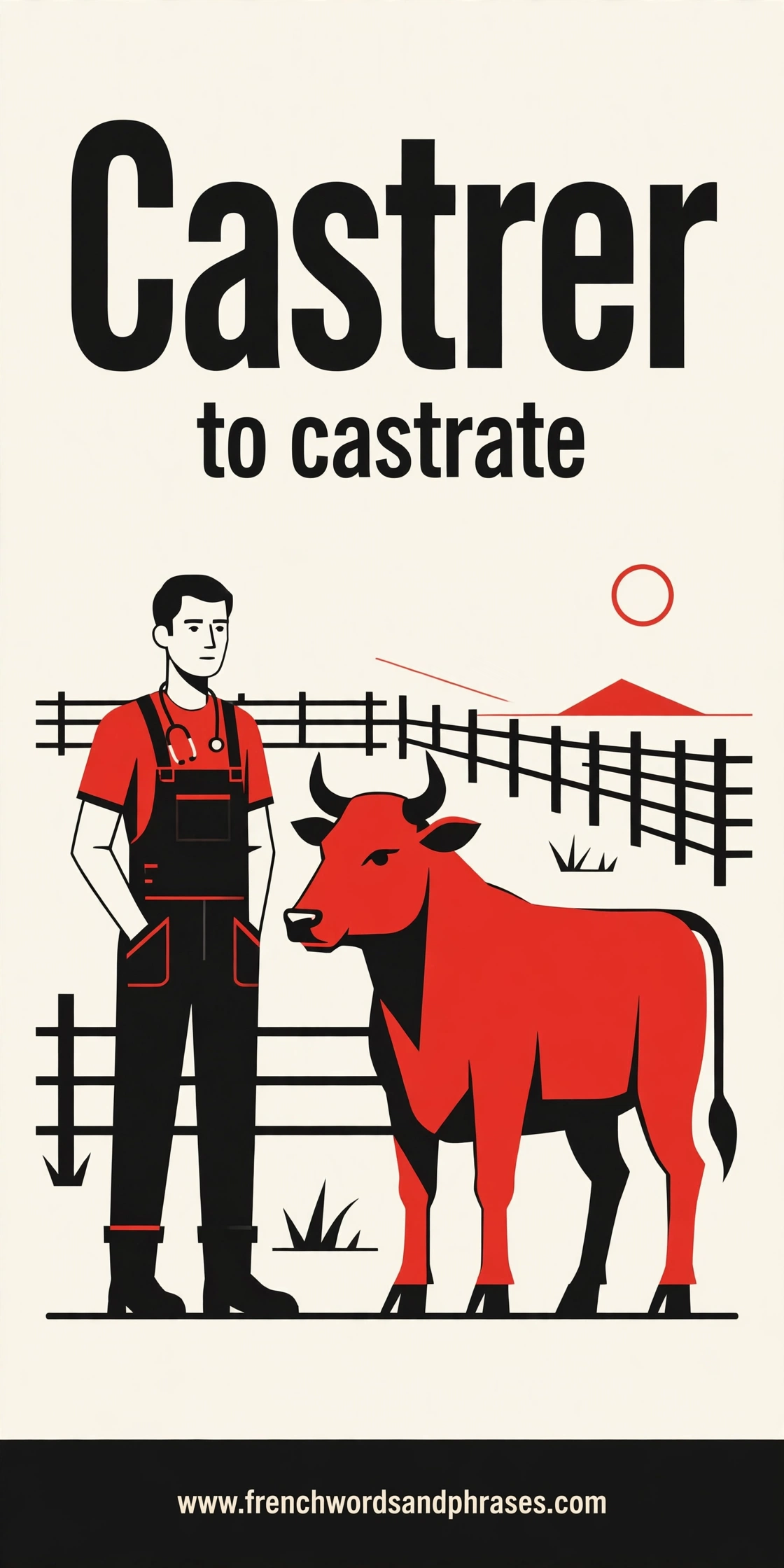
Imagine a cattle farm in spring. The vet works through the young bulls one by one, quickly and cleanly; castrés, they will grow into placid oxen, pulling and grazing side by side without the bull’s fire.
It is done without cruelty and without fuss. The animals are castrated — castrés — and the herd settles into its quiet order.
How to Conjugate Castrer: Complete French Conjugation Guide
Let’s explore every major conjugation of castrer, beginning with the indicative mood.
How to Conjugate Castrer in the Indicative Mood
The indicative mood is used to express facts, observations, actions, and events.
How to Conjugate Castrer in the Present Tense (Présent)
Used for actions happening now, habitual actions, and general truths.
| Subject | Conjugation |
|---|---|
| je | castre |
| tu | castres |
| il / elle | castre |
| nous | castrons |
| vous | castrez |
| ils / elles | castrent |
Example
Le vétérinaire castre les jeunes taureaux au printemps.
The vet castrates the young bulls in spring.
Quick Quiz 1
Complete the sentence:
Nous ______ les chats errants du village demain.
Reveal the answer
castrerons
Nous castrerons les chats errants du village demain.
We will neuter the village’s stray cats tomorrow.
How to Conjugate Castrer in the Passé Composé
Used for completed actions in the past. Castrer takes the auxiliary verb avoir.
| Subject | Conjugation |
|---|---|
| j’ | ai castré |
| tu | as castré |
| il / elle | a castré |
| nous | avons castré |
| vous | avez castré |
| ils / elles | ont castré |
Example
Ils ont castré tous les porcelets la semaine dernière.
They castrated all the piglets last week.
How to Conjugate Castrer in the Imparfait (Imperfect Tense)
Used for habitual past actions, descriptions, and ongoing situations in the past.
| Subject | Conjugation |
|---|---|
| je | castrais |
| tu | castrais |
| il / elle | castrait |
| nous | castrions |
| vous | castriez |
| ils / elles | castraient |
Example
Autrefois, on castrait les bœufs pour les atteler aux charrues.
In the old days, oxen were castrated to be yoked to the ploughs.
Quick Quiz 2
Choose the correct form:
They castrated all the piglets.
Ils ______ tous les porcelets. (ont castré / sont castrés)
Reveal the answer
ont castré
Ils ont castré tous les porcelets.
Castrer takes avoir.
How to Conjugate Castrer in the Plus-que-parfait
Used to describe an action that had already been completed before another past event.
| Subject | Conjugation |
|---|---|
| j’ | avais castré |
| tu | avais castré |
| il / elle | avait castré |
| nous | avions castré |
| vous | aviez castré |
| ils / elles | avaient castré |
Example
L’éleveur avait castré les agneaux avant l’été.
The farmer had castrated the lambs before the summer.
How to Conjugate Castrer in the Passé Simple
Primarily used in formal writing, literature, and historical narratives. It is rarely used in everyday conversation.
| Subject | Conjugation |
|---|---|
| je | castrai |
| tu | castras |
| il / elle | castra |
| nous | castrâmes |
| vous | castrâtes |
| ils / elles | castrèrent |
Example
Le chirurgien castra le cheval sous anesthésie.
The surgeon castrated the horse under anaesthetic.
How to Conjugate Castrer in the Passé Antérieur
A literary tense used to express an action completed immediately before another past action, generally in the passé simple.
| Subject | Conjugation |
|---|---|
| j’ | eus castré |
| tu | eus castré |
| il / elle | eut castré |
| nous | eûmes castré |
| vous | eûtes castré |
| ils / elles | eurent castré |
Example
Quand il eut castré le dernier verrat, il rangea ses instruments.
When he had castrated the last boar, he put away his instruments.
How to Conjugate Castrer in the Future Tense (Futur Simple)
Used to describe actions that will take place in the future.
| Subject | Conjugation |
|---|---|
| je | castrerai |
| tu | castreras |
| il / elle | castrera |
| nous | castrerons |
| vous | castrerez |
| ils / elles | castreront |
Example
Demain, nous castrerons les chats errants du village.
Tomorrow, we will neuter the village’s stray cats.
How to Conjugate Castrer in the Futur Antérieur (Future Perfect)
Used for an action that will have been completed before a particular point in the future.
| Subject | Conjugation |
|---|---|
| j’ | aurai castré |
| tu | auras castré |
| il / elle | aura castré |
| nous | aurons castré |
| vous | aurez castré |
| ils / elles | auront castré |
Example
À la fin de la semaine, le vétérinaire aura castré trente animaux.
By the end of the week, the vet will have castrated thirty animals.
How to Conjugate Castrer in the Near Future (Futur Proche)
Used to describe something that is going to happen soon. Formed with aller + infinitive.
| Subject | Conjugation |
|---|---|
| je | vais castrer |
| tu | vas castrer |
| il / elle | va castrer |
| nous | allons castrer |
| vous | allez castrer |
| ils / elles | vont castrer |
Example
Le refuge va castrer les mâles avant de les proposer à l’adoption.
The shelter is going to neuter the males before offering them for adoption.
How to Conjugate Castrer in the Conditional Mood
The conditional mood expresses what would happen under certain circumstances. It is also frequently used to make polite requests or express wishes.
How to Conjugate Castrer in the Present Conditional
| Subject | Conjugation |
|---|---|
| je | castrerais |
| tu | castrerais |
| il / elle | castrerait |
| nous | castrerions |
| vous | castreriez |
| ils / elles | castreraient |
Example
On castrerait moins d’animaux si les propriétaires étaient plus prudents.
Fewer animals would be castrated if owners were more careful.
How to Conjugate Castrer in the Past Conditional
| Subject | Conjugation |
|---|---|
| j’ | aurais castré |
| tu | aurais castré |
| il / elle | aurait castré |
| nous | aurions castré |
| vous | auriez castré |
| ils / elles | auraient castré |
Example
Ils auraient castré le taureau plus tôt sans la neige.
They would have castrated the bull earlier if not for the snow.
Castrer in the Literary Past Conditional Form
This less common literary form uses the imperfect subjunctive of avoir.
| Subject | Conjugation |
|---|---|
| j’ | eusse castré |
| tu | eusses castré |
| il / elle | eût castré |
| nous | eussions castré |
| vous | eussiez castré |
| ils / elles | eussent castré |
Example
Le vétérinaire eût castré les bœufs avant les labours.
The vet would have castrated the oxen before the ploughing.
How to Conjugate Castrer in the Subjunctive Mood
The subjunctive is used to express wishes, emotions, doubts, necessity, and uncertainty. It frequently follows expressions such as il faut que (it is necessary that) or bien que (although).
How to Conjugate Castrer in the Present Subjunctive
| Subject | Conjugation |
|---|---|
| que je | castre |
| que tu | castres |
| qu’il / qu’elle | castre |
| que nous | castrions |
| que vous | castriez |
| qu’ils / qu’elles | castrent |
Example
La loi exige que le refuge castre les animaux errants.
The law requires the shelter to neuter stray animals.
Quick Quiz 3
Complete the sentence using the subjunctive:
Il faut que le refuge ______ les animaux errants.
Reveal the answer
castre
Il faut que le refuge castre les animaux errants.
The shelter must neuter stray animals.
How to Conjugate Castrer in the Imperfect Subjunctive
A literary tense, rarely encountered in modern spoken French.
| Subject | Conjugation |
|---|---|
| que je | castrasse |
| que tu | castrasses |
| qu’il / qu’elle | castrât |
| que nous | castrassions |
| que vous | castrassiez |
| qu’ils / qu’elles | castrassent |
Example
Le fermier voulait qu’on castrât les porcelets avant l’hiver.
The farmer wanted the piglets castrated before winter.
How to Conjugate Castrer in the Pluperfect Subjunctive
A literary construction used to express an action completed before another past action.
| Subject | Conjugation |
|---|---|
| que j’ | eusse castré |
| que tu | eusses castré |
| qu’il / qu’elle | eût castré |
| que nous | eussions castré |
| que vous | eussiez castré |
| qu’ils / qu’elles | eussent castré |
Example
On racontait qu’ils eussent castré les chanteurs pour garder leurs voix.
People said singers used to be castrated to preserve their voices.
How to Conjugate Castrer in the Past Subjunctive
| Subject | Conjugation |
|---|---|
| que j’ | aie castré |
| que tu | aies castré |
| qu’il / qu’elle | ait castré |
| que nous | ayons castré |
| que vous | ayez castré |
| qu’ils / qu’elles | aient castré |
Example
Je suis content que le refuge ait castré les chats du quartier.
I am glad the shelter has neutered the neighbourhood cats.
How to Conjugate Castrer in the Imperative
The imperative is used to give commands, instructions, invitations, or suggestions. Subject pronouns are omitted.
How to Conjugate Castrer in the Present Imperative
| Person | Conjugation |
|---|---|
| (tu) | castre |
| (nous) | castrons |
| (vous) | castrez |
Example
Castrez les porcelets avant leur sixième semaine !
Castrate the piglets before their sixth week!
Quick Quiz 4
How would you say Castrate the piglets before winter (tu form)?
Reveal the answer
Castre les porcelets avant l’hiver !
French Participles of Castrer
Participles are verb forms that can be used in compound tenses and other grammatical constructions.
Present Participle of Castrer
castrant
En castrant les chats errants, le refuge limite les naissances.
By neutering stray cats, the shelter limits births.
Past Participle of Castrer
castré
Castré jeune, le taureau est devenu un bœuf paisible.
Castrated young, the bull became a placid ox.
Castrer in Everyday French: Real-Life Examples
Now that you know the conjugations, let’s see how castrer appears in everyday French.
Example 1 — Present
Le vétérinaire castre les jeunes taureaux.
The vet castrates the young bulls.
Example 2 — Passé composé
Ils ont castré tous les porcelets la semaine dernière.
They castrated all the piglets last week.
Example 3 — Imparfait
On castrait les bœufs pour les atteler aux charrues.
Oxen were castrated to be yoked to the ploughs.
Example 4 — Future
Nous castrerons les chats errants demain.
We will neuter the stray cats tomorrow.
Example 5 — Conditional
On castrerait moins d’animaux avec des propriétaires prudents.
Fewer animals would be castrated with careful owners.
Example 6 — Imperative
Castrez les porcelets avant six semaines !
Castrate the piglets before six weeks!
Beyond Translation: The Meaning of Castrer
English castrate is the same learned word from the same Latin root — French castrer shares its formal, technical tone exactly.
Everyday French often prefers its homelier twin.
At the vet’s, in the farmyard and in the shelter, you will hear châtrer far more often; castrer belongs to textbooks, history and the surgery’s written records.
How to Remember the French Verb Castrer
Remember it this way: Castrer is about the vet working through the spring herd, quickly and cleanly.
- Castrer is the technical word; châtrer is its everyday twin — the vet says châtrer un chat.
- Its world is the farm and the surgery: bulls, boars, piglets and stray cats.
- Regular -er: je castre, nous castrons, past participle castré.
The key idea is the vet working through the spring herd, quickly and cleanly.
Test Your Knowledge of Castrer
Let’s see how much you’ve learned. Try answering these questions before revealing the answers.
Question 1
Which verb does everyday French usually prefer at the vet’s, instead of castrer?
Reveal the answer
Châtrer — castrer is the learned, technical word; châtrer is the common one for animals.
Question 2
How do you say The vet castrates the young bulls in French?
Reveal the answer
Le vétérinaire castre les jeunes taureaux.
Question 3
Translate: They castrated all the piglets last week.
Reveal the answer
Ils ont castré tous les porcelets la semaine dernière.
Question 4
What is the past participle of castrer?
Reveal the answer
Castré.
Question 5
Complete the sentence:
La loi exige que le refuge ______ les animaux errants.
Reveal the answer
castre
La loi exige que le refuge castre les animaux errants.
The law requires the shelter to neuter stray animals.
Your Final Challenge
Can You Use It?
How would you say this in French?
The vet castrates the young bulls, and the herd regains its calm.
Reveal the answer
Le vétérinaire castre les jeunes taureaux, et le troupeau retrouve son calme.
The vet castrates the young bulls, and the herd regains its calm.
A little French. A little curiosity. A richer everyday life.
LEARN FRENCH ONE WORD AT A TIME