A French Word to Live By
How to Conjugate Cataloguer in French
/ka.ta.lɔ.ɡe/
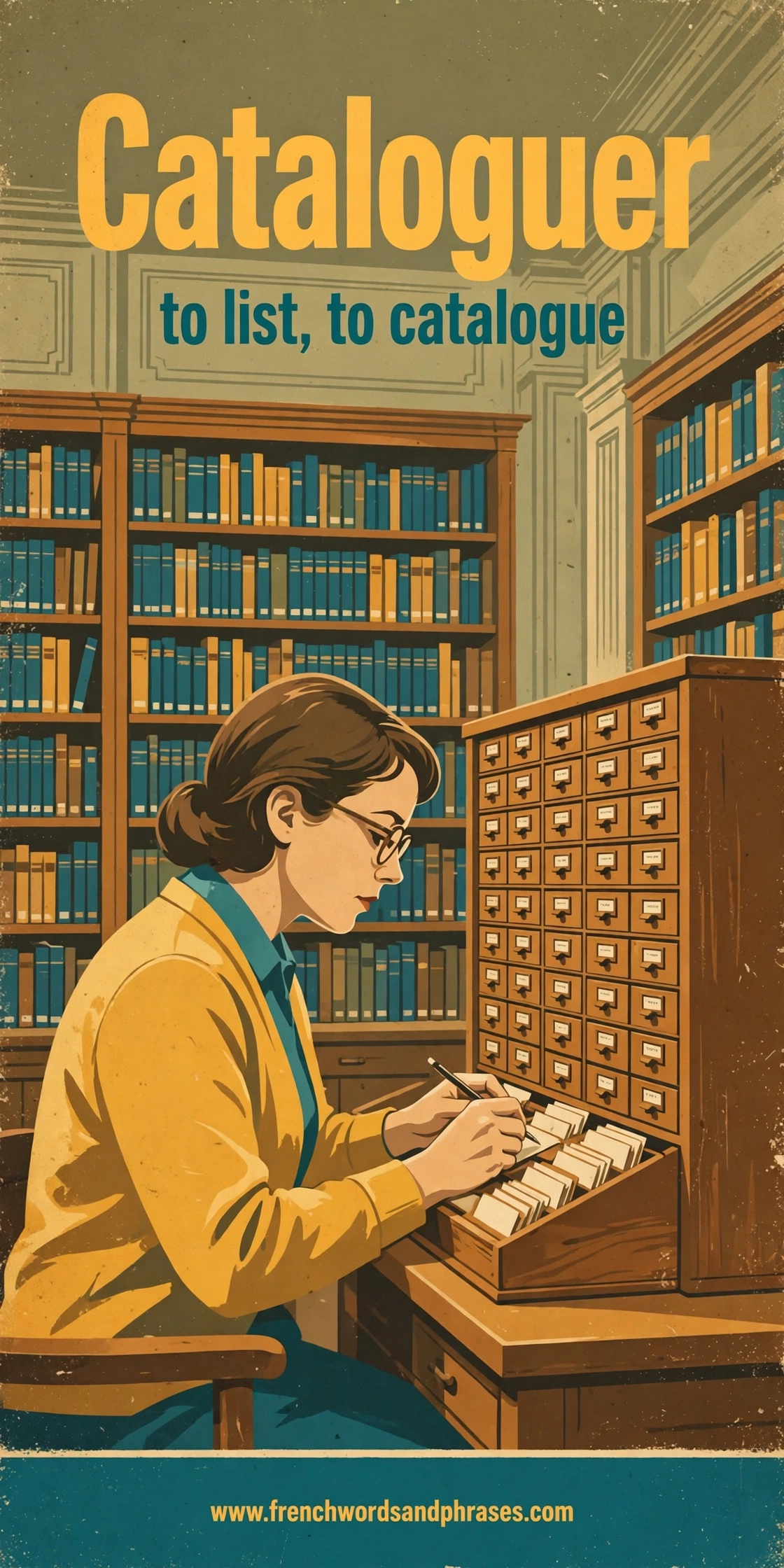
Cataloguer means to list, to catalogue — to give every book, object or star its numbered place so that nothing is ever lost.
A librarian with a pencil behind her ear, a museum storeroom full of numbered boxes, an astronomer naming stars one by one — cataloguer is the verb of patient order: whatever is catalogué can be found again, years later, in the dark.
In this guide, you’ll learn how to conjugate cataloguer in all the major French tenses and moods. Explore complete conjugation tables, French examples, English translations, and practice quizzes.
Understanding the French Verb Cataloguer
Cataloguer is a regular French verb belonging to the first group of verbs, those ending in-er.
It means to list, to catalogue. It is the everyday verb of libraries, museums, archives and online shops for putting stock into a systematic list, and in conversation it survives mostly in the figurative sense — to be catalogué is to be summed up, labelled and filed away by other people, rarely to your advantage.
Verb classification: First group (-er)
Auxiliary verb: Avoir
Past participle: catalogué
Present participle: cataloguant
English equivalents: To catalogue, to list, to inventory; cataloguer des livres — to catalogue books; cataloguer une collection — to catalogue a collection; cataloguer quelqu’un — to label someone, to pigeonhole them; être catalogué comme… — to be labelled as…
One important detail: cataloguer keeps its u everywhere, because the u guards the hard /g/ sound before a and o: nous cataloguons, en cataloguant, je cataloguais. Dropping it (cataloger) would be a spelling mistake, not a shortcut. Watch the figurative sense too: cataloguer quelqu’un is not filing a person — it is labelling them, pinning a reputation on them, usually unfairly: on l’a catalogué comme paresseux, he was written off as lazy.
Experience the Word
Cataloguer is the verb of the list that defeats chaos — one line per thing, one number per line, and the whole world within reach.
Imagine the storeroom of a small museum on a rainy Monday. Box after box of Roman coins, medieval keys and faded photographs pass across one desk; each is weighed, described and given a number — catalogué — before joining the shelves where a researcher will find it in fifty years’ time.
Nothing here is famous or precious. It is catalogued — catalogué — and that is exactly why it will survive.
How to Conjugate Cataloguer: Complete French Conjugation Guide
Let’s explore every major conjugation of cataloguer, beginning with the indicative mood.
How to Conjugate Cataloguer in the Indicative Mood
The indicative mood is used to express facts, observations, actions, and events.
How to Conjugate Cataloguer in the Present Tense (Présent)
Used for actions happening now, habitual actions, and general truths.
| Subject | Conjugation |
|---|---|
| je | catalogue |
| tu | catalogues |
| il / elle | catalogue |
| nous | cataloguons |
| vous | cataloguez |
| ils / elles | cataloguent |
Example
La bibliothécaire catalogue les nouveaux livres chaque matin.
The librarian catalogues the new books every morning.
Quick Quiz 1
Complete the sentence:
Nous ______ les archives du village.
Reveal the answer
cataloguons
Nous cataloguons les archives du village.
We are cataloguing the village archives.
How to Conjugate Cataloguer in the Passé Composé
Used for completed actions in the past. Cataloguer takes the auxiliary verb avoir.
| Subject | Conjugation |
|---|---|
| j’ | ai catalogué |
| tu | as catalogué |
| il / elle | a catalogué |
| nous | avons catalogué |
| vous | avez catalogué |
| ils / elles | ont catalogué |
Example
Nous avons catalogué toute la collection en un mois.
We catalogued the whole collection in one month.
How to Conjugate Cataloguer in the Imparfait (Imperfect Tense)
Used for habitual past actions, descriptions, and ongoing situations in the past.
| Subject | Conjugation |
|---|---|
| je | cataloguais |
| tu | cataloguais |
| il / elle | cataloguait |
| nous | cataloguions |
| vous | cataloguiez |
| ils / elles | cataloguaient |
Example
Il cataloguait les timbres de son grand-père avec soin.
He used to catalogue his grandfather’s stamps with care.
Quick Quiz 2
Choose the correct form:
We catalogued the whole collection.
Nous ______ toute la collection. (avons catalogué / avons catalogé)
Reveal the answer
avons catalogué
Nous avons catalogué toute la collection.
The u of the -guer stem never drops.
How to Conjugate Cataloguer in the Plus-que-parfait
Used to describe an action that had already been completed before another past event.
| Subject | Conjugation |
|---|---|
| j’ | avais catalogué |
| tu | avais catalogué |
| il / elle | avait catalogué |
| nous | avions catalogué |
| vous | aviez catalogué |
| ils / elles | avaient catalogué |
Example
Elle avait déjà catalogué ces tableaux avant l’exposition.
She had already catalogued these paintings before the exhibition.
How to Conjugate Cataloguer in the Passé Simple
Primarily used in formal writing, literature, and historical narratives. It is rarely used in everyday conversation.
| Subject | Conjugation |
|---|---|
| je | cataloguai |
| tu | cataloguas |
| il / elle | catalogua |
| nous | cataloguâmes |
| vous | cataloguâtes |
| ils / elles | cataloguèrent |
Example
Le musée catalogua les objets un à un.
The museum catalogued the objects one by one.
How to Conjugate Cataloguer in the Passé Antérieur
A literary tense used to express an action completed immediately before another past action, generally in the passé simple.
| Subject | Conjugation |
|---|---|
| j’ | eus catalogué |
| tu | eus catalogué |
| il / elle | eut catalogué |
| nous | eûmes catalogué |
| vous | eûtes catalogué |
| ils / elles | eurent catalogué |
Example
Quand ils eurent catalogué la dernière boîte, ils fermèrent l’atelier.
When they had catalogued the last box, they closed the workshop.
How to Conjugate Cataloguer in the Future Tense (Futur Simple)
Used to describe actions that will take place in the future.
| Subject | Conjugation |
|---|---|
| je | cataloguerai |
| tu | catalogueras |
| il / elle | cataloguera |
| nous | cataloguerons |
| vous | cataloguerez |
| ils / elles | catalogueront |
Example
Demain, nous cataloguerons les archives du village.
Tomorrow, we will catalogue the village archives.
How to Conjugate Cataloguer in the Futur Antérieur (Future Perfect)
Used for an action that will have been completed before a particular point in the future.
| Subject | Conjugation |
|---|---|
| j’ | aurai catalogué |
| tu | auras catalogué |
| il / elle | aura catalogué |
| nous | aurons catalogué |
| vous | aurez catalogué |
| ils / elles | auront catalogué |
Example
À la fin de l’été, ils auront catalogué dix mille photos.
By the end of the summer, they will have catalogued ten thousand photos.
How to Conjugate Cataloguer in the Near Future (Futur Proche)
Used to describe something that is going to happen soon. Formed with aller + infinitive.
| Subject | Conjugation |
|---|---|
| je | vais cataloguer |
| tu | vas cataloguer |
| il / elle | va cataloguer |
| nous | allons cataloguer |
| vous | allez cataloguer |
| ils / elles | vont cataloguer |
Example
Je vais cataloguer ces disques ce soir.
I am going to catalogue these records this evening.
How to Conjugate Cataloguer in the Conditional Mood
The conditional mood expresses what would happen under certain circumstances. It is also frequently used to make polite requests or express wishes.
How to Conjugate Cataloguer in the Present Conditional
| Subject | Conjugation |
|---|---|
| je | cataloguerais |
| tu | cataloguerais |
| il / elle | cataloguerait |
| nous | cataloguerions |
| vous | catalogueriez |
| ils / elles | catalogueraient |
Example
Sans ordinateur, on cataloguerait tout à la main.
Without a computer, we would catalogue everything by hand.
How to Conjugate Cataloguer in the Past Conditional
| Subject | Conjugation |
|---|---|
| j’ | aurais catalogué |
| tu | aurais catalogué |
| il / elle | aurait catalogué |
| nous | aurions catalogué |
| vous | auriez catalogué |
| ils / elles | auraient catalogué |
Example
Elle aurait catalogué les lettres si elle avait eu le temps.
She would have catalogued the letters if she had had the time.
Cataloguer in the Literary Past Conditional Form
This less common literary form uses the imperfect subjunctive of avoir.
| Subject | Conjugation |
|---|---|
| j’ | eusse catalogué |
| tu | eusses catalogué |
| il / elle | eût catalogué |
| nous | eussions catalogué |
| vous | eussiez catalogué |
| ils / elles | eussent catalogué |
Example
Il eût catalogué chaque pierre du château.
He would have catalogued every stone of the castle.
How to Conjugate Cataloguer in the Subjunctive Mood
The subjunctive is used to express wishes, emotions, doubts, necessity, and uncertainty. It frequently follows expressions such as il faut que (it is necessary that) or bien que (although).
How to Conjugate Cataloguer in the Present Subjunctive
| Subject | Conjugation |
|---|---|
| que je | catalogue |
| que tu | catalogues |
| qu’il / qu’elle | catalogue |
| que nous | cataloguions |
| que vous | cataloguiez |
| qu’ils / qu’elles | cataloguent |
Example
Il faut que tu catalogues ces documents avant vendredi.
You must catalogue these documents before Friday.
Quick Quiz 3
Complete the sentence using the subjunctive:
Il faut que vous ______ les manuscrits avec soin.
Reveal the answer
cataloguiez
Il faut que vous cataloguiez les manuscrits avec soin.
You must catalogue the manuscripts carefully.
How to Conjugate Cataloguer in the Imperfect Subjunctive
A literary tense, rarely encountered in modern spoken French.
| Subject | Conjugation |
|---|---|
| que je | cataloguasse |
| que tu | cataloguasses |
| qu’il / qu’elle | cataloguât |
| que nous | cataloguassions |
| que vous | cataloguassiez |
| qu’ils / qu’elles | cataloguassent |
Example
Je voulais qu’il cataloguât les manuscrits avec soin.
I wanted him to catalogue the manuscripts carefully.
How to Conjugate Cataloguer in the Pluperfect Subjunctive
A literary construction used to express an action completed before another past action.
| Subject | Conjugation |
|---|---|
| que j’ | eusse catalogué |
| que tu | eusses catalogué |
| qu’il / qu’elle | eût catalogué |
| que nous | eussions catalogué |
| que vous | eussiez catalogué |
| qu’ils / qu’elles | eussent catalogué |
Example
On doutait qu’ils eussent catalogué toutes les pièces.
People doubted they had catalogued all the items.
How to Conjugate Cataloguer in the Past Subjunctive
| Subject | Conjugation |
|---|---|
| que j’ | aie catalogué |
| que tu | aies catalogué |
| qu’il / qu’elle | ait catalogué |
| que nous | ayons catalogué |
| que vous | ayez catalogué |
| qu’ils / qu’elles | aient catalogué |
Example
Je suis ravi qu’elle ait catalogué la bibliothèque entière.
I am delighted she catalogued the entire library.
How to Conjugate Cataloguer in the Imperative
The imperative is used to give commands, instructions, invitations, or suggestions. Subject pronouns are omitted.
How to Conjugate Cataloguer in the Present Imperative
| Person | Conjugation |
|---|---|
| (tu) | catalogue |
| (nous) | cataloguons |
| (vous) | cataloguez |
Example
Catalogue ces photos avant de les ranger !
Catalogue these photos before putting them away!
Quick Quiz 4
How would you say Catalogue these photos (tu form)?
Reveal the answer
Catalogue ces photos !
French Participles of Cataloguer
Participles are verb forms that can be used in compound tenses and other grammatical constructions.
Present Participle of Cataloguer
cataloguant
En cataloguant les livres, elle a retrouvé une édition rare.
While cataloguing the books, she found a rare edition.
Past Participle of Cataloguer
catalogué
Une fois catalogué, chaque objet reçoit un numéro.
Once catalogued, every object receives a number.
Cataloguer in Everyday French: Real-Life Examples
Now that you know the conjugations, let’s see how cataloguer appears in everyday French.
Example 1 — Present
La bibliothécaire catalogue les livres.
The librarian catalogues the books.
Example 2 — Passé composé
Nous avons catalogué toute la collection.
We catalogued the whole collection.
Example 3 — Imparfait
Il cataloguait les timbres de son grand-père.
He used to catalogue his grandfather’s stamps.
Example 4 — Future
Nous cataloguerons les archives demain.
We will catalogue the archives tomorrow.
Example 5 — Conditional
On cataloguerait tout à la main sans ordinateur.
We would catalogue everything by hand without a computer.
Example 6 — Imperative
Catalogue ces photos avant de les ranger !
Catalogue these photos before putting them away!
Beyond Translation: The Meaning of Cataloguer
A catalogue descends from the Greek katalogos, a list or register — kata, down, plus legein, to count or recount: to count things down, one by one, until the world fits on paper.
To catalogue is to promise that nothing will be lost.
That is why the figurative sense stings: a person who is catalogué has been counted down and filed away by others — reduced to a single line in somebody else’s list.
How to Remember the French Verb Cataloguer
Remember it this way: Cataloguer is about the librarian’s pencil — every thing in its numbered place.
- The u never leaves: cataloguons, cataloguant, catalogué — it guards the hard /g/.
- Two lives: filing objects in a list, and labelling people — être catalogué comme paresseux.
- Regular -er: je catalogue, nous cataloguons, past participle catalogué.
The key idea is the librarian’s pencil — every thing in its numbered place.
Test Your Knowledge of Cataloguer
Let’s see how much you’ve learned. Try answering these questions before revealing the answers.
Question 1
Why does cataloguer keep its u in nous cataloguons?
Reveal the answer
To keep the hard /g/ sound — without the u, g before o would still be hard, but French spelling keeps the u of the -guer stem throughout: cataloguons, cataloguant, catalogué.
Question 2
How do you say We catalogued the whole collection in French?
Reveal the answer
Nous avons catalogué toute la collection.
Question 3
Translate: The librarian catalogues the new books every morning.
Reveal the answer
La bibliothécaire catalogue les nouveaux livres chaque matin.
Question 4
What is the past participle of cataloguer?
Reveal the answer
Catalogué.
Question 5
Complete the sentence:
Il faut que tu ______ ces documents avant vendredi.
Reveal the answer
catalogues
Il faut que tu catalogues ces documents avant vendredi.
You must catalogue these documents before Friday.
Your Final Challenge
Can You Use It?
How would you say this in French?
She catalogues the stars one by one, as if the sky were her library.
Reveal the answer
Elle catalogue les étoiles une à une, comme si le ciel était sa bibliothèque.
She catalogues the stars one by one, as if the sky were her library.
A little French. A little curiosity. A richer everyday life.
LEARN FRENCH ONE WORD AT A TIME