A French Word to Live By
How to Conjugate Casquer in French
/kas.ke/
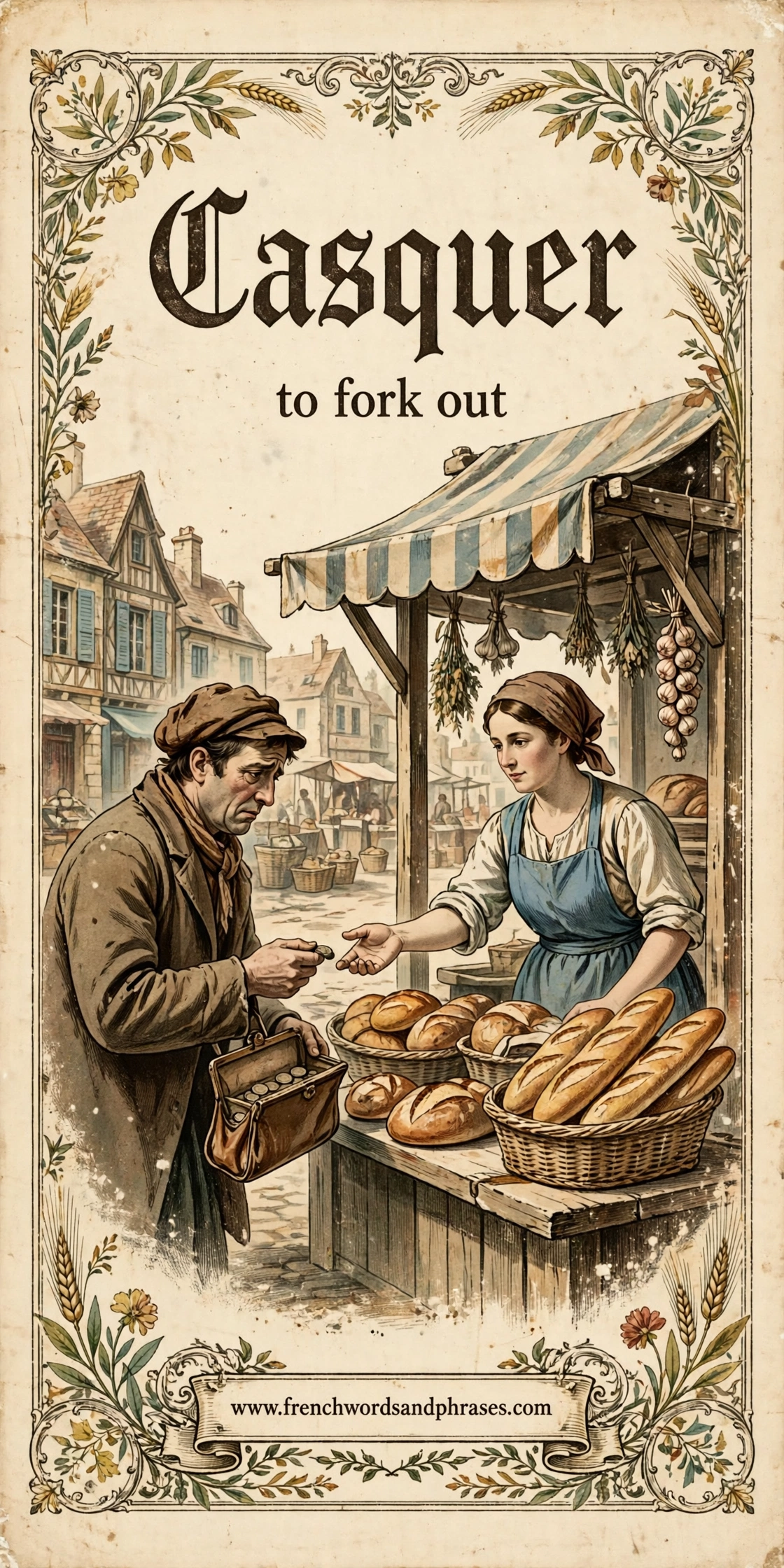
Casquer means to fork out — to pay up, usually with a sigh, when the bill cannot be avoided.
The restaurant bill lands on the table, the car fails its inspection, the plumber names his price — casquer is the familiar verb of the wallet opening reluctantly: paying, forking out, coughing up, in the language of everyday grumbling.
In this guide, you’ll learn how to conjugate casquer in all the major French tenses and moods. Explore complete conjugation tables, French examples, English translations, and practice quizzes.
Understanding the French Verb Casquer
Casquer is a regular French verb belonging to the first group of verbs, those ending in-er.
It means to fork out. It is the standard colloquial verb for paying reluctantly or paying for others: casquer une amende, casquer la réparation, casquer pour tout le monde. In its literal sense, rare in speech, casquer also means to put a helmet or cap on someone — the familiar money sense is the one you will hear daily.
Verb classification: First group (-er)
Auxiliary verb: Avoir
Past participle: casqué
Present participle: casquant
English equivalents: To fork out, to cough up, to pay up (familiar); casquer cinquante euros — to fork out fifty euros; casquer pour les autres — to pay for everyone else; c’est lui qui casque — he is the one who pays; faire casquer quelqu’un — to make someone pay.
One important detail: casquer in this sense is familiar register — slang, not vulgar, but never for a formal letter: write payer or régler there. The qu keeps the hard /k/ sound before e: je casque, nous casquons, past participle casqué. It almost always implies the money hurts a little — one casque for repairs, fines and other people’s dinners, not happily for presents.
Experience the Word
Casquer is the verb of the painful payment — the wallet opens, the eyes close, and the money is gone.
Imagine a young driver at the garage. The mechanic lists the work — clutch, brakes, two tyres — and names a sum with three zeros. She signs, she casque, and she walks home past the bus stop she will be using for a month.
She has not bought anything she wanted. She has forked out — casqué — because there was no choice.
How to Conjugate Casquer: Complete French Conjugation Guide
Let’s explore every major conjugation of casquer, beginning with the indicative mood.
How to Conjugate Casquer in the Indicative Mood
The indicative mood is used to express facts, observations, actions, and events.
How to Conjugate Casquer in the Present Tense (Présent)
Used for actions happening now, habitual actions, and general truths.
| Subject | Conjugation |
|---|---|
| je | casque |
| tu | casques |
| il / elle | casque |
| nous | casquons |
| vous | casquez |
| ils / elles | casquent |
Example
Chaque mois, il casque pour les sorties de ses enfants.
Every month, he forks out for his children’s outings.
Quick Quiz 1
Complete the sentence:
Nous ______ pour les sorties des enfants chaque mois.
Reveal the answer
casquons
Nous casquons pour les sorties des enfants chaque mois.
We fork out for the children’s outings every month.
How to Conjugate Casquer in the Passé Composé
Used for completed actions in the past. Casquer takes the auxiliary verb avoir.
| Subject | Conjugation |
|---|---|
| j’ | ai casqué |
| tu | as casqué |
| il / elle | a casqué |
| nous | avons casqué |
| vous | avez casqué |
| ils / elles | ont casqué |
Example
J’ai casqué cinquante euros pour un repas médiocre.
I forked out fifty euros for a mediocre meal.
How to Conjugate Casquer in the Imparfait (Imperfect Tense)
Used for habitual past actions, descriptions, and ongoing situations in the past.
| Subject | Conjugation |
|---|---|
| je | casquais |
| tu | casquais |
| il / elle | casquait |
| nous | casquions |
| vous | casquiez |
| ils / elles | casquaient |
Example
Autrefois, c’était toujours lui qui casquait pour tout le monde.
In the old days, it was always him who paid for everyone.
Quick Quiz 2
Choose the correct form:
I forked out fifty euros.
J’______ cinquante euros. (ai casqué / suis casqué)
Reveal the answer
ai casqué
J’ai casqué cinquante euros.
Casquer takes avoir.
How to Conjugate Casquer in the Plus-que-parfait
Used to describe an action that had already been completed before another past event.
| Subject | Conjugation |
|---|---|
| j’ | avais casqué |
| tu | avais casqué |
| il / elle | avait casqué |
| nous | avions casqué |
| vous | aviez casqué |
| ils / elles | avaient casqué |
Example
Elle avait casqué une fortune pour réparer sa vieille voiture.
She had forked out a fortune to repair her old car.
How to Conjugate Casquer in the Passé Simple
Primarily used in formal writing, literature, and historical narratives. It is rarely used in everyday conversation.
| Subject | Conjugation |
|---|---|
| je | casquai |
| tu | casquas |
| il / elle | casqua |
| nous | casquâmes |
| vous | casquâtes |
| ils / elles | casquèrent |
Example
Le père casqua sans un mot pour les dégâts de son fils.
The father paid up without a word for his son’s damage.
How to Conjugate Casquer in the Passé Antérieur
A literary tense used to express an action completed immediately before another past action, generally in the passé simple.
| Subject | Conjugation |
|---|---|
| j’ | eus casqué |
| tu | eus casqué |
| il / elle | eut casqué |
| nous | eûmes casqué |
| vous | eûtes casqué |
| ils / elles | eurent casqué |
Example
Quand il eut casqué l’amende, il vendit sa moto.
When he had paid the fine, he sold his motorbike.
How to Conjugate Casquer in the Future Tense (Futur Simple)
Used to describe actions that will take place in the future.
| Subject | Conjugation |
|---|---|
| je | casquerai |
| tu | casqueras |
| il / elle | casquera |
| nous | casquerons |
| vous | casquerez |
| ils / elles | casqueront |
Example
Demain, tu casqueras pour la réparation de la chaudière.
Tomorrow, you will fork out for the boiler repair.
How to Conjugate Casquer in the Futur Antérieur (Future Perfect)
Used for an action that will have been completed before a particular point in the future.
| Subject | Conjugation |
|---|---|
| j’ | aurai casqué |
| tu | auras casqué |
| il / elle | aura casqué |
| nous | aurons casqué |
| vous | aurez casqué |
| ils / elles | auront casqué |
Example
À la fin du mois, nous aurons casqué plus de mille euros de travaux.
By the end of the month, we will have forked out more than a thousand euros on repairs.
How to Conjugate Casquer in the Near Future (Futur Proche)
Used to describe something that is going to happen soon. Formed with aller + infinitive.
| Subject | Conjugation |
|---|---|
| je | vais casquer |
| tu | vas casquer |
| il / elle | va casquer |
| nous | allons casquer |
| vous | allez casquer |
| ils / elles | vont casquer |
Example
Prépare-toi, tu vas casquer pour cette vitre cassée.
Get ready, you are going to pay for this broken window.
How to Conjugate Casquer in the Conditional Mood
The conditional mood expresses what would happen under certain circumstances. It is also frequently used to make polite requests or express wishes.
How to Conjugate Casquer in the Present Conditional
| Subject | Conjugation |
|---|---|
| je | casquerais |
| tu | casquerais |
| il / elle | casquerait |
| nous | casquerions |
| vous | casqueriez |
| ils / elles | casqueraient |
Example
Je casquerais volontiers pour un bon repas, pas pour celui-ci.
I would gladly pay for a good meal, not for this one.
How to Conjugate Casquer in the Past Conditional
| Subject | Conjugation |
|---|---|
| j’ | aurais casqué |
| tu | aurais casqué |
| il / elle | aurait casqué |
| nous | aurions casqué |
| vous | auriez casqué |
| ils / elles | auraient casqué |
Example
Tu aurais casqué moins cher chez le petit garagiste du coin.
You would have paid less at the little garage on the corner.
Casquer in the Literary Past Conditional Form
This less common literary form uses the imperfect subjunctive of avoir.
| Subject | Conjugation |
|---|---|
| j’ | eusse casqué |
| tu | eusses casqué |
| il / elle | eût casqué |
| nous | eussions casqué |
| vous | eussiez casqué |
| ils / elles | eussent casqué |
Example
Il eût casqué le double pour éviter le procès.
He would have forked out double to avoid the trial.
How to Conjugate Casquer in the Subjunctive Mood
The subjunctive is used to express wishes, emotions, doubts, necessity, and uncertainty. It frequently follows expressions such as il faut que (it is necessary that) or bien que (although).
How to Conjugate Casquer in the Present Subjunctive
| Subject | Conjugation |
|---|---|
| que je | casque |
| que tu | casques |
| qu’il / qu’elle | casque |
| que nous | casquions |
| que vous | casquiez |
| qu’ils / qu’elles | casquent |
Example
Il faut bien que quelqu’un casque pour les dégâts.
Someone has to pay for the damage, after all.
Quick Quiz 3
Complete the sentence using the subjunctive:
Il faut que tu ______ pour cette vitre cassée.
Reveal the answer
casques
Il faut que tu casques pour cette vitre cassée.
You must pay for this broken window.
How to Conjugate Casquer in the Imperfect Subjunctive
A literary tense, rarely encountered in modern spoken French.
| Subject | Conjugation |
|---|---|
| que je | casquasse |
| que tu | casquasses |
| qu’il / qu’elle | casquât |
| que nous | casquassions |
| que vous | casquassiez |
| qu’ils / qu’elles | casquassent |
Example
Elle en avait assez qu’il casquât toujours pour ses frères.
She was fed up that he always paid for his brothers.
How to Conjugate Casquer in the Pluperfect Subjunctive
A literary construction used to express an action completed before another past action.
| Subject | Conjugation |
|---|---|
| que j’ | eusse casqué |
| que tu | eusses casqué |
| qu’il / qu’elle | eût casqué |
| que nous | eussions casqué |
| que vous | eussiez casqué |
| qu’ils / qu’elles | eussent casqué |
Example
On murmurait qu’il eût casqué une somme énorme pour étouffer l’affaire.
People whispered he had forked out an enormous sum to hush the matter up.
How to Conjugate Casquer in the Past Subjunctive
| Subject | Conjugation |
|---|---|
| que j’ | aie casqué |
| que tu | aies casqué |
| qu’il / qu’elle | ait casqué |
| que nous | ayons casqué |
| que vous | ayez casqué |
| qu’ils / qu’elles | aient casqué |
Example
Je suis étonné qu’elle ait casqué sans protester.
I am amazed she paid up without protesting.
How to Conjugate Casquer in the Imperative
The imperative is used to give commands, instructions, invitations, or suggestions. Subject pronouns are omitted.
How to Conjugate Casquer in the Present Imperative
| Person | Conjugation |
|---|---|
| (tu) | casque |
| (nous) | casquons |
| (vous) | casquez |
Example
Allez, casque ! C’est ton tour de payer l’addition.
Come on, cough up! It is your turn to pay the bill.
Quick Quiz 4
How would you say Cough up, it is your turn (tu form)?
Reveal the answer
Casque, c’est ton tour !
French Participles of Casquer
Participles are verb forms that can be used in compound tenses and other grammatical constructions.
Present Participle of Casquer
casquant
En casquant pour tout le monde, il s’est fait une réputation de généreux.
By paying for everyone, he earned a reputation for generosity.
Past Participle of Casquer
casqué
Casqués sans discuter, les cent euros ont payé la vitre et la serrure.
Forked out without argument, the hundred euros paid for the window and the lock.
Casquer in Everyday French: Real-Life Examples
Now that you know the conjugations, let’s see how casquer appears in everyday French.
Example 1 — Present
C’est toujours lui qui casque pour tout le monde.
It is always him who pays for everyone.
Example 2 — Passé composé
J’ai casqué cinquante euros pour ce repas.
I forked out fifty euros for this meal.
Example 3 — Imparfait
Autrefois, mon père casquait pour toutes nos sorties.
In the old days, my father paid for all our outings.
Example 4 — Future
Tu casqueras pour la réparation de la chaudière.
You will fork out for the boiler repair.
Example 5 — Conditional
Je casquerais volontiers pour un bon repas.
I would gladly pay for a good meal.
Example 6 — Imperative
Allez, casque ! C’est ton tour.
Come on, cough up! It is your turn.
Beyond Translation: The Meaning of Casquer
English to fork out and to cough up are perfect register twins for casquer — all three say paying with the same little grimace.
Nobody casque for pleasure.
The verb carries its reluctance inside it: fines, repairs, breakages and other people’s bills are its natural territory, and the sigh is part of the meaning.
How to Remember the French Verb Casquer
Remember it this way: Casquer is about the wallet opening with a sigh at the garage till.
- Casquer is familiar register — the everyday word for forking out, never for a formal letter.
- It implies the sigh: one casque for fines, repairs and other people’s dinners.
- Regular -er, with qu keeping the hard /k/: je casque, nous casquons, past participle casqué.
The key idea is the wallet opening with a sigh at the garage till.
Test Your Knowledge of Casquer
Let’s see how much you’ve learned. Try answering these questions before revealing the answers.
Question 1
What register is casquer, and what does it imply?
Reveal the answer
Familiar register — slang for paying, and it implies reluctance: one casque for fines and repairs, not happily.
Question 2
How do you say I forked out fifty euros for a mediocre meal in French?
Reveal the answer
J’ai casqué cinquante euros pour un repas médiocre.
Question 3
Translate: It is always him who pays for everyone.
Reveal the answer
C’est toujours lui qui casque pour tout le monde.
Question 4
What is the past participle of casquer?
Reveal the answer
Casqué.
Question 5
Complete the sentence:
Il faut bien que quelqu’un ______ pour les dégâts.
Reveal the answer
casque
Il faut bien que quelqu’un casque pour les dégâts.
Someone has to pay for the damage, after all.
Your Final Challenge
Can You Use It?
How would you say this in French?
He forks out for the repair, sighs, and sets off again on foot.
Reveal the answer
Il casque pour la réparation, soupire, et reprend la route à pied.
He forks out for the repair, sighs, and sets off again on foot.
A little French. A little curiosity. A richer everyday life.
LEARN FRENCH ONE WORD AT A TIME