A French Word to Live By
How to Conjugate Carminer in French
/kaʁ.mi.ne/
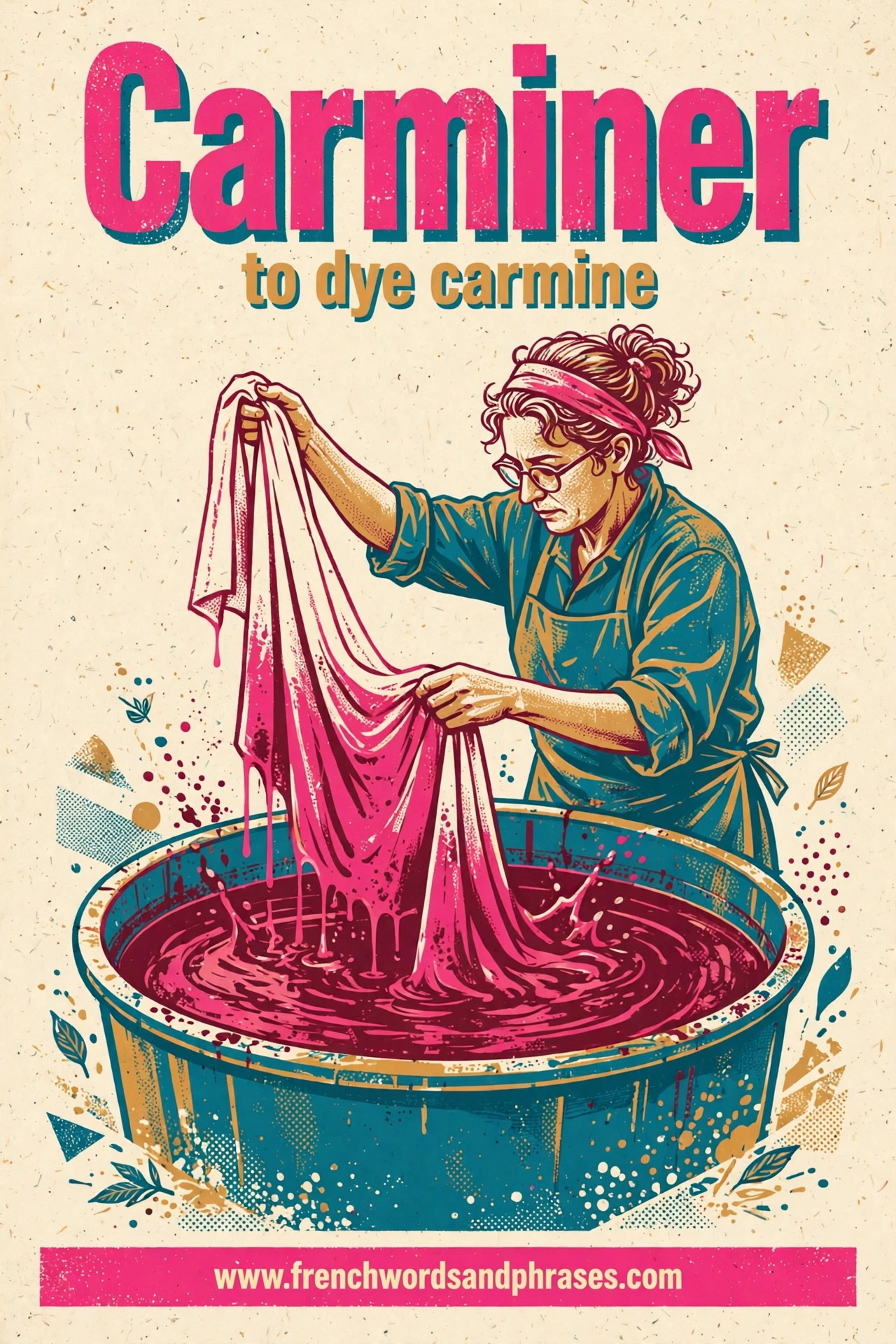
Carminer means to dye carmine, to rouge — to colour something with the deep, glowing red of carmine, the pigment of crushed cochineal insects and a thousand painted lips.
A painter grinding a precious red pigment, a length of silk taking on a crimson glow in the dyer’s vat — carminer is a rare, old-fashioned verb for giving things the richest red in the old colour box.
In this guide, you’ll learn how to conjugate carminer in all the major French tenses and moods. Explore complete conjugation tables, French examples, English translations, and practice quizzes.
Understanding the French Verb Carminer
Carminer is a regular French verb belonging to the first group of verbs, those ending in-er.
It means to dye carmine, to rouge. Expect it in historical and literary contexts: dyers carmining silk and wool, painters carmining a sunset, an author’s heroine whose cheeks the cold has carmined. In the modern street the verb has retired, but the colour carmin is alive and well on every paint chart.
Verb classification: First group (-er)
Auxiliary verb: Avoir
Past participle: carminé
Present participle: carminant
English equivalents: To dye carmine, to colour crimson, to rouge; carminer un tissu — to dye a fabric carmine; carminer ses lèvres — to rouge one’s lips; un rouge qui carmine les joues — a red that rouges the cheeks; la carmine — the carmine pigment itself.
One important detail: carminer is a rare verb, and French today usually says teindre en carmin or simply rougir — but carminer survives in old recipes, dyers’ manuals and literary descriptions of glowing reds. It is perfectly regular: je carmine, nous carminons, ils carminent, past participle carminé. The colour word behind it, le carmin, names both the pigment and the shade — a deep red with a hint of purple, warmer than scarlet.
Experience the Word
Carminer is the verb of the deepest red — the dyer’s vat glowing like embers.
Imagine a Lyon silk workshop two centuries ago. The master dyer lifts a dripping length of silk from the vat, and the whole workshop leans in: il a carminé l’étoffe — the cloth has taken the famous red, deep as wine, bright as a coal.
The silk will cross Europe at a fortune a metre. It has been dyed carmine — carminée, with the costliest red on earth.
How to Conjugate Carminer: Complete French Conjugation Guide
Let’s explore every major conjugation of carminer, beginning with the indicative mood.
How to Conjugate Carminer in the Indicative Mood
The indicative mood is used to express facts, observations, actions, and events.
How to Conjugate Carminer in the Present Tense (Présent)
Used for actions happening now, habitual actions, and general truths.
| Subject | Conjugation |
|---|---|
| je | carmine |
| tu | carmines |
| il / elle | carmine |
| nous | carminons |
| vous | carminez |
| ils / elles | carminent |
Example
Le teinturier carmine la soie dans de grandes cuves.
The dyer dyes the silk carmine in great vats.
Quick Quiz 1
Complete the sentence:
Nous ______ la laine avec de la cochenille.
Reveal the answer
carminons
Nous carminons la laine avec de la cochenille.
We dye the wool carmine with cochineal.
How to Conjugate Carminer in the Passé Composé
Used for completed actions in the past. Carminer takes the auxiliary verb avoir.
| Subject | Conjugation |
|---|---|
| j’ | ai carminé |
| tu | as carminé |
| il / elle | a carminé |
| nous | avons carminé |
| vous | avez carminé |
| ils / elles | ont carminé |
Example
Elle a carminé ses lèvres avant le bal.
She rouged her lips before the ball.
How to Conjugate Carminer in the Imparfait (Imperfect Tense)
Used for habitual past actions, descriptions, and ongoing situations in the past.
| Subject | Conjugation |
|---|---|
| je | carminais |
| tu | carminais |
| il / elle | carminait |
| nous | carminions |
| vous | carminiez |
| ils / elles | carminaient |
Example
Autrefois, on carminait la laine avec de la cochenille.
In the old days, they used to dye wool carmine with cochineal.
Quick Quiz 2
Choose the correct form:
She rouged her lips.
Elle ______ ses lèvres. (a carminé / est carminé)
Reveal the answer
a carminé
Elle a carminé ses lèvres.
Carminer takes avoir.
How to Conjugate Carminer in the Plus-que-parfait
Used to describe an action that had already been completed before another past event.
| Subject | Conjugation |
|---|---|
| j’ | avais carminé |
| tu | avais carminé |
| il / elle | avait carminé |
| nous | avions carminé |
| vous | aviez carminé |
| ils / elles | avaient carminé |
Example
Le peintre avait carminé le ciel de son tableau.
The painter had coloured the sky of his picture carmine.
How to Conjugate Carminer in the Passé Simple
Primarily used in formal writing, literature, and historical narratives. It is rarely used in everyday conversation.
| Subject | Conjugation |
|---|---|
| je | carminai |
| tu | carminas |
| il / elle | carmina |
| nous | carminâmes |
| vous | carminâtes |
| ils / elles | carminèrent |
Example
Le maître teinturier carmina l’étoffe en une nuit.
The master dyer dyed the cloth carmine in one night.
How to Conjugate Carminer in the Passé Antérieur
A literary tense used to express an action completed immediately before another past action, generally in the passé simple.
| Subject | Conjugation |
|---|---|
| j’ | eus carminé |
| tu | eus carminé |
| il / elle | eut carminé |
| nous | eûmes carminé |
| vous | eûtes carminé |
| ils / elles | eurent carminé |
Example
Quand il eut carminé la soie, il la mit à sécher.
When he had dyed the silk carmine, he put it out to dry.
How to Conjugate Carminer in the Future Tense (Futur Simple)
Used to describe actions that will take place in the future.
| Subject | Conjugation |
|---|---|
| je | carminerai |
| tu | carmineras |
| il / elle | carminera |
| nous | carminerons |
| vous | carminerez |
| ils / elles | carmineront |
Example
Demain, nous carminerons ce tissu pour le costume.
Tomorrow, we will dye this fabric carmine for the costume.
How to Conjugate Carminer in the Futur Antérieur (Future Perfect)
Used for an action that will have been completed before a particular point in the future.
| Subject | Conjugation |
|---|---|
| j’ | aurai carminé |
| tu | auras carminé |
| il / elle | aura carminé |
| nous | aurons carminé |
| vous | aurez carminé |
| ils / elles | auront carminé |
Example
À la fin du jour, ils auront carminé toutes les étoffes.
By the end of the day, they will have dyed all the cloths carmine.
How to Conjugate Carminer in the Near Future (Futur Proche)
Used to describe something that is going to happen soon. Formed with aller + infinitive.
| Subject | Conjugation |
|---|---|
| je | vais carminer |
| tu | vas carminer |
| il / elle | va carminer |
| nous | allons carminer |
| vous | allez carminer |
| ils / elles | vont carminer |
Example
Le froid va carminer tes joues, rentre !
The cold is going to rouge your cheeks, come inside!
How to Conjugate Carminer in the Conditional Mood
The conditional mood expresses what would happen under certain circumstances. It is also frequently used to make polite requests or express wishes.
How to Conjugate Carminer in the Present Conditional
| Subject | Conjugation |
|---|---|
| je | carminerais |
| tu | carminerais |
| il / elle | carminerait |
| nous | carminerions |
| vous | carmineriez |
| ils / elles | carmineraient |
Example
Avec plus de cochenille, je carminerais la laine plus profondément.
With more cochineal, I would dye the wool a deeper carmine.
How to Conjugate Carminer in the Past Conditional
| Subject | Conjugation |
|---|---|
| j’ | aurais carminé |
| tu | aurais carminé |
| il / elle | aurait carminé |
| nous | aurions carminé |
| vous | auriez carminé |
| ils / elles | auraient carminé |
Example
Elle aurait carminé ses lèvres si elle avait osé.
She would have rouged her lips if she had dared.
Carminer in the Literary Past Conditional Form
This less common literary form uses the imperfect subjunctive of avoir.
| Subject | Conjugation |
|---|---|
| j’ | eusse carminé |
| tu | eusses carminé |
| il / elle | eût carminé |
| nous | eussions carminé |
| vous | eussiez carminé |
| ils / elles | eussent carminé |
Example
Le peintre eût carminé tout le ciel du couchant.
The painter would have coloured the whole evening sky carmine.
How to Conjugate Carminer in the Subjunctive Mood
The subjunctive is used to express wishes, emotions, doubts, necessity, and uncertainty. It frequently follows expressions such as il faut que (it is necessary that) or bien que (although).
How to Conjugate Carminer in the Present Subjunctive
| Subject | Conjugation |
|---|---|
| que je | carmine |
| que tu | carmines |
| qu’il / qu’elle | carmine |
| que nous | carminions |
| que vous | carminiez |
| qu’ils / qu’elles | carminent |
Example
Il faut que tu carmines ce ruban pour la robe.
You must dye this ribbon carmine for the dress.
Quick Quiz 3
Complete the sentence using the subjunctive:
Il faut que vous ______ ce tissu pour le costume.
Reveal the answer
carminiez
Il faut que vous carminiez ce tissu pour le costume.
You must dye this fabric carmine for the costume.
How to Conjugate Carminer in the Imperfect Subjunctive
A literary tense, rarely encountered in modern spoken French.
| Subject | Conjugation |
|---|---|
| que je | carminasse |
| que tu | carminasses |
| qu’il / qu’elle | carminât |
| que nous | carminassions |
| que vous | carminassiez |
| qu’ils / qu’elles | carminassent |
Example
La couturière voulait que l’on carminât la soie.
The dressmaker wanted the silk dyed carmine.
How to Conjugate Carminer in the Pluperfect Subjunctive
A literary construction used to express an action completed before another past action.
| Subject | Conjugation |
|---|---|
| que j’ | eusse carminé |
| que tu | eusses carminé |
| qu’il / qu’elle | eût carminé |
| que nous | eussions carminé |
| que vous | eussiez carminé |
| qu’ils / qu’elles | eussent carminé |
Example
On racontait que le teinturier eût carminé les rideaux du théâtre.
People said the dyer had dyed the theatre curtains carmine.
How to Conjugate Carminer in the Past Subjunctive
| Subject | Conjugation |
|---|---|
| que j’ | aie carminé |
| que tu | aies carminé |
| qu’il / qu’elle | ait carminé |
| que nous | ayons carminé |
| que vous | ayez carminé |
| qu’ils / qu’elles | aient carminé |
Example
Je suis content que vous ayez carminé ce tissu.
I am glad you dyed this fabric carmine.
How to Conjugate Carminer in the Imperative
The imperative is used to give commands, instructions, invitations, or suggestions. Subject pronouns are omitted.
How to Conjugate Carminer in the Present Imperative
| Person | Conjugation |
|---|---|
| (tu) | carmine |
| (nous) | carminons |
| (vous) | carminez |
Example
Carmine ce ruban, il ira parfaitement avec la robe !
Dye this ribbon carmine, it will go perfectly with the dress!
Quick Quiz 4
How would you say Dye this ribbon carmine (tu form)?
Reveal the answer
Carmine ce ruban !
French Participles of Carminer
Participles are verb forms that can be used in compound tenses and other grammatical constructions.
Present Participle of Carminer
carminant
En carminant la laine, le teinturier chantait.
While dyeing the wool carmine, the dyer sang.
Past Participle of Carminer
carminé
Carminée par le froid, sa joue brillait dans la lumière.
Rouged by the cold, her cheek glowed in the light.
Carminer in Everyday French: Real-Life Examples
Now that you know the conjugations, let’s see how carminer appears in everyday French.
Example 1 — Present
Le teinturier carmine la soie.
The dyer dyes the silk carmine.
Example 2 — Passé composé
Elle a carminé ses lèvres avant le bal.
She rouged her lips before the ball.
Example 3 — Imparfait
On carminait la laine avec de la cochenille.
They used to dye wool carmine with cochineal.
Example 4 — Future
Nous carminerons ce tissu demain.
We will dye this fabric carmine tomorrow.
Example 5 — Conditional
Je carminerais la laine plus profondément.
I would dye the wool a deeper carmine.
Example 6 — Imperative
Carmine ce ruban pour la robe !
Dye this ribbon carmine for the dress!
Beyond Translation: The Meaning of Carminer
English carmine is the colour; French carminer is the old dyer’s verb for making it — from the Arabic qirmiz, the little insect whose crushed bodies gave the ancient world its finest red.
A red worth a fortune.
Cochineal crossed the Atlantic in Spanish galleons and made carmined silk a luxury of courts — the verb keeps that world of vats, recipes and guarded secrets, even though modern French has mostly let it retire into books.
How to Remember the French Verb Carminer
Remember it this way: Carminer is about the dyer’s vat glowing like embers — silk taking the costliest red.
- Le carmin is the deep red pigment from cochineal: carminer is to give something that red.
- A rare, literary verb today — everyday French says teindre en carmin or rougir.
- Regular -er: je carmine, nous carminons, past participle carminé.
The key idea is the dyer’s vat glowing like embers — silk taking the costliest red.
Test Your Knowledge of Carminer
Let’s see how much you’ve learned. Try answering these questions before revealing the answers.
Question 1
Where does the colour carmine traditionally come from?
Reveal the answer
The cochineal insect — crushed cochineal gave the old dyers their deep, glowing red.
Question 2
How do you say The dyer dyes the silk carmine in French?
Reveal the answer
Le teinturier carmine la soie.
Question 3
Translate: She rouged her lips before the ball.
Reveal the answer
Elle a carminé ses lèvres avant le bal.
Question 4
What is the past participle of carminer?
Reveal the answer
Carminé.
Question 5
Complete the sentence:
Il faut que tu ______ ce ruban pour la robe.
Reveal the answer
carmines
Il faut que tu carmines ce ruban pour la robe.
You must dye this ribbon carmine for the dress.
Your Final Challenge
Can You Use It?
How would you say this in French?
The dyer dyes the silk carmine at nightfall, and the cloth glows like an ember in the dark workshop.
Reveal the answer
Le teinturier carmine la soie à la tombée du jour, et l’étoffe brille comme une braise dans l’atelier sombre.
The dyer dyes the silk carmine at nightfall, and the cloth glows like an ember in the dark workshop.
A little French. A little curiosity. A richer everyday life.
LEARN FRENCH ONE WORD AT A TIME