
A French Word to Live By
How to Conjugate Carotter in French
/ka.ʁɔ.te/
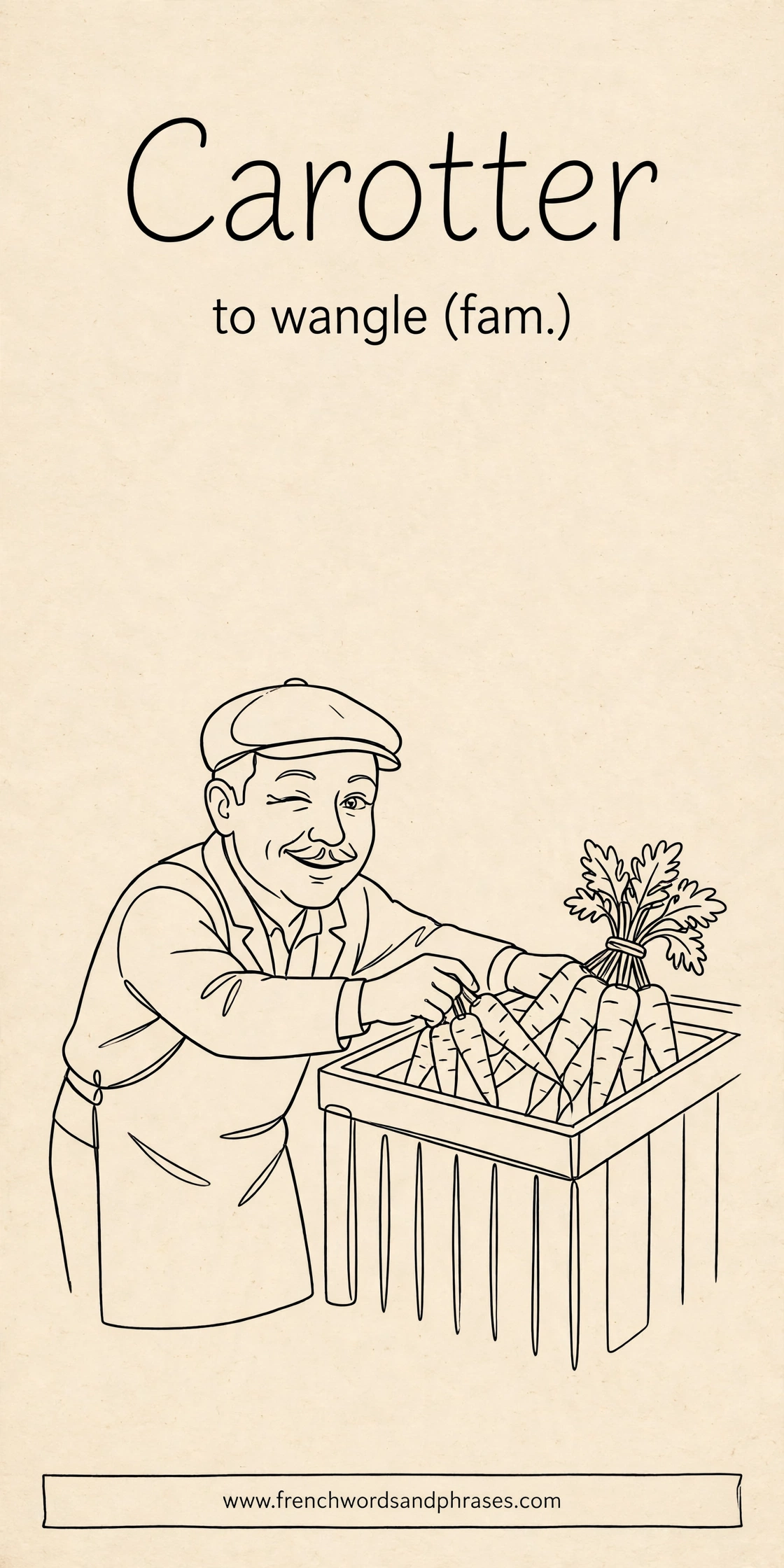
Carotter means to do out of, to wangle (fam.) — to wheedle or swindle small things out of people: a coin here, a cigarette there, a day off nobody else could get.
The office charmer who always cadges a coffee, the schoolboy who wangles an extra slice of cake — carotter is the familiar verb of small-scale wangling: never a grand theft, always a smile, a story, and something slipped into a pocket.
In this guide, you’ll learn how to conjugate carotter in all the major French tenses and moods. Explore complete conjugation tables, French examples, English translations, and practice quizzes.
Understanding the French Verb Carotter
Carotter is a regular French verb belonging to the first group of verbs, those ending in-er.
It means to do out of, to wangle (fam.). It is used for petty, good-humoured swindles: cadging money, drinks, cigarettes, days off, answers to homework. The victim is more amused than ruined — se faire carotter is to realise, laughing, that the charmer has done it again. In serious contexts of real fraud, French switches to escroquer or voler.
Verb classification: First group (-er)
Auxiliary verb: Avoir
Past participle: carotté
Present participle: carottant
English equivalents: To wangle, to cadge, to do someone out of something (fam.); carotter de l’argent à quelqu’un — to wangle money out of someone; carotter une cigarette — to cadge a cigarette; carotter un jour de congé — to wangle a day off; se faire carotter — to get oneself diddled (fam.).
One important detail: carotter is familier — informal French, the word of playgrounds and office banter, not of contracts. It is perfectly regular, double t throughout: je carotte, nous carottons, ils carottent, past participle carotté. The construction shows the little swindle’s shape: you carotte something à someone — il m’a carotté dix euros, he wangled ten euros out of me. Behind it stands une carotte, the carrot: the small tempting thing dangled, and the small thing extracted.
Experience the Word
Carotter is the verb of the charming small swindle — too little to prosecute, too neat not to admire.
Imagine the schoolyard at break. Petit Louis has no snack, but he has a story about his brother’s motorbike that lasts exactly one biscuit long. Chaque jour, il carotte un goûter à quelqu’un — and the whole class, half annoyed, half admiring, queues up to be next.
He has stolen nothing. He has simply wangled it — carotté, with a smile and a story.
How to Conjugate Carotter: Complete French Conjugation Guide
Let’s explore every major conjugation of carotter, beginning with the indicative mood.
How to Conjugate Carotter in the Indicative Mood
The indicative mood is used to express facts, observations, actions, and events.
How to Conjugate Carotter in the Present Tense (Présent)
Used for actions happening now, habitual actions, and general truths.
| Subject | Conjugation |
|---|---|
| je | carotte |
| tu | carottes |
| il / elle | carotte |
| nous | carottons |
| vous | carottez |
| ils / elles | carottent |
Example
Il carotte toujours des cigarettes à ses collègues.
He is always cadging cigarettes off his colleagues.
Quick Quiz 1
Complete the sentence:
Nous ______ toujours les réponses au professeur stagiaire.
Reveal the answer
carottons
Nous carottons toujours les réponses au professeur stagiaire.
We always cadge the answers off the trainee teacher.
How to Conjugate Carotter in the Passé Composé
Used for completed actions in the past. Carotter takes the auxiliary verb avoir.
| Subject | Conjugation |
|---|---|
| j’ | ai carotté |
| tu | as carotté |
| il / elle | a carotté |
| nous | avons carotté |
| vous | avez carotté |
| ils / elles | ont carotté |
Example
Elle m’a carotté dix euros pour un café.
She wangled ten euros out of me for a coffee.
How to Conjugate Carotter in the Imparfait (Imperfect Tense)
Used for habitual past actions, descriptions, and ongoing situations in the past.
| Subject | Conjugation |
|---|---|
| je | carottais |
| tu | carottais |
| il / elle | carottait |
| nous | carottions |
| vous | carottiez |
| ils / elles | carottaient |
Example
À l’école, il carottait les réponses des devoirs.
At school, he used to cadge the homework answers.
Quick Quiz 2
Choose the correct form:
She wangled ten euros out of me.
Elle ______ dix euros. (m’a carotté / s’est carottée)
Reveal the answer
m’a carotté
Elle m’a carotté dix euros.
Carotter takes avoir.
How to Conjugate Carotter in the Plus-que-parfait
Used to describe an action that had already been completed before another past event.
| Subject | Conjugation |
|---|---|
| j’ | avais carotté |
| tu | avais carotté |
| il / elle | avait carotté |
| nous | avions carotté |
| vous | aviez carotté |
| ils / elles | avaient carotté |
Example
Le vendeur avait carotté une belle somme aux touristes.
The salesman had wangled a tidy sum out of the tourists.
How to Conjugate Carotter in the Passé Simple
Primarily used in formal writing, literature, and historical narratives. It is rarely used in everyday conversation.
| Subject | Conjugation |
|---|---|
| je | carottai |
| tu | carottas |
| il / elle | carotta |
| nous | carottâmes |
| vous | carottâtes |
| ils / elles | carottèrent |
Example
Le petit malin carotta un jour de congé au patron.
The sly little fellow wangled a day off out of the boss.
How to Conjugate Carotter in the Passé Antérieur
A literary tense used to express an action completed immediately before another past action, generally in the passé simple.
| Subject | Conjugation |
|---|---|
| j’ | eus carotté |
| tu | eus carotté |
| il / elle | eut carotté |
| nous | eûmes carotté |
| vous | eûtes carotté |
| ils / elles | eurent carotté |
Example
Quand il eut carotté tout le monde, plus personne ne lui prêtait rien.
When he had wangled something out of everyone, nobody lent him anything any more.
How to Conjugate Carotter in the Future Tense (Futur Simple)
Used to describe actions that will take place in the future.
| Subject | Conjugation |
|---|---|
| je | carotterai |
| tu | carotteras |
| il / elle | carottera |
| nous | carotterons |
| vous | carotterez |
| ils / elles | carotteront |
Example
Demain, elle carottera encore un billet à son frère.
Tomorrow, she will wangle another banknote out of her brother.
How to Conjugate Carotter in the Futur Antérieur (Future Perfect)
Used for an action that will have been completed before a particular point in the future.
| Subject | Conjugation |
|---|---|
| j’ | aurai carotté |
| tu | auras carotté |
| il / elle | aura carotté |
| nous | aurons carotté |
| vous | aurez carotté |
| ils / elles | auront carotté |
Example
À la fin du mois, il aura carotté une fortune en cafés.
By the end of the month, he will have wangled a fortune in coffees.
How to Conjugate Carotter in the Near Future (Futur Proche)
Used to describe something that is going to happen soon. Formed with aller + infinitive.
| Subject | Conjugation |
|---|---|
| je | vais carotter |
| tu | vas carotter |
| il / elle | va carotter |
| nous | allons carotter |
| vous | allez carotter |
| ils / elles | vont carotter |
Example
Attention, il va te carotter ton dessert !
Careful, he is going to wangle your dessert off you!
How to Conjugate Carotter in the Conditional Mood
The conditional mood expresses what would happen under certain circumstances. It is also frequently used to make polite requests or express wishes.
How to Conjugate Carotter in the Present Conditional
| Subject | Conjugation |
|---|---|
| je | carotterais |
| tu | carotterais |
| il / elle | carotterait |
| nous | carotterions |
| vous | carotteriez |
| ils / elles | carotteraient |
Example
Avec son sourire, elle carotterait n’importe quoi.
With her smile, she would wangle anything.
How to Conjugate Carotter in the Past Conditional
| Subject | Conjugation |
|---|---|
| j’ | aurais carotté |
| tu | aurais carotté |
| il / elle | aurait carotté |
| nous | aurions carotté |
| vous | auriez carotté |
| ils / elles | auraient carotté |
Example
Tu aurais carotté le patron si tu avais osé.
You would have wangled the boss if you had dared.
Carotter in the Literary Past Conditional Form
This less common literary form uses the imperfect subjunctive of avoir.
| Subject | Conjugation |
|---|---|
| j’ | eusse carotté |
| tu | eusses carotté |
| il / elle | eût carotté |
| nous | eussions carotté |
| vous | eussiez carotté |
| ils / elles | eussent carotté |
Example
Le renard eût carotté le corbeau de son fromage.
The fox would have wangled the crow out of his cheese.
How to Conjugate Carotter in the Subjunctive Mood
The subjunctive is used to express wishes, emotions, doubts, necessity, and uncertainty. It frequently follows expressions such as il faut que (it is necessary that) or bien que (although).
How to Conjugate Carotter in the Present Subjunctive
| Subject | Conjugation |
|---|---|
| que je | carotte |
| que tu | carottes |
| qu’il / qu’elle | carotte |
| que nous | carottions |
| que vous | carottiez |
| qu’ils / qu’elles | carottent |
Example
Il faut que tu carottes ton frère pour une fois, chacun son tour !
You must wangle your brother for once, everyone takes a turn!
Quick Quiz 3
Complete the sentence using the subjunctive:
Il faut que vous ______ le patron pour le pont de mai.
Reveal the answer
carottiez
Il faut que vous carottiez le patron pour le pont de mai.
You must wangle the boss for the May long weekend.
How to Conjugate Carotter in the Imperfect Subjunctive
A literary tense, rarely encountered in modern spoken French.
| Subject | Conjugation |
|---|---|
| que je | carottasse |
| que tu | carottasses |
| qu’il / qu’elle | carottât |
| que nous | carottassions |
| que vous | carottassiez |
| qu’ils / qu’elles | carottassent |
Example
Je doutais qu’il carottât encore quelqu’un après cette histoire.
I doubted he would wangle anyone else after that business.
How to Conjugate Carotter in the Pluperfect Subjunctive
A literary construction used to express an action completed before another past action.
| Subject | Conjugation |
|---|---|
| que j’ | eusse carotté |
| que tu | eusses carotté |
| qu’il / qu’elle | eût carotté |
| que nous | eussions carotté |
| que vous | eussiez carotté |
| qu’ils / qu’elles | eussent carotté |
Example
On racontait qu’il eût carotté la moitié du village.
People said he had wangled half the village.
How to Conjugate Carotter in the Past Subjunctive
| Subject | Conjugation |
|---|---|
| que j’ | aie carotté |
| que tu | aies carotté |
| qu’il / qu’elle | ait carotté |
| que nous | ayons carotté |
| que vous | ayez carotté |
| qu’ils / qu’elles | aient carotté |
Example
Je suis étonné qu’elle ait carotté le directeur lui-même.
I am amazed she wangled the director himself.
How to Conjugate Carotter in the Imperative
The imperative is used to give commands, instructions, invitations, or suggestions. Subject pronouns are omitted.
How to Conjugate Carotter in the Present Imperative
| Person | Conjugation |
|---|---|
| (tu) | carotte |
| (nous) | carottons |
| (vous) | carottez |
Example
Carotte-lui un café, il te doit bien ça !
Wangle a coffee out of him, he owes you that much!
Quick Quiz 4
How would you say Wangle a coffee out of him (tu form)?
Reveal the answer
Carotte-lui un café !
French Participles of Carotter
Participles are verb forms that can be used in compound tenses and other grammatical constructions.
Present Participle of Carotter
carottant
En carottant ses amis, il a fini par dîner seul.
By wangling his friends, he ended up dining alone.
Past Participle of Carotter
carotté
Carotté par son propre frère, il a ri jaune.
Wangled by his own brother, he laughed ruefully.
Carotter in Everyday French: Real-Life Examples
Now that you know the conjugations, let’s see how carotter appears in everyday French.
Example 1 — Present
Il carotte des cigarettes à tout le monde.
He cadges cigarettes off everyone.
Example 2 — Passé composé
Elle m’a carotté dix euros.
She wangled ten euros out of me.
Example 3 — Imparfait
À l’école, il carottait les réponses.
At school, he used to cadge the answers.
Example 4 — Future
Elle carottera un billet à son frère.
She will wangle a banknote out of her brother.
Example 5 — Conditional
Elle carotterait n’importe quoi avec son sourire.
She would wangle anything with her smile.
Example 6 — Imperative
Carotte-lui un café, il te doit bien ça !
Wangle a coffee out of him, he owes you that!
Beyond Translation: The Meaning of Carotter
English wangle is the perfect twin — a small, smiling swindle — and French carotter keeps the carrot in view: une carotte is the little prize dangled and the little prize extracted.
It is theft reduced to a party trick.
That is why carotter belongs to familier French: the word itself smiles. The victim loses a coffee or a cigarette, the wangleur gains a legend, and nobody calls the police.
How to Remember the French Verb Carotter
Remember it this way: Carotter is about the schoolyard charmer wangling a biscuit with a story.
- Familier register: carotter is playground and office banter, never contract language.
- The shape of the swindle: carotter quelque chose à quelqu’un — il m’a carotté dix euros.
- Regular -er with a double t: je carotte, nous carottons, past participle carotté.
The key idea is the schoolyard charmer wangling a biscuit with a story.
Test Your Knowledge of Carotter
Let’s see how much you’ve learned. Try answering these questions before revealing the answers.
Question 1
What register is carotter, and what does that mean for where you use it?
Reveal the answer
Familier — informal: perfect for banter about cadging and wangling, out of place in formal writing.
Question 2
How do you say He is always cadging cigarettes off his colleagues in French?
Reveal the answer
Il carotte toujours des cigarettes à ses collègues.
Question 3
Translate: She wangled ten euros out of me.
Reveal the answer
Elle m’a carotté dix euros.
Question 4
What is the past participle of carotter?
Reveal the answer
Carotté.
Question 5
Complete the sentence:
Attention, il faut que tu ne ______ pas ton petit frère.
Reveal the answer
carottes
Attention, il faut que tu ne carottes pas ton petit frère.
Careful, you must not wangle your little brother.
Your Final Challenge
Can You Use It?
How would you say this in French?
With a smile and a good story, he wangles a coffee out of the waitress, and the whole café smiles with him.
Reveal the answer
Avec un sourire et une belle histoire, il carotte un café à la serveuse, et tout le café sourit avec lui.
With a smile and a good story, he wangles a coffee out of the waitress, and the whole café smiles with him.
A little French. A little curiosity. A richer everyday life.
LEARN FRENCH ONE WORD AT A TIME




