
A French Word to Live By
How to Conjugate Carillonner in French
/ka.ʁi.jɔ.ne/
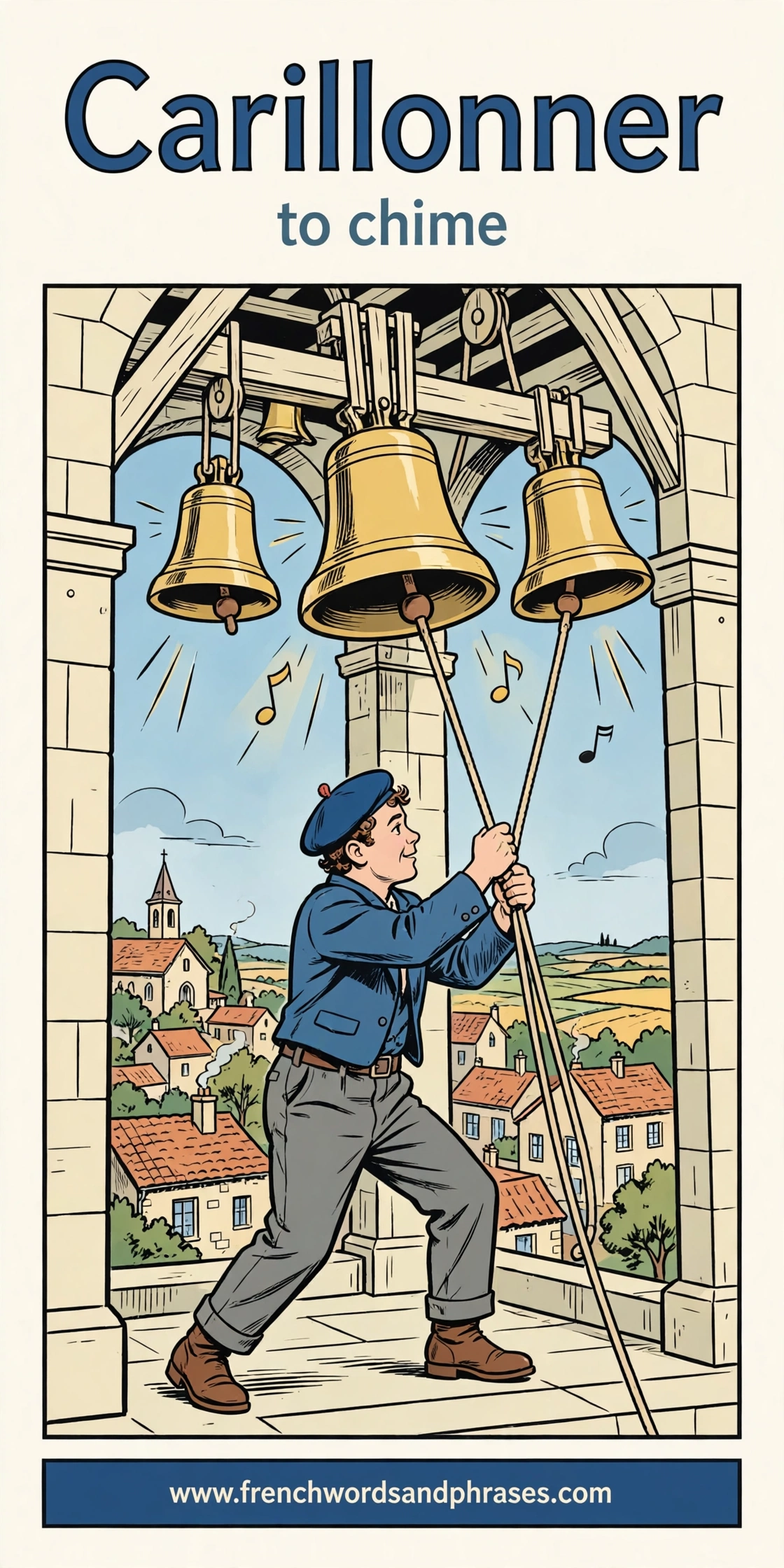
Carillonner means to chime, to jingle — to ring out a tune on bells, or to keep ringing, bell after bell, the way a doorbell or a church tower fills the air with sound.
The church tower at noon striking a tune over the rooftops, a bicycle bell jingling down a lane — carillonner is the verb of bells in good humour: ringing that is closer to music than to alarm.
In this guide, you’ll learn how to conjugate carillonner in all the major French tenses and moods. Explore complete conjugation tables, French examples, English translations, and practice quizzes.
Understanding the French Verb Carillonner
Carillonner is a regular French verb belonging to the first group of verbs, those ending in-er.
It means to chime, to jingle. Church bells carillonnent on feast days and at weddings, clocks carillonnent the hour, and in lively everyday French a doorbell or a telephone that will not stop is said to carillonner. The sound it names is always bright and repeated, never a single dull clang.
Verb classification: First group (-er)
Auxiliary verb: Avoir
Past participle: carillonné
Present participle: carillonnant
English equivalents: To chime, to peal, to jingle; les cloches carillonnent — the bells are chiming; carillonner à la porte — to ring the doorbell again and again; carillonner un air — to chime a tune on the bells; le carillon carillonne midi — the carillon chimes noon.
One important detail: carillonner is built on un carillon — a set of bells played like an instrument, and the cheerful tune itself. The verb is perfectly regular, double n throughout: je carillonne, nous carillonnons, ils carillonnent, past participle carillonné. Keep the family straight: sonner is any ringing at all, but carillonner is bells ringing tunefully or repeatedly — a tower at noon, a doorbell pressed ten times by an impatient visitor.
Experience the Word
Carillonner is the verb of bells enjoying themselves — ringing as music, not as warning.
Imagine a small town on a wedding morning. At eleven the tower wakes, and les cloches carillonnent over the square — a tune, almost a dance — while the café tables fill and the pigeons scatter and resettle with every peal.
Nobody checks the time. The bells are simply chiming — carillonnant, brightly, for the joy of it.
How to Conjugate Carillonner: Complete French Conjugation Guide
Let’s explore every major conjugation of carillonner, beginning with the indicative mood.
How to Conjugate Carillonner in the Indicative Mood
The indicative mood is used to express facts, observations, actions, and events.
How to Conjugate Carillonner in the Present Tense (Présent)
Used for actions happening now, habitual actions, and general truths.
| Subject | Conjugation |
|---|---|
| je | carillonne |
| tu | carillonnes |
| il / elle | carillonne |
| nous | carillonnons |
| vous | carillonnez |
| ils / elles | carillonnent |
Example
Les cloches carillonnent pour le mariage.
The bells are chiming for the wedding.
Quick Quiz 1
Complete the sentence:
Nous entendons les cloches qui ______ au loin.
Reveal the answer
carillonnent
Nous entendons les cloches qui carillonnent au loin.
We hear the bells chiming in the distance.
How to Conjugate Carillonner in the Passé Composé
Used for completed actions in the past. Carillonner takes the auxiliary verb avoir.
| Subject | Conjugation |
|---|---|
| j’ | ai carillonné |
| tu | as carillonné |
| il / elle | a carillonné |
| nous | avons carillonné |
| vous | avez carillonné |
| ils / elles | ont carillonné |
Example
Le carillon a carillonné midi sur la place.
The carillon chimed noon over the square.
How to Conjugate Carillonner in the Imparfait (Imperfect Tense)
Used for habitual past actions, descriptions, and ongoing situations in the past.
| Subject | Conjugation |
|---|---|
| je | carillonnais |
| tu | carillonnais |
| il / elle | carillonnait |
| nous | carillonnions |
| vous | carillonniez |
| ils / elles | carillonnaient |
Example
Chaque dimanche, les cloches carillonnaient dès huit heures.
Every Sunday, the bells used to chime from eight o’clock.
Quick Quiz 2
Choose the correct form:
The carillon chimed noon.
Le carillon ______ midi. (a carillonné / est carillonné)
Reveal the answer
a carillonné
Le carillon a carillonné midi.
Carillonner takes avoir.
How to Conjugate Carillonner in the Plus-que-parfait
Used to describe an action that had already been completed before another past event.
| Subject | Conjugation |
|---|---|
| j’ | avais carillonné |
| tu | avais carillonné |
| il / elle | avait carillonné |
| nous | avions carillonné |
| vous | aviez carillonné |
| ils / elles | avaient carillonné |
Example
La sonnette avait carillonné trois fois avant qu’il ouvre.
The doorbell had rung three times before he opened.
How to Conjugate Carillonner in the Passé Simple
Primarily used in formal writing, literature, and historical narratives. It is rarely used in everyday conversation.
| Subject | Conjugation |
|---|---|
| je | carillonnai |
| tu | carillonnas |
| il / elle | carillonna |
| nous | carillonnâmes |
| vous | carillonnâtes |
| ils / elles | carillonnèrent |
Example
À l’aube, les cloches du village carillonnèrent joyeusement.
At dawn, the village bells chimed joyfully.
How to Conjugate Carillonner in the Passé Antérieur
A literary tense used to express an action completed immediately before another past action, generally in the passé simple.
| Subject | Conjugation |
|---|---|
| j’ | eus carillonné |
| tu | eus carillonné |
| il / elle | eut carillonné |
| nous | eûmes carillonné |
| vous | eûtes carillonné |
| ils / elles | eurent carillonné |
Example
Quand les cloches eurent carillonné, la procession sortit de l’église.
When the bells had chimed, the procession left the church.
How to Conjugate Carillonner in the Future Tense (Futur Simple)
Used to describe actions that will take place in the future.
| Subject | Conjugation |
|---|---|
| je | carillonnerai |
| tu | carillonneras |
| il / elle | carillonnera |
| nous | carillonnerons |
| vous | carillonnerez |
| ils / elles | carillonneront |
Example
Demain, le carillon carillonnera pour la fête nationale.
Tomorrow, the carillon will chime for the national holiday.
How to Conjugate Carillonner in the Futur Antérieur (Future Perfect)
Used for an action that will have been completed before a particular point in the future.
| Subject | Conjugation |
|---|---|
| j’ | aurai carillonné |
| tu | auras carillonné |
| il / elle | aura carillonné |
| nous | aurons carillonné |
| vous | aurez carillonné |
| ils / elles | auront carillonné |
Example
À midi, les cloches auront carillonné trois fois.
By noon, the bells will have chimed three times.
How to Conjugate Carillonner in the Near Future (Futur Proche)
Used to describe something that is going to happen soon. Formed with aller + infinitive.
| Subject | Conjugation |
|---|---|
| je | vais carillonner |
| tu | vas carillonner |
| il / elle | va carillonner |
| nous | allons carillonner |
| vous | allez carillonner |
| ils / elles | vont carillonner |
Example
Écoute, les cloches vont carillonner pour le mariage.
Listen, the bells are going to chime for the wedding.
How to Conjugate Carillonner in the Conditional Mood
The conditional mood expresses what would happen under certain circumstances. It is also frequently used to make polite requests or express wishes.
How to Conjugate Carillonner in the Present Conditional
| Subject | Conjugation |
|---|---|
| je | carillonnerais |
| tu | carillonnerais |
| il / elle | carillonnerait |
| nous | carillonnerions |
| vous | carillonneriez |
| ils / elles | carillonneraient |
Example
Sans le vent, le carillon carillonnerait jusqu’au village voisin.
Without the wind, the carillon would chime as far as the next village.
How to Conjugate Carillonner in the Past Conditional
| Subject | Conjugation |
|---|---|
| j’ | aurais carillonné |
| tu | aurais carillonné |
| il / elle | aurait carillonné |
| nous | aurions carillonné |
| vous | auriez carillonné |
| ils / elles | auraient carillonné |
Example
La sonnette aurait carillonné si le facteur était passé.
The doorbell would have rung if the postman had called.
Carillonner in the Literary Past Conditional Form
This less common literary form uses the imperfect subjunctive of avoir.
| Subject | Conjugation |
|---|---|
| j’ | eusse carillonné |
| tu | eusses carillonné |
| il / elle | eût carillonné |
| nous | eussions carillonné |
| vous | eussiez carillonné |
| ils / elles | eussent carillonné |
Example
Les cloches eussent carillonné toute la journée de fête.
The bells would have chimed all through the feast day.
How to Conjugate Carillonner in the Subjunctive Mood
The subjunctive is used to express wishes, emotions, doubts, necessity, and uncertainty. It frequently follows expressions such as il faut que (it is necessary that) or bien que (although).
How to Conjugate Carillonner in the Present Subjunctive
| Subject | Conjugation |
|---|---|
| que je | carillonne |
| que tu | carillonnes |
| qu’il / qu’elle | carillonne |
| que nous | carillonnions |
| que vous | carillonniez |
| qu’ils / qu’elles | carillonnent |
Example
Il faut que les cloches carillonnent pour annoncer la fête.
The bells must chime to announce the festival.
Quick Quiz 3
Complete the sentence using the subjunctive:
Il faut que vous ______ à la porte, il est sourd.
Reveal the answer
carillonniez
Il faut que vous carillonniez à la porte, il est sourd.
You must ring the doorbell again and again, he is deaf.
How to Conjugate Carillonner in the Imperfect Subjunctive
A literary tense, rarely encountered in modern spoken French.
| Subject | Conjugation |
|---|---|
| que je | carillonnasse |
| que tu | carillonnasses |
| qu’il / qu’elle | carillonnât |
| que nous | carillonnassions |
| que vous | carillonnassiez |
| qu’ils / qu’elles | carillonnassent |
Example
On attendait que le carillon carillonnât l’heure du départ.
They waited for the carillon to chime the hour of departure.
How to Conjugate Carillonner in the Pluperfect Subjunctive
A literary construction used to express an action completed before another past action.
| Subject | Conjugation |
|---|---|
| que j’ | eusse carillonné |
| que tu | eusses carillonné |
| qu’il / qu’elle | eût carillonné |
| que nous | eussions carillonné |
| que vous | eussiez carillonné |
| qu’ils / qu’elles | eussent carillonné |
Example
On racontait que les cloches eussent carillonné toute la nuit.
People said the bells had chimed all night long.
How to Conjugate Carillonner in the Past Subjunctive
| Subject | Conjugation |
|---|---|
| que j’ | aie carillonné |
| que tu | aies carillonné |
| qu’il / qu’elle | ait carillonné |
| que nous | ayons carillonné |
| que vous | ayez carillonné |
| qu’ils / qu’elles | aient carillonné |
Example
Je suis ravi que les cloches aient carillonné pour leur mariage.
I am delighted the bells chimed for their wedding.
How to Conjugate Carillonner in the Imperative
The imperative is used to give commands, instructions, invitations, or suggestions. Subject pronouns are omitted.
How to Conjugate Carillonner in the Present Imperative
| Person | Conjugation |
|---|---|
| (tu) | carillonne |
| (nous) | carillonnons |
| (vous) | carillonnez |
Example
Carillonne à la porte, il est peut-être sourd !
Ring the doorbell again and again, he may be deaf!
Quick Quiz 4
How would you say Ring the doorbell again and again (tu form)?
Reveal the answer
Carillonne à la porte !
French Participles of Carillonner
Participles are verb forms that can be used in compound tenses and other grammatical constructions.
Present Participle of Carillonner
carillonnant
En carillonnant, les cloches ont réveillé tout le quartier.
By chiming, the bells woke the whole neighbourhood.
Past Participle of Carillonner
carillonné
Carillonné par toutes les cloches du village, midi arriva en musique.
Chimed in by all the village bells, noon arrived in music.
Carillonner in Everyday French: Real-Life Examples
Now that you know the conjugations, let’s see how carillonner appears in everyday French.
Example 1 — Present
Les cloches carillonnent pour le mariage.
The bells are chiming for the wedding.
Example 2 — Passé composé
Le carillon a carillonné midi.
The carillon chimed noon.
Example 3 — Imparfait
Les cloches carillonnaient chaque dimanche.
The bells used to chime every Sunday.
Example 4 — Future
Le carillon carillonnera demain à midi.
The carillon will chime tomorrow at noon.
Example 5 — Conditional
Le carillon carillonnerait jusqu’au village voisin.
The carillon would chime as far as the next village.
Example 6 — Imperative
Carillonne à la porte, il n’entend pas !
Ring the doorbell again and again, he cannot hear!
Beyond Translation: The Meaning of Carillonner
English carillon names the instrument; French carillonner sets it in motion — and then lends the verb to any bright, repeated ringing.
A doorbell can carillonner too.
That extension is the verb’s everyday charm: the impatient visitor, the telephone at dawn, the bicycle bell — whenever ringing turns tuneful or tireless, French reaches for carillonner.
How to Remember the French Verb Carillonner
Remember it this way: Carillonner is about the tower at noon striking a tune over the rooftops.
- Un carillon is a set of tuned bells: carillonner is those bells ringing a tune — bright and repeated.
- Everyday extension: carillonner à la porte, to ring the doorbell again and again.
- Regular -er with a double n: je carillonne, nous carillonnons, past participle carillonné.
The key idea is the tower at noon striking a tune over the rooftops.
Test Your Knowledge of Carillonner
Let’s see how much you’ve learned. Try answering these questions before revealing the answers.
Question 1
What kind of ringing does carillonner name, as opposed to plain sonner?
Reveal the answer
Tuneful or repeated bell-ringing — a carillon playing, bells pealing, a doorbell rung again and again.
Question 2
How do you say The bells are chiming for the wedding in French?
Reveal the answer
Les cloches carillonnent pour le mariage.
Question 3
Translate: The carillon chimed noon.
Reveal the answer
Le carillon a carillonné midi.
Question 4
What is the past participle of carillonner?
Reveal the answer
Carillonné.
Question 5
Complete the sentence:
Il faut que les cloches ______ pour annoncer la fête.
Reveal the answer
carillonnent
Il faut que les cloches carillonnent pour annoncer la fête.
The bells must chime to announce the festival.
Your Final Challenge
Can You Use It?
How would you say this in French?
At noon, the bells chime over the village, and even the pigeons seem to dance in the ringing air.
Reveal the answer
À midi, les cloches carillonnent sur le village, et même les pigeons semblent danser dans l’air sonore.
At noon, the bells chime over the village, and even the pigeons seem to dance in the ringing air.
A little French. A little curiosity. A richer everyday life.
LEARN FRENCH ONE WORD AT A TIME




