
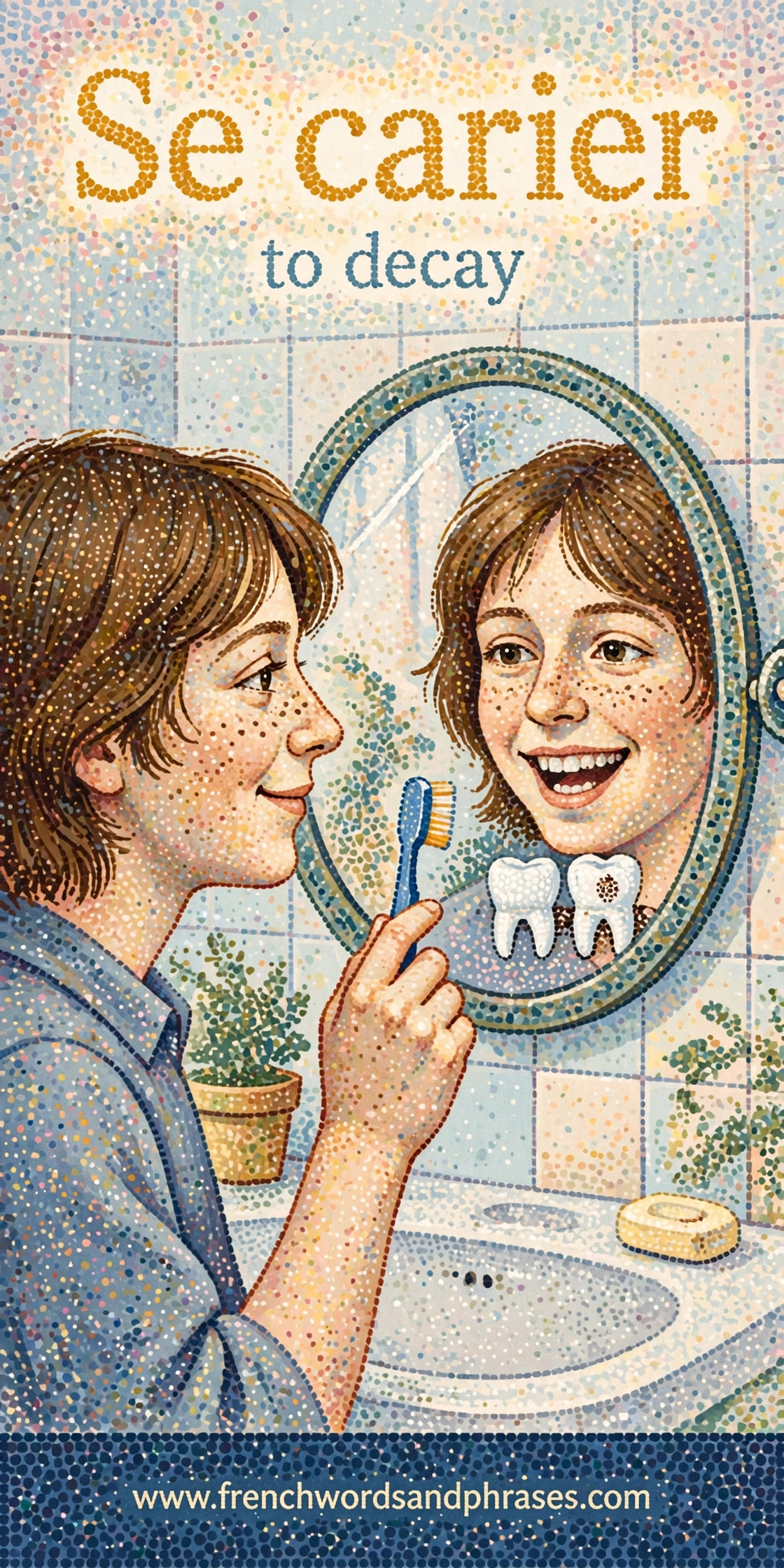
A French Word to Live By
How to Conjugate Se carier in French
/sə ka.ʁje/
Se carier means to decay, to rot — what a tooth or a bone does when decay takes hold of it: to go bad from within, all by itself.
Nobody rots a tooth on purpose: left alone with sugar and time, it decays by itself. Se carier is the reflexive of quiet ruin — teeth, bones and old timbers going bad from the inside while nobody watches.
In this guide, you’ll learn how to conjugate se carier in all the major French tenses and moods. Explore complete conjugation tables, French examples, English translations, and practice quizzes.
Understanding the French Verb Se carier
Se carier is a regular French verb belonging to the first group of verbs, those ending in-er.
It means to decay, to rot. This is the everyday way to say a tooth is decaying — ma dent se carie is what the patient says, and le bois se carie covers rotting timber. It presents decay as a process the thing undergoes by itself, where transitive carier names the culprit: le sucre carie la dent, puis la dent se carie.
Verb classification: First group (-er), reflexive
Auxiliary verb: Être
Past participle: carié
Present participle: cariant
English equivalents: To decay, to rot, to go bad; une dent se carie — a tooth is decaying; les os se carient — bones decay; le bois se carie à l’humidité — wood rots in the damp; une dent cariée — a decayed tooth.
One important detail: se carier is the reflexive twin of carier — the tooth is not rotted by anyone in the sentence, it decays itself: la dent se carie, les dents se carient. Being reflexive, it takes être in every compound tense and the past participle agrees with the subject: la dent s’est cariée, les poutres se sont cariées. As an -ier verb it doubles the i in the imperfect and subjunctive nous/vous forms: nous nous cariions, il faut que vous vous cariiez. The tu imperative tucks the pronoun behind the verb: carie-toi les dents would be a strange order — the verb lives almost entirely in statements, not commands.
Experience the Word
Se carier is decay as a solo performance — no villain in the sentence, just time, sugar and silence.
Imagine a molar at the back of a busy mouth. Never quite reached by the brush, fed on sweet tea, it quietly se carie — a shadow, a softness, a hole — until the day the cold water at breakfast makes its owner jump.
No one did anything to it. The tooth has simply decayed — cariée, all by itself.
How to Conjugate Se carier: Complete French Conjugation Guide
Let’s explore every major conjugation of se carier, beginning with the indicative mood.
How to Conjugate Se carier in the Indicative Mood
The indicative mood is used to express facts, observations, actions, and events.
How to Conjugate Se carier in the Present Tense (Présent)
Used for actions happening now, habitual actions, and general truths.
| Subject | Conjugation |
|---|---|
| je | me carie |
| tu | te caries |
| il / elle | se carie |
| nous | nous carions |
| vous | vous cariez |
| ils / elles | se carient |
Example
Cette dent se carie si tu ne la soignes pas.
This tooth is decaying if you do not get it treated.
Quick Quiz 1
Complete the sentence:
Nos dents se ______ quand nous mangeons trop de sucre.
Reveal the answer
carient
Nos dents se carient quand nous mangeons trop de sucre.
Our teeth decay when we eat too much sugar.
How to Conjugate Se carier in the Passé Composé
Used for completed actions in the past. Se carier takes the auxiliary verb être.
| Subject | Conjugation |
|---|---|
| je | me suis carié / me suis cariée |
| tu | t’es carié / t’es cariée |
| il / elle | s’est carié / s’est cariée |
| nous | nous sommes cariés / nous sommes cariées |
| vous | vous êtes cariés / vous êtes cariées / vous êtes carié / vous êtes cariée |
| ils / elles | se sont cariés / se sont cariées |
Example
Sa molaire s’est cariée en quelques mois.
His molar decayed in a few months.
How to Conjugate Se carier in the Imparfait (Imperfect Tense)
Used for habitual past actions, descriptions, and ongoing situations in the past.
| Subject | Conjugation |
|---|---|
| je | me cariais |
| tu | te cariais |
| il / elle | se cariait |
| nous | nous cariions |
| vous | vous cariiez |
| ils / elles | se cariaient |
Example
Le bois se cariait lentement sous la pluie.
The wood was slowly rotting in the rain.
Quick Quiz 2
Choose the correct form:
His molar decayed in a few months.
Sa molaire ______ en quelques mois. (s’est cariée / a carié)
Reveal the answer
s’est cariée
Sa molaire s’est cariée en quelques mois.
Se carier is reflexive, takes être, and the participle agrees: cariée.
How to Conjugate Se carier in the Plus-que-parfait
Used to describe an action that had already been completed before another past event.
| Subject | Conjugation |
|---|---|
| je | m’étais carié / m’étais cariée |
| tu | t’étais carié / t’étais cariée |
| il / elle | s’était carié / s’était cariée |
| nous | nous étions cariés / nous étions cariées |
| vous | vous étiez cariés / vous étiez cariées / vous étiez carié / vous étiez cariée |
| ils / elles | s’étaient cariés / s’étaient cariées |
Example
La dent s’était cariée avant même de faire mal.
The tooth had decayed before it even started to hurt.
How to Conjugate Se carier in the Passé Simple
Primarily used in formal writing, literature, and historical narratives. It is rarely used in everyday conversation.
| Subject | Conjugation |
|---|---|
| je | me cariai |
| tu | te carias |
| il / elle | se caria |
| nous | nous cariâmes |
| vous | vous cariâtes |
| ils / elles | se carièrent |
Example
La vieille poutre se caria et finit par céder.
The old beam rotted and ended up giving way.
How to Conjugate Se carier in the Passé Antérieur
A literary tense used to express an action completed immediately before another past action, generally in the passé simple.
| Subject | Conjugation |
|---|---|
| je | me fus carié / me fus cariée |
| tu | te fus carié / te fus cariée |
| il / elle | se fut carié / se fut cariée |
| nous | nous fûmes cariés / nous fûmes cariées |
| vous | vous fûtes cariés / vous fûtes cariées / vous fûtes carié / vous fûtes cariée |
| ils / elles | se furent cariés / se furent cariées |
Example
Dès que la dent se fut cariée, le dentiste dut intervenir.
As soon as the tooth had decayed, the dentist had to step in.
How to Conjugate Se carier in the Future Tense (Futur Simple)
Used to describe actions that will take place in the future.
| Subject | Conjugation |
|---|---|
| je | me carierai |
| tu | te carieras |
| il / elle | se cariera |
| nous | nous carierons |
| vous | vous carierez |
| ils / elles | se carieront |
Example
Sans brossage, tes dents se carieront vite.
Without brushing, your teeth will decay quickly.
How to Conjugate Se carier in the Futur Antérieur (Future Perfect)
Used for an action that will have been completed before a particular point in the future.
| Subject | Conjugation |
|---|---|
| je | me serai carié / me serai cariée |
| tu | te seras carié / te seras cariée |
| il / elle | se sera carié / se sera cariée |
| nous | nous serons cariés / nous serons cariées |
| vous | vous serez cariés / vous serez cariées / vous serez carié / vous serez cariée |
| ils / elles | se seront cariés / se seront cariées |
Example
À la fin de l’hiver, le bois se sera carié sous la neige.
By the end of winter, the wood will have rotted under the snow.
How to Conjugate Se carier in the Near Future (Futur Proche)
Used to describe something that is going to happen soon. Formed with aller + infinitive.
| Subject | Conjugation |
|---|---|
| je | vais me carier |
| tu | vas te carier |
| il / elle | va se carier |
| nous | allons nous carier |
| vous | allez vous carier |
| ils / elles | vont se carier |
Example
Attention, cette dent va se carier si tu continues.
Careful, this tooth is going to decay if you go on.
How to Conjugate Se carier in the Conditional Mood
The conditional mood expresses what would happen under certain circumstances. It is also frequently used to make polite requests or express wishes.
How to Conjugate Se carier in the Present Conditional
| Subject | Conjugation |
|---|---|
| je | me carierais |
| tu | te carierais |
| il / elle | se carierait |
| nous | nous carierions |
| vous | vous carieriez |
| ils / elles | se carieraient |
Example
Le bois se carierait moins vite à l’abri de la pluie.
The wood would rot less quickly sheltered from the rain.
How to Conjugate Se carier in the Past Conditional
| Subject | Conjugation |
|---|---|
| je | me serais carié / me serais cariée |
| tu | te serais carié / te serais cariée |
| il / elle | se serait carié / se serait cariée |
| nous | nous serions cariés / nous serions cariées |
| vous | vous seriez cariés / vous seriez cariées / vous seriez carié / vous seriez cariée |
| ils / elles | se seraient cariés / se seraient cariées |
Example
Ta dent ne se serait pas cariée avec un meilleur brossage.
Your tooth would not have decayed with better brushing.
Se carier in the Literary Past Conditional Form
This less common literary form uses the imperfect subjunctive of être.
| Subject | Conjugation |
|---|---|
| je | me fusse carié / me fusse cariée |
| tu | te fusses carié / te fusses cariée |
| il / elle | se fût carié / se fût cariée |
| nous | nous fussions cariés / nous fussions cariées |
| vous | vous fussiez cariés / vous fussiez cariées / vous fussiez carié / vous fussiez cariée |
| ils / elles | se fussent cariés / se fussent cariées |
Example
La poutre se fût cariée en dix ans d’humidité.
The beam would have rotted in ten years of damp.
How to Conjugate Se carier in the Subjunctive Mood
The subjunctive is used to express wishes, emotions, doubts, necessity, and uncertainty. It frequently follows expressions such as il faut que (it is necessary that) or bien que (although).
How to Conjugate Se carier in the Present Subjunctive
| Subject | Conjugation |
|---|---|
| que je | me carie |
| que tu | te caries |
| qu’il / qu’elle | se carie |
| que nous | nous cariions |
| que vous | vous cariiez |
| qu’ils / qu’elles | se carient |
Example
Je crains que cette dent ne se carie.
I fear this tooth may be decaying.
Quick Quiz 3
Complete the sentence using the subjunctive:
Je crains que vous ne vous ______ les dents avec ces sodas.
Reveal the answer
cariiez
Je crains que vous ne vous cariiez les dents avec ces sodas.
I fear you may be rotting your teeth with those fizzy drinks — note the double i of the -ier subjunctive.
How to Conjugate Se carier in the Imperfect Subjunctive
A literary tense, rarely encountered in modern spoken French.
| Subject | Conjugation |
|---|---|
| que je | me cariasse |
| que tu | te cariasses |
| qu’il / qu’elle | se cariât |
| que nous | nous cariassions |
| que vous | vous cariassiez |
| qu’ils / qu’elles | se cariassent |
Example
Le dentiste craignait que la molaire se cariât.
The dentist feared the molar might decay.
How to Conjugate Se carier in the Pluperfect Subjunctive
A literary construction used to express an action completed before another past action.
| Subject | Conjugation |
|---|---|
| que j’ | me fusse carié / me fusse cariée |
| que tu | te fusses carié / te fusses cariée |
| qu’il / qu’elle | se fût carié / se fût cariée |
| que nous | nous fussions cariés / nous fussions cariées |
| que vous | vous fussiez cariés / vous fussiez cariées / vous fussiez carié / vous fussiez cariée |
| qu’ils / qu’elles | se fussent cariés / se fussent cariées |
Example
On racontait que les os se fussent cariés avec l’âge.
People said the bones had decayed with age.
How to Conjugate Se carier in the Past Subjunctive
| Subject | Conjugation |
|---|---|
| que j’ | me sois carié / me sois cariée |
| que tu | te sois carié / te sois cariée |
| qu’il / qu’elle | se soit carié / se soit cariée |
| que nous | nous soyons cariés / nous soyons cariées |
| que vous | vous soyez cariés / vous soyez cariées / vous soyez carié / vous soyez cariée |
| qu’ils / qu’elles | se soient cariés / se soient cariées |
Example
Je suis étonné que le bois se soit carié si vite.
I am surprised the wood rotted so quickly.
How to Conjugate Se carier in the Imperative
The imperative is used to give commands, instructions, invitations, or suggestions. Subject pronouns are omitted.
How to Conjugate Se carier in the Present Imperative
| Person | Conjugation |
|---|---|
| (tu) | carie-toi |
| (nous) | carions-nous |
| (vous) | cariez-vous |
Example
Ne te carie pas les dents avec tous ces sodas !
Do not rot your teeth with all those fizzy drinks!
Quick Quiz 4
How would you say Do not rot your teeth with those sweets (tu form)?
Reveal the answer
Ne te carie pas les dents avec ces bonbons !
French Participles of Se carier
Participles are verb forms that can be used in compound tenses and other grammatical constructions.
Present Participle of Se carier
cariant
En se cariant, la dent est devenue sensible au froid.
By decaying, the tooth became sensitive to cold.
Past Participle of Se carier
carié
Cariée jusqu’à la racine, la dent a dû être arrachée.
Decayed down to the root, the tooth had to be pulled out.
Se carier in Everyday French: Real-Life Examples
Now that you know the conjugations, let’s see how se carier appears in everyday French.
Example 1 — Present
Cette dent se carie lentement.
This tooth is slowly decaying.
Example 2 — Passé composé
Sa molaire s’est cariée en quelques mois.
His molar decayed in a few months.
Example 3 — Imparfait
Le bois se cariait sous la pluie.
The wood was rotting in the rain.
Example 4 — Future
Tes dents se carieront sans brossage.
Your teeth will decay without brushing.
Example 5 — Conditional
Le bois se carierait moins vite à l’abri.
The wood would rot less quickly under shelter.
Example 6 — Imperative
Ne te carie pas les dents avec ces bonbons !
Do not rot your teeth with those sweets!
Beyond Translation: The Meaning of Se carier
English says a tooth decays all by itself, and French agrees — that is exactly why se carier exists beside carier.
The reflexive leaves out the culprit.
Name the sugar and you get le sucre carie les dents; watch the tooth instead, and the grammar turns reflexive — la dent se carie — decay as something a thing does to itself, in the dark, over time.
How to Remember the French Verb Se carier
Remember it this way: Se carier is about the molar decaying in the dark — no culprit, just time and sugar.
- Always reflexive in this sense: la dent se carie, elle s’est cariée — être, and the participle agrees.
- -ier verb with double i: nous nous cariions, il faut que vous vous cariiez.
- The pair to hold together: le sucre carie la dent (culprit named) — la dent se carie (process watched).
The key idea is the molar decaying in the dark — no culprit, just time and sugar.
Test Your Knowledge of Se carier
Let’s see how much you’ve learned. Try answering these questions before revealing the answers.
Question 1
Which auxiliary does se carier use, and why?
Reveal the answer
Être — it is a reflexive verb: la dent s’est cariée.
Question 2
How do you say This tooth is decaying in French?
Reveal the answer
Cette dent se carie.
Question 3
Translate: His molar decayed in a few months.
Reveal the answer
Sa molaire s’est cariée en quelques mois.
Question 4
What is the past participle of se carier?
Reveal the answer
Carié — agreeing: cariée, cariés, cariées.
Question 5
Complete the sentence:
Je crains que cette dent ne se ______ .
Reveal the answer
carie
Je crains que cette dent ne se carie.
I fear this tooth may be decaying.
Your Final Challenge
Can You Use It?
How would you say this in French?
A tooth decays in silence, like a secret the mouth keeps until the day of pain.
Reveal the answer
Une dent se carie en silence, comme un secret que la bouche garde jusqu’au jour de la douleur.
A tooth decays in silence, like a secret the mouth keeps until the day of pain.
A little French. A little curiosity. A richer everyday life.
LEARN FRENCH ONE WORD AT A TIME




