
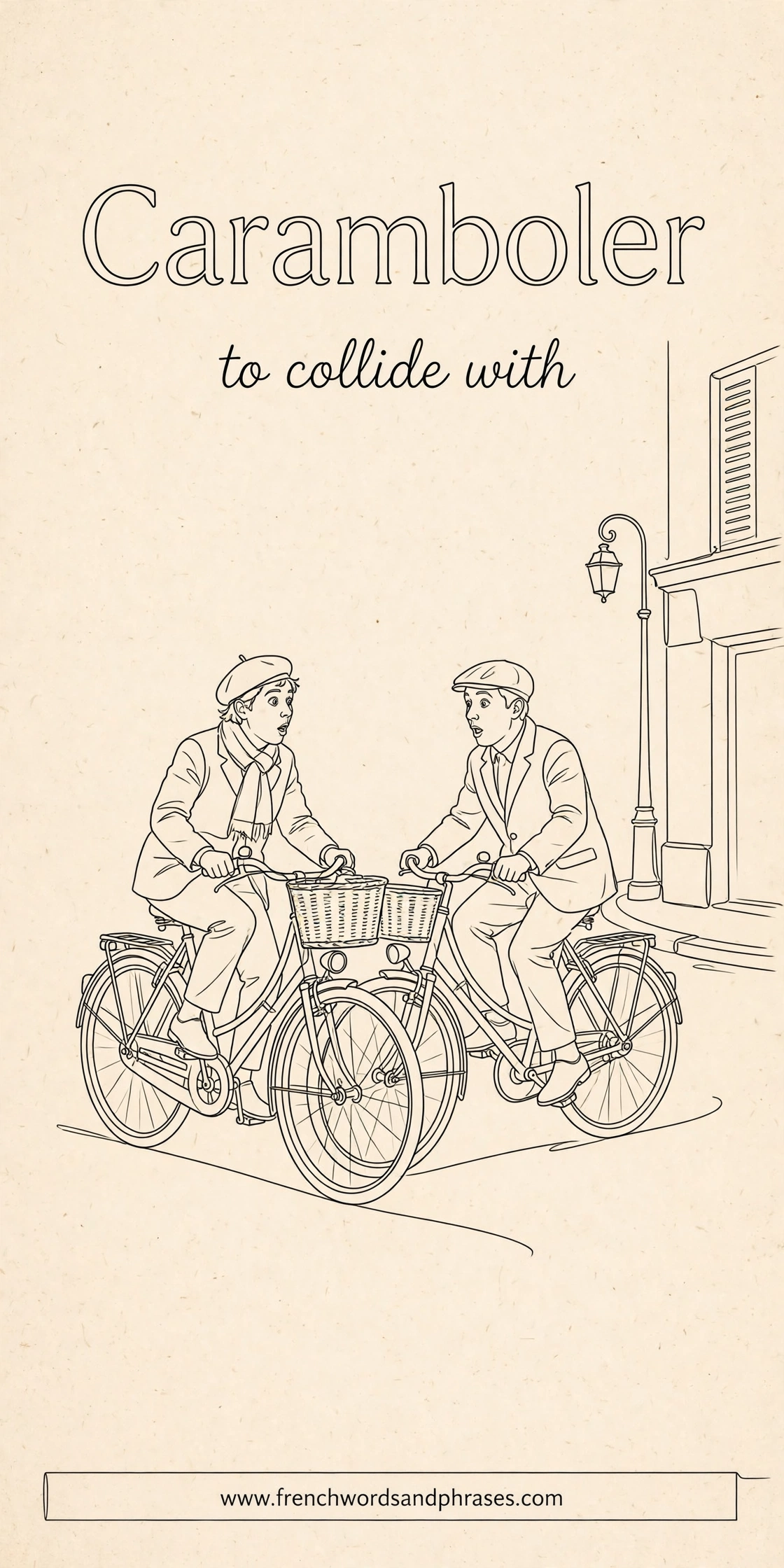
A French Word to Live By
How to Conjugate Caramboler in French
/ka.ʁɑ̃.bɔ.le/
Caramboler means to collide with, to cannon into — to smash into something the way a billiard ball cannons off another, suddenly and with a crack.
Two billiard balls meeting with a click on green cloth; two cars meeting rather less gently at a crossroads — caramboler is the verb of the sudden impact, born at the billiard table and now at home in every traffic report.
In this guide, you’ll learn how to conjugate caramboler in all the major French tenses and moods. Explore complete conjugation tables, French examples, English translations, and practice quizzes.
Understanding the French Verb Caramboler
Caramboler is a regular French verb belonging to the first group of verbs, those ending in-er.
It means to collide with, to cannon into. At the billiard table it is precise and technical — the cue ball must caramboler, cannon from one ball to another. On the road it is dramatic: vehicles carambolent, and the resulting mess is un carambolage, the word every French traffic bulletin uses for a pile-up.
Verb classification: First group (-er)
Auxiliary verb: Avoir
Past participle: carambolé
Present participle: carambolant
English equivalents: To collide with, to cannon into, to smash into; caramboler une voiture — to collide with a car; caramboler dans un poteau — to cannon into a post; un carambolage — a pile-up; les billes carambolent — the balls cannon into each other.
One important detail: caramboler is a regular -er verb with nothing to hide — je carambole, nous carambolons, ils carambolent, past participle carambolé. Its noun is the one you will meet in the news: un carambolage, a multiple pile-up on the motorway. The verb usually takes a direct object (caramboler un camion) or dans (caramboler dans un mur).
Experience the Word
Caramboler is the verb of the impact itself — the instant two moving things meet with a crack.
Imagine an icy January morning on the ring road. A van brakes, slides, and carambole the car in front; that car strikes the next — in ten seconds, douze véhicules se sont carambolés, and the radio is already announcing un carambolage monstre.
One ball strikes another, and the whole table changes. That chain reaction is caramboler.
How to Conjugate Caramboler: Complete French Conjugation Guide
Let’s explore every major conjugation of caramboler, beginning with the indicative mood.
How to Conjugate Caramboler in the Indicative Mood
The indicative mood is used to express facts, observations, actions, and events.
How to Conjugate Caramboler in the Present Tense (Présent)
Used for actions happening now, habitual actions, and general truths.
| Subject | Conjugation |
|---|---|
| je | carambole |
| tu | caramboles |
| il / elle | carambole |
| nous | carambolons |
| vous | carambolez |
| ils / elles | carambolent |
Example
Sur le verglas, les voitures carambolent facilement.
On black ice, cars collide easily.
Quick Quiz 1
Complete the sentence:
Nous avons vu les billes qui ______ sur le tapis.
Reveal the answer
carambolent
Nous avons vu les billes qui carambolent sur le tapis.
We saw the balls cannoning on the cloth.
How to Conjugate Caramboler in the Passé Composé
Used for completed actions in the past. Caramboler takes the auxiliary verb avoir.
| Subject | Conjugation |
|---|---|
| j’ | ai carambolé |
| tu | as carambolé |
| il / elle | a carambolé |
| nous | avons carambolé |
| vous | avez carambolé |
| ils / elles | ont carambolé |
Example
Le camion a carambolé trois voitures au carrefour.
The lorry collided with three cars at the crossroads.
How to Conjugate Caramboler in the Imparfait (Imperfect Tense)
Used for habitual past actions, descriptions, and ongoing situations in the past.
| Subject | Conjugation |
|---|---|
| je | carambolais |
| tu | carambolais |
| il / elle | carambolait |
| nous | carambolions |
| vous | caramboliez |
| ils / elles | carambolaient |
Example
Sur la glace, les luges carambolaient les unes dans les autres.
On the ice, the sledges kept cannoning into one another.
Quick Quiz 2
Choose the correct form:
The cyclist cannoned into the post.
Le cycliste ______ le poteau. (a carambolé / a carambolée)
Reveal the answer
a carambolé
Le cycliste a carambolé le poteau.
With avoir, the participle does not agree with the subject.
How to Conjugate Caramboler in the Plus-que-parfait
Used to describe an action that had already been completed before another past event.
| Subject | Conjugation |
|---|---|
| j’ | avais carambolé |
| tu | avais carambolé |
| il / elle | avait carambolé |
| nous | avions carambolé |
| vous | aviez carambolé |
| ils / elles | avaient carambolé |
Example
La bille avait carambolé la rouge avant de tomber dans la poche.
The ball had cannoned into the red before dropping into the pocket.
How to Conjugate Caramboler in the Passé Simple
Primarily used in formal writing, literature, and historical narratives. It is rarely used in everyday conversation.
| Subject | Conjugation |
|---|---|
| je | carambolai |
| tu | carambolas |
| il / elle | carambola |
| nous | carambolâmes |
| vous | carambolâtes |
| ils / elles | carambolèrent |
Example
Le wagon carambola le butoir au bout de la voie.
The wagon smashed into the buffer at the end of the track.
How to Conjugate Caramboler in the Passé Antérieur
A literary tense used to express an action completed immediately before another past action, generally in the passé simple.
| Subject | Conjugation |
|---|---|
| j’ | eus carambolé |
| tu | eus carambolé |
| il / elle | eut carambolé |
| nous | eûmes carambolé |
| vous | eûtes carambolé |
| ils / elles | eurent carambolé |
Example
Quand le cycliste eut carambolé le poteau, il se releva sans mal.
When the cyclist had cannoned into the post, he got up unhurt.
How to Conjugate Caramboler in the Future Tense (Futur Simple)
Used to describe actions that will take place in the future.
| Subject | Conjugation |
|---|---|
| je | carambolerai |
| tu | caramboleras |
| il / elle | carambolera |
| nous | carambolerons |
| vous | carambolerez |
| ils / elles | caramboleront |
Example
Si le frein lâche, la voiture carambolera le mur.
If the brake fails, the car will smash into the wall.
How to Conjugate Caramboler in the Futur Antérieur (Future Perfect)
Used for an action that will have been completed before a particular point in the future.
| Subject | Conjugation |
|---|---|
| j’ | aurai carambolé |
| tu | auras carambolé |
| il / elle | aura carambolé |
| nous | aurons carambolé |
| vous | aurez carambolé |
| ils / elles | auront carambolé |
Example
À cette vitesse, il aura carambolé le camion avant de s’arrêter.
At that speed, he will have hit the lorry before stopping.
How to Conjugate Caramboler in the Near Future (Futur Proche)
Used to describe something that is going to happen soon. Formed with aller + infinitive.
| Subject | Conjugation |
|---|---|
| je | vais caramboler |
| tu | vas caramboler |
| il / elle | va caramboler |
| nous | allons caramboler |
| vous | allez caramboler |
| ils / elles | vont caramboler |
Example
Attention, la luge va caramboler la barrière !
Careful, the sledge is going to cannon into the fence!
How to Conjugate Caramboler in the Conditional Mood
The conditional mood expresses what would happen under certain circumstances. It is also frequently used to make polite requests or express wishes.
How to Conjugate Caramboler in the Present Conditional
| Subject | Conjugation |
|---|---|
| je | carambolerais |
| tu | carambolerais |
| il / elle | carambolerait |
| nous | carambolerions |
| vous | caramboleriez |
| ils / elles | caramboleraient |
Example
Sans verglas, les voitures ne caramboleraient pas si souvent.
Without black ice, cars would not collide so often.
How to Conjugate Caramboler in the Past Conditional
| Subject | Conjugation |
|---|---|
| j’ | aurais carambolé |
| tu | aurais carambolé |
| il / elle | aurait carambolé |
| nous | aurions carambolé |
| vous | auriez carambolé |
| ils / elles | auraient carambolé |
Example
Le train aurait carambolé le wagon sans le signal d’alarme.
The train would have smashed into the wagon without the alarm signal.
Caramboler in the Literary Past Conditional Form
This less common literary form uses the imperfect subjunctive of avoir.
| Subject | Conjugation |
|---|---|
| j’ | eusse carambolé |
| tu | eusses carambolé |
| il / elle | eût carambolé |
| nous | eussions carambolé |
| vous | eussiez carambolé |
| ils / elles | eussent carambolé |
Example
La bille eût carambolé la noire sans cet effet.
The ball would have cannoned into the black without that spin.
How to Conjugate Caramboler in the Subjunctive Mood
The subjunctive is used to express wishes, emotions, doubts, necessity, and uncertainty. It frequently follows expressions such as il faut que (it is necessary that) or bien que (although).
How to Conjugate Caramboler in the Present Subjunctive
| Subject | Conjugation |
|---|---|
| que je | carambole |
| que tu | caramboles |
| qu’il / qu’elle | carambole |
| que nous | carambolions |
| que vous | caramboliez |
| qu’ils / qu’elles | carambolent |
Example
Il est possible que la voiture carambole le poteau sur le verglas.
The car may well cannon into the post on the black ice.
Quick Quiz 3
Complete the sentence using the subjunctive:
Il est possible que le camion ______ une voiture sur le verglas.
Reveal the answer
carambole
Il est possible que le camion carambole une voiture sur le verglas.
The lorry may collide with a car on the black ice.
How to Conjugate Caramboler in the Imperfect Subjunctive
A literary tense, rarely encountered in modern spoken French.
| Subject | Conjugation |
|---|---|
| que je | carambolasse |
| que tu | carambolasses |
| qu’il / qu’elle | carambolât |
| que nous | carambolassions |
| que vous | carambolassiez |
| qu’ils / qu’elles | carambolassent |
Example
Tout arriva si vite qu’on eût dit que les billes carambolassent toutes ensemble.
It all happened so fast you would have said the balls cannoned all at once.
How to Conjugate Caramboler in the Pluperfect Subjunctive
A literary construction used to express an action completed before another past action.
| Subject | Conjugation |
|---|---|
| que j’ | eusse carambolé |
| que tu | eusses carambolé |
| qu’il / qu’elle | eût carambolé |
| que nous | eussions carambolé |
| que vous | eussiez carambolé |
| qu’ils / qu’elles | eussent carambolé |
Example
On craignait que le camion eût carambolé plusieurs voitures.
People feared the lorry had collided with several cars.
How to Conjugate Caramboler in the Past Subjunctive
| Subject | Conjugation |
|---|---|
| que j’ | aie carambolé |
| que tu | aies carambolé |
| qu’il / qu’elle | ait carambolé |
| que nous | ayons carambolé |
| que vous | ayez carambolé |
| qu’ils / qu’elles | aient carambolé |
Example
Je regrette que le cycliste ait carambolé la barrière.
I am sorry the cyclist cannoned into the fence.
How to Conjugate Caramboler in the Imperative
The imperative is used to give commands, instructions, invitations, or suggestions. Subject pronouns are omitted.
How to Conjugate Caramboler in the Present Imperative
| Person | Conjugation |
|---|---|
| (tu) | carambole |
| (nous) | carambolons |
| (vous) | carambolez |
Example
Ralentis, ne carambole pas la voiture devant toi !
Slow down, do not crash into the car in front of you!
Quick Quiz 4
How would you say Do not crash into the wall (tu form)?
Reveal the answer
Ne carambole pas le mur !
French Participles of Caramboler
Participles are verb forms that can be used in compound tenses and other grammatical constructions.
Present Participle of Caramboler
carambolant
En carambolant le poteau, il a plié sa roue avant.
By cannoning into the post, he buckled his front wheel.
Past Participle of Caramboler
carambolé
La voiture, ayant carambolé le mur, ne pouvait plus rouler.
The car, having smashed into the wall, could no longer move.
Caramboler in Everyday French: Real-Life Examples
Now that you know the conjugations, let’s see how caramboler appears in everyday French.
Example 1 — Present
Sur le verglas, tout carambole.
On black ice, everything collides.
Example 2 — Passé composé
Le camion a carambolé trois voitures.
The lorry collided with three cars.
Example 3 — Imparfait
Les luges carambolaient sur la glace.
The sledges kept cannoning into each other on the ice.
Example 4 — Future
À cette vitesse, tu caramboleras le mur.
At that speed, you will smash into the wall.
Example 5 — Conditional
Sans le verglas, rien ne carambolerait.
Without the black ice, nothing would collide.
Example 6 — Imperative
Ne carambolez pas le véhicule devant vous !
Do not crash into the vehicle in front of you!
Beyond Translation: The Meaning of Caramboler
The word was born at the billiard table: in French billiards, a carambolage is the stroke where the cue ball strikes both other balls, and the game itself is called le billard carambole.
The image is the click of balls on green cloth.
French then took the word to the roads: when cars cannon into one another in a chain, the pile-up that results is un carambolage — a billiard break played with vehicles.
How to Remember the French Verb Caramboler
Remember it this way: Caramboler is about billiard balls clicking — then cars doing the same.
- Think billiards first: caramboler is one ball cannoning into another — then apply it to traffic.
- Its noun is everywhere in the news: un carambolage = a pile-up.
- Perfectly regular -er: je carambole, nous carambolons, past participle carambolé.
The key idea is billiard balls clicking — then cars doing the same.
Test Your Knowledge of Caramboler
Let’s see how much you’ve learned. Try answering these questions before revealing the answers.
Question 1
What is un carambolage?
Reveal the answer
A pile-up — a chain collision of several vehicles; at billiards, a cannon stroke.
Question 2
How do you say The lorry collided with three cars in French?
Reveal the answer
Le camion a carambolé trois voitures.
Question 3
Translate: On black ice, cars collide easily.
Reveal the answer
Sur le verglas, les voitures carambolent facilement.
Question 4
What is the past participle of caramboler?
Reveal the answer
Carambolé — a regular -er participle.
Question 5
Complete the sentence:
Il est possible que la luge ______ la barrière.
Reveal the answer
carambole
Il est possible que la luge carambole la barrière.
The sledge may cannon into the fence.
Your Final Challenge
Can You Use It?
How would you say this in French?
On the morning’s black ice, three cars collided at the same crossroads, like balls on a green cloth.
Reveal the answer
Sur le verglas du matin, trois voitures carambolèrent au même carrefour, comme des billes sur un tapis vert.
On the morning’s black ice, three cars collided at the same crossroads, like balls on a green cloth.
A little French. A little curiosity. A richer everyday life.
LEARN FRENCH ONE WORD AT A TIME




