
A French Word to Live By
How to Conjugate Caraméliser in French
/ka.ʁa.me.li.ze/
Caraméliser means to caramelize — to cook sugar, or sugary food, until it melts into the deep amber, bittersweet gold that coats a crème caramel.
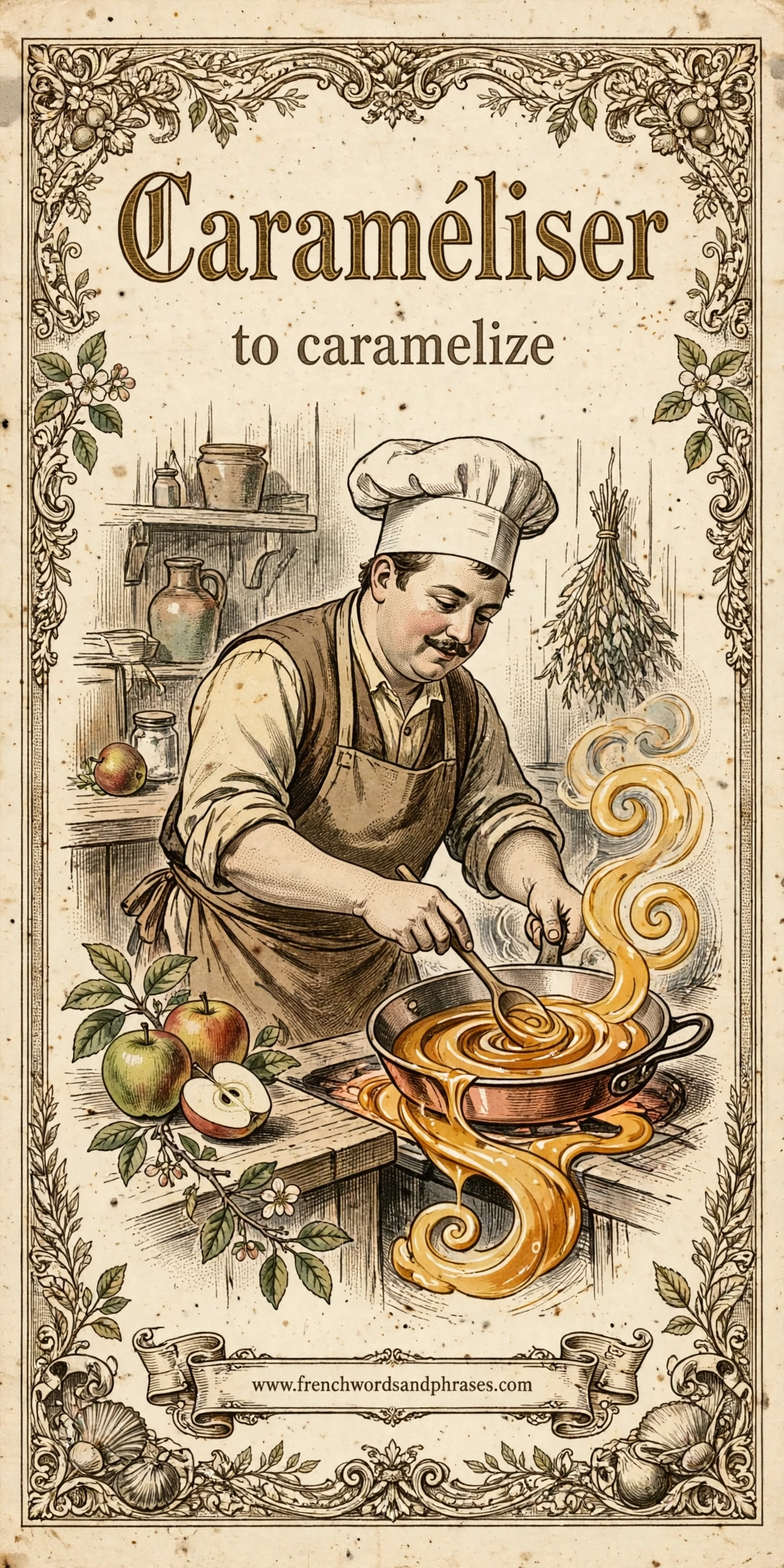
White sugar in a hot pan, watched like a hawk: first it melts, then it blonds, then in seconds it turns the colour of old cognac — caraméliser is the cook’s most theatrical verb, the moment sugar becomes caramel.
In this guide, you’ll learn how to conjugate caraméliser in all the major French tenses and moods. Explore complete conjugation tables, French examples, English translations, and practice quizzes.
Understanding the French Verb Caraméliser
Caraméliser is a regular French verb belonging to the first group of verbs, those ending in-er.
It means to caramelize. It covers sugar itself, foods cooked in or with caramel (oignons caramélisés, pommes caramélisées), and lining a mould with caramel before a flan goes in. The line between blond, doré and brûlé is a matter of seconds — every recipe warns you not to leave the pan.
Verb classification: First group (-er)
Auxiliary verb: Avoir
Past participle: caramélisé
Present participle: caramélisant
English equivalents: To caramelize; caraméliser du sucre — to caramelize sugar; caraméliser des oignons — to caramelize onions; caraméliser un moule — to coat a mould with caramel; des noisettes caramélisées — caramelized hazelnuts.
One important detail: caraméliser keeps both its accents in every form — je caramélise, nous caramélisons, ils caramélisent, past participle caramélisé. It is transitive: the cook caramélise the sugar or the onions. When the sugar does it by itself, French switches to the reflexive — le sucre se caramélise — which has its own page.
Experience the Word
Caraméliser is the verb of the watched pan — nothing happens, nothing happens, and then everything happens at once.
Imagine a pâtissier making the evening’s crème caramel. The sugar melts, sighs, turns amber; one breath too long and it would smoke. Au moment exact, il caramélise le sucre, verse, et le moule brille comme un miroir de cuivre.
White, then gold, then amber. That transformation, caught at the second, is caraméliser.
How to Conjugate Caraméliser: Complete French Conjugation Guide
Let’s explore every major conjugation of caraméliser, beginning with the indicative mood.
How to Conjugate Caraméliser in the Indicative Mood
The indicative mood is used to express facts, observations, actions, and events.
How to Conjugate Caraméliser in the Present Tense (Présent)
Used for actions happening now, habitual actions, and general truths.
| Subject | Conjugation |
|---|---|
| je | caramélise |
| tu | caramélises |
| il / elle | caramélise |
| nous | caramélisons |
| vous | caramélisez |
| ils / elles | caramélisent |
Example
Le chef caramélise le sucre à feu vif.
The chef caramelizes the sugar over a high heat.
Quick Quiz 1
Complete the sentence:
Nous ______ les oignons pendant que la soupe mijote.
Reveal the answer
caramélisons
Nous caramélisons les oignons pendant que la soupe mijote.
We are caramelizing the onions while the soup simmers.
How to Conjugate Caraméliser in the Passé Composé
Used for completed actions in the past. Caraméliser takes the auxiliary verb avoir.
| Subject | Conjugation |
|---|---|
| j’ | ai caramélisé |
| tu | as caramélisé |
| il / elle | a caramélisé |
| nous | avons caramélisé |
| vous | avez caramélisé |
| ils / elles | ont caramélisé |
Example
Elle a caramélisé les oignons pendant une heure.
She caramelized the onions for an hour.
How to Conjugate Caraméliser in the Imparfait (Imperfect Tense)
Used for habitual past actions, descriptions, and ongoing situations in the past.
| Subject | Conjugation |
|---|---|
| je | caramélisais |
| tu | caramélisais |
| il / elle | caramélisait |
| nous | caramélisions |
| vous | caramélisiez |
| ils / elles | caramélisaient |
Example
Grand-mère caramélisait les pommes pour la tarte.
Grandmother used to caramelize the apples for the tart.
Quick Quiz 2
Choose the correct form:
She has caramelized the hazelnuts.
Elle ______ les noisettes. (a caramélisé / a caraméliser)
Reveal the answer
a caramélisé
Elle a caramélisé les noisettes.
The past participle of an -er verb ends in -é.
How to Conjugate Caraméliser in the Plus-que-parfait
Used to describe an action that had already been completed before another past event.
| Subject | Conjugation |
|---|---|
| j’ | avais caramélisé |
| tu | avais caramélisé |
| il / elle | avait caramélisé |
| nous | avions caramélisé |
| vous | aviez caramélisé |
| ils / elles | avaient caramélisé |
Example
Le pâtissier avait caramélisé le moule avant de verser la crème.
The pastry chef had coated the mould with caramel before pouring in the custard.
How to Conjugate Caraméliser in the Passé Simple
Primarily used in formal writing, literature, and historical narratives. It is rarely used in everyday conversation.
| Subject | Conjugation |
|---|---|
| je | caramélisai |
| tu | caramélisas |
| il / elle | caramélisa |
| nous | caramélisâmes |
| vous | caramélisâtes |
| ils / elles | caramélisèrent |
Example
Le sucre chauffa, blondit, et le cuisinier le caramélisa d’un geste sûr.
The sugar heated, turned golden, and the cook caramelized it with a sure hand.
How to Conjugate Caraméliser in the Passé Antérieur
A literary tense used to express an action completed immediately before another past action, generally in the passé simple.
| Subject | Conjugation |
|---|---|
| j’ | eus caramélisé |
| tu | eus caramélisé |
| il / elle | eut caramélisé |
| nous | eûmes caramélisé |
| vous | eûtes caramélisé |
| ils / elles | eurent caramélisé |
Example
Dès qu’il eut caramélisé les noisettes, il les concassa.
As soon as he had caramelized the hazelnuts, he crushed them.
How to Conjugate Caraméliser in the Future Tense (Futur Simple)
Used to describe actions that will take place in the future.
| Subject | Conjugation |
|---|---|
| je | caraméliserai |
| tu | caraméliseras |
| il / elle | caramélisera |
| nous | caraméliserons |
| vous | caraméliserez |
| ils / elles | caraméliseront |
Example
Tu caraméliseras le sucre sans le quitter des yeux.
You will caramelize the sugar without taking your eyes off it.
How to Conjugate Caraméliser in the Futur Antérieur (Future Perfect)
Used for an action that will have been completed before a particular point in the future.
| Subject | Conjugation |
|---|---|
| j’ | aurai caramélisé |
| tu | auras caramélisé |
| il / elle | aura caramélisé |
| nous | aurons caramélisé |
| vous | aurez caramélisé |
| ils / elles | auront caramélisé |
Example
Quand la crème sera prête, tu auras caramélisé le moule.
When the custard is ready, you will have coated the mould with caramel.
How to Conjugate Caraméliser in the Near Future (Futur Proche)
Used to describe something that is going to happen soon. Formed with aller + infinitive.
| Subject | Conjugation |
|---|---|
| je | vais caraméliser |
| tu | vas caraméliser |
| il / elle | va caraméliser |
| nous | allons caraméliser |
| vous | allez caraméliser |
| ils / elles | vont caraméliser |
Example
Je vais caraméliser les oignons pour la soupe.
I am going to caramelize the onions for the soup.
How to Conjugate Caraméliser in the Conditional Mood
The conditional mood expresses what would happen under certain circumstances. It is also frequently used to make polite requests or express wishes.
How to Conjugate Caraméliser in the Present Conditional
| Subject | Conjugation |
|---|---|
| je | caraméliserais |
| tu | caraméliserais |
| il / elle | caraméliserait |
| nous | caraméliserions |
| vous | caraméliseriez |
| ils / elles | caraméliseraient |
Example
Avec un peu de beurre, le sucre caraméliserait plus doucement.
With a little butter, the sugar would caramelize more gently.
How to Conjugate Caraméliser in the Past Conditional
| Subject | Conjugation |
|---|---|
| j’ | aurais caramélisé |
| tu | aurais caramélisé |
| il / elle | aurait caramélisé |
| nous | aurions caramélisé |
| vous | auriez caramélisé |
| ils / elles | auraient caramélisé |
Example
Sans surveillance, tu aurais caramélisé le sucre jusqu’à le brûler.
Unwatched, you would have caramelized the sugar until it burnt.
Caraméliser in the Literary Past Conditional Form
This less common literary form uses the imperfect subjunctive of avoir.
| Subject | Conjugation |
|---|---|
| j’ | eusse caramélisé |
| tu | eusses caramélisé |
| il / elle | eût caramélisé |
| nous | eussions caramélisé |
| vous | eussiez caramélisé |
| ils / elles | eussent caramélisé |
Example
Le miel eût caramélisé les amandes à la perfection.
The honey would have caramelized the almonds to perfection.
How to Conjugate Caraméliser in the Subjunctive Mood
The subjunctive is used to express wishes, emotions, doubts, necessity, and uncertainty. It frequently follows expressions such as il faut que (it is necessary that) or bien que (although).
How to Conjugate Caraméliser in the Present Subjunctive
| Subject | Conjugation |
|---|---|
| que je | caramélise |
| que tu | caramélises |
| qu’il / qu’elle | caramélise |
| que nous | caramélisions |
| que vous | caramélisiez |
| qu’ils / qu’elles | caramélisent |
Example
Il faut que tu caramélises le sucre sans le remuer.
You must caramelize the sugar without stirring it.
Quick Quiz 3
Complete the sentence using the subjunctive:
Il faut que vous ______ le sucre sans le quitter des yeux.
Reveal the answer
caramélisiez
Il faut que vous caramélisiez le sucre sans le quitter des yeux.
You must caramelize the sugar without taking your eyes off it.
How to Conjugate Caraméliser in the Imperfect Subjunctive
A literary tense, rarely encountered in modern spoken French.
| Subject | Conjugation |
|---|---|
| que je | caramélisasse |
| que tu | caramélisasses |
| qu’il / qu’elle | caramélisât |
| que nous | caramélisassions |
| que vous | caramélisassiez |
| qu’ils / qu’elles | caramélisassent |
Example
La recette voulait qu’on caramélisât les pommes à part.
The recipe required the apples to be caramelized separately.
How to Conjugate Caraméliser in the Pluperfect Subjunctive
A literary construction used to express an action completed before another past action.
| Subject | Conjugation |
|---|---|
| que j’ | eusse caramélisé |
| que tu | eusses caramélisé |
| qu’il / qu’elle | eût caramélisé |
| que nous | eussions caramélisé |
| que vous | eussiez caramélisé |
| qu’ils / qu’elles | eussent caramélisé |
Example
On racontait que le chef eût caramélisé le sucre en dix secondes.
People said the chef had caramelized the sugar in ten seconds.
How to Conjugate Caraméliser in the Past Subjunctive
| Subject | Conjugation |
|---|---|
| que j’ | aie caramélisé |
| que tu | aies caramélisé |
| qu’il / qu’elle | ait caramélisé |
| que nous | ayons caramélisé |
| que vous | ayez caramélisé |
| qu’ils / qu’elles | aient caramélisé |
Example
Je suis content que tu aies caramélisé les oignons lentement.
I am glad you caramelized the onions slowly.
How to Conjugate Caraméliser in the Imperative
The imperative is used to give commands, instructions, invitations, or suggestions. Subject pronouns are omitted.
How to Conjugate Caraméliser in the Present Imperative
| Person | Conjugation |
|---|---|
| (tu) | caramélise |
| (nous) | caramélisons |
| (vous) | caramélisez |
Example
Caramélise le sucre, mais ne le laisse pas fumer !
Caramelize the sugar, but do not let it smoke!
Quick Quiz 4
How would you say Caramelize the apples (tu form)?
Reveal the answer
Caramélise les pommes !
French Participles of Caraméliser
Participles are verb forms that can be used in compound tenses and other grammatical constructions.
Present Participle of Caraméliser
caramélisant
En caramélisant les pommes, elle parfume toute la cuisine.
By caramelizing the apples, she fills the whole kitchen with their scent.
Past Participle of Caraméliser
caramélisé
Le sucre, caramélisé à point, nappe le fond du moule.
The sugar, caramelized to perfection, coats the bottom of the mould.
Caraméliser in Everyday French: Real-Life Examples
Now that you know the conjugations, let’s see how caraméliser appears in everyday French.
Example 1 — Present
Le chef caramélise le sucre à feu vif.
The chef caramelizes the sugar over a high heat.
Example 2 — Passé composé
Elle a caramélisé les oignons lentement.
She caramelized the onions slowly.
Example 3 — Imparfait
Grand-mère caramélisait les pommes pour la tarte.
Grandmother used to caramelize the apples for the tart.
Example 4 — Future
Tu caraméliseras le sucre sans le quitter des yeux.
You will caramelize the sugar without taking your eyes off it.
Example 5 — Conditional
Avec du beurre, il caraméliserait plus doucement.
With butter, it would caramelize more gently.
Example 6 — Imperative
Caramélisez le sucre sans le remuer !
Caramelize the sugar without stirring it!
Beyond Translation: The Meaning of Caraméliser
English caramelize and French caraméliser share the same sweet ancestor — caramel, a word that travelled from Spanish and Portuguese kitchens into every European language.
The image is sugar turning to amber glass.
Caraméliser names both the chemistry and the craft: anyone can melt sugar, but caraméliser is to stop it at the exact shade the recipe dreams of.
How to Remember the French Verb Caraméliser
Remember it this way: Caraméliser is about sugar turning amber in a watched pan.
- Both accents stay put: je caramélise, nous caramélisons, caramélisé — nothing changes.
- Transitive: the cook caramélise le sucre, les oignons, le moule.
- If the sugar does it alone, use the reflexive: le sucre se caramélise.
The key idea is sugar turning amber in a watched pan.
Test Your Knowledge of Caraméliser
Let’s see how much you’ve learned. Try answering these questions before revealing the answers.
Question 1
What is the difference between caraméliser and se caraméliser?
Reveal the answer
Caraméliser is what the cook does to the sugar; se caraméliser is what the sugar does by itself.
Question 2
How do you say She caramelized the onions in French?
Reveal the answer
Elle a caramélisé les oignons.
Question 3
Translate: Caramelize the sugar without stirring it.
Reveal the answer
Caramélise le sucre sans le remuer.
Question 4
What is the past participle of caraméliser?
Reveal the answer
Caramélisé — a regular -er participle.
Question 5
Complete the sentence:
Il faut que tu ______ le moule avant de verser la crème.
Reveal the answer
caramélises
Il faut que tu caramélises le moule avant de verser la crème.
You must coat the mould with caramel before pouring in the custard.
Your Final Challenge
Can You Use It?
How would you say this in French?
The sugar melted, turned golden, and then the pastry chef caramelized it to the deep amber of the crème caramels of his childhood.
Reveal the answer
Le sucre fondit, blondit, puis le pâtissier le caramélisa jusqu’à l’ambre profond des crèmes caramel de son enfance.
The sugar melted, turned golden, and then the pastry chef caramelized it to the deep amber of the crème caramels of his childhood.
A little French. A little curiosity. A richer everyday life.
LEARN FRENCH ONE WORD AT A TIME




