
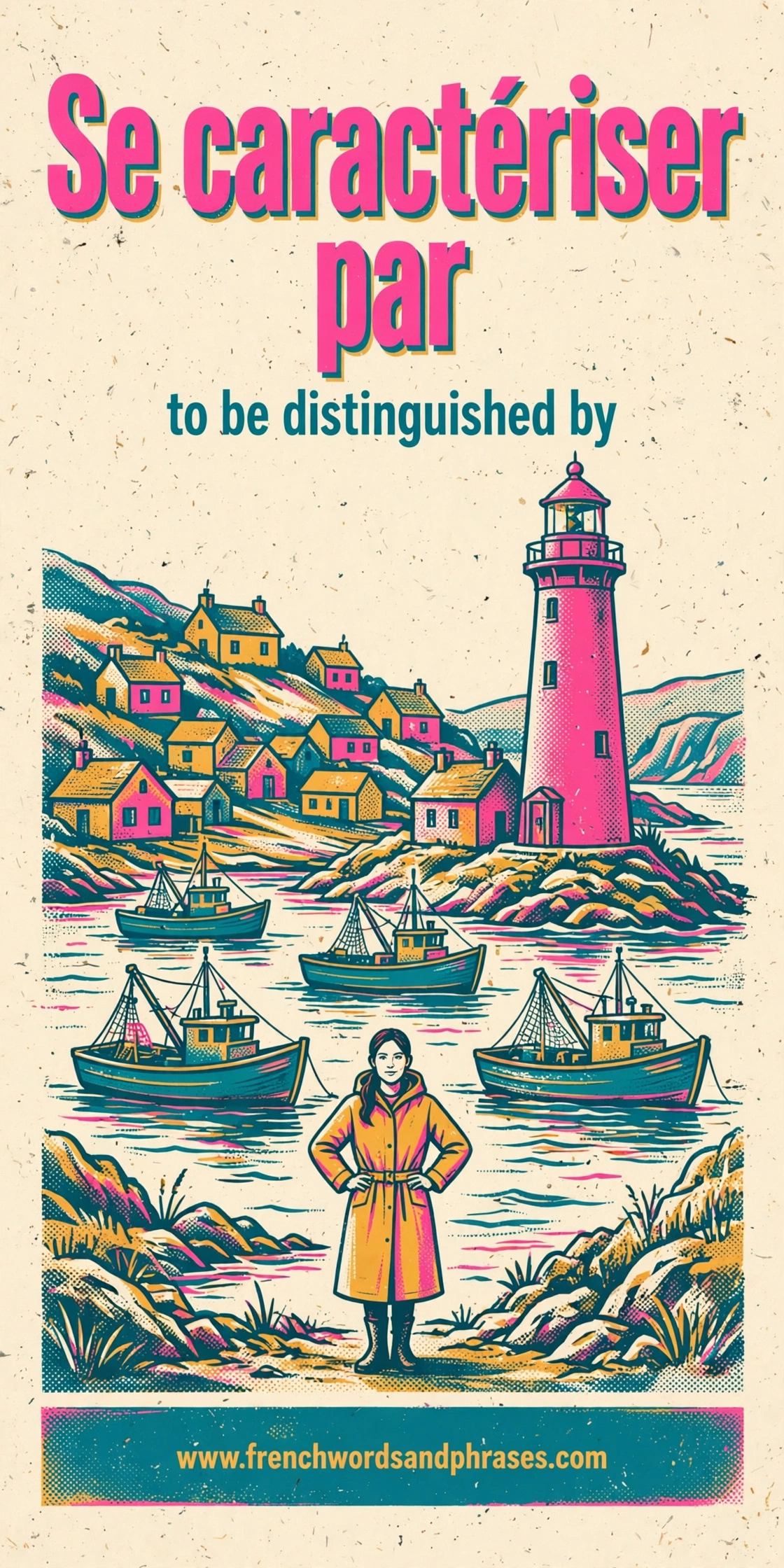
A French Word to Live By
How to Conjugate Se caractériser par in French
/sə ka.ʁak.te.ʁi.ze paʁ/
Se caractériser par means to be distinguished by — a thing or a place is marked out by the very feature that follows par.
A city known for its rain, a wine known for its peppery finish, a style known for its bare simplicity — se caractériser par is the construction French reaches for when one feature sums up the whole: the subject is distinguished by what comes after par.
In this guide, you’ll learn how to conjugate se caractériser par in all the major French tenses and moods. Explore complete conjugation tables, French examples, English translations, and practice quizzes.
Understanding the French Verb Se caractériser par
Se caractériser par is a regular French verb belonging to the first group of verbs, those ending in-er.
It means to be distinguished by. Its subject is almost never a person acting, but a thing being described — a climate, a style, a region, a period, a piece of work. It is the natural partner of the plain verb: le critique caractérise le style (the critic describes it), le style se caractérise par sa clarté (the style is marked by its clarity).
Verb classification: First group (-er), reflexive
Auxiliary verb: Être
Past participle: caractérisé
Present participle: caractérisant
English equivalents: To be distinguished by, to be characterized by; se caractériser par qqch — to be marked by something; le climat se caractérise par des étés secs — the climate is distinguished by dry summers; son style se caractérise par sa simplicité — his style is marked by its simplicity; une œuvre qui se caractérise par son audace — a work distinguished by its boldness.
One important detail: se caractériser par is a fixed construction — the reflexive verb plus par, and the defining feature always follows par: la région se caractérise par ses vignobles. Being reflexive, it takes être in every compound tense and the past participle agrees with the subject: elle s’est caractérisée par son audace, ils se sont caractérisés par leur calme. The é of caractériser never changes: je me caractérise, nous nous caractérisons.
Experience the Word
Se caractériser par is the label on the museum case — the one feature the visitor is meant to remember.
Imagine a guide leading you through a small coastal town. « Ce village ? Il se caractérise par ses maisons bleues et par le vent qui ne s’arrête jamais. » In one sentence you know the place for ever.
No long description was needed. One feature, named after par, and the village is distinguished — caractérisé — for good.
How to Conjugate Se caractériser par: Complete French Conjugation Guide
Let’s explore every major conjugation of se caractériser par, beginning with the indicative mood.
How to Conjugate Se caractériser par in the Indicative Mood
The indicative mood is used to express facts, observations, actions, and events.
How to Conjugate Se caractériser par in the Present Tense (Présent)
Used for actions happening now, habitual actions, and general truths.
| Subject | Conjugation |
|---|---|
| je | me caractérise |
| tu | te caractérises |
| il / elle | se caractérise |
| nous | nous caractérisons |
| vous | vous caractérisez |
| ils / elles | se caractérisent |
Example
Ce climat se caractérise par des hivers très froids.
This climate is distinguished by very cold winters.
Quick Quiz 1
Complete the sentence:
Nous visitons une région qui ______ par ses châteaux.
Reveal the answer
se caractérise
Nous visitons une région qui se caractérise par ses châteaux.
We are visiting a region distinguished by its castles.
How to Conjugate Se caractériser par in the Passé Composé
Used for completed actions in the past. Se caractériser par takes the auxiliary verb être.
| Subject | Conjugation |
|---|---|
| je | me suis caractérisé / me suis caractérisée |
| tu | t’es caractérisé / t’es caractérisée |
| il / elle | s’est caractérisé / s’est caractérisée |
| nous | nous sommes caractérisés / nous sommes caractérisées |
| vous | vous êtes caractérisés / vous êtes caractérisées / vous êtes caractérisé / vous êtes caractérisée |
| ils / elles | se sont caractérisés / se sont caractérisées |
Example
Son œuvre s’est caractérisée par une grande audace.
Her work was distinguished by great boldness.
How to Conjugate Se caractériser par in the Imparfait (Imperfect Tense)
Used for habitual past actions, descriptions, and ongoing situations in the past.
| Subject | Conjugation |
|---|---|
| je | me caractérisais |
| tu | te caractérisais |
| il / elle | se caractérisait |
| nous | nous caractérisions |
| vous | vous caractérisiez |
| ils / elles | se caractérisaient |
Example
La région se caractérisait par ses vignobles en terrasses.
The region was marked by its terraced vineyards.
Quick Quiz 2
Choose the correct form:
The festival was marked by its diversity.
Le festival ______ par sa diversité. (s’est caractérisé / a caractérisé)
Reveal the answer
s’est caractérisé
Le festival s’est caractérisé par sa diversité.
The reflexive construction takes être.
How to Conjugate Se caractériser par in the Plus-que-parfait
Used to describe an action that had already been completed before another past event.
| Subject | Conjugation |
|---|---|
| je | m’étais caractérisé / m’étais caractérisée |
| tu | t’étais caractérisé / t’étais caractérisée |
| il / elle | s’était caractérisé / s’était caractérisée |
| nous | nous étions caractérisés / nous étions caractérisées |
| vous | vous étiez caractérisés / vous étiez caractérisées / vous étiez caractérisé / vous étiez caractérisée |
| ils / elles | s’étaient caractérisés / s’étaient caractérisées |
Example
Le quartier s’était caractérisé par ses ateliers d’artistes.
The district had been distinguished by its artists’ studios.
How to Conjugate Se caractériser par in the Passé Simple
Primarily used in formal writing, literature, and historical narratives. It is rarely used in everyday conversation.
| Subject | Conjugation |
|---|---|
| je | me caractérisai |
| tu | te caractérisas |
| il / elle | se caractérisa |
| nous | nous caractérisâmes |
| vous | vous caractérisâtes |
| ils / elles | se caractérisèrent |
Example
Cette période se caractérisa par une paix durable.
This period was marked by a lasting peace.
How to Conjugate Se caractériser par in the Passé Antérieur
A literary tense used to express an action completed immediately before another past action, generally in the passé simple.
| Subject | Conjugation |
|---|---|
| je | me fus caractérisé / me fus caractérisée |
| tu | te fus caractérisé / te fus caractérisée |
| il / elle | se fut caractérisé / se fut caractérisée |
| nous | nous fûmes caractérisés / nous fûmes caractérisées |
| vous | vous fûtes caractérisés / vous fûtes caractérisées / vous fûtes caractérisé / vous fûtes caractérisée |
| ils / elles | se furent caractérisés / se furent caractérisées |
Example
Dès que le style se fut caractérisé par sa simplicité, les imitateurs affluèrent.
As soon as the style had become distinguished by its simplicity, imitators flocked in.
How to Conjugate Se caractériser par in the Future Tense (Futur Simple)
Used to describe actions that will take place in the future.
| Subject | Conjugation |
|---|---|
| je | me caractériserai |
| tu | te caractériseras |
| il / elle | se caractérisera |
| nous | nous caractériserons |
| vous | vous caractériserez |
| ils / elles | se caractériseront |
Example
Le nouveau quartier se caractérisera par ses jardins partagés.
The new district will be distinguished by its shared gardens.
How to Conjugate Se caractériser par in the Futur Antérieur (Future Perfect)
Used for an action that will have been completed before a particular point in the future.
| Subject | Conjugation |
|---|---|
| je | me serai caractérisé / me serai caractérisée |
| tu | te seras caractérisé / te seras caractérisée |
| il / elle | se sera caractérisé / se sera caractérisée |
| nous | nous serons caractérisés / nous serons caractérisées |
| vous | vous serez caractérisés / vous serez caractérisées / vous serez caractérisé / vous serez caractérisée |
| ils / elles | se seront caractérisés / se seront caractérisées |
Example
À la fin des travaux, la place se sera caractérisée par sa grande fontaine.
By the end of the works, the square will have become known for its great fountain.
How to Conjugate Se caractériser par in the Near Future (Futur Proche)
Used to describe something that is going to happen soon. Formed with aller + infinitive.
| Subject | Conjugation |
|---|---|
| je | vais me caractériser |
| tu | vas te caractériser |
| il / elle | va se caractériser |
| nous | allons nous caractériser |
| vous | allez vous caractériser |
| ils / elles | vont se caractériser |
Example
Ce vin va se caractériser par une note de fruits rouges.
This wine is going to be distinguished by a note of red fruits.
How to Conjugate Se caractériser par in the Conditional Mood
The conditional mood expresses what would happen under certain circumstances. It is also frequently used to make polite requests or express wishes.
How to Conjugate Se caractériser par in the Present Conditional
| Subject | Conjugation |
|---|---|
| je | me caractériserais |
| tu | te caractériserais |
| il / elle | se caractériserait |
| nous | nous caractériserions |
| vous | vous caractériseriez |
| ils / elles | se caractériseraient |
Example
Sans ses canaux, la ville ne se caractériserait pas par son charme.
Without its canals, the town would not be distinguished by its charm.
How to Conjugate Se caractériser par in the Past Conditional
| Subject | Conjugation |
|---|---|
| je | me serais caractérisé / me serais caractérisée |
| tu | te serais caractérisé / te serais caractérisée |
| il / elle | se serait caractérisé / se serait caractérisée |
| nous | nous serions caractérisés / nous serions caractérisées |
| vous | vous seriez caractérisés / vous seriez caractérisées / vous seriez caractérisé / vous seriez caractérisée |
| ils / elles | se seraient caractérisés / se seraient caractérisées |
Example
Le roman se serait caractérisé par son humour sans les coupures.
The novel would have been marked by its humour without the cuts.
Se caractériser par in the Literary Past Conditional Form
This less common literary form uses the imperfect subjunctive of être.
| Subject | Conjugation |
|---|---|
| je | me fusse caractérisé / me fusse caractérisée |
| tu | te fusses caractérisé / te fusses caractérisée |
| il / elle | se fût caractérisé / se fût caractérisée |
| nous | nous fussions caractérisés / nous fussions caractérisées |
| vous | vous fussiez caractérisés / vous fussiez caractérisées / vous fussiez caractérisé / vous fussiez caractérisée |
| ils / elles | se fussent caractérisés / se fussent caractérisées |
Example
Le siècle se fût caractérisé par sa foi dans le progrès.
The century would have been distinguished by its faith in progress.
How to Conjugate Se caractériser par in the Subjunctive Mood
The subjunctive is used to express wishes, emotions, doubts, necessity, and uncertainty. It frequently follows expressions such as il faut que (it is necessary that) or bien que (although).
How to Conjugate Se caractériser par in the Present Subjunctive
| Subject | Conjugation |
|---|---|
| que je | me caractérise |
| que tu | te caractérises |
| qu’il / qu’elle | se caractérise |
| que nous | nous caractérisions |
| que vous | vous caractérisiez |
| qu’ils / qu’elles | se caractérisent |
Example
Il est rare qu’une œuvre se caractérise par une telle unité.
It is rare for a work to be distinguished by such unity.
Quick Quiz 3
Complete the sentence using the subjunctive:
Il est rare qu’un vin ______ par une telle finesse.
Reveal the answer
se caractérise
Il est rare qu’un vin se caractérise par une telle finesse.
It is rare for a wine to be distinguished by such finesse.
How to Conjugate Se caractériser par in the Imperfect Subjunctive
A literary tense, rarely encountered in modern spoken French.
| Subject | Conjugation |
|---|---|
| que je | me caractérisasse |
| que tu | te caractérisasses |
| qu’il / qu’elle | se caractérisât |
| que nous | nous caractérisassions |
| que vous | vous caractérisassiez |
| qu’ils / qu’elles | se caractérisassent |
Example
Rien ne laissait penser que la région se caractérisât par ses vins.
Nothing suggested that the region was distinguished by its wines.
How to Conjugate Se caractériser par in the Pluperfect Subjunctive
A literary construction used to express an action completed before another past action.
| Subject | Conjugation |
|---|---|
| que je | me fusse caractérisé / me fusse caractérisée |
| que tu | te fusses caractérisé / te fusses caractérisée |
| qu’il / qu’elle | se fût caractérisé / se fût caractérisée |
| que nous | nous fussions caractérisés / nous fussions caractérisées |
| que vous | vous fussiez caractérisés / vous fussiez caractérisées / vous fussiez caractérisé / vous fussiez caractérisée |
| qu’ils / qu’elles | se fussent caractérisés / se fussent caractérisées |
Example
On doutait que le quartier se fût caractérisé par son calme.
People doubted the district had been known for its calm.
How to Conjugate Se caractériser par in the Past Subjunctive
| Subject | Conjugation |
|---|---|
| que j’ | me sois caractérisé / me sois caractérisée |
| que tu | te sois caractérisé / te sois caractérisée |
| qu’il / qu’elle | se soit caractérisé / se soit caractérisée |
| que nous | nous soyons caractérisés / nous soyons caractérisées |
| que vous | vous soyez caractérisés / vous soyez caractérisées / vous soyez caractérisé / vous soyez caractérisée |
| qu’ils / qu’elles | se soient caractérisés / se soient caractérisées |
Example
Je suis heureux que le festival se soit caractérisé par sa diversité.
I am glad the festival was distinguished by its diversity.
How to Conjugate Se caractériser par in the Imperative
The imperative is used to give commands, instructions, invitations, or suggestions. Subject pronouns are omitted.
How to Conjugate Se caractériser par in the Present Imperative
| Person | Conjugation |
|---|---|
| (tu) | caractérise-toi |
| (nous) | caractérisons-nous |
| (vous) | caractérisez-vous |
Example
Caractérise-toi par ta ponctualité, et l’on te fera confiance.
Be distinguished by your punctuality, and people will trust you.
Quick Quiz 4
How would you say Be distinguished by your punctuality (tu form)?
Reveal the answer
Caractérise-toi par ta ponctualité !
French Participles of Se caractériser par
Participles are verb forms that can be used in compound tenses and other grammatical constructions.
Present Participle of Se caractériser par
caractérisant
Se caractérisant par des étés secs, la région attire les oliviers.
Being distinguished by dry summers, the region suits olive trees.
Past Participle of Se caractériser par
caractérisé
Caractérisée par ses maisons bleues, la ville attire les peintres.
Distinguished by its blue houses, the town attracts painters.
Se caractériser par in Everyday French: Real-Life Examples
Now that you know the conjugations, let’s see how se caractériser par appears in everyday French.
Example 1 — Present
La région se caractérise par ses vignobles.
The region is distinguished by its vineyards.
Example 2 — Passé composé
Le festival s’est caractérisé par sa diversité.
The festival was marked by its diversity.
Example 3 — Imparfait
Son style se caractérisait par sa simplicité.
His style was marked by its simplicity.
Example 4 — Future
Le quartier se caractérisera par ses jardins.
The district will be distinguished by its gardens.
Example 5 — Conditional
Sans le vent, l’île se caractériserait par sa douceur.
Without the wind, the island would be known for its mildness.
Example 6 — Imperative
Caractérisez-vous par votre sérieux, jeunes diplômés !
Be distinguished by your seriousness, young graduates!
Beyond Translation: The Meaning of Se caractériser par
The construction se caractériser par is the passive idea wearing reflexive clothes: English says a style is characterized by its clarity, and French turns the style into its own subject — le style se caractérise par sa clarté.
The image is a coat of arms.
Every town, wine and style carries one emblem above the gate; se caractériser par is how French reads that emblem aloud.
How to Remember the French Verb Se caractériser par
Remember it this way: Se caractériser par is about a coat of arms over the gate — one emblem that sums up the town.
- Always par after it: se caractériser par + the defining feature — never de, never avec.
- Reflexive rules apply: être in compound tenses, participle agrees — elle s’est caractérisée par…
- The subject is a thing being described (a climate, a style, a region), not a person acting.
The key idea is a coat of arms over the gate — one emblem that sums up the town.
Test Your Knowledge of Se caractériser par
Let’s see how much you’ve learned. Try answering these questions before revealing the answers.
Question 1
Which preposition always follows se caractériser?
Reveal the answer
Par — the defining feature comes after par: se caractériser par sa simplicité.
Question 2
How do you say The climate is distinguished by dry summers in French?
Reveal the answer
Le climat se caractérise par des étés secs.
Question 3
Translate: Her work was distinguished by great boldness.
Reveal the answer
Son œuvre s’est caractérisée par une grande audace.
Question 4
Which auxiliary does se caractériser use?
Reveal the answer
Être — it is reflexive: ils se sont caractérisés par leur calme.
Question 5
Complete the sentence:
Il est rare qu’une région ______ par un seul produit.
Reveal the answer
se caractérise
Il est rare qu’une région se caractérise par un seul produit.
It is rare for a region to be distinguished by a single product.
Your Final Challenge
Can You Use It?
How would you say this in French?
This little harbour is distinguished by its colourful boats and by a silence the tourists have not yet disturbed.
Reveal the answer
Ce petit port se caractérise par ses barques colorées et par un silence que les touristes n’ont pas encore troublé.
This little harbour is distinguished by its colourful boats and by a silence the tourists have not yet disturbed.
A little French. A little curiosity. A richer everyday life.
LEARN FRENCH ONE WORD AT A TIME




