
A French Word to Live By
How to Conjugate Canner in French
/ka.ne/
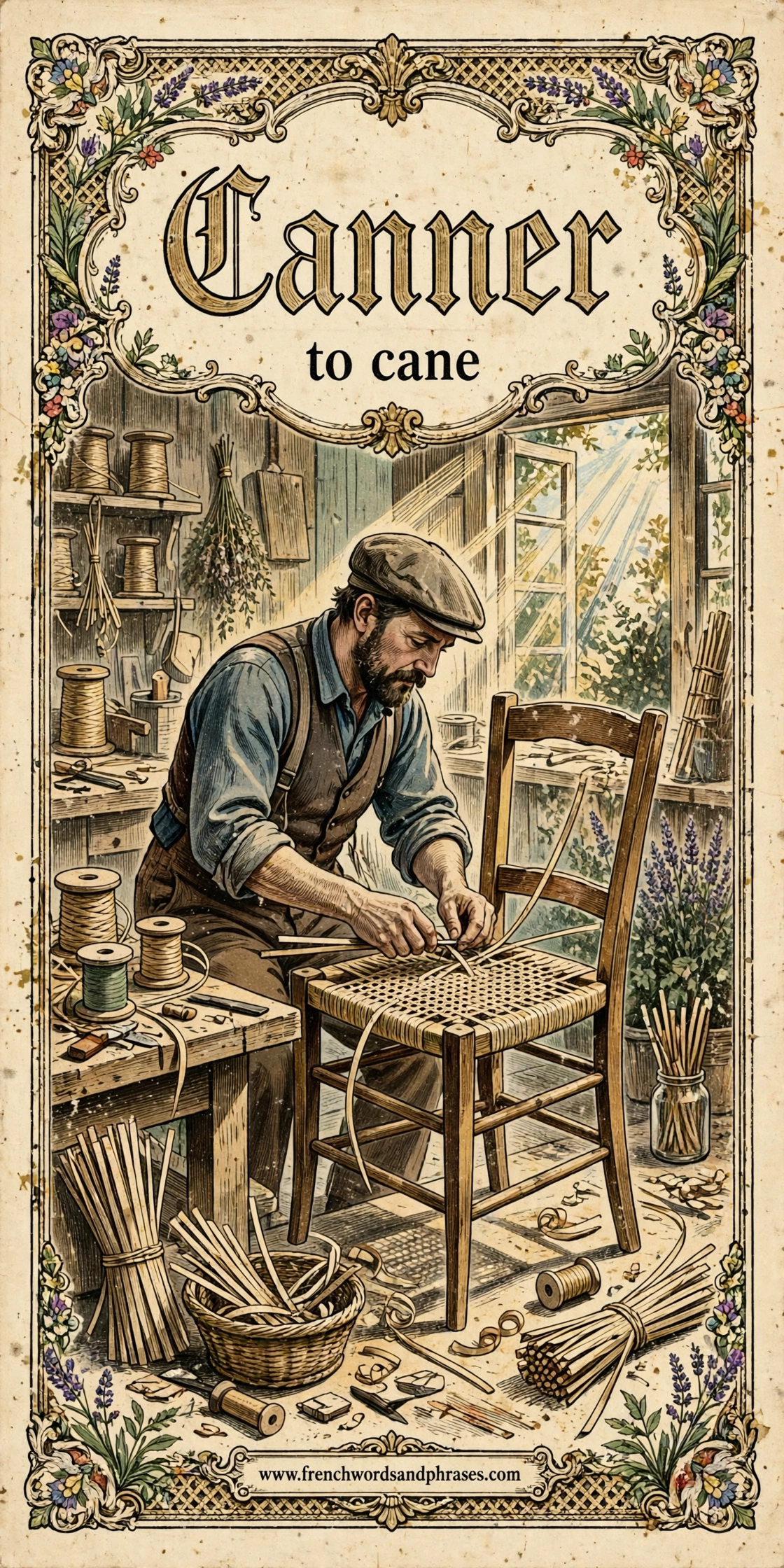
Canner means to cane — to weave split cane or rattan strands across a chair seat or back until the wooden frame holds a light, springy web.
A workshop smelling of rattan and warm wood, an old chair turned upside down on the bench — canner is the craftsman’s verb of the woven seat: strand over, strand under, until a broken chair is ready for another fifty years of dinners.
In this guide, you’ll learn how to conjugate canner in all the major French tenses and moods. Explore complete conjugation tables, French examples, English translations, and practice quizzes.
Understanding the French Verb Canner
Canner is a regular French verb belonging to the first group of verbs, those ending in-er.
It means to cane. It belongs to the furniture workshop: the canneur or canneuse weaves the six-way pattern of the classic French bistro chair. The noun for the craft and its result is le cannage, and a chair described as cannée has a seat of woven cane rather than wood or cloth.
Verb classification: First group (-er)
Auxiliary verb: Avoir
Past participle: canné
Present participle: cannant
English equivalents: To cane, to fit with a cane seat; canner une chaise — to cane a chair; canner un fauteuil — to re-cane an armchair; le cannage — the cane webbing itself; une chaise cannée — a cane-seated chair.
One important detail: canner is built on la canne, cane — the rattan of the chair seat (and, in its other life, the walking stick). Older dictionaries sometimes print the variant spelling can(n)er, with the second n in brackets; the modern standard spelling is canner, with two n’s throughout: je canne, nous cannons, ils cannent, past participle canné. Do not confuse it with caner, one n, the familiar verb meaning to chicken out.
Experience the Word
Canner is the verb of the patient weave — a hundred crossings of cane that together hold a person’s weight.
Imagine a little workshop behind a Paris courtyard. Madame Fabre soaks the rattan strands, threads them through the holes of the chair frame — verticales, horizontales, diagonales — elle canne la chaise de sa grand-mère, restoring the exact pattern woven a century before she was born.
No single strand could hold anyone. Woven together, they hold the whole family — la chaise est cannée, prête pour cent ans de repas.
How to Conjugate Canner: Complete French Conjugation Guide
Let’s explore every major conjugation of canner, beginning with the indicative mood.
How to Conjugate Canner in the Indicative Mood
The indicative mood is used to express facts, observations, actions, and events.
How to Conjugate Canner in the Present Tense (Présent)
Used for actions happening now, habitual actions, and general truths.
| Subject | Conjugation |
|---|---|
| je | canne |
| tu | cannes |
| il / elle | canne |
| nous | cannons |
| vous | cannez |
| ils / elles | cannent |
Example
L’artisan canne les chaises du café d’en face.
The craftsman is caning the chairs of the café across the street.
Quick Quiz 1
Complete the sentence:
Nous ______ les tabourets de la cuisine.
Reveal the answer
cannons
Nous cannons les tabourets de la cuisine.
We are caning the kitchen stools.
How to Conjugate Canner in the Passé Composé
Used for completed actions in the past. Canner takes the auxiliary verb avoir.
| Subject | Conjugation |
|---|---|
| j’ | ai canné |
| tu | as canné |
| il / elle | a canné |
| nous | avons canné |
| vous | avez canné |
| ils / elles | ont canné |
Example
Elle a canné ce fauteuil avec du rotin neuf.
She re-caned this armchair with new rattan.
How to Conjugate Canner in the Imparfait (Imperfect Tense)
Used for habitual past actions, descriptions, and ongoing situations in the past.
| Subject | Conjugation |
|---|---|
| je | cannais |
| tu | cannais |
| il / elle | cannait |
| nous | cannions |
| vous | canniez |
| ils / elles | cannaient |
Example
Autrefois, on cannait les chaises dans chaque village.
In the old days, people caned chairs in every village.
Quick Quiz 2
Choose the correct form:
She caned the armchair.
Elle ______ le fauteuil. (a canné / est cannée)
Reveal the answer
a canné
Elle a canné le fauteuil.
Canner takes avoir.
How to Conjugate Canner in the Plus-que-parfait
Used to describe an action that had already been completed before another past event.
| Subject | Conjugation |
|---|---|
| j’ | avais canné |
| tu | avais canné |
| il / elle | avait canné |
| nous | avions canné |
| vous | aviez canné |
| ils / elles | avaient canné |
Example
Il avait canné toute la série avant l’arrivée des clients.
He had caned the whole set before the customers arrived.
How to Conjugate Canner in the Passé Simple
Primarily used in formal writing, literature, and historical narratives. It is rarely used in everyday conversation.
| Subject | Conjugation |
|---|---|
| je | cannai |
| tu | cannas |
| il / elle | canna |
| nous | cannâmes |
| vous | cannâtes |
| ils / elles | cannèrent |
Example
Le rempailleur canna les six chaises en une semaine.
The chair-mender caned the six chairs in a week.
How to Conjugate Canner in the Passé Antérieur
A literary tense used to express an action completed immediately before another past action, generally in the passé simple.
| Subject | Conjugation |
|---|---|
| j’ | eus canné |
| tu | eus canné |
| il / elle | eut canné |
| nous | eûmes canné |
| vous | eûtes canné |
| ils / elles | eurent canné |
Example
Quand elle eut canné le dernier siège, l’atelier ferma.
When she had caned the last seat, the workshop closed.
How to Conjugate Canner in the Future Tense (Futur Simple)
Used to describe actions that will take place in the future.
| Subject | Conjugation |
|---|---|
| je | cannerai |
| tu | canneras |
| il / elle | cannera |
| nous | cannerons |
| vous | cannerez |
| ils / elles | canneront |
Example
Demain, nous cannerons les tabourets de la cuisine.
Tomorrow, we will cane the kitchen stools.
How to Conjugate Canner in the Futur Antérieur (Future Perfect)
Used for an action that will have been completed before a particular point in the future.
| Subject | Conjugation |
|---|---|
| j’ | aurai canné |
| tu | auras canné |
| il / elle | aura canné |
| nous | aurons canné |
| vous | aurez canné |
| ils / elles | auront canné |
Example
À Noël, il aura canné toutes les chaises de la salle à manger.
By Christmas, he will have caned all the dining-room chairs.
How to Conjugate Canner in the Near Future (Futur Proche)
Used to describe something that is going to happen soon. Formed with aller + infinitive.
| Subject | Conjugation |
|---|---|
| je | vais canner |
| tu | vas canner |
| il / elle | va canner |
| nous | allons canner |
| vous | allez canner |
| ils / elles | vont canner |
Example
Le rempailleur va canner ce fauteuil ancien.
The chair-mender is going to cane this antique armchair.
How to Conjugate Canner in the Conditional Mood
The conditional mood expresses what would happen under certain circumstances. It is also frequently used to make polite requests or express wishes.
How to Conjugate Canner in the Present Conditional
| Subject | Conjugation |
|---|---|
| je | cannerais |
| tu | cannerais |
| il / elle | cannerait |
| nous | cannerions |
| vous | canneriez |
| ils / elles | canneraient |
Example
Avec du rotin plus fin, elle cannerait plus vite.
With finer rattan, she would cane faster.
How to Conjugate Canner in the Past Conditional
| Subject | Conjugation |
|---|---|
| j’ | aurais canné |
| tu | aurais canné |
| il / elle | aurait canné |
| nous | aurions canné |
| vous | auriez canné |
| ils / elles | auraient canné |
Example
J’aurais canné la chaise moi-même si j’avais su le métier.
I would have caned the chair myself if I had known the trade.
Canner in the Literary Past Conditional Form
This less common literary form uses the imperfect subjunctive of avoir.
| Subject | Conjugation |
|---|---|
| j’ | eusse canné |
| tu | eusses canné |
| il / elle | eût canné |
| nous | eussions canné |
| vous | eussiez canné |
| ils / elles | eussent canné |
Example
L’artisan eût canné les sièges du château entier.
The craftsman would have caned the seats of the whole castle.
How to Conjugate Canner in the Subjunctive Mood
The subjunctive is used to express wishes, emotions, doubts, necessity, and uncertainty. It frequently follows expressions such as il faut que (it is necessary that) or bien que (although).
How to Conjugate Canner in the Present Subjunctive
| Subject | Conjugation |
|---|---|
| que je | canne |
| que tu | cannes |
| qu’il / qu’elle | canne |
| que nous | cannions |
| que vous | canniez |
| qu’ils / qu’elles | cannent |
Example
Il faut que tu cannes ce siège avant samedi.
You must cane this seat before Saturday.
Quick Quiz 3
Complete the sentence using the subjunctive:
Il faut que vous ______ ces chaises anciennes.
Reveal the answer
canniez
Il faut que vous canniez ces chaises anciennes.
You must cane these old chairs.
How to Conjugate Canner in the Imperfect Subjunctive
A literary tense, rarely encountered in modern spoken French.
| Subject | Conjugation |
|---|---|
| que je | cannasse |
| que tu | cannasses |
| qu’il / qu’elle | cannât |
| que nous | cannassions |
| que vous | cannassiez |
| qu’ils / qu’elles | cannassent |
Example
Je doutais qu’il cannât encore à son âge.
I doubted he still caned chairs at his age.
How to Conjugate Canner in the Pluperfect Subjunctive
A literary construction used to express an action completed before another past action.
| Subject | Conjugation |
|---|---|
| que j’ | eusse canné |
| que tu | eusses canné |
| qu’il / qu’elle | eût canné |
| que nous | eussions canné |
| que vous | eussiez canné |
| qu’ils / qu’elles | eussent canné |
Example
On admirait qu’elle eût canné le fauteuil sans modèle.
People admired that she had caned the armchair without a pattern.
How to Conjugate Canner in the Past Subjunctive
| Subject | Conjugation |
|---|---|
| que j’ | aie canné |
| que tu | aies canné |
| qu’il / qu’elle | ait canné |
| que nous | ayons canné |
| que vous | ayez canné |
| qu’ils / qu’elles | aient canné |
Example
Je suis content que vous ayez canné ces chaises anciennes.
I am glad you caned these old chairs.
How to Conjugate Canner in the Imperative
The imperative is used to give commands, instructions, invitations, or suggestions. Subject pronouns are omitted.
How to Conjugate Canner in the Present Imperative
| Person | Conjugation |
|---|---|
| (tu) | canne |
| (nous) | cannons |
| (vous) | cannez |
Example
Canne d’abord le fond, puis le dossier !
Cane the seat first, then the back!
Quick Quiz 4
How would you say Cane the seat first (tu form)?
Reveal the answer
Canne d’abord le fond !
French Participles of Canner
Participles are verb forms that can be used in compound tenses and other grammatical constructions.
Present Participle of Canner
cannant
En cannant les chaises, elle écoute la radio toute la journée.
While caning chairs, she listens to the radio all day.
Past Participle of Canner
canné
Cannées à la main, ces chaises valent une petite fortune.
Caned by hand, these chairs are worth a small fortune.
Canner in Everyday French: Real-Life Examples
Now that you know the conjugations, let’s see how canner appears in everyday French.
Example 1 — Present
L’artisan canne les chaises du café.
The craftsman is caning the café chairs.
Example 2 — Passé composé
Elle a canné ce fauteuil avec du rotin neuf.
She re-caned this armchair with new rattan.
Example 3 — Imparfait
On cannait les chaises dans chaque village.
People caned chairs in every village.
Example 4 — Future
Nous cannerons les tabourets de la cuisine.
We will cane the kitchen stools.
Example 5 — Conditional
Elle cannerait plus vite avec du rotin fin.
She would cane faster with fine rattan.
Example 6 — Imperative
Canne d’abord le fond !
Cane the seat first!
Beyond Translation: The Meaning of Canner
English cane the noun and French canner the verb both grow from la canne — Latin canna, a reed.
English kept the stick; French kept the craft.
The woven pattern of a cannée chair — the little octagons of the classic bistro seat — is called le cannage, and the men and women who weave it, les canneurs, are among the last artisans of the Paris furniture trade.
How to Remember the French Verb Canner
Remember it this way: Canner is about rattan strands woven into the bistro chair.
- La canne is cane/rattan: canner is to weave it into a chair seat.
- Two n’s everywhere — je canne, nous cannons — and old books may print the variant can(n)er.
- Not caner (one n): that is the familiar verb for chickening out.
The key idea is rattan strands woven into the bistro chair.
Test Your Knowledge of Canner
Let’s see how much you’ve learned. Try answering these questions before revealing the answers.
Question 1
What is the woven cane work of a chair called in French?
Reveal the answer
Le cannage — and a chair with such a seat is une chaise cannée.
Question 2
How do you say She re-caned this armchair in French?
Reveal the answer
Elle a canné ce fauteuil.
Question 3
Translate: The craftsman is caning the café chairs.
Reveal the answer
L’artisan canne les chaises du café.
Question 4
What is the past participle of canner?
Reveal the answer
Canné.
Question 5
Complete the sentence:
Il faut que tu ______ ce siège avant samedi.
Reveal the answer
cannes
Il faut que tu cannes ce siège avant samedi.
You must cane this seat before Saturday.
Your Final Challenge
Can You Use It?
How would you say this in French?
She canes her grandmother’s chair, strand after strand, and the past becomes a seat you can sit on again.
Reveal the answer
Elle canne la chaise de sa grand-mère, brin après brin, et le passé redevient un siège où l’on peut s’asseoir.
She canes her grandmother’s chair, strand after strand, and the past becomes a seat you can sit on again.
A little French. A little curiosity. A richer everyday life.
LEARN FRENCH ONE WORD AT A TIME




