A French Word to Live By
How to Conjugate Canneler in French
/kan.le/
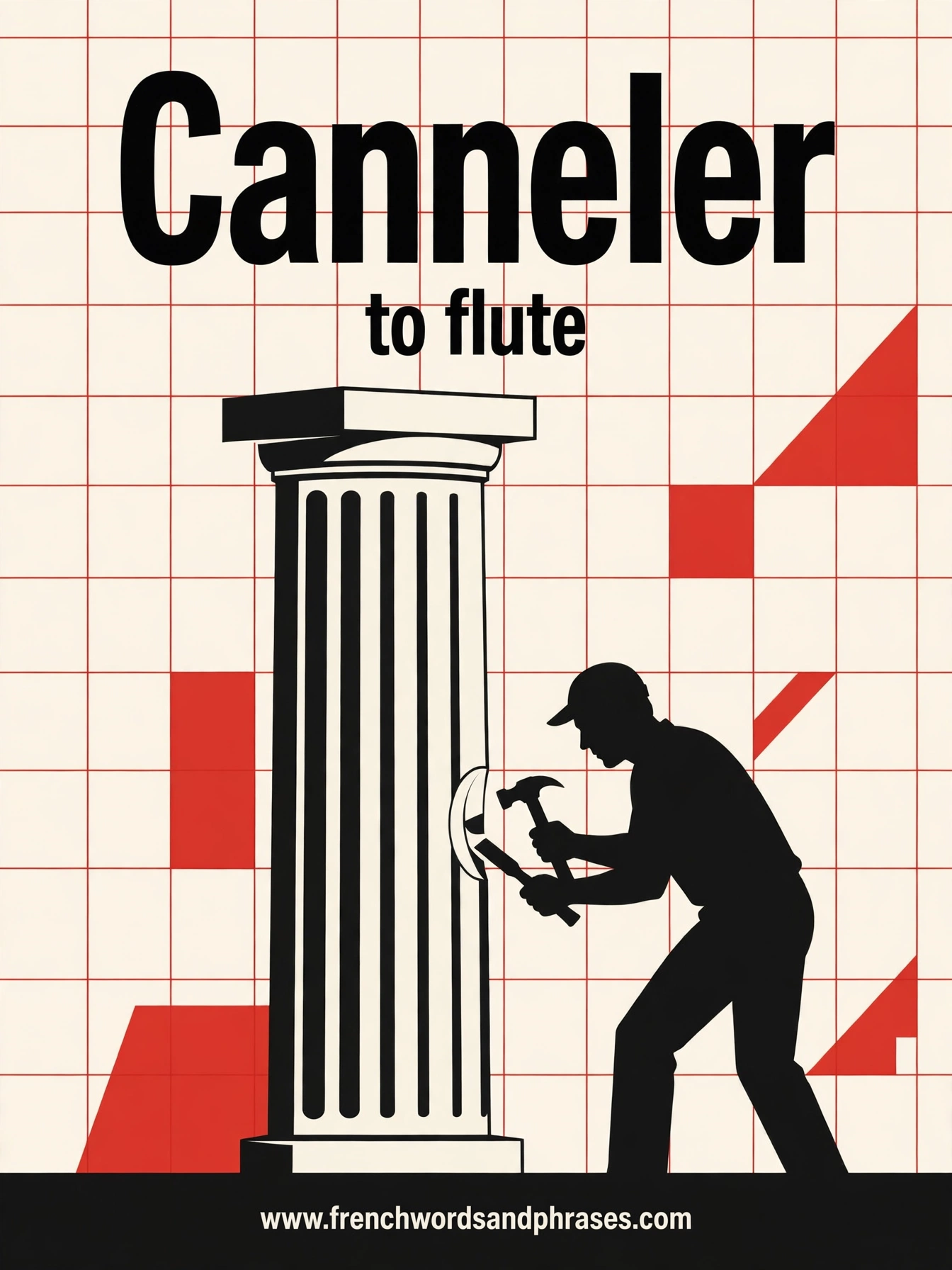
Canneler means to flute, to corrugate — to cut or shape long parallel grooves into a surface, the way columns, pastry moulds and cardboard are ribbed with channels.
The grooves running down a Greek column, the ribs inside a jelly mould, the waves of a sheet of cardboard — canneler is the verb of the long, even channel: wherever a flat surface is given ribs, light and shadow start to play in stripes.
In this guide, you’ll learn how to conjugate canneler in all the major French tenses and moods. Explore complete conjugation tables, French examples, English translations, and practice quizzes.
Understanding the French Verb Canneler
Canneler is a regular French verb belonging to the first group of verbs, those ending in-er.
It means to flute, to corrugate. It belongs to architecture (fluted columns and pilasters), to the kitchen (fluted moulds for jellies, charlottes and cakes) and to industry (corrugated iron and cardboard). The adjective cannelé is the form you will meet most: un pilier cannelé, une tôle cannelée.
Verb classification: First group (-er)
Auxiliary verb: Avoir
Past participle: cannelé
Present participle: cannelant
English equivalents: To flute, to corrugate, to groove; canneler une colonne — to flute a column; un moule cannelé — a fluted mould; du carton cannelé — corrugated cardboard; canneler une tôle — to corrugate a sheet of metal.
One important detail: canneler is an acheter-type verb — the stem’s e opens to è wherever a mute ending follows, and this time the change runs through the future and conditional too: je cannèle, tu cannèles, il cannèle, ils cannèlent, and je cannèlerai, je cannèlerais. Only the nous and vous forms keep the plain stem: nous cannelons, vous cannelez. The noun inside the verb is la cannelure, the groove itself — one column carries twenty cannelures, and the pastry cook’s moule cannelé gives cakes their elegant ribs.
Experience the Word
Canneler is the verb of the groove — it turns a flat, silent surface into one that catches light in stripes.
Imagine a stonemason at work on a courthouse column. His chisel travels slowly downward, one channel at a time, dust falling in a thin line — il cannèle la colonne, and with every groove the plain cylinder becomes a Greek column, solemn and striped with shadow.
The stone has not changed its shape from a distance. But it has been fluted — cannelé, ribbed with light.
How to Conjugate Canneler: Complete French Conjugation Guide
Let’s explore every major conjugation of canneler, beginning with the indicative mood.
How to Conjugate Canneler in the Indicative Mood
The indicative mood is used to express facts, observations, actions, and events.
How to Conjugate Canneler in the Present Tense (Présent)
Used for actions happening now, habitual actions, and general truths.
| Subject | Conjugation |
|---|---|
| je | cannèle |
| tu | cannèles |
| il / elle | cannèle |
| nous | cannelons |
| vous | cannelez |
| ils / elles | cannèlent |
Example
Le tailleur de pierre cannèle la colonne du temple.
The stonemason is fluting the temple column.
Quick Quiz 1
Complete the sentence:
Nous ______ les piliers de la façade.
Reveal the answer
cannelons
Nous cannelons les piliers de la façade.
We are fluting the pillars of the façade.
How to Conjugate Canneler in the Passé Composé
Used for completed actions in the past. Canneler takes the auxiliary verb avoir.
| Subject | Conjugation |
|---|---|
| j’ | ai cannelé |
| tu | as cannelé |
| il / elle | a cannelé |
| nous | avons cannelé |
| vous | avez cannelé |
| ils / elles | ont cannelé |
Example
Elle a cannelé le moule pour la charlotte aux fraises.
She fluted the mould for the strawberry charlotte.
How to Conjugate Canneler in the Imparfait (Imperfect Tense)
Used for habitual past actions, descriptions, and ongoing situations in the past.
| Subject | Conjugation |
|---|---|
| je | cannelais |
| tu | cannelais |
| il / elle | cannelait |
| nous | cannelions |
| vous | canneliez |
| ils / elles | cannelaient |
Example
Les artisans cannelaient les piliers à la main.
The craftsmen used to flute the pillars by hand.
Quick Quiz 2
Choose the correct form:
She fluted the mould herself.
Elle ______ le moule elle-même. (a cannelé / est cannelée)
Reveal the answer
a cannelé
Elle a cannelé le moule elle-même.
Canneler takes avoir.
How to Conjugate Canneler in the Plus-que-parfait
Used to describe an action that had already been completed before another past event.
| Subject | Conjugation |
|---|---|
| j’ | avais cannelé |
| tu | avais cannelé |
| il / elle | avait cannelé |
| nous | avions cannelé |
| vous | aviez cannelé |
| ils / elles | avaient cannelé |
Example
Ils avaient cannelé la tôle avant de la peindre.
They had corrugated the sheet metal before painting it.
How to Conjugate Canneler in the Passé Simple
Primarily used in formal writing, literature, and historical narratives. It is rarely used in everyday conversation.
| Subject | Conjugation |
|---|---|
| je | cannelai |
| tu | cannelas |
| il / elle | cannela |
| nous | cannelâmes |
| vous | cannelâtes |
| ils / elles | cannelèrent |
Example
L’architecte cannela les colonnes de la façade.
The architect fluted the columns of the façade.
How to Conjugate Canneler in the Passé Antérieur
A literary tense used to express an action completed immediately before another past action, generally in the passé simple.
| Subject | Conjugation |
|---|---|
| j’ | eus cannelé |
| tu | eus cannelé |
| il / elle | eut cannelé |
| nous | eûmes cannelé |
| vous | eûtes cannelé |
| ils / elles | eurent cannelé |
Example
Quand il eut cannelé le dernier pilier, le chantier s’arrêta.
When he had fluted the last pillar, the works stopped.
How to Conjugate Canneler in the Future Tense (Futur Simple)
Used to describe actions that will take place in the future.
| Subject | Conjugation |
|---|---|
| je | cannèlerai |
| tu | cannèleras |
| il / elle | cannèlera |
| nous | cannèlerons |
| vous | cannèlerez |
| ils / elles | cannèleront |
Example
Demain, l’ouvrier cannèlera les tôles du toit.
Tomorrow, the workman will corrugate the roof sheets.
How to Conjugate Canneler in the Futur Antérieur (Future Perfect)
Used for an action that will have been completed before a particular point in the future.
| Subject | Conjugation |
|---|---|
| j’ | aurai cannelé |
| tu | auras cannelé |
| il / elle | aura cannelé |
| nous | aurons cannelé |
| vous | aurez cannelé |
| ils / elles | auront cannelé |
Example
À la fin du mois, ils auront cannelé toutes les colonnes.
By the end of the month, they will have fluted all the columns.
How to Conjugate Canneler in the Near Future (Futur Proche)
Used to describe something that is going to happen soon. Formed with aller + infinitive.
| Subject | Conjugation |
|---|---|
| je | vais canneler |
| tu | vas canneler |
| il / elle | va canneler |
| nous | allons canneler |
| vous | allez canneler |
| ils / elles | vont canneler |
Example
Le pâtissier va canneler le moule en silicone.
The pastry chef is going to flute the silicone mould.
How to Conjugate Canneler in the Conditional Mood
The conditional mood expresses what would happen under certain circumstances. It is also frequently used to make polite requests or express wishes.
How to Conjugate Canneler in the Present Conditional
| Subject | Conjugation |
|---|---|
| je | cannèlerais |
| tu | cannèlerais |
| il / elle | cannèlerait |
| nous | cannèlerions |
| vous | cannèleriez |
| ils / elles | cannèleraient |
Example
Avec un meilleur outil, il cannèlerait plus régulièrement.
With a better tool, he would flute more evenly.
How to Conjugate Canneler in the Past Conditional
| Subject | Conjugation |
|---|---|
| j’ | aurais cannelé |
| tu | aurais cannelé |
| il / elle | aurait cannelé |
| nous | aurions cannelé |
| vous | auriez cannelé |
| ils / elles | auraient cannelé |
Example
Elle aurait cannelé le carton si la machine avait marché.
She would have corrugated the cardboard if the machine had worked.
Canneler in the Literary Past Conditional Form
This less common literary form uses the imperfect subjunctive of avoir.
| Subject | Conjugation |
|---|---|
| j’ | eusse cannelé |
| tu | eusses cannelé |
| il / elle | eût cannelé |
| nous | eussions cannelé |
| vous | eussiez cannelé |
| ils / elles | eussent cannelé |
Example
Le sculpteur eût cannelé le marbre le plus dur.
The sculptor would have fluted the hardest marble.
How to Conjugate Canneler in the Subjunctive Mood
The subjunctive is used to express wishes, emotions, doubts, necessity, and uncertainty. It frequently follows expressions such as il faut que (it is necessary that) or bien que (although).
How to Conjugate Canneler in the Present Subjunctive
| Subject | Conjugation |
|---|---|
| que je | cannèle |
| que tu | cannèles |
| qu’il / qu’elle | cannèle |
| que nous | cannelions |
| que vous | canneliez |
| qu’ils / qu’elles | cannèlent |
Example
Il faut que la machine cannèle la tôle sans la plier.
The machine must corrugate the sheet without bending it.
Quick Quiz 3
Complete the sentence using the subjunctive:
Il faut que vous ______ la tôle régulièrement.
Reveal the answer
canneliez
Il faut que vous canneliez la tôle régulièrement.
You must corrugate the sheet evenly.
How to Conjugate Canneler in the Imperfect Subjunctive
A literary tense, rarely encountered in modern spoken French.
| Subject | Conjugation |
|---|---|
| que je | cannelasse |
| que tu | cannelasses |
| qu’il / qu’elle | cannelât |
| que nous | cannelassions |
| que vous | cannelassiez |
| qu’ils / qu’elles | cannelassent |
Example
Je doutais qu’il cannelât la colonne en une journée.
I doubted he could flute the column in one day.
How to Conjugate Canneler in the Pluperfect Subjunctive
A literary construction used to express an action completed before another past action.
| Subject | Conjugation |
|---|---|
| que j’ | eusse cannelé |
| que tu | eusses cannelé |
| qu’il / qu’elle | eût cannelé |
| que nous | eussions cannelé |
| que vous | eussiez cannelé |
| qu’ils / qu’elles | eussent cannelé |
Example
On admirait qu’il eût cannelé ces piliers sans machine.
People admired that he had fluted these pillars without a machine.
How to Conjugate Canneler in the Past Subjunctive
| Subject | Conjugation |
|---|---|
| que j’ | aie cannelé |
| que tu | aies cannelé |
| qu’il / qu’elle | ait cannelé |
| que nous | ayons cannelé |
| que vous | ayez cannelé |
| qu’ils / qu’elles | aient cannelé |
Example
Je suis content qu’elle ait cannelé le moule elle-même.
I am glad she fluted the mould herself.
How to Conjugate Canneler in the Imperative
The imperative is used to give commands, instructions, invitations, or suggestions. Subject pronouns are omitted.
How to Conjugate Canneler in the Present Imperative
| Person | Conjugation |
|---|---|
| (tu) | cannèle |
| (nous) | cannelons |
| (vous) | cannelez |
Example
Cannèle la colonne doucement, sans éclats !
Flute the column gently, without chipping it!
Quick Quiz 4
How would you say Flute the column gently (tu form)?
Reveal the answer
Cannèle la colonne doucement !
French Participles of Canneler
Participles are verb forms that can be used in compound tenses and other grammatical constructions.
Present Participle of Canneler
cannelant
En cannelant le pilier, il suit le fil de la pierre.
By fluting the pillar, he follows the grain of the stone.
Past Participle of Canneler
cannelé
Cannelée par le vent et la pluie, la falaise semble rayée.
Grooved by the wind and rain, the cliff looks striped.
Canneler in Everyday French: Real-Life Examples
Now that you know the conjugations, let’s see how canneler appears in everyday French.
Example 1 — Present
Le tailleur de pierre cannèle la colonne.
The stonemason is fluting the column.
Example 2 — Passé composé
Elle a cannelé le moule pour la charlotte.
She fluted the mould for the charlotte.
Example 3 — Imparfait
Les artisans cannelaient les piliers à la main.
The craftsmen used to flute the pillars by hand.
Example 4 — Future
L’ouvrier cannèlera les tôles du toit.
The workman will corrugate the roof sheets.
Example 5 — Conditional
Il cannèlerait plus régulièrement avec un meilleur outil.
He would flute more evenly with a better tool.
Example 6 — Imperative
Cannèle la colonne doucement !
Flute the column gently!
Beyond Translation: The Meaning of Canneler
English flute names the grooves after the musical instrument; French canneler names them after little channels — cannelure comes from the same family as canal.
One groove is a channel for the eye.
That is why the word travels so easily from the temple column to the jelly mould and the cardboard box: anywhere a surface is ribbed with small, regular canals, French reaches for canneler.
How to Remember the French Verb Canneler
Remember it this way: Canneler is about grooves running down the Greek column like stripes of shadow.
- Acheter-type spelling: je cannèle with è — and the è continues into je cannèlerai, je cannèlerais.
- Nous and vous keep the plain stem: nous cannelons, vous cannelez.
- The groove itself is une cannelure; the adjective is cannelé — un moule cannelé, du carton cannelé.
The key idea is grooves running down the Greek column like stripes of shadow.
Test Your Knowledge of Canneler
Let’s see how much you’ve learned. Try answering these questions before revealing the answers.
Question 1
Why does je cannèlerai have a grave accent when je fédérerai keeps é?
Reveal the answer
Canneler is acheter-type — the è runs through the whole future and conditional stems: je cannèlerai, je cannèlerais.
Question 2
How do you say The stonemason is fluting the column in French?
Reveal the answer
Le tailleur de pierre cannèle la colonne.
Question 3
Translate: She fluted the mould for the charlotte.
Reveal the answer
Elle a cannelé le moule pour la charlotte.
Question 4
What is the past participle of canneler?
Reveal the answer
Cannelé — as in du carton cannelé, corrugated cardboard.
Question 5
Complete the sentence:
Il faut que la machine ______ la tôle sans la plier.
Reveal the answer
cannèle
Il faut que la machine cannèle la tôle sans la plier.
The machine must corrugate the sheet without bending it.
Your Final Challenge
Can You Use It?
How would you say this in French?
The mason flutes his column, and the smooth stone becomes a music of light and shadow.
Reveal the answer
Le tailleur cannèle sa colonne, et la pierre lisse devient une musique de lumière et d’ombre.
The mason flutes his column, and the smooth stone becomes a music of light and shadow.
A little French. A little curiosity. A richer everyday life.
LEARN FRENCH ONE WORD AT A TIME